Showing posts with label Li Bai. Show all posts

Monday, December 18, 2017

In the Classical Style


In the Classical Style


this lifetime passes, a wandering guest;
this death, like someone who returns home—

an upstream journey between earth and heaven,
then the grief of dust across ten thousand years—

the moon rabbit grinds the elixir in vain,
the tree of life already turns to kindling—

white bones lie desolate, without voice,
while dark pines rejoice, sensing springtime—

ahead there’s sighing, behind there’s sighing too:
this glory of a brief day, what’s it worth


translation © Jack Hayes 2017
based on Li Bai: 拟古
nĭ gŭ


Note:
This poem has been titled “Old Dust” in other English translations, though that isn’t the meaning of the characters passed down in Chinese tradition as a title: 拟古. It’s worth noting in this context that Li Bai has a series of fifty poems titled古風 (gŭ fēng), which might be translated as “Antiquity”, or “Ancient Airs” or “After the Classics” or some similar phrase. Victor Mair has translated the whole sequence in his excellent Four Introspective Poets, & Paula Varsano has translated a number of the poems in her study, Tracking the Banished Immortal: The Poetry of Li Bo and Its Critical Reception. My sense is that Li Bai in this poem is also deliberately looking back to his classical predecessors.


Image links to its source on Wiki Commons:
Sunset at Mt Tai in Shandong province, China, January 2005. Photo by Wiki Commons user Pfctdayelise, who makes the image available under the Creative Commons Attribution-Share Alike 2.5 Generic, 2.0Generic & 1.0 Generic licenses.




Thursday, August 4, 2016

visiting Daitianshan’s Daoist master but not finding him


visiting Daitianshan’s Daoist master but not finding him


barking dogs heard amid the sound of water;
peach blossoms are heavy-laden with dew—
deep in the trees, waiting for a glimpse of deer;
a mountain creek, no noon bell can be heard—
the wild bamboo splits a blue haze;
swift springs divide the jade peaks—
he’s absent, & no one knows where he’s gone:
fretful, I trust to two or three pines


Jack Hayes
© 2016
Li Bai:
訪戴天山道士不遇
făng dàitianshān dàoshi bùyù


Notes: There's a whole genre of poems from Classical Chinese literature devoted to visiting a hermit, often but not always a Daoist master, who is absent from his lodgings. Translator Arthur Cooper in his Li Po and Tu Fu volume discussed how the absent master is “teaching” through his very absence—to observe what is present, not to focus on what one is “looking for.” Cooper connects this with Wittgenstein’s dictum “Don’t think: look!” but it’s also very much a part of Daoist & Chan Buddhist thought.

“visiting Daitianshan’s Daoist master but not finding him” is thought to be one of Li Bai’s earliest poems. David Hinton dates it to 701 CE.

As always, many thanks to Sheila Graham-Smith for her help & insights. She pointed out that the pines the poet “trusts to” or “relies on” are symbols of both eternity & steadfastness.


Image links to its source on Wiki Commons:

萬壑松風 (Wind in Pines Among a Myriad Valleys): Li Tang; 1124. Hanging scroll, ink and colors on silk.
Public domain.

Tuesday, May 17, 2016

Translating Li Bai’s Cháng’àn Xíng (Chang'an Ballad)


The poet should always recognize his complete audacity when venturing into the realm of translation, & venturing to translate Li Bai's great poem 長干行 (Cháng’àn Xíng) is doubly audacious, because one is dealing not only with the great original, but also Ezra Pound's justifiably famous version, "The River-Merchant's Wife: a Letter".  But after some debate, my translation partner Sheila Graham-Smith & I have rushed in where angels fear to tread. You can see the result here.

To say that Classical Chinese presents challenges to the translator is an understatement. It’s difficult enough to render a French, or Latin, or German poem into English, & English is directly related to all three of those languages. There are problems of nuance & expression that arise constantly. But Classical Chinese is a much different situation. While there are important differences between all European languages, & especially between the Romance & Germanic languages (of which English is a hybrid), Classical Chinese (& Mandarin as well) really presents a whole new set of problems that go far beyond nuance. Classical Chinese poems are telegraphic in the extreme; there’s no conjugation of verbs, declension of nouns, pronouns are for the most part absent, word order is not fixed in the way we’re used to (& indeed, word order of Classical Chinese poetry is much more fluid than word order of Classical Chinese prose) & any number of markers that could guide a person through a sentence of French or Latin simply don’t exist on the page. By way of illustration, here is a simplified word-for-word translation of the first six lines of the poem (remembering that a number of these words have multiple possible meanings:

I, your servant develop at first cover forehead
break off blossom gate in front play
boy ride horseback bamboo horse arrive
surround bench play with green plums
together dwell Chang’an inside
two small not have suspicion misgivings

Sheila & I have developed a process for our translations. Once a poem is chosen, I make a literal crib of the characters—but I try to find all the nuances of meaning in the first go-round rather than limiting each character to its most likely meaning. I also find all the existing English language versions of a given poem I can (& also other English language cribs, if they are available), & review them carefully. At what points do they seem to diverge from the meanings I’ve derived from my crib? Do a number of translations (especially among the more reliable translators) all diverge at this same point? At what points are the translations weak as English language poems, & at what points are they strong. I remain of the opinion that one needs to strive to produce the best English language poem possible within the framework of the translation’s determined meaning. If we are going to interest readers in the great poets of another language, how are we going to do so with bad English verse? This is why Pound’s version of Cháng’àn Xíng, for all its errors in translating Chinese to English, is far better than a more accurate version that’s insipid poetry. Pound made mistakes—even some fairly big mistakes—but if you read his poem, you will want to find out more about Li Bai. This is certainly not true for many versions!


Once I’ve compiled the crib & other versions, I work on a draft & attempt to polish that as well as I can before sending it, along with everything else from the poem in Chinese to English versions to cribs to Sheila for editing & research. Depending on the complexity of the issues involved, there may be a number of subsequent exchanges before we settle on a final version.

Now to turn to some specifics. One of the great debates about Cháng’àn Xíng has to do with the speaker’s tone, especially in the poem’s concluding lines. There are some who believe that she is saying she will go as far as Changfengsha but not a step further; others, myself included, believe the tone to be tender & deferential throughout, & I’ve tried to convey that as well as I can. Indeed, the poem’s first character, 妾 or Qiè, can be translated as “I, your concubine”, or “I, your servant”. It’s a word that indicates deference by a woman to a man. However, the most reliable sources all agree that to translate it literally calls too much attention in English to an expression that would be natural in Chinese. Such deference is assumed, whereas in English it would be read either as an unnatural submission or an exotic expression of humility, or both, & the point would be missed. This same character appears again in line 25. I have tried to indicate some of this deference not only in the general tone, but also in my version of line 7: “at fourteen I became, my lord, your wife”; Pound, in one of his more inspired moves, translated this as “At fourteen I married My Lord you.”

But back to Changfengsha. No less a translator than David Hinton renders the ending as “I’m not saying I’d go far to meet you,/no further than Ch’ang-feng Sands.” There is also the problem of the line about the letter immediately preceding this. Why does she ask him to write a letter? Indeed, the line can come across as being imperious, though I don’t believe for a moment that’s Li Bai’s intent. A literal crib of the final four lines might read:

sooner or later to go down three Ba
in advance do letter tell home
together greet not to speak of distance
all the way arrive Changfengsa

San Ba ( sometimes translated as the Three Bas) was a district in Tang Dynasty China in what is now eastern Sichuan; Changfengsha is literally “Long Wind Sands”, & some translate the place name. Interestingly, 巴 means among other things “sorrow”, & if one wanted to take a risk in translating, rendering the San Ba into the Three Sorrows would potentially add to the poem’s meaning. We considered this possibility, but decided we wanted to keep the place names in Chinese—if we translated San Ba, why not translate Chang’an to “Eternal Peace”?


This also raises the point of the conditionality strongly implied in the San Ba line. Is she saying “when you sail back through San Ba” or “if you sail back through San Ba”. This is just the sort of thing that tends not to be explicit in Classical Chinese poetry. We debated this point for a long time. My inclination at one point was to follow the example of Arthur Sze & Jun Tang, who in his paper titled "Ezra Pound’s The River Merchant’s Wife: Representations of a Decontextualized “Chineseness”" & use “if; it seemed to me that "if" softens the request for a letter in the following line. 


But I've changed my thinking on this. First, it seems certain that his return journey would take him through San Ba, so why would she say "if"? Then why would she request a letter? Because she isn't waiting for him to get homeshe's so eager for his return that she wants to meet him on the way. How else would she know when to expect him in Changfengsha? In any case, my somewhat archaic use of “do” in line 28 is intended to convey tenderness rather than a demand. I actually use the expression myself, but then, I too am somewhat archaic at this point. 
 
The other crux I’d like to mention comes especially in lines 13-14, though the passage really begins in line 7. A literal reading goes as follows:

Fourteen become my lord wife
shy face not yet experience open
lower head toward dark wall
thousand calls not to be one turn around
fifteen begin to beam with joy
desire together with dust follow ashes
always keep to hold pillar truthful
how go up gaze into the distance husband I?

There are two separate issues here, though the lines certainly present a condensed narrative throughout the passage. First, I take lines 8-11 to specifically address sexual awakening. Generally these lines are translated as having to do with whether she would look at, & more specifically, smile for her husband, but I believe the meaning is more intimate than that, & have translated them to suggest that. In this case I’m going a lot on instinct, but Sheila does agree with me on this point.

Lines 13-14 are more obscure however. Pound essentially sidestepped them, especially line 13, which he combined with line 12 to produce: “I desired my dust to be mingled with yours/Forever and forever and forever.” First, it’s worth noting that Classical Chinese poems typically break into couplets, & as such, line 13 would not follow upon line 12 in the way his version suggests. But more importantly, his version is at best an extremely free rendering of the underlying meaning in line 13, without capturing any of the literal meaning.

Line 13 refers to a legend about one Wei Sheng, who, to quote the online Yabla dictionary was a “legendary character who waited for his love under a bridge until he was drowned in the surging waters”, & by extension, someone “who keeps to their word no matter what”. Most, but not all, translations assign these lines as describing the husband—the speaker believes he will stay as true to her as Wei Sheng did to his love.

Not all translators do this, however—JP Seaton & Arthur Sze both assign the line to the woman—that she has decided to stay true no matter what. Sheila’s research uncovered not only the fact that the Blue Bridge where Wei Sheng drowned has proverbially referred to devoted love in general, whether the love is a man’s or woman’s love, but also that the Wei Sheng story, at least by the late Tang, was a Romeo & Juliet type story in which the woman committed suicide after finding out that Wei Sheng drowned. We can’t say for certain this story was current in the high Tang period when Li Bai was writing, but since it’s attested in a written source not all that long afterward, it does seem likely.

What put Sheila on to exploring this question further was line 14. First, she surmised that the line about climbing something high to look for her husband made no sense if line 13 was about the husband, & it’s hard to argue with her logic. She also found stories of women climbing mountains to look for their men returning & staying to gaze so long they turned into salt. It’s our sense that Li Bai is alluding to such stories in line 14, & as such, they complement the Wei Sheng story in line 13.

There are many issues that could be raised in discussing the impossible but richly absorbing experience of translating Cháng’àn Xíng. I’ve only sketched a few of the main cruxes & already this is an extraordinarily long blog post. But I hope this will inspire some to study the poem, the great Li Bai, & indeed, Classical Chinese poetry more deeply. There are wonders to be found.

A select bibliography of important versions of Cháng’àn Xíng, & other Li Bai poems would include the following:

Cooper, Arthur, Li Po and Tu Fu. New York: Penguin, 1973
Hinton, David, The Selected Poems of Li Po. New York: New Directions, 1996
Holyoak, Keith, Facing the Moon: Poems by Li Bai and Du Fu. Durham: Oyster River, 2015
Pound, Ezra, Cathay. London: Elkin Matthews, 1915
Seaton, J.P., Bright Moon, White Clouds: Selected Poems of Li Po. Boston: Shambala, 2012
Sze, Arthur, The Silk Dragon: Translations from the Chinese. Port Townsend: Copper Canyon Press, 2001
Waley, Arthur, The Poet Li Po. London: East and West, 1919


The works by Pound & Waley are both in the public domain, & links to them at the Internet Archive & Project Gutenberg respectively are provided. For what it's worth, I like both the Waley & Sze versions quite well.


Image links to its source on Wiki Commons:“Emperor Minghuang, seated on a terrace, observes Li Bai write poetry while having his boots taken off (Qing dynasty illustration)” – 17th century: piblic domain.

Wednesday, May 11, 2016

Chang’an Ballad


Chang’an Ballad


when my hair was scarcely fringed across my brows
I plucked blossoms, playing by the front gate;
you a boy astride a bamboo horse came by,
chasing me round the garden bed, flinging green plums:
together we dwelt in the midst of Chang’an,
two little ones without mistrust or misgivings;
at fourteen I became, my lord, your wife—
bashful, not yet ready to smile for you,
I lowered my head toward the dark wall;
a thousand times you called; not once did I turn—
at fifteen my eyes were opened:
I wished our ashes and dust to mingle at last;
always keeping faith, clinging to the post:
how could I climb on high to watch for my husband?
at sixteen, my lord, you traveled far away,
to the Qutang Gorge & the Yanyu Stone—
in the fifth month the reef is impassible;
the gibbons’ wailing rises to the heavens—
by the gate the hesitant footprints of your leaving
one by one overgrown by the green moss,
the moss so thick it can’t be swept away—
leaves fall in the early autumn wind:
September butterflies flit near;
in pairs they dart through the west garden grass—
seeing them I fall sick at heart;
I sit & fret, my youthful bloom fading—
soon or late, when you sail back through San Ba,
do write a letter home to tell me in time;
& I will go forth to meet you, no matter the distance,
even as far as Changfengsha


Jack Hayes
© 2016
based on Li Bai:
長干行
Cháng’àn Xíng


Image links to its source on Wiki Commons:Tang Dynasty Tomb Painting: Public Domain

Notes & background on “Chang’an Ballad” will appear on Friday.

Wednesday, March 30, 2016

ancient air #7


ancient air #7


there is an immortal wanderer, riding atop a crane
flying & flying across the High Translucence

he raises his voice in the midst of jade-green clouds
& pronounces his own tranquil name: An Qi

two by two, the jade white children
play music on their violet luan-bird shengs

shadows take flight at once & turn invisible
the wind circles back transporting their heavenly sound

I lift my head to gaze at them in the distance
where they’re floating & they’re flowing like the stars

& I hope to dine on grass of golden light
granting longevity until heaven collapses


Jack Hayes
© 2016
based on Li Bai:
古風 (七)
gŭ fēng (qī)


Image links to its source on Wiki Commons:瑞鶴 (Auspicious Cranes) 1112 (Song Dynasty): handscroll - ink and color on silk.
Public domain


Friday, January 22, 2016

thinking of Li Bai at the edge of the sky


thinking of Li Bai at the edge of the sky

cold winds arise here at the edge of the sky;
noble friend, what news do you have to send me?

will the swan geese return in their season?
rivers & lakes swell now with the autumn rains

poetry detests the life of attainment,
& demons take their delight in those who stray

you should speak with that other wronged poet’s ghost,
cast a poem as offering into the Miluo 


based on Du Fu: 天末懷李白
tiān mò huái lĭ bái


Note: The poem is of course addressed to Du Fu’s great contemporary, Li Bai, who had been exiled (& narrowly escaped a death sentence) as a result of the turmoil caused by the An Lushan rebellion; this upheaval also had displaced Du Fu to the southern edge of the empire.

Additionally, the “other wronged poet” referred to in the final couplet is Qu Yuan, a poet from the “Warring States” period who lived during the late 4th & early 3rd centuries BCE. Like Li Bai, Qu Yuan was exiled during a period of turmoil, & finally committed ritual suicide by throwing himself into the Miluo River in Hunan province. Qu Yuan is an important mytho-historical figure, & indeed, the Dragon Boat Festival is held to commemorate him. See also the reference to Qu Yuan in Du Fu’s “deep winter”.


Image links to its source on Wiki Commons:

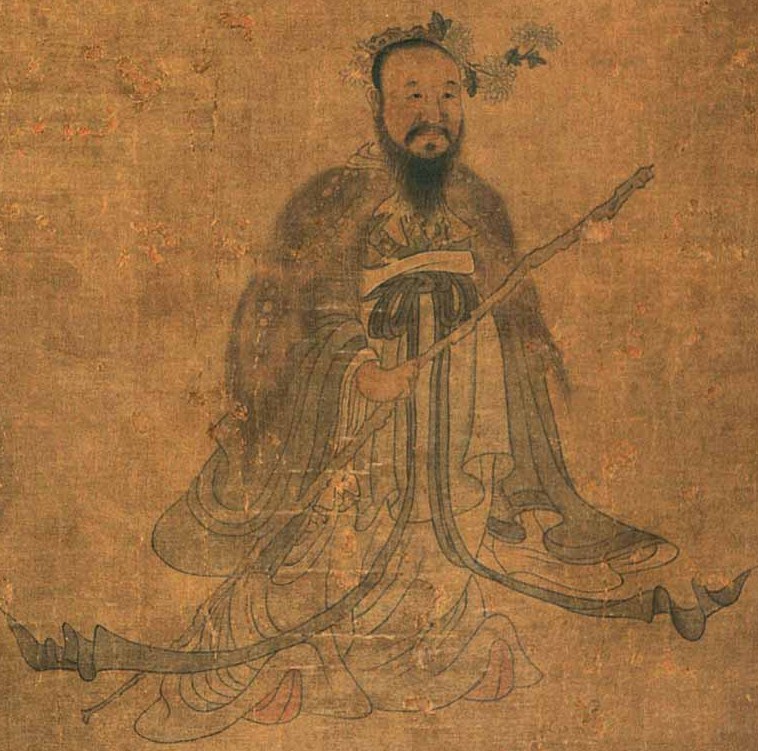
Painting (cropped) of the ancient Chinese poet Qu Yuan by the late Ming era painter Chen Hongshou.  c. 1598-1652
Public domain

Friday, January 8, 2016

ancient air 40

ancient air #40


when hungry the fenghuang won’t peck millet
indeed he eats only cast off white jade—

how should he mix with such rabble as chickens
scrambling & fighting to get a single meal!

mornings on Kunlun he calls from a barrow tree
at dusk he drinks from the Mount Dizhu rapids

returning he follows far off routes over seas
& alone he spends the night in the frosty heavens

but as good luck has it, he runs into Wangzi Jin:
connects with the farthest green cloud fringe—

by his heart’s grace he’ll reach it at Mid-Autumn Fest
taking to the air in endless wonder


Jack Hayes
© 2016
based on Li Bai:
古風四十
gǔ fēng sì shí

Grateful acknowledgement to Sheila Graham-Smith whose painstaking research was absolutely crucial to this poem, & who is smart enough to conceive of 長歎 as “endless wonder”.

Notes:
 
  • Fenghuang is often translated as Phoenix or Chinese Phoenix. However, other than being mythical birds, the Fenghuang really has nothing in common with the Phoenix of Mediterranean myth—no cyle of fiery death & re-birth. Indeed, it’s thought that the Fenghuang is based on a real bird, the crested argus pheasant, or more strictly speaking the Rheinard's Crested Argus. Here’s a link to a minute & 30 second of a great argus calling & displaying. Remarkable! If I came across that bird in the wild I’d be convinced it was a mythic creature too. 
  • Wangzi Jin is a Daoist immortal, who is known for being able to imitate the call of the fenghuang on the sheng, or reed pipe. He is often depicted riding on either a fenghuang or a crane, whose call he is also said to imitate on the sheng. Wangzi Jin is more commonly known as Wangzi Qiao. 
  • Mid-Autumn Festival is one of the major holidays of the Chinese year, & has been so from ancient times to the present day. There are a number of myths associated with the holiday, & Sheila uncovered a lovely myth connecting two lovers, one an immortal, one a mortal, who both can play the song of the fenghuang on the flute & are transported to the celestial realm by a fenghuang at Mid-Autumn.


Image links to its source on Wiki Commons:
"A Fenghuang or Chinese phoenix on the roof of the Main Hall of the Mengjia Longshan Temple in Taipei, Taiwan": photo by Wiki Commons user Bernard Gagnon who makes it available under the Creative Commons Attribution-Share Alike 3.0 Unported, 2.5 Generic, 2.0 Generic and 1.0 Generic license, as well as under the GNU Free Documentation License, Version 1.2 or any later version published by the Free Software Foundation; with no Invariant Sections, no Front-Cover Texts, and no Back-Cover Texts.


Tuesday, January 5, 2016

ancient air #33

ancient air #33

in the northern sea there exists a gigantic fish
his length must measure one thousand li—

when he breaches he spouts three mountains of snow:
swimming, he swallows one hundred rivers of water—

he rides roughshod over the shipping lanes—
then radiant breathtaking he takes to the air

I watch him scour the heavens in his flight:
90,000 li & not a sign of stopping

Jack Hayes
© 2016
based on Li Bai:
古風三十三
gǔ fēnɡ sān shí sān


Image links to its source on Wiki Commons
The first two sentences of Zhuangzi: Gōga Doi, a 19th century calligrapher
Public Domain


The first two sentences of the Zhuangzi read as follows: “IN THE NORTHERN DARKNESS there is a fish and his name is K'un. The K'un is so huge I don't know how many thousand li he measures.” The opening passage is all relevant to the poem & goes on to state: “He changes and becomes a bird whose name is P'eng. The back of the P'eng measures I don't know how many thousand li across and, when he rises up and flies off, his wings are like clouds all over the sky. When the sea begins to move, this bird sets off for the southern darkness, which is the Lake of Heaven.” (Burton Watson translation)

Monday, December 28, 2015

ancient air #9


ancient air #9

when Zhuang Zhou dreamed he was a butterfly
did the butterfly become Zhuang Zhou?

in one body’s effortless metamorphosis
the ten thousand things appear in endless virtue

you know eastern seas pass the isle of immortals
to flow as a clear shallow stream from the west

the man who plants his melons outside Ch’ing Gate
at one time held sway as Lord of Dongling—

the same law governs riches & fame:
abuzz, disquieted, what is it we seek?


Jack Hayes
© 2015
based on Li Bai: 古風 (九)
gǔ fēng (jiǔ)


Image links to its source on Wiki Commons
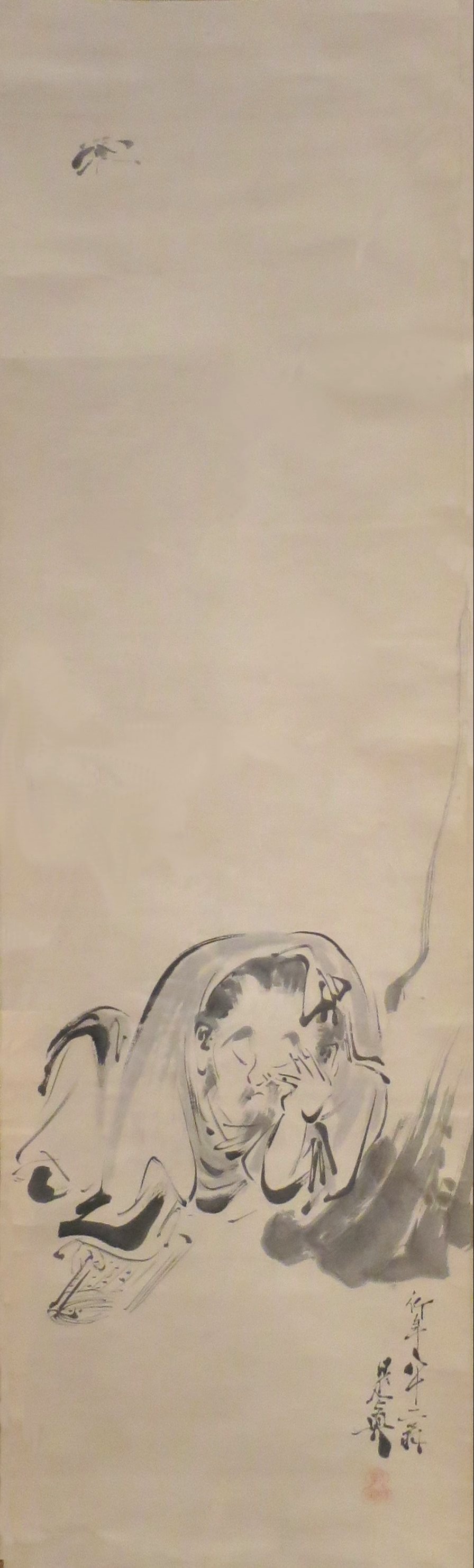
Zhuangzi Dreaming of a Butterfly:  Shibata Zeshin, 1888, ink on paper, Honolulu Museum of Art, accession 13879.1
Public domain

(the name 莊周 has been Romanized in various ways: Zhuang Zou & Zhuangzi are typical contemporary versions using the simplified pinyin system, while under the older Wade-Giles system the name was typically Chuang Tzu or Chuang Chou)


Sunday, December 6, 2015

crows crying at nightfall


crows crying at nightfall

yellow clouds: crows wish to roost by the city walls
returning they caw caw: in the boughs they’re crying
the Qin River woman weaves brocade on the loom
jade green thread like smoke: the window muffles her voice
upset, she stops the shuttle: recalls the man far away
all night by herself in a lonely room: tears like rain


Jack Hayes
© 2015
based on Li Bai: 乌夜啼
wū yè tí


Image links to its source at the Iowa State website – ultimate source is the Smithsonian
“A Silk Loom”: no further information (thanks to Sheila Graham-Smith for finding this image)


Wednesday, November 25, 2015

Autumn Wind Poem


Autumn Wind Poem

the autumn wind’s fresh
the autumn moon’s bright
leaf fall gathers & likewise scatters
jackdaw roosts, startles, perches again
how can we know the next day we’ll see each other
this season, this night: these passions can’t be governed


Jack Hayes © 2015
based on Li Bai’s
秋 風 詞
qiū fēng cí

Image links to its source on Wiki Commons
English: Daurian Jackdaw Corvus dauuricus, Beijing
中文:  里寒鸦,摄于北京通县坝河,自拍。

Originally from zh.wikipedia; description page is/was here.
The original uploader was 中文维基百科的 Snowyowls

本文件采用知识共享“署名-相同方式共享 1.0 通用
that is: Published under Creative Commons Attribution-ShareAlike 1.0 Generic

Thursday, November 19, 2015

After Li Bai’s “Cháng xiāng sī”


After Li Bai’s “cháng xiāng sī”


eternal longing
in the city called eternal peace
crickets weave autumn weeping by the gold-railed well,
frost clings to my bamboo mat—bitter, bitter cold—tints it wintry
this single lantern flickers; I want to extinguish thoughts,
& roll back the curtain & look at the moon—my sighs hollow—
the beautiful one’s a blossom far off past the edge of clouds
above is the black expanse of lofty heavens
below is the green water with breakers & floods
the heavens endless, the road remote, my spirit’s flight bitter—
the dream spirit won’t arrive, the mountain pass rises arduous
eternal longing 
my heart laid waste


Jack Hayes © 2015
based on Li Bai’s Cháng xiāng sī 长相思


Image links to its source on Wiki Commons
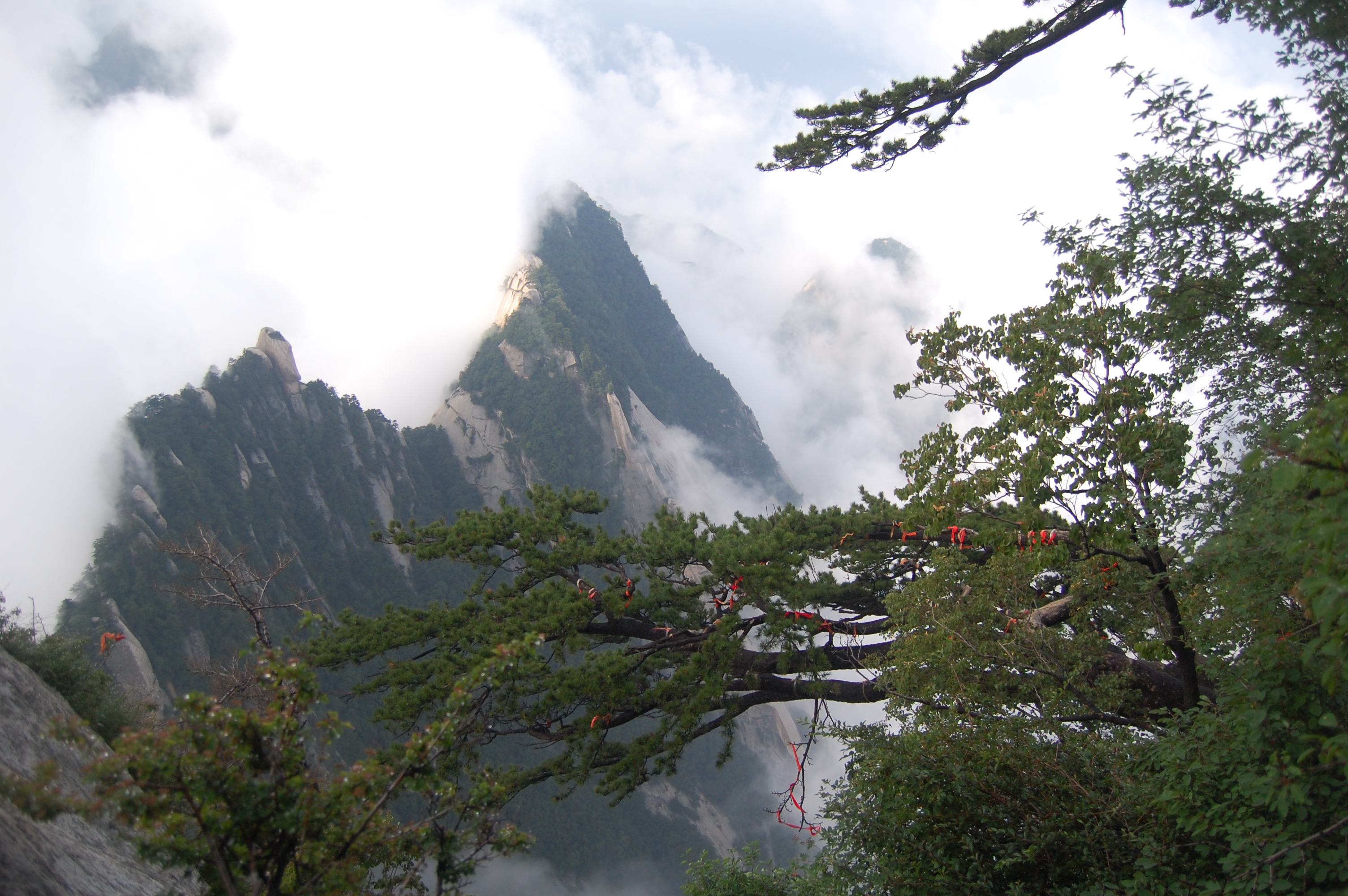
The Mount Huashan in Xi'an [Xi’an is modern Chang’an—i.e., the city named “endless peace”, which is what Chang’an means]: photo by Flickr user Darren On The Road who has made it available under the Creative Commons Attribution 2.0 Generic license.

Thursday, January 29, 2015

"Thoughts on a Quiet Night"

Night Thoughts

This moon-shine past my bed—
Could it be frosted ground?
I lift my head and see it’s the dazzling moon.
I lower my head and think of home.

Jack Hayes 

Version of Li Bai’s “Jìng Yè Sī”
静夜思
© 2015

Image links to it source on Wiki Commons
Liang Kai: “Li Bai In Stroll”; 13th century
Public domain