A miscellany like Grandma’s attic in Taunton, MA or Mission Street's Thrift Town in San Francisco or a Council, ID yard sale in cloudy mid April or a celestial roadmap no one folded—you take your pick.
I’m a bit behind my time today, but here we are with the wrap up of this month’s series featuring the great Brazilian singer Gal Costa. As I mentioned last week, in March there will be an installment of Any Woman’s Blues each Monday, so that’s something exciting to look forward to!
Choosing four songs to somehow give an idea of a singer with such a long, diverse & rich career as Gal Costa is challenging at the very least, if not a fool’s errand. As I planned for the series, & even into this month, my selections changed. At one time, I thought of the series as all Gal Costa performing Tom Jobim’s songs, & certainly that would have made for a great set of videos too. Costa is a fantastic interpreter of Jobim’s material. But I decided to try to show more of her diverse range. Still for quite some time I planned on ending the series with Gal Costa covering “Wave” at a concert in the 00s—in full full & beautifully melodic voice in her 60s, & I do recommend that video for those who’d like to hear more of her music.
But in the end I decided on a video recorded in 1996, in which she duets with her longtime friend Caetano Veloso on his lovely song about love & connection, “Tá Combinado.” Costa’s friendship with Veloso dates back to their youth in Bahia, & continued through to the present day—in fact there’s a recent interview with them available on YouTube, but it is in Portuguese without subtitles.
Caetano Veloso, like Gal Costa, was a major figure in Tropicália, the Brazilian psychedelic counter-culture music of the 1960s & 70s (also, as I have mentioned in previous posts, a movement that included all forms of art.) Veloso’s songs at that time were seen as subversive by the military dictatorship that took power in 1964, & he was sentenced to exile (along with Gilberto Gil) in 1969, & lived in London for a few years before returning to Bahia in 1972. I should note that Veloso’s sister, Maria Bethânia, was also a major figure in Tropicalismo.
This is a beautiful song & the performance by two seasoned performers with impeccable delivery & pure melodic voices is a great pleasure. It is also, in my opinion, a deeply sexy video—proving that sensuality doesn’t cease being available just because you’re in your 50s!
I have a lovely video for you today featuring this month’s featured artist, Gal Costa, with yet another giant of Brazilian music—Antonio Carlos Jobim (AKA Tom Jobim), one of the major forces behind the bossa nova movement, & a man whose songs have become classics in North American jazz circles almost as much as they are in Brazil: a very short list, with English titles: “The Girl from Impanema,” “Quiet Night of Quiet Stars,” “The Waters of March,” “No More Blues,” “One Note Samba,” & many more. Truly one of the 20th century’s greatest songwriters.
& while North Americans may associate his songs with the singing of Astrud Gilberto, as well as with João Gilberto & for those a bit more in the know, Elis Regina, it’s also true that Gal Costa is one of Jobim’s foremost interpreters. In fact, prior to her involvement in the Tropicalismo movement, which was more counter-culture, more inclusive of foreign influence, Gal Costa says that bossa nova was everything to her. In a 1988 Spin magazine article, Costa said, “I was fascinated by João Gilberto’s cultivated singing, his technique…And I was very radical. I only liked bossa nova, & anything that wasn’t bossa nova was mindless, a sellout…rock & roll, whatever.”
While Costa turned away from the bossa nova sound in favor of the more psychedelic Tropicàlia during the late 1960s & much of the 1970s, she eventually gravitated back to that style, & has made a number of recordings of the great bossa nova songs. Her vocal style is a bit less laid back than some singers associated with bossa nova—certainly very different from the Gilberto’s—João singing almost in a whisper, & Astrud in the musical equivalent of a “flat affect.”
Costa & Jobim had a notable concert together in Los Angeles in 1987 (YouTube link to the entire concert here); if you’re not up for the entire hour-long show, I’d still recommend this version of “Corcovado” (AKA “Quiet Night of Quiet Stars”) excerpted from it. But here we have a version of Jobim’s beautiful love song “Dindi” that's not from this show, but is from that same general period. It's a beautiful performance by both Costa & Jobim, & I must say the two of them have musical flirting down to a high art!
By the way, you’d probably figure this out, but just in case: the subtitles in this video are in Spanish, & Gal Costa is, of course, singing in Portuguese—hence the discrepancies.
Just wonderful in so many ways—hope you enjoy it, too!
Happy Monday! Carnival is in full swing, & so let’s take a trip to Brazil this morning! Musically speaking of course.
The featured artist on Mondays all through February is Gal Costa, an amazing singer who’s had a long & storied career, stretching from the 1960s to the present. During that time, she interpreted songs in a number of styles, from Tropicalismo psychedalia to jazz, from Bossa Nova to funky dance music—& more. Gal Costa truly is a major talent, & it’s a shame that she is not better known in North America.
Today’s selection comes from around 1980, & with all the videos this month, it presents her in live performance, this time around joining Jorge Ben’s band for a rendition of his song, “Que Pena,” which she had also recorded prior to this with Caetano Veloso. Jorge Ben, or Jorge Ben Jor, is himself a major figure in Brazilian music, & was also associated with the Tropicália movement, though he has also branched out to incorporate African styles & funk in his music, & frequently uses electric guitar, as in this song. Jorge Ben is probably best known in North America for his song, “Mas Que Nada,” which has been covered by artists as diverse as Sergio Mendes & Ella Fitzgerald. Jorge Ben also wrote a song titled “Taj Mahal,” which was plagerized by Rod Stewart as “Do Ya Think I’m Sexy”—this was settled in court, with the ruling coming in Ben Jor’s favor. He has released over 30 albums.
The pairing of Gal Costa & Jorge Ben Jor is electric—they are both highly charismatic performers, & “Que Pena” has a festive mood about it. The song’s title translates to “What a Pity,” & is a lighthearted lament for lost love that always returns to the idea of simply enjoying life despite this disappointment. Gal Costa’s version was one of the hits from her self-titled 1969 solo debut album; other hits from that album included “Baby,” "Divino Maravilhoso" & Caetano Veloso’s "Não identificado."
I mentioned in last week’s post that I’ll give those interested a link to yet another song each week that seems to complement the one I’ve selected—as a token of trying to show Costa’s great range. The link this time is to a duet of Costa & Gilberto Gil performing his song “Lavagem do Bonfim.” This was recorded later in Costa’s career, but it has the same festive & playful air, & she & Gil—who are friends of longstanding—are just great together. "Lavagem do Bonfim" refers to a festival surrounding the washing of the church steps at Bonfim in Bahia; it occurs around Epiphany. The link is here.
But for now: Gal Costa & Jorge Ben!
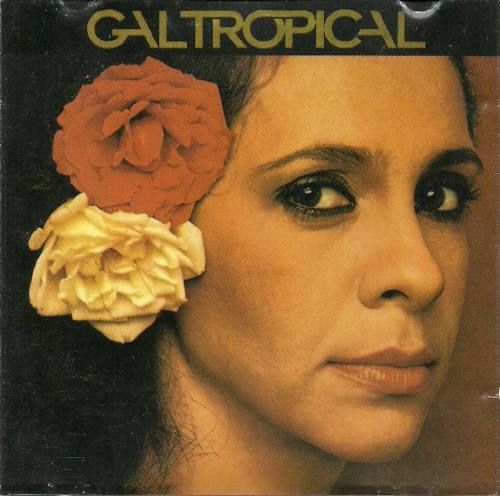
Image from Gal Costa’s 1979 album Gal Tropical links to its source on Tumblr
A happy Monday, friends! We’re in for a change of pace today, as Monday is not bringing the blues to Robert Frost’s Banjo—but it is bringing music, & I have an exciting series planned for Mondays this month.
I’m sure you know that Mardi Gras is a week from tomorrow, which means that Carnival is either being celebrated or about to be celebrated in the many parts of the world that observe this wonderful holiday. & of course, if one could pick any place to celebrate Carnival, Brazil would be a great choice.
So this February I’ll be posting videos by one of Brazil’s greatest singers, Gal Costa, a woman whose career has now spanned at least parts of six decades; indeed, it would be difficult to find a North American singer with whom to compare Gal Costa, not simply because of her artistic longevity, but also because of the great range of her work. As a young singer in the 1960s & 70s, she was a central figure in Tropicália or Tropicalismo, a highly innovative movement that combined the popular with the avant-garde & the native Brazilian with the foreign—in fact musically, Tropicália often mingled traditional Brazilian sounds with psychedalia. In addition, the Tropicália movement was political, standing in opposition to the military coup of 1964, which toppled the left wing President João Goulart & his government. As a result, a number of the Tropicália artists were subject to arrest, imprisonment & even torture. Costa’s close friends Caetano Veloso & Gilberto Gil were both imprisoned & later exiled for a period of time.
Through the years, Costa has explored an array of sounds, from bossa nova, & even full-on North American jazz standards, to rock, various forms of dance music, pop, & traditional Brazilian forms. Obviously, four videos can’t hope to do anything more than give the most cursory idea of a career with such scope. In each case, I’ll also provide a link to another video that may help those who are interested to get a broader idea of Costa’s music. One positive: there are a lot of Gal Costa videos on YouTube—she is a big star in Brazil, & lest we forget, Brazil is both the fifth largest country in area & the fifth most populous in the world.
Today’s song is from early in Costa’s career, & it’s her version of the samba “Trem Das Onze,” or “11:00 pm. Train”by Adoniran Barbosa, an important singer & composer, who used the informal language of the lower class in his lyrics—a big departure in his time, & a departure that obviously appealed to Costa. Wikipedia says this about “Trem Das Onze”:
It is widely considered one of the best Brazilian popular songs ever. In the song, Barbosa portrays in funny lyrics the drama of a lover who lives in a distant and poor suburb of São Paulo called Jaçanã, and who cannot stay longer with his beloved because the last train will be departing soon and his mother cannot sleep until he gets home.
“Trem das Onze” dates to 1964.
The audio in this selection is pretty good, given that it was recorded off Brazilian TV in the early 70s. The video per se is in pretty poor condition, & you can barely see the members of Costa’s band stage left (or the accordionist on stage right.) But Costa’s performance is brilliant, & the audience sing-a-long is not to be missed.
You can also hear Gal Costa’s singing Caetano Veloso’s beautiful “Volta” in a 1973 TV appearance here.