A miscellany like Grandma’s attic in Taunton, MA or Mission Street's Thrift Town in San Francisco or a Council, ID yard sale in cloudy mid April or a celestial roadmap no one folded—you take your pick.
It’s been quite some time since I featured a blues number on Robert Frost’s Banjo, but there’s a great one for you today: Mississippi Fred McDowell’s version of the old gospel tune, “Get Right, Church.” This one is the late career, electric guitar Mississippi Fred McDowell, with Tom Pomposello on bass, recorded live at the Gaslight in Chicago in 1971, though not released until 2000 on the Grapeshot Media label.
McDowell recorded “Get Right, Church” on other occasions, as well, notably as a duet with his wife Annie, who took the lead vocal on a 1965 recording made at their home in Como, Mississippi. [https://www.youtube.com/watch?v=vPk27dyudTY] The Como recording features McDowell’s acoustic playing.
Some powerful music indeed.
https://www.youtube.com/watch?v=AuzXMrRdZS0
Image links to its source on Wiki Commons: Postcard photo of the Illinois Central train "Panama Limited". Date circa 1940s to 1950s. This train is diesel powered but the freight train next to it is a steam locomotive. The Panama Limited no longer ran as an Illinois Central train after the 1971 Amtrak takeover of passenger rail service. This work is in the public domain because it was published in the United States between 1923 and 1977 and without a copyright notice.
A happy Sunday, friends. We’re back at you with another installment in the Jazz on Nylon series. Great song for a hot summer evening or night—so great in fact, that I’m posting two versions for your listening pleasure.
Thelonious Monk’s composition “’Round Midnight” is, according to the Jazz Standards website, “the most-recorded jazz standard written by any jazz musician.” There are conflicting stories about the songs composition. Some claim that Monk was as young as 18 or 19 when he wrote the song, originally under the title of “Grand Finale.” Others claim it was written in 1940 or 1941, when Monk was in his early 20s. At any rate, it’s known that trumpet player Cootie Williams recorded the song in 1944; as Cootie Williams shares the composition credit with Monk, it’s generally thought that a handful of Williams’ embellishments became a part of the song, but there is a bit of controversy on this point. Bernie Hanighen added lyrics a few years later.
“’Round Midnight” became a signature song for Cootie Williams, & later for Miles Davis as well (who titled an album “Round About Midnight,” which led to this being used as an alternate title); Dizzy Gillespie & Art Pepper also recorded notable versions, & the vocal version has been sung by a number of jazz singers.
The song is written in the key of Eb minor, which is considerably more friendly for a piano, brass, or reed instrument than it is for the guitar. According to Jazz Standards,”the initial harmonic progression is i -vi -ii7 -V7, similar to ‘Alone Together’”; however, on the same page, saxophonist Jim Clark states that while this is the progression given in The Real Book, it’s not what he hears Monk & others actually playing.
My original idea was to post Ukrainian guitarists Roman Viazovskiy’s great version based on Roland Dyen’s arrangement. Intricate & highly lyrical, this is a beautiful reading. But let’s face it: when there’s a version that exists by the Brazilian virtuoso Baden Powell, it’s pretty hard to overlook that! The video & audio are better on the Viazovskiy rendition, but Powell’s highly improvised Latin reading is masterful—& given the importance of this song in the Jazz songbook, why not go with two versions? In addition, it will make up a little for the lapse since the last post in this series! Finally, as an added bonus for those who find even two versions to be insufficient: here’s a link to the great guitarist Wes Montgomery playing a jazz box version in his amazing thumb style & a link to a beautiful solo piano version by Monk himself.
Enjoy!
Image links to its source on Wiki CommonsThelonious Monk, Minton's Playhouse, New York, ca. September 1947. Photograph by William P. Gottlieb – Library of Congress, Public Domain
Some music for your Thursday—& more Hoagy Carmichael at that.
When it comes to the Carmichael canon of songs, so many of which have become standards at a deep level, almost like folk songs (approached in our time probably only by the Beatles), we must admit it’s hard to pinpoint one as a high water mark. But if one had to make such a selection, “Stardust” would almost have to be the choice. There have been over 1,500 recordings of the song since it was first composed as an instrumental in 1927; the Library of Congress added it to the definitive recording archive, the National Recording Register, in 2004.
The song has a complex evolution. Carmichael claimed it came to him first as a melody he whistled. He first recorded it—actually as an upbeat instrumental—in 1927, but the song didn’t attract much public interest. Carmichael composed a lyric for it, but his publisher rejected it, & the lyric we know today was written by Mitchell Parrish, with some input from Carmichael. The song with Parrish’s lyric & a slightly modified melody was published in 1929. It wasn’t until the following year that Isham Jones recorded it as a slow ballad that it reached the form we know today.
“Stardust” was composed in the key of C, & that’s the key it’s typically played in. The song’s structure is idiosyncratic, & the melody wanders widely, spanning the range of a 10th. It's been noted that there are distinct similarities between the melodic structure of the song & the pattern of some Bix Beiderbecke improvisations. There is a contrast between the arpeggiated movement in the A section & the straightforward quarter note melody found especially in the C section. As Oscar Hammerstein II wrote:
“Star Dust” “rambles and roams like a truant schoolboy in a meadow. Its structure is loose, its pattern complex. Yet it has attained the kind of long-lived popularity that few songs can claim. What has it got? I’m not certain. I know only that it is beautiful and I like to hear it.”
Today’s guitar version is based on an arrangement by the great Brazilian master Laurindo Almeida, & played with great skill & feeling by Tony R Clef. Clef is, like Naudo Rodrigues who has also been featured in this series, a guitarist whose work appears on YouTube, & I'd encourage you to check out his channel there; however, he has recorded an album, Tuesday Afternoon on Big Round Records, & this has received really positive reviews. I admire both his playing overall & his handling of the Almeida arrangement, which moves from a fairly straightforward reading of the song into a full on Bossa Nova treatment.
Okay, I really promise not to contribute overmuch to the ubiquitous holiday soundtrack, but I do have a wonderful performance today of Vince Guaraldi’s “Linus & Lucy” as part of the Jazz on Nylon series. It’s such a delightfully buoyant composition, & it seemed just the thing for a rainy Portland day.
“Linus & Lucy” became known through A Charlie Brown Christmas special that first aired in 1965—& yes, I was one of the many who watched during that first airing. Guaraldi’s score for the special produced not only “Linus & Lucy”, but also the lovely “Christmas Time is Here” & “Skating”. The song was originally written in Ab & is notable for an immediately recognizable bass line that weaves under the melody.
Vince Guaraldi was, of course, much more than a one-off composer who happened to score a Peanuts special. He was a highly respected jazz pianist & composer who also had a hit with “Cast Your Fate to the Wind”, released in 1962. Unfortunately, Guaraldi passed away in 1976 at the young age of 47.
Today’s version is by a formidable guitarist, Andrew York, who was one of the founding members of the Los Angeles Guitar Quartet. York’s recording career dates back to the mid 1980s with Perfect Sky, which not only includes his version of “Linus & Lucy”, but also some of his own noteworthy compositions like “Andecy” & “Sunshine Rag”. His most recent release is Yamour, which came out on Majian Music in 2012.
York’s version of “Linus & Lucy” is in an interesting tuning that I’d not encountered previously: DADF#BE. The open strings form a D6/9 chord, & it’s a hybrid of standard tuning & open D tuning. Using this tuning—not to mention his very impressive chops!—York keeps the bass line moving as he moves the melody all over the fretboard. But the performance is much more than a tour de force; it’s a joyous & lyrical interpretation.
Hope you enjoy it!
Image links to its source. This is an image in Andrew York’s press kit; the photograph is by Terry De Wolf
Music for a Friday—& a rainy Friday at that for those of us in Portland.
“Here’s that Rainy Day” was written in 1953 by the songwriting team of Jimmy Van Heusen & Johnny Burke; Van Heusen & Burke were of course prolific, & wrote many other standards in the “Great American Songbook,” including such notable songs as “Swinging on a Star”, “Moonlight Becomes You”, “It Could Happen to You”, & “Imagination”. Both Van Heusen & Burke collaborated with others, Van Heusen working with Sammy Cahn, with whom he composed “All the Way”, “Call Me Irresponsible”, “Come Fly with Me” & many others. Burke meanwhile also worked with (among others) Arthur Johnston, with whom he penned the standard “Pennies from Heaven”. “Here’s that Rainy Day” was written in F major, & was debuted by Dolores Gray in the Broadway musical, Carnival in Flanders.
Here’s a fine short analysis of “Here’s that Rainy Day” by Jeremy Wilson on jazzstandards.com:
John Barrett Jr. aptly described “Here’s That Rainy Day” as “a gentle yawn, the sun rising on a sad feeling.” It is a ballad about lost love, about love turning to a cold, rainy day. With a relaxed tempo and a feeling of melancholy, the lyrics and music support each other in creating the mood. That is not to say that it is a simple song. Alec Wilder, in his book American Popular Song: The Great Innovators, 1900-1950, comments that “Here’s That Rainy Day” is “a very difficult song” with a complex bass line. He characterizes it as “powerful,” “affecting,” and with “great weight and authority.” The song is an excellent example of the sophistication that became acceptable in popular songs in the 1940’s.
Jazz musicians appreciate the elegance of “Here’s That Rainy Day” with its surprising melodies and harmonies. The song’s flexibility has allowed it to be recorded hundreds of times as a ballad, a swing number, and even an up-tempo, bossa nova tune.
Eric Hill is today’s guitarist, & I wish I knew more about him. He does have a website, & we learn there that he retired after a long career as a professional classical guitarist & teacher. He also mentions that his retirement occurred after recovering from a serious illness, & goes on to say that in retirement he plans to work on improvisation using jazz standards. His YouTube channel has a handful of videos, each excellent—& each will probably appear in this series as it continues—but it’s worth noting that he hasn’t uploaded anything since 2008; not sure what that means, but it is certainly a loss, because Mr Hill is a formidable player.
Hope you enjoy this.
Image links to its source at .erichillguitardownloads.co.uk
Some music for your Monday, played by someone who will be familiar to at least some of you.
Yes, resurrecting something from deep in the recesses of this blog’s past, it’s yours truly playing guitar on video. A lot has changed since I used to do that.
This recording is Elizabeth Cotton’s version of “Spanish Flang Dang”, AKA “Spanish Fandango”. The original version was in 3/4 time (waltz time) like Cotton’s rendering, but the tune was often played in 4/4 time by any number of notable guitarists, including Mississippi John Hurt & Mance Lipscomb. The tune was originally copyrighted in 1869 by Henry Worrall, a British born guitar instructor who’d immigrated to the United States; on the same day, Worrall copyrighted the piece “Sebastapol”, a composition in the open D tuning, & that also became a staple among guitar players. Just as “Spanish Fandango” often became “Spanish Flang Dang”, “Sepastapol” became “Vestapol”.
In any case, open G tuning was, & still is, sometimes referred to as “Spanish” tuning in honor of this tune, just as open D tuning is sometimes called “Vestapol”. Open G tuning, for the non-guitar players out there, simply means that the guitar is tuned so that the unfretted strings produce a G major chord—as heard at the very beginning of the piece. A guitar’s standard tuning is E-A-D-G-B-E, while open G is D-G-D-G-B-D. As you can see, three strings remain the same, which is why this is often considered the “easiest” open tuning for a guitar player brought up on standard tuning to adopt. It also is very close to the standard tuning of a 5-string banjo (at least these days), which is g-D-G-B-D (the small case G indicates that the drone string is tuned high, an octave above the open G string). As a result, it is often possible to adopt banjo tunes to the guitar open G tuning & vice-versa. “Spanish Flang Dang” is one that works quite well that way, though of course you lose the bass notes.
Open G or Spanish tuning was quite common in Delta blues; it was used by such notable blues artists as Charlie Patton (“Pea Vine Blues”, “Bird’s Nest Bound”, “High Water Everywhere”); Willie Brown (“Future Blues”, one of the Ur-Delta songs that inspired lots of imitations, especially by Patton); Robert Johnson (“Cross Road Blues”, “Terraplane Blues”, “Walking Blues”); Son House (“My Black Mama”, “Death Letter Blues”, “Jinx Blues”); Muddy Waters (“I Be Troubled”, etc. etc.) Of course sometimes these musicians would crank the tuning up to Ab, A or even Bb, but the intervals between the strings stayed the same.
Odd tale indeed how this video came to be posted. I visited YouTube on Sunday wondering if there was a version of “Autumn Leaves” played on classical guitar. Indeed there is, & a very good version at that, played by a terrific guitar player I’d never heard before Naudo Rodrigues.
There was only one catch—embedding wasn’t available. Undaunted, I looked through what turns out to be Naudo Rodrigues’ vast catalog of performances—not only mind boggling in number, but also in the diversity of music he covers. Everything from traditional songs to jazz standards to rock to pop. He is clearly a phenomenon, & I would encourage anyone to check out his YouTube channel. There’s also a playlist assembled by another user, which can be found here. In any case, I found a live version of Django Reinhardt’s beautiful “Nuages,” & decided that would be a good fallback option. The sound quality isn’t as good, but the performance is first rate for all that—& embedding was allowed. Then this morning as I began to put the post together, I found that, overnight as it were, embedding had been disabled on this version of “Nuages”! On a whim, I checked back, & found that embedding is now allowed on “Autumn Leaves.” The vicissitudes of YouTube. Anyway, this is a caveat that the video may not available on the post for long, but if the embedded version goes away, it can be found at this link.
Naudo Rodrigues, as I was saying, appears to be a singular musical genius. There’s very little biographical information about him. He was born in Brazil & now lives in Tenerife in the Canary Islands. He does perform locally. On the other hand, I can’t find much recording information, though there are about a dozen songs on iTunes. He seems to be—in addition of course to his live shows in Tenerife—a YouTube phenomenon. YouTube in its infinite wisdom closed down one of his accounts for copyright violation, but Rodriques opened a new one. In any case, his playing is superb, & he really deserves to be heard by a wide audience.
“Autumn Leaves” needs no introduction. Originally composed as “Les Feuilles Mortes” by Joseph Kosma with lyrics by the wonderful French poet, Jacques Prévert, the song moved into the “Great American Songbook” when Johnny Mercer composed the English lyric we know today. Yves Montand gave the original version its premier in 1946 in the film Les Portes de la Nuit, while Jo Stafford premiered Mercer’s English version.
Some wonderful music for your Friday listening pleasure.
“All of Me”is a staple in the Great American Songbook, & has been recorded at least 140 times since it was first composed by Gerald Marks & Seymour Simons in 1931. The song was debuted that same year in live performance by Belle Baker, while the original recordings were by the Paul Whitman Orchestra & Ruth Etting, both in 1932.
Marks & Simons are not among the better known songwriters of that period, but each had his hand in other notable compositions. Marks composed “Is It True What They Say About Dixie”, while Simons collaborated with Richard A. Whiting on “Breezin’ Along with the Breeze.” Certainly “All of Me” was their most notable achievement.
The song was originally composed in “the people’s key” of C, & is typically performed in that key when played instrumentally. The chord progression is one I associate with ragtime compositions, as the first change jumps from the tonic to the 3 chord in its major iteration, & then follows a circle of fifths progression through the first 16 bars. There’s also a bridge involving a typical move from the 4 major to the 4 minor chord. “All of Me” is a 32-bar song, which is of course typical of Great American Songbook tunes.
Francesco Buzzurro is a virtuoso guitarist from Italy. His mix of swing, feeling & pure chops is truly formidable, as he uses both impeccable classical & flamenco techniques with a lightning fast right hand. Buzzurro favors a Godin classical guitar as his primary instrument.
Hope you enjoy this!
Image links to its source on Wiki Commons. “Francesco Buzzurro guitarist in concert” 20 March 08. The file has generously been released into the public domain by its creator “Albatros978”. (dead link on Wiki Commons)
Some wonderful music for your Friday listening pleasure!
It occurred to me a while back that if I was going to run a series called Jazz on Nylon, there were a few players who simply couldn’t be omitted. While the series so far has focused on guitarists who aren’t as well known, & while that may continue to be the focus going forward, I don’t want to simply overlook the handful of guitarists who’ve made a significant reputation for themselves in the jazz world while playing a classical guitar as their main instrument. Of course Charlie Byrd has to be high on that list,
Although Charlie Byrd began playing guitar as a boy on a regular steel string acoustic, he began studying classical guitar after being discharged from the army in 1945. In the 1950s he studied with Sophocles Pappas & then later with the great Andrés Segovia. Byrd’s first major engagement was a European tour with Woody Herman’s Herd in 1959—this version of the Herd also included Vince Guaraldi & Nate Adderly. Also around this same time Byrd began to develop an interest in Bossa Nova, & he & Stan Getz recorded the seminal Jazz Samba in 1962 for Verve Records. Byrd’s passion for Bossa Nova continued throughout his career, & you can hear him playing such classics as “Samba de Orfeu” & “Corcovado”on YouTube.
Unlike the other guitarists featured so far in this series, Byrd really didn’t work as a soloist. He collaborated with many notable players, including his work with Herb Ellis & Barney Kessel in Great Guitars. But his standard format was the trio, as in this video; & as in this video, his bass player was often his brother Joe Byrd.
“The Jitterbug Waltz” is a true jazz classic. Written by the great Fats Waller, who first recorded it on Hammond organ in 1942, the song was reportedly inspired by some piano exercises his son Maurice was studying. Waller is a giant in the jazz world. Although he was known for his comic persona & his novelty songs like “All That Meat & No Potatoes” & “Your Feet’s Too Big,” he was a masterful composer & a virtuoso both on piano & organ.
Byrd’s rendering of the song is just lovely—plenty of swing, as well as the great warmth & clarity of tone for which he is always noted. Hope you enjoy this beautiful music.
Music for today: one of my favorite songs from the Great American Songbook, the lovely “My Funny Valentine” from Roger & Hart, as played on classical guitar by French virtuoso Roland Dyens.
Rogers & Hart composed “My Funny Valentine” for the 1937 musical, Babes in Arms, & it was sung in the original production by Mitzi Green. The song was also featured in the 1957 film adaptation of Pal Joey (it was not part of the Broadway play on which the film is based). Interestingly, the song was not included in the 1939 film version of Babes in Arms directed by Busby Berkeley & starring Mickey Rooney & Judy Garland. There have been a number of notable versions of the song by jazz greats such as Miles Davis, Anita O’Day, Bill Evans, Chet Baker, Sarah Vaughn & many more.
In addition to featuring one of Hart’s best lyrics, the song features a haunting minor key melody with an underlying harmonic structure built on a descending chromatic bass line leading from the tonic to the dominant chord. This particular chord structure comes up in any number of popular songs (just for example among very many, it’s also in the verse of “The Hotel California”!) but it works with particular effectiveness in this tune. “My Funny Valentine” was originally composed in C minor. It moves to Eb (the corresponding major key) in the bridge & also features a final resolution to Eb major in the tag, usually in some form of major 7 or 6 chord.
Roland Dyens is not only an accomplished classical guitar player; he’s also a composer of some note, as well as a skilled improviser, so it makes sense he’s able to make a jazz standard come alive on the classical guitar.
Of course, Corea is a giant in jazz, & more specifically in the fusion genre. In a career that began in the 1960s, Corea first came to prominence as a member of the Miles Davis band, he transitioned to leader with his recording Tones for Joan's Bones in 1966. In the 1970s Corea formed the seminal fusion band, Return to Forever. The first version of the band featured Corea on piano, singer Flora Purim, her husband Airto Moreira on drums & percussion, Joe Farrell on saxophone & flute, & Stanley Clarke on bass. The band debuted with their self-titled album in 1972 & released a total of total of seven albums before disbanding in 1977. After a period of involvement in other projects, Corea put together the Elektric Band in 1986. The main line-up for this group included Frank Gambale on guitar, Dave Weckl on drums, Eric Marienthal on sax & John Patitucci on bass. Patitucci was later replaced by Victor Wooten.
Samantha Wells was born & raised in Italy, & while in school studied classical guitar with Sergio Notaro at Centro Romano della Chitarra in Rome. Wells later studied with Emanuele C.Torrente of Conservatory Cherubini & Andrés Segovia school of Florence, Italy, & Joao Luiz Lopes of Brazil Guitar Duo. She now lives in California & is an active performer. Wells is also versatile, as she seems equally at home with the Classical repertoire & with arrangements of both jazz standards & pop songs for classical guitar. For you guitar players out there, Wells offers a transcription of her arrangement of “Eternal Child” on her website for $10.00. I’d also recommend her YouTubechannel. Not all of Wells’ videos are available for embedding, so pay her channel a visit to listen to her version of “Goodbye Pork Pie Hat” & Pat Metheny’s “Letter from Home.”
& in the meantime, hope you enjoy this lovely rendering of Corea’s beautiful song.
There is never a bad day to listen to a Thelonious Monk composition, right? & today we have something a bit different—a Monk composition rendered on classical guitar!
In fact, when the guitarist is Pino Russo, this works pretty much to perfection. There’s not much information on Russo in English, but he’s an Italian guitar virtuoso (also apparently an accomplished mandolinist), & there are a number of videos on YouTube showcasing his work on compositions by Coltrane, Miles Davis, Wynton Marsalis & others. Russo has superb tone & melodic sense in his arrangements, & plenty of soul—really inspired work.
While everyone thinks of the typical archtop guitar “jazzbox” as being the sine qua non instrument for playing standards—say a Gibson ES-175, à la Joe Pass—there is precedent for using a nylon string classical in top flight jazz playing, most famously of course by Charlie Byrd. Byrd, of course, played a lot of bossa nova, & the nylon string guitar is integral to the Brazilian jazz sound, but the mellow nylon tone has great possibilities for standards of all sorts. As Russo shows here, it can swing blue as well!
“Blue Monk” is said to have been Monk’s favorite among his own compositions. Written in Bb, it’s in essence a 12-bar blues, though depending upon which lead sheet you look at there can be a fair number of chord substitutions on that basic form.
There are a number of videos on YouTube featuring top-notch classical/nylon string guitarists producing versions of jazz standards & Great American Songbook tunes, & I’ll be posting some of these as an ongoing (though irregularly appearing) series. Hope you enjoy this kickoff edition!
Image of Pino Russo links to its source at pinorusso.it
Music for a hot day here in Portland, Oregon—temperatures predicted to climb into the high 90s! We are certainly “On the Sunny Side of the Ocean.”
This is a signature piece from the late, great guitarist & composer, John Fahey. For those who are unfamiliar with his work, he was much influenced by the fingerstyle guitar playing of Delta blues musicians like Skip James, Mississippi John Hurt & Charlie Patton. Fahey morphed the sound of that music into his own style, which he called “American Primitive.” Although Fahey did compose a number of pieces in standard tuning, he (like his blues playing predecessors) favored open tunings like open G (which is the tuning he used for “On the Sunny Side of the Ocean”) & “crossnote tuning,” or open D minor, as was used in particular by Skip James.
“On the Sunny Side of the Ocean” was originally released on Fahey’s 1965 album The Transfiguration of Blind Joe Death; this video is from a 1978 concert in Hamburg, Germany—sorry they cut the final chord a second or two short!
How about some more harp guitar for you weekend listening pleasure! It’s full on spring here in Portland: the camellias, magnolias & many of the cherries are in full bloom, & there have been some glorious days this month. In honor of that: a song named after my adopted home state.
“Oregon” is composed & performed by Stephen Bennett, one of the notable harp guitarists on the contemporary scene, but also just simple an excellent guitar player, no matter how many strings (& guitar necks) he has at his disposal. In fact, the Toronto Fingerstyle Guitar Association dubbed Bennett “the Jedi master of fingerstyle guitar.”
As is the case with many musicians who focus on instrumental performance, Bennett is not well known to the general public, & that’s a shame as he really is a marvelous performer who can wield considerable technical skills in the service of interpreting both his own compositions & covers—for instance, his 2005 release The Beatles for Acoustic Guitar or his 2012 Cool Tunes for Harp Guitar, which features versions of a diverse array of music—from Gershwin to Satie to themes from classic western films & much more! His website lists close to 30 CDs, as well as dvds, instructional books, & pdf transcriptions of close to 100 songs (including both 6-string & harp guitar transcriptions). Speaking of instructional books—if you’re looking to learn to play the harp guitar, Stephen Bennett does have material that can help you along!
Bennett explains the tuning of his sub-basses for this song in his video. Looking through his transcriptions, it appears that he G A B C D G quite often for the sub basses, & more often than not leaves the 6-string neck in standard tuning.
It’s a beautiful song—beautiful as our early spring Oregon days. Enjoy!
Image of Stephen Bennett links to its source at harpguitar.com
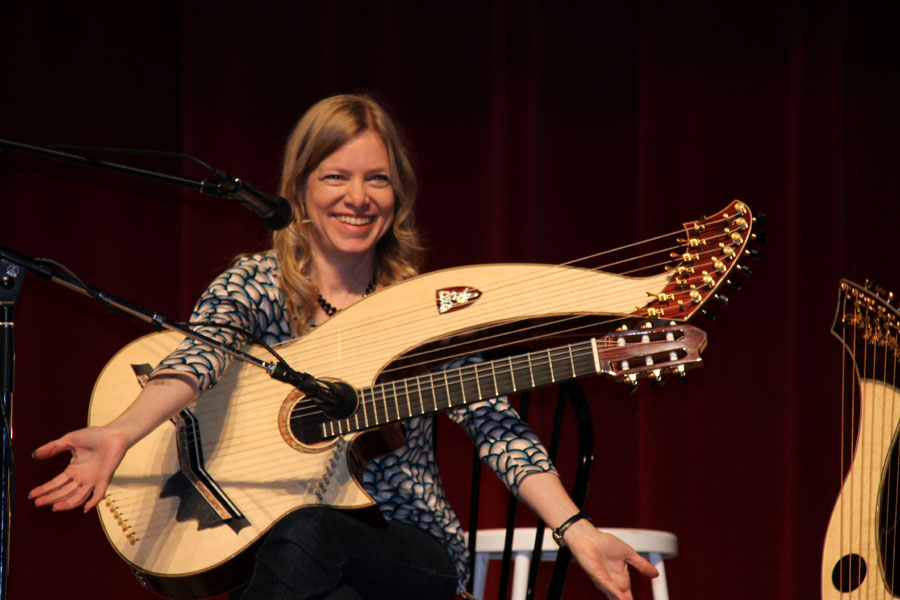
What is better than space photography, astronauts & guitars? Space photography, astronauts & a harp guitar played by one of today’s top fingerstyle guitar players, Muriel Anderson!
The fact that the general public isn’t aware of Muriel Anderson is certainly not because of her guitar playing skills. A top instrumental performer, she is the first woman to win the National Fingerpicking Championship. But while her technical skills are first rate, she is not merely a skilled technician—she plays an impressive range of music reflecting broad musical tastes, & performs that music with deep musicality. Anderson’s scope is indeed impressive, ranging from old-time country to classical to pop, not to mention her beautiful original compositions. We can get a sense of this range when we discover that her early idol & mentor was Chet Atkins, but that she went on to study classical guitar with Christopher Parkening. & yes, in case you're wondering, Muriel Anderson plays 6-string guitars as well as harp models.
In addition, Anderson is the founder of the non-profit Music for Life Alliance, which brings musical instruction to kids in under-served communities; she also founded & hosts the All Star Guitar Night at the NAMM trade shows. She has issued 17 cd albums (not to mention several compilations, as well as seven dvds—both performance & instructional), including the 2013 release Nightlight Daylight. A particular favorite of mine is the 2003 New Classics for Guitar & Cello, on which she duets with cellist Julie Adams. All of her cds & dvds are available at her website (see link above) as is tab for her compositions in pdf form at a very reasonable $5.00 per song. So guitar players, if you have five bucks to spend & you want to perfect your pinch harmonics, you too can learn to play today’s selection!
Muriel Anderson has the following to say about “View From Space”:
Some years ago astronaut Susan Helms had picked up one of my Heartstrings recordings and told me that “it would be good music to watch the earth by.” It traveled with her 2.5 million miles on the space shuttle “Discovery.” With my harp guitar in my lap, I composed “View from Space” while watching the beautiful images that were taken from the space shuttle.
It’s a wonderful piece of music & a beautiful performance—enjoy!
Image of Muriel Anderson links to its source at harpguitars.net
If there’s any truth to the many-worlds interpretation of multiple universes, where quantum uncertainty operates on the macroscopic scale by creating new worlds at any point of uncertainty, I have no doubt that in at least one multiverse I own a harp guitar. I’ve had an off-&-on obsession with the instrument for some years now, & these days it’s mostly “on” again. So I thought I’d run a short series this month on the harp guitar. It’s not a well known instrument, but there’s some wonderful music & musicians associated with it.
You see the harp guitar in the photo above; you can hear it in the video below. But what is it? We find the following definition on harpguitars.net:
A guitar, in any of its accepted forms, with any number of additional "floating" unstopped strings that can accommodate individual plucking.
The modern harp guitar must have at least one unfretted string lying off the main fretboard; these unfretted strings are played as an open string.
The word "harp" is a specific reference to the unstopped open strings, and is not specifically a reference to the tone, pitch range, volume, silhouette similarity, construction, floor-standing ability, nor any other alleged "harp-like" properties.
One issue with the guitar in terms of playing any sort of polyphony is the fact that in either standard tuning or even non-standard forms, you just simply run out of bass notes more quickly than you’d like. The harp guitar addresses this problem rather ingeniously by adding an unspecified number of unfretted bass strings on the second arm. These strings (usually referred to as “sub-basses”) can be tuned in a number of different ways, depending largely on what key the player is employing. The standard tuning for the guitar portion of the harp guitar is—surprise—standard guitar tuning of EADGBE, though altered tunings can be used for the guitar portion, just as they can be on your garden variety guitar.
Today’s video features a live performance of his original song “Because It’s There” by the late Michael Hedges, a phenomenal guitar player who was certainly one of the most notable fingerstyle players of recent memory. Hedges used an altered tuning for “Because It’s There”—the 6-string guitar is tuned EADEAD, while the sub-basses are tuned G, Bb, C, A, D. The composition makes extensive use of harmonics & tapping; the latter refers to a player producing notes with only his or her left hand, as Hedges does here allowing him to simultaneously play both the guitar & the harp portions. Hedges gives the background to the song during his introduction in the video. If you’d like to hear a second version of the song, there’s an excellent cover by another phenomenal guitarist, Kaki King (with a fun introduction) here on YouTube.
Next time around I’ll write about the harp guitar’s history & have more fun music—enjoy!
So in the torpor of last year’s blogging, I never really had a chance to expatiate upon just how much I love Kaki King, not only because she is a superb guitarist & gifted compsoer, but also because she is such a wonderful creative force—there was a series planned about her, but it never quite got off the ground. So that’s one thing I can set right straight away.
Of course, Kaki King is far from “a new thing” at this point—she’s in the prime of a career that dates back to the 1990s, & her recordings go back to 2003, with Everybody Loves You on the Velour label. In the interim, she has established herself as one of the top guitar instrumentalists & composers, & is clearly one of the preeminent contemporary fingerstyle players. “Cargo Cult,” here from a 2012 performance in Livorno, Italy, is from her most recent album, Glow from 2012.
But my purpose here is not to be on the leading edge, but simply to communicate about music & artists I care about (among other things), so while Kaki King isn’t a new discovery, she’s a musician who’s worth getting to know better if you’ve already heard her—& if you love guitar music & you don’t know her work, then I can’t recommend her highly enough!
Obviously this also could be titled “I Spoke Too Soon.”
Yes, friends, Robert Frost’s Banjo is back, refreshed from the vacation! I really didn’t anticipate this back in August—or through most of 2013, in which I was anticipating shutting the blog down. But a while ago, I realized my main contributions to the Facebook universe were music postings—& it occurred to me that I could be doing this on the blog & maybe do some other writing besides. So here I am.
Robert Frost’s Banjo will continue to be the same in its broad outlines. However, I did learn a lesson from the past year or so that really only sunk in when I’d stepped away from the blog: the tight scheduling of weekly series was a great thing at one time, but it also has a limiting effect; so while I’ll still be writing about many of the same topics (& some new ones as well, I hope), there will be no ongoing weekly series. They do tend to defeat the notion of “A miscellany like Grandma’s attic in Taunton, MA or Mission Street's Thrift Town in San Francisco or a Council, ID yard sale in cloudy mid April or a celestial roadmap no one folded.”
So I hope to return to more of that original miscellany idea—but don’t worry, there will be plenty of guitars & banjos & the like in all their amazing incarnations. I’m also really happy to let you know that the four poet contributors, Barbie Angell, Carmen Leone, Mairi Graham-Shaw & AK Barkley will be back, though poems will appear just a couple of times a month rather than weekly.
Anyway, for today I have a wonderful guitar duet featuring the father & son jazz guitar team Bucky & John Pizzarelli. But in addition to being a rousing duet on the perennial crowd pleaser, “Sweet Georgia Brown,” note that both men are playing seven- string guitars.
Of course the quest to extend the guitar’s range is a seemly endless endeavor; & if you take the time to read the Wikipedia article, you’ll find that seven-string guitars have been around for a good long time. In terms of jazz guitar, they first caught on with George Van Epps in the 1930s, & while they aren’t uncommon at jazz gigs anymore, for a long time Van Epps & Bucky Pizzarelli were the main proponents of this type of instrument. The advantage is more bass—the seventh string is typically tuned down to a low B, just as a five-string electric bass will have a B on the fifth string. This means that the interval between the seventh & sixth strings (typically an E) remains the same for the added string—a fourth, as is the case with all the strings in standard tuning except for the third to second strings, in which the interval is a major third.
Seven-string guitars are used in many forms of music—jazz, classical, & more recently, even in rock & heavy metal. In fact if you search for images of seven-string guitars online, the photos of seven-string solid body electrics tend to predominate.
So: something that may be new to some of you! A happy New Year & thanks for coming back to Robert Frost’s Banjo!
Image links to its source at the top1000songs blog
Happy Friday, friends! A short post in terms of words, but some very beautiful music.
If you checked in last Friday, you know that I’m featuring the music of guitarist Kaki King this month on the blog. Indeed, Kaki King is a personal favorite guitarist, not only because of her amazing chops & stunning compositional skills, but also because of her singular & intense creative spirit.
Actually, the video I wanted to use for today’s post has been disabled for embedding—something I discovered in the eleventh hour (literally true in more ways than one), & that’s part of the reason for this post is a bit short—there was some scrambling involved at an hour when I didn't intend to be doing any such thing. But I found King’s performance of “Goby” from the same concert as last week’s post (“Playing with Pink Noise”), & that is also a fine version with good audio. If you’d like to listen to my first choice, you can watch it on YouTube here. The audio on that one is really high quality. There are also some cool versions of King playing “Goby” with her guitar rigged to a synth set-up—great fun! One such performance—& a good one at that—is here.
“Goby” was released on Kaki King’s third album, Until We Felt Red on Velour. As I understand it, the tuning is CGCFGC (again, as with the tuning I mentioned in last week’s post, this doesn’t come from an authoritative source, & I haven’t double-checked it.) Those who are familiar with alternate guitar tunings will notice that this is a full step down from the D suspended tuning, better known as DADGAD (these being the notes of the open strings), & I understand King likes that tuning, so this all seems quite plausible.
While “Playing with Pink Noise” featured much of King’s percussive playing—fretboard tapping, slapping the strings, drumming on the guitar, “Goby” is a bit more of a “conventional” fingerstyle piece, though it very much carries her individual stamp, & her playing is both powerful & exquisite.
Enjoy!
Image of Kaki King at the 1st Adelaide International Guitar Festival links to its source on Wiki Commons. Its creator is Mandy Hall, & this file is licensed under the Creative CommonsAttribution 2.0 Generic license.
The guitar as we know it today was most certainly not an instrument used in early music. The modern classical guitar (& all its various descendants) is in many ways a 19th century invention, a thorough re-working of an instrument that lacked many of its current properties, especially in terms of sound projection.
Of course there was the baroque guitar, which is an ancestor of our modern instrument, without question, but there were a number of dissimilarities, & also the baroque guitar was primarily a continuo instrument, & as such its voice often was not featured. Of course, the classical guitar as we know it today is primarily a solo concert instrument.
Still, much music from the Baroque period & even earlier has been adapted for the classical guitar. The repertoire of Gaspar Sanz, Sylvius Leopold Weiss & Robert de Visée, who all wrote for both baroque guitar & lute, is often adapted, as are works by the well known Baroque composers—obviously, Bach, whose cello & lute works in particular have been transcribed & often performed, but also other well known composers of the time, such as Vivaldi, Handel & others. & so, rushing in where angels fear to tread, I’ll be featuring classical guitar performances of Baroque music this month on Early Music Sunday.
Here we have guitar virtuoso John Williams' performance of Domenico Scarlatti’sSonata in D minor, K. 213, originally written either for harpsichord or the early form of the pianoforte. If you’re curious, you can hear this piece played on a piano at this link.
Domenico Scarlatti was Italian by birth, but lived much of his life in Spain & Portugal, where he was music master for both royal families. He was the son of Alessandro Scarlatti, who was a renowned composer himself, especially in terms of the early opera.
Scarlatti arrived in Lisbon in 1719, & became music teacher to Portuguese princess Maria Magdalena Barbara. After spending some time in Italy in the later 1720s, he moved to Sevilla in 1729, & in 1733 he traveled to Madrid to be rejoined with his pupil Maria Barbara, who had since married into the Spanish royal house. He is thought to have composed most of his keyoboard sonatas during his years in Madrid, where he stayed until his death at age 71 in 1757. Scarlatti, like Johann Sebastian Bach’s son, Carl Phillip Emanuel Bach, is seen as a composer who bridged the Baroque & early Classical periods.
A lovely version of this lovely piece of music—enjoy!
Image links to its source on Wiki Commons Retrato de Domenico Scarlatti (Portrait of Domenico Scarlatti), Domingo Antonio Velasco, 1730 – public domain


.jpg)