A miscellany like Grandma’s attic in Taunton, MA or Mission Street's Thrift Town in San Francisco or a Council, ID yard sale in cloudy mid April or a celestial roadmap no one folded—you take your pick.
Showing posts with label Any Woman's Blues. Show all posts
Showing posts with label Any Woman's Blues. Show all posts
It’s Monday, & the final day 2012. What better way to celebrate than with this month’s edition of Any Woman’s Blues?
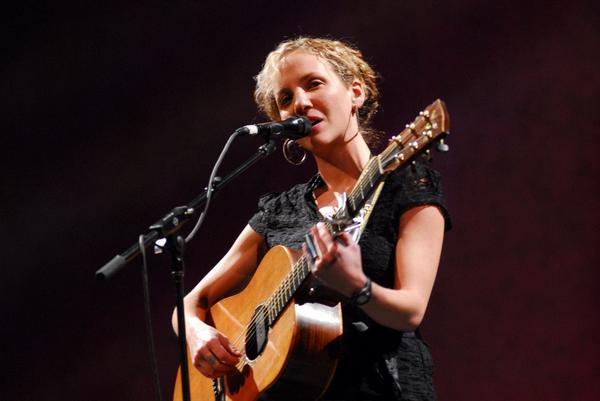
The featured artist for December is Natalia Zukerman, an exciting up & coming performer who is comfortable in any number of genres, & blends them all in her strong songwriting. But blues—& slide guitar, which is always near to my heart—is a sound & form that underlies much of her work, as you will hear in evidence in the two video selections.
Natalia Zukerman comes from Manhattan, & she was raised in a musical family: both her parents are virtuoso performers (her father is violinist/conductor Pinchas Zukerman & her mother is flutist Eugenia Zukerman), while her sister Arianna is an opera singer. Given her background, it’s not at all surprising that Zukerman draws from a number of genres & styles when she composes, utilizing not only blues, but also rock, bluegrass, jazz & classical.
She is a talented singer & songwriter, but make no mistake: her guitar chops are also impressive. The New Yorker proclaimed, “Natalia’s voice could send an orchid into bloom while her guitar playing can open a beer bottle with its teeth.” Her playing is indeed gritty when need be, but she is able to wield a full dynamic palette in her fingerstyle playing.
To date, Natalia Zukerman has released five cds, beginning with her 2001 debut, Mortal Child on Talisman. She followed that up in 2003 with On a Clear Day & Only One in 2006, both on Talisman, then moved to Weasel Records for her 2008 release, Brand New Frame (title track is the second video below) & the 2011 Gas Station Roses (first video is the title track.)
Natalia Zukerman also plays lap steel guitar & electric guitar as well as her acoustic Guild. She’s definitely a significant talent & someone to watch for—in fact, she’s starting to announce dates for her 2013 tour, so check her out if she passes through your town—I certainly will!
In the meantime, enjoy some great songwriting, singing, & guitar playing on these two videos.
A happy Monday, friends! We’re here with the Monday Morning Blues, Any Woman’s Blues edition, & we’ve got some smoking hot guitar playing.
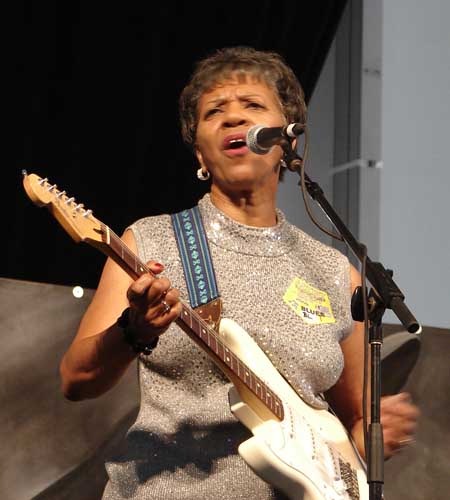
Beverly Watkins has had a long career as a blues guitarist, but for much of life she’s plied her trade in obscurity. While still in high school, she began playing guitar with Piano Red & toured with his band the Meter-tones until the combo broke up in 1965 (the group was also known as Piano Red & The Interns, Dr. Feelgood & The Interns, & Dr. Feelgood); following this she performed with such groups as Eddie Tigner & the Ink Spots, Joseph Smith & the Fendales, & Leroy Redding & the Houserockers.
Watkins’ solo career didn’t really take off, however, until she became associated with the Music Maker Relief Foundation in the 1990s. This wonderful organization, which we learned about also in an earlier post on guitarist Precious Bryant, describes its mission as follows:
Music Maker Relief Foundation preserves and promotes the musical traditions of the American South. Since 1994 we have partnered with traditional artists over 55 years old who survive on a yearly income of less than $18,000, sustaining their day-to-day needs while building their careers. Through Music Maker, our rich heritage of folk music will not be lost with the passing of time.
Beverly Watkins is a truly remarkable musician. Still rocking hard in her 70s, she sings & plays guitar with great power, verve & energy. Watkins says of her music:
My style is real Lightnin’ Hopkins lowdown blues. I call it hard classic blues, stompin’ blues, railroad smokin’ blues.
In the wake of a howling guitar chord & drum roll,& over the top of a jagged & funky guitar riff, Danielia Cotton’s voice roars into the opening of her new album, Gun in Your Hand: “Somebody save me.” This voice come from someone who may be wounded, but is clearly not defeated; it’s s strong voice, a voice that asserts itself even in the face of a world that stops making sense. Danielia Cotton has said that the message of “survival” is what she’d like people to take away from her latest album, & survival is clearly a central theme—but there’s a lot of salvation here too, even if under the surface. A voice that can rise up to sing “Save Me” in the face of tribulation knows: rock & roll can save your soul.
Make no mistake: while The Gun in Your Hand employs a wide sonic palette in painting its music pictures of loss, survival & salvation, it always rocks. Even its quietest songs, like the plaintive & acoustic “Boy Blue,” appear out of the silence with an underlying rhythmic urgency; at the other extreme, there’s the deliciously hardcore “Deep Dark Love,” with its lyric about Jesus & Mary Magdalene broken down by the side of the road, & a nod to Willie Dixon’s great “Spoonful.” One of the great interpreters of “Spoonful” was Howlin’ Wolf, & while Danielia Cotton is not a blues artist in a strict sense of the word, she absolutely can marshal the kind of elemental power that the great Wolf deployed!
But there’s so much here to discover. It’s an album that asks for salvation, for love, for understanding, but that also teaches: in fact, that also seems to be a central concept. & I don’t mean that Gun in Your Hand is didactic or preachy in the least; it rocks far too much for that, & the songwriting is far too good. Seven of the album’s 12 songs were either written or co-written by Danielia Cotton, while producer & musician Kevin Salem wrote or collaborated on six, & both are strong songwriters both in terms of lyrics & music. In addition, Cotton covers two standards: “Purple Rain,” one of the greatest rock songs ever written, & the haunting & disturbing “Strange Fruit,” known from the great versions by Billie Holiday & Nina Simone. The standard versions of these two songs are masterpieces in their genres, unquestionably; but Cotton truly produces exquisite versions that are completely her own & can stand alongside the best. To return to the teaching theme: in her song “Smile,” Danielia Cotton sings the apparently simple line, “In a good life there’ll be hard times.” This statement seems crucial to the album, which is so much about hard times & navigating them, even when the waters seem overwhelming; for instance, in the beautiful love ballad, “The Only Reason,” the lover may indeed be “the only reason anything good happens at all”—but the crucial point is that there is a reason in the midst of all the chaos & unreason. These thoughts don’t only apply on a personal level either; Cotton asks us to put ourselves in the place of lost souls in “Boy Blue”; she sings about the struggle for social justice in “Long Days”; the whole arc of the album, from the very personal “Save Me” through the historic & cultural touchstone of “Strange Fruit,” not only places suffering in various contexts, but it continues to raise a strong voice as a way of surviving & seeking a real form of salvation.
The Gun in Your Hand was co-produced by Kevin Salem, Cotton, & the band, & the production is simply superb. Salem & the others know when to layer on heavy sound, as in “Deep Dark Love” or “Save Me,” & when to pull back & let Cotton’s truly amazing voice stand out against a spare backdrop. This is done so effectively in the two cover songs, “Purple Rain” & “Strange Fruit.” The playing throughout the album is top-notch; riff-driven, exact, clear gestures, even when the distortion is turned up highest on the guitars.
I highly recommend this album, & I predict it’s one that will stand up as time passes. Indeed, the sound is classic, without ever being dated. The Gun in Your Hand is available at iTunes & is also going into release today, November 1st, so do check out your local music shop—listen, learn, enjoy, be moved. Images links to their source on Danielia Cotton's website
Happy Monday, friends! & welcome to the October edition of Any Woman’s Blues! But before we get to today’s featured artist, I’d like to announce some exciting news! I’ve been contacted by the publicist for last month’s featured artist Danielia Cotton, & as a result, Robert Frost’s Banjo will be featuring a free download of her song “Easy” from her new album The Gun in Your Hand, scheduled for release this very Wednesday, October 30th! I’ll also be reviewing that album as Thursday’s post here.
It’s difficult to do justice to today’s featured artist, Odetta, in the scope of a blog post & through two videos. Indeed, the breadth of her music expands well beyond the scope of the blues as well: she sang—& made her own—songs from many traditions, & her version of the lovely Irish air, “I Know Where I’m Going” is every bit as moving as her singing of the African-American song “Take this Hammer.” Odetta was born in Alabama, but raised in Los Angeles. Blessed with a remarkable voice, Odetta began operatic training in her early teens, & she seemed destined for a career in opera, given the beauty, power & range of her singing. However, while in San Francisco in 1950 (on tour with Finian’s Rainbow!) she became involved in the city’s burgeoning folk music scene, & decided that was the artistic path she would follow.
Early in her career, Odetta performed solo, accompanying herself on the guitar, or in partnership with banjoist Larry Mohr (as Odetta & Larry.) Seminal recordings from this time include Odetta Sings Ballads & Blues on Tradition & The Tin Angel/Odetta & Larry on Fantasy (Original Blues Classics.) The latter title refers to her gig at San Francisco’s Tin Angel nightclub near Fisherman’s Wharf in 1953-1954.
Later, Odetta moved beyond the solo or duet format, & began to sing with the band backing; as a result she broadened her repertoire still further, moving into jazz & blues with a much “bigger sound.” A good example of this from her later career is her version of Leadbelly’s “Jim Crow Blues,” which you can view on YouTubehere. All in all, Odetta released close to 30 albums, counting both studio & live recordings.
In the tradition of folk music, Odetta was politically active, & not only sang about struggle, but put her considerable talent & energy to work for the Civil Rights movement, not just during the 1960s, but throughout her career, right up until she passed away in December 2008. A history of Odetta’s career looked at from this perspective can be found here at workers.org.
I’ve broken a bit with Any Woman’s Blues tradition in today’s videos. Although one is a live recording, there is no live footage of Odetta in either (though again, check out the link above for that!) The reason for this is simple: Any Woman’s Blues focuses on performers who not only sing but also play guitar, & most of the live videos of Odetta currently available are all so recent that they don't feature her excellent guitar playing (however there is also this very fun video of her with Tennessee Ernie Ford.) So we have two early songs in which she performs with guitar. One is the African-American work song “Waterboy,” & the second is the beautiful lullaby “All the Pretty Horses,” which also has an African-American heritage (though it may or may not have European elements as well—but of course, much of American folk song combines the two.)
Hope you enjoy these beautiful & powerful performances by a truly amazing & singular artist!
Image links to its source
Civil Rights March on Washington, D.C. [Entertainment: Vocalist Odetta.] – Wiki Commons – Public Domain as a US Government work
Happy Monday, & welcome to a somewhat belated Monday Morning Blues—it is actually still morning here in Portland, at least as I begin typing this! It’s the final Monday of September (unbelievably enough), so it’s time for this month’s edition of Any Woman’s Blues.
Some may say that Danielia Cotton’s music belongs more in a discussion of soul, funk or rock than in a blues series—but the fact is, all of these genres spring from the blues an an ultimate source; & at various points in the past, no distinction was made between what we now call “soul” music & what we now think of as “blues”—the category “rhythm & blues” included Ray Charles & Ike & Tina Turner right alongside Howlin’ Wolf & John Lee Hooker.
& however one might quibble about genres in terms of Cotton’s music, there is one main point that can’t be disputed: this is powerful stuff indeed. Indeed, Cotton’s singing has been favorably compared with Tina Turner’s & Janis Joplin’s (two truly great artists who also formed a synthesis between blues, rock & “R&B.”) Cotton came from a musical family—her mother is jazz singer Wenonah Brooks, & jazz singers Jeannie Brooks & Carol Brooks-Meyners are her aunts. Danielia Cotton was given an acoustic guitar as a gift when she was 12 years old, & she took to the instrument quickly; she also began singing with her mother & aunts in a gospel group around this time. Her great vocal abilities won her a full scholarship to Bennington College, where she focused on theater, & she studied at the Royal Academy of Dramatic Arts in London during her senior year.
Music became her career, however; Cotton released a self-titled EP in 2004 thru Hip Shake Music, & then she released her debut full-length album, Small White Town in 2005 on the Thirty Tigers label. This was followed this up with Rare Girl on Adrenaline in 2008 & the Live Child EP in 2009 on Cottonwood. A new album, The Gun in Your Hand, is scheduled for a release next month.
In the context of her own band, Cotton plays rhythm guitar, & switches between a Gibson jumbo (acoustic) & a Fender Telecaster Thinline (semi-hollow Tele!) depending on the overall sound she’s seeking. I do notice she's playing a Rickenbacker on the cover of Small White Town.
Welcome back to our first edition of Any Woman’s Blues in quite some time! It’s one of my own favorite series here, & I’m happy to begin posting it again. From now on, I’ll endeavor to get back to monthly installments of this.
This month’s featured artist is Barbara Lynn, a fantastic singer & guitarist whose career dates back to the early 1960s (as evidenced by the first video below.) Ms Lynn hails from Beaumont, Texas, & she really hit the scene in 1962 with the #1 Billboard R&B hit, “You’ll Lose a Good Thing” (later covered in a country version by Freddy Fender!) You can follow this link to hear Lynn play this tune—I opted against including here because I believe the two videos I chose showcase her guitar-playing more effectively. In addition, her song "Oh Baby (We've Got A Good Thing Goin')" was covered by the Rolling Stones on their 1965 release The Rolling Stones Now! After recording on the Jamie & Tribe labels thru much of the 1960s, she was signed by Atlantic in 1967 & produced yet another hit, “"This Is the Thanks I Get."
Following her marriage (around 1970—can’t find the exact date), her career went mostly on hold as she devoted herself to family for most of the next two decades, with only occasional nightclub appearances. But towards the end of the 1980s, she returned to her musical career, signing with the Iciban label & releasing You Don’t Have to Go in 1988. Lynn also has inked recording deals with Antone’s & Dialtone, & now has 11 albums to her credit. She’s also touring, & as you can hear in the second video—her beautiful cover of “Misty Blue,” both her guitar & vocal chops are as impressive as ever.
Lynn’s guitar style mixes solid rhythm featuring lots of damped & accented upstrokes with very direct & compelling leads & fills. You’ll notice that she plays fingerstyle, using a thumbpick—unusual in general on electric guitar, tho it is used by some blues artists (for example, Lynn’s fellow Texan Lightnin’ Hopkins.) Early in her career her standby guitar was a Fender Esquire, but these days she seems to favor the Stratocaster.
Hope you enjoy the music by this truly wonderful artist!
A happy Monday, friends! It’s time for this month’s edition of Any Woman’s Blues.
Today’s featured artist, Debbie Davies, has an impressive resume & the chops to back it up. Davies grew up in Los Angeles in the 1950s & 60s, & was introduced to music at the earliest age by her two professional musician parents. On her website, Davies notes that she found herself attracted to the blues sound when still quite young, being drawn to Ray Charles’ music. Later, she came under the spell of the electric blues thru the music of the British Invasion, & specifically thru Clapton’s work with John Mayall’s Bluesbreakers.
Drawn to the sound of the electric blues, Davies settled on electric guitar as her instrument early on, despite the fact that in those days, the electric guitar was seen as very much a “male instrument.” After some time playing in the San Francisco blues scene, Davies headed back to Los Angeles in the early 80s & played with Maggie Mayall & the Cadillacs, the all-woman band fronted by John Mayall’s wife. Then a big break came in 1988, when she began touring & recording with Albert Collins. Davies says,
“I stepped through a door into the real blues world when I joined Albert’s band. It’s one thing to listen to the records and pull off the licks, or sit in the audience watching these artists play. But actually going out and touring with one, turned the blues into something completely three-dimensional for me.”
Davies also had a stint with Fingers Taylor & the Ladyfinger Revue, but also began a solo career in the 1990s, signing a contract with the great blues label, Blind Pig. She has released a dozen albums, starting with Picture This in 1993, with the most recent being Holdin’ Court from Little Dipper in 2009.
Davies won the coveted W. C. Handy Award for Best Contemporary Female Artist in 1997, & followed that up with the 2010 Blues Music Award for Best Traditional Female Artist. Her guitar playing has won kudos from critics & her fellow musicians alike, & she plays a fierce, hard-edged style on a Fender Stratocaster.
We have two videos as usual to enjoy Davies’ playing; the second is an instrumental number that’s a tribute to the great Otis Rush!
Happy Monday, friends! The Monday Morning Blues this morning is coming at you with another exciting performer in our Any Woman’s Blues series.
Roxanne Potvin is I believe the youngest musician profiled so far in the series—not quite 30 years old as of this posting. But despite that fact, she has already amassed an impressive resume as guitarist, singer, & songwriter. Potvin has released four albums, beginning with her self-produced 2003 release, Careless Loving, which contained a half dozen original numbers, as well as covers of tunes from the likes of Dinah Washington & Etta James. She followed this up with the 2006 The Way It Feels on Alert Canada, an album on which she was joined by several notables, including Bruce Cockburn & John Hiatt, & which also featured a cover from one of her guitar heroes—her version of Freddie King’s “Your Love Keeps Working On Me.” This was followed by No Love for the Poisonous in 2008, also on Alert Canada, which was released to glowing reviews, & the 2011 release, Play in which Potvin moved more in the directions of folk & pop. Play was released on the Black Hen Music label.
In addition to those releases as a solo artist, Roxanne Potvin also collaborated with Sue Foley & Deborah Coleman (two guitarists who’ve been featured in previous Any Woman’s Blues installments) on the 2007 album, Time Bomb on Ruf Records. Time Bomb featured each guitarist as a soloist, & then brought the three women together to combine their impressive guitar chops on the final cut, “In the Basement.”
As one might assume based on her label, Ms Potvin is Canadian, born in Regina, Saskatchewan in 1982. Her family moved to Ottawa when she was two, & she began singing as a young child. When she took up guitar in her teens, she was drawn to a number of noted blues players—Freddie King, whom she names as a special influence, as well as Muddy Waters, Jimmy Reed & Lonnie Johnson—but also to artists from other genres as well, including vocalists Aretha Franklin, Sarah Vaughn & Dinah Washington, & also John Hiatt & Elvis—& in recording her most recent album, she notes she found herself “going back to the Beatles & Beck.” She is currently based out of Gatineau, Quebec; her website is maintained in both English & French, & Potvin is herself bilingual.
We’ve got a couple of videos to showcase Roxanne Potvin’s talent, & I know you’ll enjoy them. The first video, “A Love that’s Simple,” focuses more on her wonderful vocal ability, while the second, “Caught Up,” not only features another great singing performance, but also some really nice guitar work. As you can see, Potvin plays a Telecaster. I’ve also seen photos & videos of her with an acoustic, but I’m unable to identify the brand or model. She gets a great tone out of the Telecaster; I really enjoy her direct playing style.
Happy Monday! February is drawing to a close, so it’s time for another edition of Any Woman’s Blues, & as usual, we’ve got a great guitarist to discuss & listen to.
That guitarist is Ellen McIlwaine, a veteran professional whose playing, singing & songwriting deserve much more recognition than has come her way in a career spanning four decades & change. Ellen McIlwaine was an opening act for the likes of Jimi Hendrix, John Lee Hooker, Howlin’ Wolf & other greats; her first professional recording dates to 1969, with the group Fear Itself, & she began issuing solo records with the 1972 Honky Tonk Angel on Polydor. McIlwaine has changed labels often, as she’s also put out labels on United Artists, Blind Pig, Stoney Plain, Tradition und Moderne & others. Her most recent release, the 2007 Mystic Bridge on her own Ellen McIlwaine Music label, is a true adventure, as she teams with tabla player Cassius Khan, soprano saxaphonist Linsey Wellman & harmonium player Amika Kushwaha (the latter only on the last track, which features spoken word over music); otherwise, the album features four McIlwaine originals as well as covers of Al Green’s “Take Me to the River," John Lee Hooker’s “Crawling Kingsnake” & Hendrix’ “May This Be Love.” Quite a set!
Ellen McIlwaine is particularly known as a slide player, & her technique & musicality with the slide are impeccable; her playing style is fiery but melodic, as the best slide work invariably is. In addition—as suggested by the song line-up on Mystic Bridge—McIlwaine doesn’t simply use the slide to reproduce gutbucket blues. Her slide work is extremely versatile, ranging from a cover of Hendrix’ “Waterfall” to Middle Eastern music—as found in the second video below—& more.
McIlwaine is a cosmopolitan person, which may in part explain her wide-ranging music tastes & interests. Although she was born in Nashville, Tennessee, she was raised in Japan, where her adoptive parents served as missionaries. She has recorded for the German Tradition Und Moderne label, including the 2002 Spontaneous Combustion, which not only features more of her take on Middle Eastern sounds, but also includes a couple of duets with Taj Mahal; & she moved to Canada in the late 1980s, living first in Toronto & now in Alberta province.
As far as guitars go, McIlwaine favors Guilds both for acoustic & electric playing. I should also mention that her cds are all available on her website here. Remember: buying direct from the artist whenever possible is always best!
It was a bit of a challenge to find videos for this post. I like to stick with live video as much as possible because it’s ideal to be able to hear the performer without the mediation that can happen in a studio, & it’s also ideal to see she what she’s doing. Having said that, it seems that a high percentage of the live videos of McIlwaine don’t feature full performances. But I do think that these two videos, despite being cut off at the end, showcase her playing well. Ellen McIlwaine is absolutely the real deal—enjoy!
Happy Monday, folks! A belated edition of the Monday Morning Blues is coming your way at last.
I must admit I was a bit shocked to realize that I’d written almost 20 posts in the Any Woman’s Blues series without featuring Elizabeth Cotten. If you’re familiar with Ms Cotten at all, you know that her playing has been highly influential & that she was a fixture in the 1960s folkie scene. To this day, her song “Freight Train” is the one tune that pretty much every fingerstyle guitar player learns.
Of course, when I say influential, I should note that many players have reproduced her overall sound, but in fact, very few imitate her actual playing style, as that was singular. Cotten was left-handed, & when she was young she picked up a guitar in the way that seemed natural to her—namely, what would be considered upside-down & backwards. These days, they make left-handed guitars (tho depending on the degree of left-handedness, a number of left-handed folks also play “as if” they were right-handed), Elizabeth Cotten came to the guitar after learning the banjo at age seven (she learned on her older brother’s banjo); again, she played the banjo “upside-down & backwards.”
A banjo has a quirk in that the string that would be typically played with the thumb by a right-handed person is a high-pitched drone. It’s also true that old-time banjo styles the thumb plays a good deal of the melody. So in that sense, her approach to the banjo was slightly less novel. But when she started to play the guitar, she came up with the odd technique of playing the bass strings with her index finger & the treble strings with her thumb—exactly the opposite of how the instrument is typically played.
Despite or because of her unusual playing technique, Elizabeth Cotten grew to be a masterful guitar player. She also was a precocious composer—Cotten wrote “Freight Train,” as a young teenager, not long after she’d scraped together enough money to buy a Stella guitar. She didn’t become a professional musician, however, & by the time she moved to the Washington, D.C. area she’d mostly put the guitar aside.
Cotten was working in a department store one day when a young girl became lost. Elizabeth Cotten helped the child, who was Penny Seeger—yes, of that Seeger family. The upshot was that Cotten became the Seeger’s maid, & at a certain point young Mike Seeger discovered that Elizabeth Cotten could not only play the guitar but could really play the guitar. He began taping her performances on reel-to-reel tapes, & these were later issued by Folkways Records.
Elizabeth Cotten, now in her 60s, became a fixture at folk festivals from the 1960s almost until her death at age 92 in 1987—in fact, she won a Grammy Award for best traditional album in 1985 (for her Live! on Arhoolie). As far as guitars go, Cotten mostly played Martins after her “discovery,” switching between three sizes of the 18 model: 00, 000 & D. She also sometimes played a Gibson Jumbo.
Today’s two videos show Cotten’s musicianship on a total of three songs; the first (despite the video description, which references “Spanish Flang Dang) has her playing “Washington Blues & an untitled jig—this is a live video, so you can watch Cotten’s playing. The second is her version of the great folk-blues instrumental, “Vestapol” from her wonderful Smithsonian Folkways release, Elizabeth Cotten. Freight Train and Other North Carolina Folk Songs and Tunes.
A happy Monday, friends. If you were celebrating Christmas yesterday, I hope your time was merry. If for any reason the merriness has worn off or worn thin, don’t worry: we’re here with the Monday Morning Blues! (Sorry it's a bit late.)
Today’s post is a special one indeed: the last post of the year in our Any Woman’s Blues series (I want to stress: this series definitely will continue in the new year)—& I saved a very special musician for the year’s end: Bonnie Raitt. Let’s face it, if you’re having a series about great blues guitarists who also happen to be women, you can’t overlook Bonnie Raitt.
Although Raitt may be best known to the general public for more commercial material that’s a step away from hardcore blues, her blues roots run deep. She began playing guitar at age 8—& in good blues tradition, her first guitar was a Stella. She also credits listening to the album Blues at Newport 1963 while in her early teens with piquing her interest in this style of music. While Raitt was a freshman at Radcliffe, she met blues promoter Dick Waterman, who handled such performers as Howlin’ Wolf, Son House, Sippie Wallace, Mississippi Fred McDowell & others. Raitt became friends with Waterman & thru him had a chance to perform with & learn from these veteran bluesmen. In particular, Raitt learned much about bottleneck slide playing from McDowell.
While at Radcliffe, Raitt had performed local coffeehouse gigs, but she left school in her third year to devote herself to music. At this point she was performing as an opening act for some major blues stars, & Warner Brothers signed her to a contract that led to her self-titled debut album in 1971. This was largely traditional blues, tho it did include a Stephen Stills song & two of her original compositions. From the very beginning, Raitt was able to present contemporary material in the mix with more traditional sounds.
Between 1972 & 1989, Raitt released eight other albums, generally to critical acclaim, & she won a solid fan base that was drawn to her great singing, guitar playing & strong material, both original & covers. However, none of these albums really “hit”—the highest chart position any reached was number 25 by Sweet Forgiveness in 1977.
This changed with the release of Nick of Time in 1989. Now on Capitol Records, Raitt worked with renowned producer Don Was, & the result was a number one record that won three Grammys—including album of the year—& went 5 times multi-platinum in the U.S. Raitt built on this success with a string of three more platinum albums, Luck of the Draw, Longing in their Hearts, & Fundamental.
Bonnie Raitt’s main guitar is a Fender Stratocaster, tho I have seen photos of her early in her career playing a Gibson ES-175 hollow body; & she also (as in the second video below) plays a Guild jumbo acoustic. Raitt is a masterful guitarist & slide player. One particular quirk—for lack of a better term—Raitt has is that she wears the slide on her middle finger. This is quite unusual; typically people use either the pinky or the ring finger, as either of these keep the more dextrous index & middle finger free for fretting the strings. While I can’t see any advantage in using the middle finger—& can see some distinct disadvantages to it—I have to say it doesn’t hurt Raitt’s playing at all! I’m only aware of one other guitar player who wears the slide on the middle finger, & that’s Joe Walsh. Again, it definitely doesn’t seem to handicap him!
Two videos today, as usual: the first is Raitt covering Elmore James’ “Coming Home,” while the second is her original composition, “Love Me Like a Man.”
A happy Monday to you, friends! The Monday Morning Blues are coming down here, so get ready for some great tunes.
Yes, it’s time for the monthly installment of the Any Woman’s Blues series, our own tribute to women blues guitar-slingers, & this month’s featured performer is truly electrifying. Ruthie Foster is probably thought of first & foremost as a singer, but she accompanies herself on guitar, & does so very well indeed. After all, for all that we think of many of the classic bluesmen as guitarists first, blues was historically vocal music—the notion of the blues as a vehicle for guitar pyrotechnics & virtousoic extended solos more or less came into the genre when it hybridized with rock. The genius of the country blues guitarists was not in their solos, but in their ability to accompany themselves in effective ways—the ability to build riffs & call & response that was the basis for so much playing that’s heard on early recordings. Of course, early recordings were restricted to a three minute format, & it’s quite possible that in actual performance there was a lot more soling. Still, when we read accounts of no less a blues personage than Charlie Patton, we learn that often when playing extended pieces for dances he would use the guitar essentially as a drum, beating out a rhythm on the soundboard to stretch out the music.
In any case, Ruthie Foster for my money most definitely belongs in this series. Of course, as a vocalist, she is nonpareil—her singing has been compared to that of both Ella Fitzgerald & Aretha Franklin, & in this case you can believe the hype—except as you will hear, Foster has a passion & power that’s completely her own.
Foster grew up in Texas in a family of gospel singers. She studied music McLennan Community College, did a stint in the Navy, & then in the 1990s began a performing career—including a recording contract with Atlantic—that was put on hold for a few years when she took time to care for her mother in her last illness. However, since the release of Full Circle in 1997, Foster has gone on to win acclaim as a performer, including the Blues Music Award as Best Traditional Blues Female Artist & the Blues Foundation’s Contemporary Blues Female Artist of the Year, both in 2010; Foster has also released at least eight other albums, with the most recent being Live at Antone in 2011 on Blue Corn Music.
Ruthie Foster keeps up a busy touring schedule, & if she’s in your area, make a point to check here out—you can find out her tour dates here. In the meantime, please enjoy these two great numbers—I know you will!
A happy Monday morning to you! If it’s not morning where you are, at least you know it is here in sunny Portland. It’s time for another edition of the Monday Morning Blues, & as our monthly Any Woman’s Blues Feature for October we’re showcasing the work of an extraordinary guitarist & singer.
First it must be said: Joanna Connor is nowhere near as well known as she should be based on the talent she brings to her playing. In fact, in terms of electric blues & blues rock, I would completely agree with the statement on her website that she presents “the complete electric guitar package,” who “covers the range of modern blues, slide guitar and blues rock.” The old-timers used to compliment blues guitar players by saying they could “make the guitar talk”—that absolutely applies to Connor’s playing. To top it off, she also is a vocalist of extraordinary range & feeling.
Joanna Connor began playing guitar when she was seven, & began playing in bands in the Worcester, Massachusetts area while in her teens. She moved to Chicago in the mid 80s while in her early 20s, & was soon sitting in with the likes of Buddy Guy, James Cotton & Junior Wells. In the later 80s she assembled her own band & recorded Believe It! for the renowned blues label, Blind Pig. She has released at least eight albums since, with the most recent being Live & Raw #1 & 2 (I believe the dates on these are 2008.)
Although I chose two cover tunes for the videos, Joanna Connor also is talented composer in her own right, & her repertoire contains a number of original songs. Still, she brings her formidable talent & chops to blues standards as well, & has recorded noteworthy covers of songs ranging from Robert Johnson’s “Walking Blues” to the old Percy Sledge number “The Dark End of the Street.” Connor certainly is able to synthesize a number of styles, from the rawest Delta sounds to smooth R&B & make them her own.
Joanna Connor has collaborated with a number of noteworthy artists; in addition to the blues greats I mentioned earlier, she also toured with tenor saxaphone great A.C. Reed & has appeared on albums by Deborah Coleman (last month’sAny Woman’s Blues feature artist!) & Luther Allison. The Joanna Connor Band tours & can also be heard as the house band at Kingston Mines in Chicago—in fact, if you’re in the Windy City this weekend, you can catch them at Kingston Mines Thursday thru Saturday!
When Cashbox Magazine reviewed Believe It, the reviewer noted Connor’s “razor-sharp tone.” She achieves that on her Gibson Les Paul. Her versions of “Statesboro Blues” & “People Get Ready” are simply outstanding—there’s a bit of distortion on the recording to “People Get Ready,” but I liked the guitar solo so much I had to include it.
Good morning—er, well it’s till morning out here on the U.S. Left Coast, at least for a little while (assuming you read this within minutes of when it posts.) The Monday Morning Blues train has arrived, & better late than never as we always say!
Today’s feature is this month’s installment in the Any Woman’s Blues series, & wow, what an exciting artist we have for your listening pleasure today! Deborah Coleman is a virtuosic guitarist, as well as a fanastic singer, & she infuses her contemporary blues with a healthy dose of soul. After all, the term R&B did originally mean “rhythm & blues,” & included musicians like John Lee Hooker & Muddy Waters. As you can hear from her guitar playing, especially on her live version of “The Dream” in the first video below, there’s also plenty of rock & roll bite—in all the best senses—in her playing as well.
Interestingly, Deborah Coleman dates her interest in blues to a show she saw at age 21 which featured Waters, Hooker & the great Howlin’ Wolf, tho she also lists a number of other influences—from Jimi Hendrix & Memphis Minnie, & from Patti Smith to Bessie Smith. Ms Coleman grew up in a musical family, & began learning guitar at age 8; she also began her professional music career as a bassist at age 15. However, she married in her mid twenties & spent the next several years working as an electrician & a nurse, while keeping music as a sideline. Then she entered the National Blues Talent Search of South Carolina's Charleston Blues Festival in 1993 & won first prize, which then propelled her into a full-time touring & recording career.
Deborah Coleman has released eight solo albums, starting with the 1995 New Moon Records release Takin’ a Stand. Following this, she released five albums on the great blues label, Blind Pig Records, followed by releases on Telarc & JSP. The latter is her most recent, the 2007 release Stop the Game. In addition, she recorded Time Bomb with guitarists Sue Foley (who was our very first featured artist in the Any Woman’s Blues series) & Roxanne Potvin.
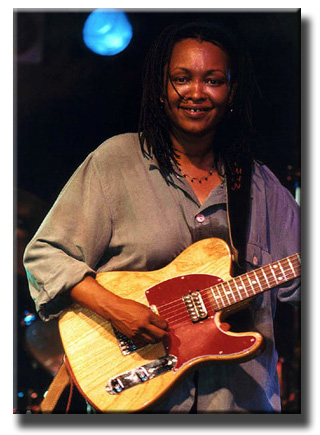
Deborah Coleman performs using both a Gibson Les Paul (again, check out “The Dream” video) & a Fender Telecaster (see pic leading off post.) In addition to her great guitar playing & singing, she’s also a composer—in fact, both “The Dream” & “My Love Belongs to You” are originals.
Deborah Coleman won an Orville Gibson Award for Best Blues Guitarist in 2001, & has placed two albums on Billboard’s top 20 chart—these were the Blind Pig releases Livin’ On Love (2001) & Soul Be It (2002). In addition, she has been nominated for a W.C. Handy Blues Music Award nine times!
What an exciting performer! I know you’re going to love her music.
Sorry we’re a bit behind schedule today, but Happy Monday, & welcome to this month’s installment of Any Woman’s Blues!
I’ve been planning to write a feature on guitarist-uker Del Rey for this series for some time. Now, you may not be familiar with Del Rey’s work, but I’m happy to introduce you—& you’ll see this series would be incomplete without her inclusion.
First, Del Rey is an extremely accomplished blues guitar player; she also happens to be a fantastic uke player too, & regular readers know I have a soft spot for that instrument; Del Rey has done instructional guitar & uke videos for Happy Traum’s Homespun Music. In addition, Del Rey herself has been a tremendous force for increasing all of our knowledge about the role of women in American music thru both her “Women with Guitar” & her “Women in American Music” series; Del Rey has brought these presentations to colleges, universities, folk societies & more. Del Rey is particularly keen on the music of the great Memphis Minnie (see her version of “When the Levee Breaks” below), & she also has arranged jazz pianist Mary Lou Williams’ “Boogie Mysterioso” for solo guitar!
The problem I kept running into is that there’s a shortage of Del Rey videos on YouTube—a sad situation, as she is an extremely talented performer—not based solely on her formidable instrumental chops or her strong & clear singing, but also on the more intangible qualities that make a musician into an entertainer. Witty, informative & evincing joy in the music she clearly loves, Del Rey shows an engaging onstage presence. But while I'd have preferred more videos to choose from (& admittedly, the sound on "When the Levee Breaks" isn't ideal), I decided not to wait, but to go ahead with a feature on this wonderful performer.
Del Rey has issued around a dozen cds on Hobemian Records, Southern Records & Kicking Mule. She also tours, so be sure to catch her if she comes thru your town.
As far as instruments go, Del Rey favors resonators, & her performing guitar, which is parlor size, & her performing uke (concert scale) both were crafted by luthier Ron Phillips. Her playing is remarkable for a clear, clean, singing tone & her fingerpicking on both the guitar & the uke is intricate & melodic.
A happy Monday! Sure hope you’re in the mood for some amazing guitar-playing, because that’s what we have in store on this month’s Any Woman’s Blues edition of the Monday Morning Blues.
This month’s featured artist, Etta Baker, is a musician who really should be much more widely known; her guitar playing is superb both in terms of technique & feeling, & no less of a musician than Taj Mahal claimed her playing was “the greatest influence” on his own.
But there was only one recording of Etta Baker available thru much of her adult life, a field recording of her, her father & other family members that was released in 1956 as Instrumental Music From the Southern Appalachians. Following this, Etta Baker didn’t put her guitar aside, but she didn’t pursue a musical career. Instead, she raised nine children & worked in a textile mill in her native North Carolina.
But in 1991, she began a recording career that lasted until her death (at age 93) in 2006. She issued One Dime Blues on Rounder, & followed this with in 1999 Railroad Bill on Music Maker. Etta Baker’s final recording was a series of duets with Taj Mahal, also on Music Maker; Etta Baker & Taj Mahal was released in 2004.
I first encountered Etta Baker not on a compact disc but on a printed page, namely in Happy Traum’s Fingerpicking Styles for Guitar (Oak Publications) where he provides transcriptions of her versions of “Bully of the Town” & “John Henry.” The latter is a slide piece played in open D. Traum claims she played this using a knife blade as a slide on her Instrumental Music From the Southern Appalachians, & I assume he’s right; it was fairly common to use a knife as a slide in traditional blues playing. You can see (& hear!) her playing an excerpt from “John Henry” as part of a Music Maker video here—I love her version of this old great old tune. Later, I purchased One Dime Blues, & was wowed by what I heard; I’ve always held Etta Baker’s playing in high regard.
Ms. Baker plays what is called “Piedmont style,” a form of fingerpicking that owes a lot to old-time banjo playing styles (if you do watch the Music Maker video, you’ll notice that she only uses her right hand’s thumb & index finger, which was a common form of old-time banjo picking—& in fact Etta Baker also played the banjo.) Other guitar players associated with this style are Blind Willie McTell, Blind Blake, Elizabeth Cotton & Reverend Gary Davis. In general, Piedmont style is associated with players from east coast states—Georgia, the Carolinas & Virginia—tho Mississippi John Hurt played in this style while living in the Mississippi delta.
Etta Baker’s recordings are virtually all instrumentals. By the time she began her recording career in the 1990s, she was well into her 70s, & her voice was weak. I don’t know if she sang much as a younger woman, but her guitar certainly always sang beautifully as she played!
Hope you enjoy the music from this extraordinarily gifted musician!
The photo leading off the post is from Wiki Commons, where it’s entitled “Etta Baker with acoustic guitar. Photo taken in the front yard of Etta Baker's home on Bracket Street in Morganton, North Carolina, United States.” Photo is by Timothy Duffy of the Music Maker Relief Foundation, & is licensed under the Creative Commons Attribution 2.0 Generic license.
It appears Monday has caught up with us once again! & if you need some music to get the week started, you’re in the right place—some very fine old-time blues right here on the Monday Morning Blues.
Today’s featured artist in the Any Woman’s Blues series is Geeshie Wiley, who recorded with last month’s featured artist Elvie Thomas. Wiley & Thomas recorded a total of six songs at two separate sessions in Paramount’s Grafton, Wisconsin recording studio (where such better known Delta artists as Charlie Patton, Willie Brown & Son House also recorded around the same time).
Wiley's signature song is “Last Kind Words,” a masterful if lyrically bleak song about a soldier in World War I. Wiley’s singing & the guitar work on this song have both received high praise. As far as I can determine the song is played as tho the guitar were in standard tuning & the song were being played in E, but the guitar is in fact tuned down a semitone (or possibly a bit more) so the song’s actual key is E flat (or a rather flat E/rather sharp D.) In any case, you can read more about the guitar playing on “Last Kind Words” here on the Acoustic Guitar Forum.
Not much is known about Geeshie Wiley’s biography, tho there’s a bit more information about her than about her partner Elvie Thomas. Interestingly, the name Geeshie (or Geechie) is often associated with the Gullah, who historically have lived in South Carolina & Georgia. Here’s a dime store description of their culture from Wikipedia:
The Gullah are known for preserving more of their African linguistic and cultural heritage than any other African-American community in the United States. They speak an English-based creole language containing many African loanwords and significant influences from African languages in grammar and sentence structure. The Gullah language is related to Jamaican Creole, Barbadian Dialect, Bahamian Dialect, and the Krio language of Sierra Leone in West Africa. Gullah storytelling, cuisine, music, folk beliefs, crafts, farming and fishing traditions, all exhibit strong influences from West and Central African cultures.
Ishman Bracey, a Delta bluesman of some note, claimed to have known Wiley & said she was from Natchez, Mississippi. Bracey also claimed that she was linked romantically with Charlie McCoy, the great mandolin & guitar player who partner with Bracey & Tommy Johnson. Bracey said Wiley “could play on the guitar as good as on that record,” that she also played ukulele, & that she had performed in medicine shows. The great Memphis-based blues guitarist Robert Wilkins also had some recollection of Wiley.
Sadly, we have only six songs by which to judge Geeshie Wiley’s & Elvie Thomas’ talents, tho it seems clear from those songs that those talents were considerable. Why so few songs? It’s impossible to say for sure, but 1930 & 1931 were the beginnings of the Great US Depression, & the recording industry was very hard hit by this. The so-called “race records” boom of the 1920s went bust in the Depression, as labels that relied on these recordings either went under or turned to types of music that would produce more reliable income. It’s also true that—with the notable exception of Blind Lemon Jefferson—so-called “country blues” artists simply didn’t sell as many records back in the day as either the classic women blues singers like Bessie Smith, Ida Cox et al, or more urban & “smooth” musicians like Lonnie Johnson & Leroy Carr. Elijah Wald discusses this in his excellent book, Escaping the Delta: Robert Johnson & the Invention of the Blues;Wald produces playlists from various Delta jukeboxes in 1941—with fascinating & surprising results.
By the way: a bit off topic, but please consider swinging by the Ms. Magazine blog today & checking out my good friend (& occasional Robert Frost's Bano contributor) Audrey Bilger's follow-up interview with Twitter sensation Feminist Hulk (@feministhulk.) Audrey interviewed this big, green, purple-shorts-wearing, Judith Butler-reading phenomenon last year, & the interview was the second most popular feature on the Ms blog in 2010. This time around, we're all hoping Audrey & Feminist Hulk are #1!
In the meantime, hope you enjoy Geeshie Wiley’s great music!
Happy Monday, all. I’m making this installment of Any Woman’s Blues short for two reasons—first, as I mentioned yesterday, I don’t have a reliable computer at this time, & the one I can use is powering off without warning; this rewards circumspection! Second, there simply isn’t much known about today’s featured artist, Elvie Thomas.
What we do know about Elvie Thomas is that she is credited with two recordings, both made in Grafton, Wisconsin in March 1930. Both of those recordings, “Motherless Child Blues” & “Over to My House” are found below in Youtube videos.
We also know that Thomas was accompanied on these recordings by Gereshie Wiley, another woman who sang the blues & played guitar. In fact, based on their small recorded output, it seems likely that Wiley & Thomas were musical partners, as Thomas backed Wiley on the latter’s four extant recordings, two of which were made at the same Grafton session.
Based on this, I wondered if I should write up Thomas & Wiley in one post. I decided against that based on the following rhetorical question: if I were writing up a series on men who played blues guitar, would I combine Charlie Patton & Willie Brown (or for that matter, Son House & Willie Brown) in one entry? After all, Brown backed Patton on a number of recordings & only has two existing recordings of his own; in addition, not much is known about Willie Brown’s biography, despite his association with Patton, House & Robert Johnson. But the fact is, Willie Brown is generally acknowledged as one of the best guitar players from the pre-War Delta region, & his two recorded songs are considered seminal. Tho his reputation may be greater, I think that Thomas & Wiley deserve similar treatment, so next month’s featured artist on Any Woman’s Blues will be Geeshie Wiley; actually, a bit more is known about her biography than about Thomas’.
There are various forms of “Motherless Child Blues,” from Thomas’ version to Barbecue Bob’s & Blind Willie McTell’s & on to the Carter Family’s. The versions vary a lot both musically & lyrically. In the case of Thomas’ rendition, the song is played in E in standard guitar tuning, tho with some unusual chord voicings.
Happy Monday, folks, from rainy Idaho. Gettong a late start today, as yesterday was a rather wild churchmouse party involving lots of music & lots of curry! But I’m here at last with the Monday Morning Blues, & an exciting one, because I get to write about a blues performer who's been a huge inspiration to me both as a musician & as someone who loves the old time blues. Yes, I’ve postponed adding Rory Block to the Any Woman’s Blues series long enough.
I don’t recall exactly why I bought the cd Gone Woman Blues back in the mid 1990s, but I doubt I’ve listened to any cd more over the past 15 or 16 years. What is it about this cd & Rory Block’s music in general that I find so compelling? Of course she is a masterful guitar player—that’s a given. She has a dazzling array of chops—great slide playing, dynamic rhythms, intricate fingerstyle playing: as far as “country blues/Delta blues” playing goes, Rory Block has it all. & her singing is also amazing—a huge vocal range, with power & feeling in all parts of that range.
“Feeling”—I would say, “passion” is indeed a quality that sets Rory Block’s playing apart. Let’s face it: there are lots of great guitar players out there in the blues field—simply being able to string together amazing licks doesn’t make one a great musician. & when you’re talking about professional singers—well, a good number of them can sing an impressive range of notes. But without bringing that extra dimension to the playing & singing, it just doesn’t rise to the highest level. I had the chance to see her perform live last year in a small venue in Eureka, Montana, & I can assure you, her performance in person was every bit as masterful as what you hear on her recordings!
Rory Block adds that extra dimension, & to spare. She doesn’t simply “preserve” the old blues traditions, she makes her repertoire her own. & while I can’t play or sing like Rory Block, I’ve tried to take this lesson with me as much as I can when I play & perform the blues songs I love.
I realize I haven’t given you much background on Rory Block—but if you’d like that, there are plenty of sources online, such as the bio on Rory Block’s own site or the old standby, Allmusic. You can even get Rory Block’s autobiography When a Woman Gets the Blues as an e-book/pdf at this link! Since I do mention the guitars performers favor, I will note that Rory Block typically plays a Martin OM-28 VR
I think Rory’s performance on the following two classic Delta blues (by Son House & Robert Johnson) will give an idea of what I mean—enjoy!
A happy Monday, all! I’m hoping to get back on a more regular posting schedule. This isn’t being helped by a bout of fatigue that laid me up much of Sunday, but I’m forging ahead with this week’s Any Woman’s Blues.
Very little is known about this week’s featured artist, Mattie Delaney; in fact, she is only known to recorded two songs during her career, “Tallahatchie River Blues” & “Down the Big Road Blues.” These were issued on a 78 that’s extremely rare—apparently a mint condition copy of this record would be worth about $6,000 to $8,000 on the collector’s market.
We do know that Delaney was born in Tchula, Mississippi & that she made the two Vocalion recordings in 1930. It’s also true that around this time the effects of the Great Depression began to have a profound effect on the recording industry & that field recordings were sharply curtailed.
As things stand, Delaney is an enigmatic figure. While there were many women who became big stars as blues singers—in fact, in the early 20s all the blues recording stars were women singers—very few women in the blues were also “guitar slingers.” There was Memphis Minnie, of course, but she was associated with the city sounds of Memphis & Chicago, while Delaney is very much a “country blues” performer.
My suspicion is that Delaney was not alone; that there were other talented women guitarists playing the country blues in the “classic period” just as there are today. It’s important to remember that what we have on record from the 1920s & 1930s (& beyond) was largely determined by the tastes & biases of the men who were setting up the sessions & making the recordings.
Rory Block has covered both of Delaney’s songs, recording “Down the Big Road Blues” as “Travelin’ Blues” (on her High-Heeled Blues & Best Blues & Originals, both on Rounder); her version of “Tallahatchie Blues” appears on both When a Woman Gets the Blues & Gone Woman Blues, also both on Rounder. Lucinda Williams covered “Down the Big Road Blues” on Car Wheels on a Gravel Road from Mercury.
Hope you enjoy this rare & wonderful piece of music!




_-_NARA_-_542020.tif/lossy-page1-800px-Civil_Rights_March_on_Washington,_D.C._(Entertainment,_Vocalist_Odetta.)_-_NARA_-_542020.tif.jpg)