A miscellany like Grandma’s attic in Taunton, MA or Mission Street's Thrift Town in San Francisco or a Council, ID yard sale in cloudy mid April or a celestial roadmap no one folded—you take your pick.
I’m not one for hero worship & I don't have much use for the U.S. cult of celebrity, which makes everyone from newscasters to athletes to movie stars to politicians into larger than life figures, as well as the fascination with celebrities’ deaths that frequently captivate the internet. But I do think heroism is possible, & that a person can indeed hold steadfast to his or her ideals even when all instincts for self-preservation may tell them to do otherwise. & such a man was Pete Seeger, who passed away tonight at the age of 94 years young. & in related news, I believe this man’s passing is worth memorializing.
Pete Seeger taught us many things—the power of song—that is of voices rising up in song, not as a single pop star on the stage singing to his audience, but as a singer who believed every song was an opportunity for a sing-along. Of course, the real lesson here is cooperation—working together toward a common goal & a common good, not in a zero sum game of winners & losers.
Along the way, Pete Seeger faced the HUAC, a blacklist, FBI investigations, & maintained his course. He said in an interview once that he always believed things would be set right, because he always believed in America. Remarkable that a man could react with equanimity toward a country that was, through the force of its governmental institutions, seeking to destroy him. But that is why no less of an American icon than Johnny Cash, who bucked the blacklist & asked Seeger to appear on his 1960s TV show during the height of the Viet Name war, could call Seeger one of the most patriotic men he ever knew.
Pete Seeger was an optimist—her took the Woody Guthrie slogan of “This Machine Kills Fascists,” taken from machine shops involved in the World War II effort & stamped on his guitar, to the much transformed “This Machine Surrounds Hate & Forces It To Surrender,” lettered around the rim of his banjo. Remarkable. Pete Seeger taught us how to play the banjo, but he taught us so much more, if we are willing to open our hearts & minds to it—simple lessons, because the most basic.
It’s easy to say Pete Seeger will be missed, & of course he will be; what a unique voice & force he has been for so many years, a man who in many ways embodied our best angels in his public persona & also in refusing to be broken. It’s just that he was celebrated in later life by the celebrity musicians of our own day, & it’s to be hoped that he passed on his message to them. But more than that, Seeger’s life is a life to be celebrated—perhaps the best way to do so is to put his lessons to practice in small ways. It seems to me that Pete Seeger was always singing with a political soul (in the best & etymological sense of the word "political"), whether he was entertaining us with "Skip to My Lou" or lifting our spirits with "We Shall Overcome."
Image of Pete Seeger’s banjo links to its source on the woodshed. The image is found on many sites across the internet.
As you may know, next Tuesday is the Juneteenth holiday, commemorating the end of slavery in the state of Texas in 1865. Specifically, it’s understood as the date that the Emancipation Proclamation was recognized as law in Texas, & as such was a watershed day for the Proclamation becoming the law of the land not just in woird, but in action. While the holiday originated in Texas, it is now recognized as either a holiday or an “observance” in 41 states in addition to the District of Columbia.
Despite that official recognition, Juneteenth isn’t widely known, but it certainly deserves our attention. As my own small way of doing this, I wanted to bring it up in the context of Banjo Friday—because the banjo, with its African origin, followed by initial descriptions in which various European writers find it hardly “musical” at all, to its appropriation for mistrel shows & later morphing into a bluegrass instrument—is in itself a potent object that can teach a lot about shifting race relations & racial identity in the US. A great place to start exploring this is Picturing the Banjo (which I wrote about some time ago.)
One arc traced in Picturing the Banjo is the history of the African American community turning away from the banjo & the string music associated with it, because these were seen as hearkening back to slavery. Other writers on the history of the blues have conjectured that the development of this music around the turn of the 20th century was itself a reaction to the older music associated with the fiddle & the banjo, again because of the slavery connection. In this reading, the blues became a revolutionary music, a turning away from the past.
The reality is never quite that simple, of course. As we know from the great Carolina Chocolate Drops, the string band tradition never completely died out in the African American communities, especially in the south, & there were plenty of popular musicians who continued to incorporate fiddle & banjo music into the blues & some of its relations (like hot jazz & jug band music) thru the first few decades of the 20th century.
But while that arc isn’t true in anything like an absolute sense, it is generally true in terms of an overall trend. & not only was that a cultural trend within the black community; it also describes the musical development of a talented & intriguing musician named Otis Taylor, who’s made a name for himself over the past 17 years as a blues musician & composer of considerable talent & vision (in fact, Taylor also was a performing musician as a young man in the 1970s, but he walked away from it for almost 20 years.)
Taylor’s first instrument was the banjo; however, when he learned about its history of appropriation & minstrelsy, he put the instrument aside in favor of the guitar. However, in recent years, Talor has returned to the banjo, & in fact released Recapturing the Banjo on Telarc in 2008, a seminal contemporary banjo album on which Taylor is joined by the likes of Alvin Youngblood Hart, Keb’Mo’ & several other notable black blues artists to produce an album of reclamation.
Only in retrospect do we know both how much & how little was accomplished on June 19, 1865. There was the absolutely necessary implementation of the Emancipation Proclamation, & a literal end of the horrific institution of slavery; yet this was followed by the implementation of Jim Crow & the feudal sharecropping system. & let’s not delude ourselves that these problems were restricted to the south; in Boston, once the center of the abolition movement, school integration turned ugly even in the late 20th century. Also, while we’ve advanced culturally to the point that we can elect a black man as president, it’s disturbing to witness the unconscionably disrespectful treatment he’s received from a significant portion of the population, including elected officials at almost every level. We still have far to go.
Hope you enjoy the music, & hope you take the chance to follow some of the links & learn more about Juneteenth, Otis Taylor, & the banjo!
The photo shows the Juneteenth committee from 1900 in Austin, Texas. The image is in the public domain.
[Today's post, rounding off our month of promoting David LaMotte's White Flour project, is by Barbie Angell]
With just 2 days left of David LaMotte’s Kickstarter project for his children’s book, White Flour, John asked me to write a piece in support of this, and we hope to drum up some last minute support. Yes, now is the time to discuss the ku klux klan, the Coup Clutz Clowns & what happens when hatred meets humor.
This past week, while I was catching up on Facebook & Twitter, I was horrified to discover that some people find the anti-Obama, “n-word” bumper stickers
to be funny. I was even more bothered by the fact that the rest of the
posts were people shaking their head, but not completely outraged.
Have we as a nation become so complacent about racism that we no longer
feel compelled to act against it? Does it take the shooting of an unarmed boy
to give us cause to raise our voices? Do we have to encounter such
extremes to become involved? I think not. I think we just don’t know
what we can do….but I believe David’s book provides an answer and that
is one reason I am so fully in support of it.
White Flour illustration by Jenn Hales.
White Flour tells the true story of a whimsical and effective
response by counter-protesters to a white supremacists’ march in
Knoxville, Tennessee in 2007. The Coup Clutz Clowns, a group of local
anti-racism activists, used humor and non-violence to reveal the
silliness of the march, vanquishing hatred with laughter.
The clowns slightly altered the supremacists’ chants to make them
a bit… better. As the hooded marchers shouted “white power!” the
clowns joined right in, shouting “white flour!” and pulling out bags of
the stuff they had brought from home for a flour fight. They walked a
bit farther and decided they had heard wrong, and that the klansmen must
be shouting “white flowers!” so they shouted that, and passed flowers
out to the crowd …and it gets better from there (the full text of the
poem is below). The point is that rather than shouting down the
shouters, meeting rage with rage, they simply refused to take such
foolishness seriously. Fight and flight are not our only two options,
and humor, it turns out, beats hatred. At least it did on that day. ~ David LaMotte
Do I propose we all dress up as clowns and take a stand if the klan
comes to our town? No. But I do suggest that we teach our children
the values that are so cheerfully and eloquently brought to light in
White Flour. Teaching our children that bigotry is wrong is only the
beginning, but what an important beginning it is. I’ve tried to
explain it to my six year-old son, and it is a completely foreign
concept. He kind of understands that some people don’t like the little
girl he has a crush on. Since she is an African-American he knows
they can easily see the difference in her skin color, but he doesn’t
comprehend how that can be bad. Explaining to him, however, that some
people don’t like me because I’m a Jew, is altogether lost on him. I
don’t look any different than other white people, but I’m hated by some
just the same. As for explaining his Godfather, who is gay, or any of
my gay, lesbian or transgendered friends (whom he adores), well, to him
that’s just an ungraspable idea. The fact that they love shouldn’t be a
bad thing, no matter who that love is given to.
The other incredibly important lesson in David LaMotte’s poem, White
Flour, is that the clowns are not reaching for violence to counter
hatred. They are reaching into their bag of tricks for humor, praise
and peace. David best explains this in an email discussion we had recently.
White Flour illustration by Jenn Hales.
Someone sent me an indie press article about the event and I was
knocked out by several things: one, that the mainstream press had missed
this. Two, that it’s such a good example of creative nonviolence—
finding a third way beyond fight and flight. Three, that it was so
effective. And four, that it’s so creative and funny. I find it to be
an accessible story for lots of audiences, but also extremely
instructive, so I wanted to share it.
“Breaking the script” is a fundamental tenet of creative
nonviolence. Responding in ways that are completely unexpected breaks
us out of our patterns and opens a conflict situation up to new possible
outcomes. I love what these folks did, and it’s been fun to track them
down and have some conversations about it. The original organizers are
really excited about the book.
There are plenty of other examples of this in my own life and in
conflict situations I’ve been around, but this is the most entertaining
story I know to illustrate that point.
The first time I heard David perform White Flour,
I asked him if I could get an audio version of it to send to my family
and friends for Christmas. Being such a wonderful friend and wanting to
spread this story far and wide, he agreed without hesitation. When I
learned that this, my favorite poem of all time, was going to be turned
into a children’s book, I was completely thrilled. A few weeks ago,
when he launched the Kickstarter project, I felt certain that it would
be successful as long as people were aware of it. This story is so
important, especially for children. It isn’t preachy or condescending;
on the contrary, it’s fun and accessible. It is, in my opinion, the
perfect way to educate our children on bigotry and nonviolence. Most
importantly, it’s true. It’s a piece of history that should be
remembered. Should be celebrated. Should become a part of our
national conversation about putting an end to racism.
When the White Flour project surpassed its goal of $18,500 in 12
days, I was amazed. People really embraced this story. They fell in
love with the idea and wanted to share it with their friends, both in
real life and online. You may think that the story ends here, but it doesn’t. David has
gained some pretty impressive attention with this real-life story,
turned into a poem, turned into a children’s book. There is now talk of this book
becoming a part of the 5th grade curriculum in schools in Texas. He
is in also in contact with a national publicist and has learned that
several well-known artists in the music industry are planning to give
testimonials about his book.
White Flour illustration by Jenn Hales.
Given all this inspiring news, White Flour is no longer going to be a
little project that inches its way up a tiny hill. No, that plan just
isn’t what this book wants to do. This is now the Little Book That
Could and, with the help of 471 backers so far, this book fully intends
to climb a mountain. I truly believe that it can. The original goal
of $18,500 to print 2,500 copies of White Flour is a distant memory.
The top of this mountain is now $39,000 for an initial printing of
10,000 copies and a national publicity campaign. This means that we
need to continue to spread the word. If this money is brought in
strictly through pre-orders, at $25 each, we only need 412 more to reach
this goal.
That $25 on the Kickstarter page not only orders the book and
includes the shipping, but because of the way Kickstarter works you also
get whatever was included prior to that level. In this case, it would
include:
$1 – SMILE! I will look up from my computer and grin and be thankful for
your kind support. Then I will celebrate that there are people in the
world who are happy to trade a dollar for a smile, and to help with an
effort to tell an inspiring story with no tangible reward to themselves.
You rock.
$5 – LAUGH! Loads of gratitude, plus a digitally (i.e. magically)
transported scan of some book art to use as wallpaper on your computer
screen.
$15 – CLAP! We’ll send gratitude, digital wallpaper and an e-book version of White Flour.
And, of course,
$25 – STAND UP! We’ll send the physical book and pay the postage
(please add $5 if overseas) and we’ll send you the wallpaper image.
There are many other levels for this book, including autographed
copies of the book, David’s award winning album, S.S. Bathtub, VIP
tickets to one of his release parties and even the opportunity to have
him perform for you.
I’ve gone on long enough about this book….and so I leave you with
David LaMotte performing White Flour. This book will go far, mark my
words, The Little Book That Could will climb unimaginable mountains and
become an essential tool to help keep bigotry out of the hearts of our
children.
as always, thanks for playing. : ) you can find additional information about White Flour at www.whiteflourbook.com
We’ve been promoting David LaMotte’s Kickstarter project for an illustrated children’s book based on his poem “White Flour” this month—thanks to my friend & blog co-conspirator Barbie Angell for suggesting this! I’m happy to announce that David LaMotte’s Kickstarter is fully funded, & that the book will have an initial printing of 10,000 copies. However, additional pledges will help keep this a viable, ongoing project, plus you can get really cool stuff!
With David laMotte’s blessing, we’re posting both the text of the poem plus the promotional video for the project. If you’d like more information about David LaMotte, please visit his website, & also read Barbie Angell’s excellent write up about him last week on Robert Frost’s Banjo!
Thanks!
White Flour
The day was bright and sunny as most May days tend to be In the hills of Appalachia, down in Knoxville, Tennessee A dozen men put on their suits and quickly took their places In white robes and those tall and pointed hoods that hid their faces
Their feet fell down in rhythm as they started their parade They raised their fists into the air, they bellowed and they brayed They loved to stir the people up, they loved when they were taunted They didn’t mind the anger—it’s exactly what they wanted
As they came around the corner, sure enough the people roared But they couldn’t quite believe their ears, it seemed to be… support! Had Knoxville finally seen the light? Were people coming ‘round? The men thought for a moment that they’d found their kind of town
But then they turned their eyes to where the cheering had its source As one their shoulders crumpled when they saw the mighty force The crowd had painted faces and some had tacky clothes Their hair and hats outrageous, each had a red foam nose
The clowns had come in numbers to enjoy the grand parade They laughed and danced that other clowns had come to town that day And then the marchers shouted, and the clowns all strained to hear Each one tuned in intently with a gloved hand to an ear
“White power!” screamed the marchers, and they raised their fisted hands The clowns leaned in and listened like they couldn’t understand Then one held up his finger and helped all the others see The point of all this yelling, and they joined right in with glee
“White flour!” the clowns shouted, and they reached inside their clothes They pulled out bags and tore them and huge clouds of powder rose They poured it on each other and they threw it in the air It got all over baggy clothes and multi-colored hair
Now all but just a few of them were joining in the jokes You could almost see the marchers turning red beneath white cloaks They wanted to look scary. They wanted to look tough. One rushed right at the clowns in rage and was hauled away in cuffs
But the others chanted louder, marching on around the bend The clowns all marched on too, of course, supporting their new friends “White power!” came the marchers’ cry. They were not amused. The clowns grew still and thoughtful. Well... perhaps they’d been confused?
They huddled and consulted, this bright and silly crowd They listened quite intently, then one said “I’ve got it now!” “White flowers!” screamed the happy clown, and all the rest joined in The air was filled with flowers, and they laughed and danced again
“Everyone loves flowers, and white’s a pretty sort I can’t think of a better cause for people to support!” Green flower stems went flying like small arrows from bad archers White petals covered everything, including the mad marchers
And then a very tall clown called the others to attention He choked down all his chuckles and said “Friends I have to mention That what with all this mirth and fun it’s sort of hard to hear But now I know the cause that these paraders hold so dear...
“Tight showers!” the clown blurted and he hit his head in wonder He held up a camp shower and the others all got under Or at least they tried to get beneath, they strained but couldn’t quite There wasn’t room for all of them. They pushed, but it was tight.
“White Power!” came the mad refrain, quite carefully pronounced The clowns consulted once again, then a woman clown announced “I’ve got it! I’m embarrassed that it took so long to see, But what these marchers march for is a cause quite dear to me!”
“Wife power!” she exclaimed and all the other clowns joined in They shook their heads and laughed at how erroneous they’d been The women clowns were hoisted up on shoulders of the others Some pulled on wedding dresses, chanting “Here’s to wives and mothers!”
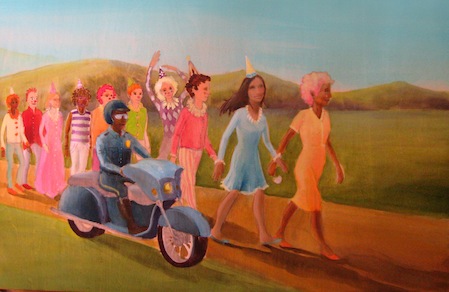
The men in robes were sullen, and they knew they’d been defeated They yelled a few more times and then they finally retreated And when they’d gone a motorcycle cop called to the clowns And offered them an escort through the center of the town
The day was bright and sunny as most May days tend to be In the hills of Appalachia down in Knoxville, Tennessee People joined the new parade. The crowd stretched out for miles The clowns passed out more flowers and made everybody smile
And what would be the lesson of that shiny southern day? Can we understand the message that the clowns sought to convey? Seems that when you’re fighting hatred, hatred’s not the thing to use So here’s to those who march on in their big red floppy shoes
[As promised, today’s post is by Barbie Dockstader Angell; she discusses her friend, musician/writer/activist David LaMottte—including a great interview in the video below. That’s David in the photo to the right with Barbie’s own “Little Man.”]
I first met David LaMotte at Kinko’s, where I was working in 2000 in Asheville, NC. Most people who come in are stressed & hurried, but I could tell immediately that the smiling customer patiently waiting for me was not “most people.”
By the time he & I finished up with his project, I had his brand new album, Corners, in my hand; a gift from my appreciative customer. I put the cd in the stereo when I got home from work and I didn’t listen to much else for the next month. When I’d go sit somewhere with my discman & headphones to work on my writing, that cd was my first choice for the next year.
I was still quite new to Asheville when I met David, and he quickly became a friend. We have shared a great many wonderful times and some sad ones through these last 12 years, and always he has been ready with that same patient smile, willing to wait a moment so that we can both be completely involved in the conversation.
If you’ve met me in real-life, then I’ve already told you about David LaMotte. I am just that type of girl. There are a handful of writers, musicians and businesses that I seem to bring up in conversation all the time and he is most certainly one of them. Because aside from being a brilliant singer/songwriter & musician, he is also a children’s book author, humanitarian and founder of a nonprofit organization called PEG which builds schools in Guatemala. It seems like he does everything except moderate a Nobel Peace Prize nomination committee....oh wait, I’m wrong, he does that too.
If you think that I’m putting David on a pedestal, you would be wrong. I’m just incredibly proud of my friend because he saw that he could effect change as a full-time touring musician. As a performer myself, I can assure you that the spotlight’s glow can cause people to look up to the person on the stage. There’s an even greater responsibility there when some of those faces in the audience belong to children or anyone who is still searching for the person that they wish to become. And so I’m proud that David took that knowledge and ran forward, constantly finding new ways to improve the lives of the people in the world around him. Not as a man on a pedestal looking down, but as one who is doing the heavy lifting side by side with his community.
The video below is my first interview for an organization called Lingua Musica. We talk with artists about more than just their music, but what they are doing offstage as well. I was thrilled when David said he would be a part of our endeavor and taken in as always by the power of his words.
Underneath the video, you’ll see the link for his Kickstarter project. His goal has been funded for his new book, White Flour, but you can still use that link to pre-order this fun and inspiring story. If you’re unfamiliar with the subject, White Flour is the true story of the day the kkk came to Knoxville, TN to march....and were defeated with humor by a group of clowns. In addition, it happens to be my favorite poem of all time....and that’s saying quite a bit.
Here's the link Barbie promised to David LaMotte's "White Flour" Kickstarter project. Please consider pre-ordering the book & supporting this wonderful artist's important message!
I’d be remiss if I allowed Gil Scott-Heron’s passing to occur without a post to commemorate him—at one time, his music was extremely important to me, & I still hold his position as songwriter/musician/poet/philosopher in high regard. So, although this is a bit belated & more brief than it should be, here are some thoughts to mark the fact that this remarkable man made an impact in my life.
I was fortunate enough to see him perform twice, both times in the 1970s; & oddly, both times he was the opening act. Talk about a tough act to follow! When he opened for George Benson, the first time I saw Scott-Heron, Benson’s performance just couldn’t come up to the energy level to which Gil Scott-Heron & the Midnight Band had risen; & the only reason he didn’t steal the show the second time was that Rahsaan Roland Kirk was the headline act. What a privilege to have seen such amazing performers!
Back in the 1970s & early 80s, I listened to the Winter in America & It’s Your World albums a lot—songs like “The Bottle,” “Home is Where the Hatred Is,” “Tomorrow’s Trane,” & others were a soundtrack. As a songwriter, Scott-Heron was literate but also able to convey direct meaning & emotion, as a singer, he was blessed with a remarkable voice; & the Midnight Band could really play—what a foundation, with three drummers! & atop that drumming, they could swing out uptempo or play lush & lovely ballads. His frequent collaborator Brian Jackson is a soulful flautist & keyboard player—Scott-Heron also played piano, & he employed various talented horn men. His main bassist was the rock-solid Danny Bowens, tho he also recorded with Ron Carter.
Gil Scott-Heron is justifiably remember as one of hip hop’s fathers; he did a number of spoken word pieces with rhythmic musical settings, the most famous being “The Revolution Will Not Be Televised.” He should also be remembered as both a talented jazz artist & as a social commentator of great depth—& as a man who struggled with his own demons. His 2010 album, I’m New Here was his first release of new material in 16 years. It met with critical acclaim & even had one successful single, “Me & the Devil,” which is an adaptation of Robert Johnson’s “Me & the Devil Blues.”
It was difficult for me to pick just two songs to feature with this post, but I decided on “It’s Your World,” the title track from his 1976 Arista live album & one of his real masterpieces, “Winter in America,” the title track from the 1974 album that may well be his best.
[Happy Thursday, all! Today's post is a somewhat revised re-post from November of 2008. Since the blog didn't have a wide readership then, this shouldn't be redundant to most folks. I've been thinking about this lately as I've been wracking my brain figuring out settings for a few Captain Beefheart songs. Oh, & fans of Writer's Talk: don't despair! That series will be back soon!]
No, this post isn’t some nostalgia trip for a long lost love of Eastern European descent; it’s about the Online Guitar Archive—remember that? Home to page after page of chord charts & tabs, many of them not very well-conceived, but conveying at least some idea of how to play songs ranging from the most famous artists to the most obscure. OLGA has been shut down for quite some time now under the threat of legal action from the music publishing industry, tho of course scores of other chord sites are still available.
My history of OLGA in this paragraph was adapted from Wikipedia’s, so you can get pretty much the same info here. If you don’t feel like opening a new tab, I can tell you that OLGA developed from a newsgroup at the University of Nevada Las Vegas at which a host of folks started compiling chord charts & tabs. In 1992, these files (which had been purged from the newsgroup every few days) were collected onto an ftp site, & this later developed into OLGA.net. In the early, heady days of the internet the collection expanded like dandelions on an April lawn. Now, you can look at dandelions one of two ways. They are actually quite pretty flowers, & they also attract goldfinches. However, to most folks’ eyes, they’re just odd & unattractive when they go to seed. So it was with OLGA; the online guitarist community loved it, while the music publishing industry saw it as their worst nightmare. EMI filed a complaint with the University of Nevada Las Vegas in 1996, & as a result the burgeoning archive was booted off their server. OLGA found a new server, & then again was forced to shut down in 1998 following a threat of legal action from the Harry Fox Agency. A third version of the archive, now OLGA incorporated, was closed following a takedown letter in 2006 from lawyers representing the National Music Publisher’s Association & the Music Publisher’s Association.
So OLGA is no more, & realistically is not likely to resurrect itself. What is the actual basis of the Music Publisher’s objection to OLGA & similar sites? At first glance it would seem obvious: making a chord progression public without licensing must be a copyright infringement. Well, wait a moment there. A chord progression can’t be copyrighted; any number of songs share the same chord progressions; 12-bar blues is by definition a standard chord progression, & to name all the country songs built around a strict I-IV-V chord progression would result in a very long list. The "Heart & Soul/Blue Moon" progression also has been used in hundreds of songs, from the two old standards I mentioned to "The Tide is High" & "Hungry Heart." & then there’s the time-honored jazz tradition of “the head”—basing a new song on the chord progression of an old standard. Any number of jazz tunes—each itself a copyrighted song—are built on the chord progression of Gershwin’s “I Got Rhythm,” which is also still under copyright. Some other famous heads (with the original song on which they’re based noted in parentheses) include: Thelonious Monk’s “Bright Mississippi” (“Sweet Georgia Brown”), Charlie Parker’s “Crazyeology” (“Back Home in Indiana”), Dizzy Gillespie’s “Groovin’ High” (“Whispering”), Thelonious Monk’s “In Walked Bud” (“Blue Skies”), Charlie Parker’s “Ornithology” (“How High the Moon”), & Billy Strayhorn’s “Take the A Train” (“Exactly Like You”). This is a very selective list, & doesn’t include any of the numerous heads based on “I Got Rhythm.”
But the publishing industry was within their rights, not about the chord progressions per se, but about posting the lyrics along with the chords (without the lyrics, it’s more difficult to figure out where the changes come), because lyrics are copyrighted. Also, tablature that attempts to give a note-by-note transcription of a solo would be considered a copyright infringement. At first glance this makes perfect sense, but logically (if not legally) it seems a bit more complicated. If, as has been asserted, a number of such tabs were actually incorrect, they actually were re-interpretations (willy-nilly, perhaps). Any melody played against a given chord progression will have notes in common with another melody played against that same progression—thus you can typically hear similarities between a head & its original. In country or rock songs with shared chord progressions, there tend to be fewer harmonizing notes, simply because these types of songs don’t tend to have melody notes falling “outside” the chord changes (notes that aren’t part of the scale related to a given chord). It is interesting that OLGA removed lyrics from the site at some point in the 00s, & was still taken down, even tho lyrics seem to be the one irrefutable case of copyright infringement.
Now, I’m a musician myself, & I’m all for musician compensation. Being a musician in a small town where folks often expect musicians to play for free at various events & can react with anything from surprise to indignation if you ask for any remuneration, I know it’s tough to make a living off music. I don’t think that Keith Richards’ quality of life is materially affected by some kid downloading tab to “Wild Horses,” but I understand this is legally irrelevant. Why the kid wants to play a song exactly like Keith Richards (or anyone else) rather than like him/herself is a more complicated question for another time. However, I have a few points to raise about this legal dilemma which I believe are valid (tho I’m sure they’re not “legally” valid—it’s just that they make sense).
At this point there is the MusicNotes site, which is backed by the afore-mentioned Harry Fox Agency. This site offers sheet music downloads of individual songs at a reasonable price: $4.00-$5.00, which is pretty much the going rate for piano sheet music. In addition, a recent random & unscientific search I did on the site showed me that they have some stuff I wouldn’t have expected them to offer; it’s not all the 100 best-known songs.
But there’s still a problem. OLGA’s collection wasn’t based on what the music industry wants to peddle to us (even if they get sufficiently hip to realize folks want songs in addition to the best known or most aggressvely marketed). OLGA offered whatever some guitar player had the initiative to figure out & then post, so there was a lot of obscure stuff there; & frankly, once OLGA shut down, a lot of that stuff disappeared for good. So I guess one thing I wonder is: what’s the legal basis for enforcing copyright on material that publishers don’t make available? It seems to me (again, from a logical not legal standpoint) that the privileges & benefits of copyright should entail some obligation—i.e., “use it or lose it.” If you don’t want to go to the expense of making your copyrighted material available, I’m not sure that you really have moral high ground when you try to prevent others from doing so. Of course, I realize there’s a “real world” argument about this—do enough people really want the Yo Lo Tengo songbook to justify publishing it? Unless the publishers actually make the material available for purchase, it seems difficult for the artist to profit by it.
Now in the "real" musician world, the fact is that figuring out a chord progression is simply a matter of time spent & work—including the work you have to put in to be able to do it in the first place. The same goes for melodies & solos. So in a sense, no matter what the music publishers decide to publish or not publish, the music is available. But the fact is, it's not available to everyone who might want it. While people who are serious about music probably should be able to figure out the majority of chord progressions by ear (& except for a blessed few, this ability will only come thru application & training), many guitarists are hobbyists—if they want to play & sing a particular tune they should be able to benefit from the experience of others. They may not have a teacher to help them; & unless that song is one the music publishing industry decided to make available, they're out of luck.
I’ll let you to draw your own conclusions—I’ll admit it’s a complicated issue, just as I’ll also point out the issue isn’t without double standards & misleading, self-serving arguments. I also don’t believe it’s any great secret that money & power & legal standing make a very cozy threesome of bedfellows….
& forces it to surrender." These are the words emblazoned on Pete Seeger’s banjo. & today as I thought about how anyone might respond not only to the enormity of 9/11/2001 but also to all the enormities that have come in the wake of that day—including the enormity of those who are using this year's anniversary to further hatred, division & polarization—as I thought about those things, I kept thinking about Pete Seeger’s banjo.
Pete Seeger is a true American hero in my mind—a man of immense moral courage & a patriot in the deepest sense of the word. One of Johnny Cash’s finest moments was when he defied the blacklisting of Seeger & had him as a guest on his show—& stated his opinion for the cameras, in the midst of the late 60s turmoil—that Seeger was one of the most patriotic men he knew. I agree.
But more important: Seeger’s message. I’m not a Christian, nor even a “believer” in any religious sense of the word, but I must say I’ve never found the phrase “love your enemies” to be particularly ambiguous.
Regarding this, I found the following excerpt from Gustave Gilbert’s interview with Herman Göring during the Nuremberg Trials to be both illuminating & chilling:
Göring: Why, of course, the people don't want war. Why would some poor slob on a farm want to risk his life in a war when the best that he can get out of it is to come back to his farm in one piece. Naturally, the common people don't want war; neither in Russia nor in England nor in America, nor for that matter in Germany. That is understood. But, after all, it is the leaders of the country who determine the policy and it is always a simple matter to drag the people along, whether it is a democracy or a fascist dictatorship or a Parliament or a Communist dictatorship. Gilbert: There is one difference. In a democracy, the people have some say in the matter through their elected representatives, and in the United States only Congress can declare wars. Göring: Oh, that is all well and good, but, voice or no voice, the people can always be brought to the bidding of the leaders. That is easy. All you have to do is tell them they are being attacked and denounce the pacifists for lack of patriotism and exposing the country to danger. It works the same way in any country.
We may not all have the fortitude of someone like Pete Seeger, but we can all in small ways try to “surround hate with love & force it to surrender.”
It’s Labor Day weekend—these days a convenient marker as a transition from summer to fall, from vacation to school. But let’s not forget that Labor Day is to celebrate workers & workers’ rights—& the struggle to gain those rights, which we should be very loathe to see eroded. In fact, Labor Day began to commemorate the deaths of workers at the hands the US military & US marshalls during during the 1894 Pullman Strike. These are the ultimate sacrifices that many have had to give for justice; I think it’s important to remember that on this weekend.
As a help in that remembrance, I offer one of the best of the Labor songs, “Which Side Are You On?” This was written by Florence Reese in 1931. Mrs Reese was married to a union organizer, & the song was written after an evening in which she & her children were terrorized by deputies hired by mine owners in an attempt to intimidate the family. This version, with a powerful vocal by Natalie Merchant backed only by a banjo, is a moving rendition.
I’m often reminded of the saying painted as part of the mural on the side of the Anarchist Collective Bookshop in San Francisco: “History remembers two kinds of people, those who murder and those who fight back.” Please take a moment to contemplate the sacrifices made by those who have come before us.
Happy Thursday afternoon, everyone! If you’re interested in staying informed on the California Prop H8 decision, you really should stay tuned to our dear friend & sometime collaborator Audrey Bilger over at the Ms blog. Although this is ancient news by interweb standards, Audrey has recently blogged about the link between Judge Walker’s ruling on the Proposition & how this is furthers the equal status of women—all women, both straight & lesbian—in marriage. In a fun but informative post yesterday, Audrey compared the Prop H8 ruling to a gothic novel, complete with sinister villains & happy wedding ending. They’re both must-reads—not just for our LGBT friends but for everyone.
Because, if you also tune in to hear Dr Bilger participate in a roundtable discussion on PRI’s To The Point program, you’ll find out from the pro-Prop H8 speakers that Prop H8 really isn’t so much about gay couples as about straight ones. Seems like us straight folks might forget to have children if gay marriage is legal. Dr Bilger, Slate’s Dahlia Lithwick & Jonathan Rauch of the Brookings Institute provide voices of sanity to these & similar arguments—including the statement by William May, Chairman of Catholics for the Common Good that essentially links feminism to the downfall of civilization as we know it. Brian Brown, Executive Director of the National Organization for Marriage also speaks in support of Prop H8 & decries Judge walker’s ruling.
Please give Audrey’s informative posts a read (here & here) & give the discussion (which starts about 7:40 into the overall program) a listen! & have a great day.
Update: this afternoon, Audrey posted about Judge Walker's decision today to lift the stay on gay marriages in California as of next Wednesday, August 18th. You can read Audrey's latest post here.
Hello folks! I'm happy to announce - in case you don't know this from any other source - that Federal District Judge Vaughn Walker today overturned California's heinous Proposition 8, AKA Prop H8. Please check out our dear friend & colleague Audrey Bilger, who also blogs for Ms. Audrey's post on the ruling is right here. To anticipate just a tad, part of Judge Walker's ruling reads as follows:
Proposition 8 fails to advance any rational basis in singling out gay men and lesbians for denial of a marriage license. Indeed, the evidence shows Proposition 8 does nothing more than enshrine in the California Constitution the notion that opposite-sex couples are superior to same-sex couples. Because California has no interest in discriminating against gay men and lesbians, and because Proposition 8 prevents California from fulfilling its constitutional obligation to provide marriages on an equal basis,the court concludes that Proposition 8 is unconstitutional.
Although Robert Frost's Banjo only occasionally ventures into the political arena, I've made my opinions about Proposition 8 - & by extension, similar measures in other states - clear on this blog since its early days in 2008.
But enough from me - head on over to Audrey's space at Ms. Don't miss it!
Please check out our good friend Audrey Bilger's coverage of the California Proposition 8 gay marriage ban trial on the Ms Blog. Why is this important reading for everyone? Human rights issues aside, it turns out that, according to pro Prop 8 (i.e., anti-gay marriage) lead Attorney Charles Cooper, the real reason why California needs Proposition 8 isn't for gay couples, but for straight couples. Curious how this topsy-turvy logic works? Check out Ms.
Thanks for the fine coverage, Audrey. You're a blogging star!
Happy Wednesday, all. I’ve been looking for the perfect time to feature today’s video—a story from folksinger / raconteur / anarchist Utah Phillips with musical backing by Ani DiFranco—for some time. At a certain point, I realized there might not be a perfect time—so I’m taking this opportunity to share it with you.
I can’t add much to what Utah Phillips has to say; this is an extremely powerful & moving testimony. There are many memorable moments, but the final line always sticks with me: “It was all wrong & it all had to change, & that change had to start with me.”
Hope you find this moving & inspiring, too. Oh, yes: Adams County Makes the News will be returning on June 23rd, & will continue every other Wednesday from then on until the series is completed.
What do Marvel Comics & feminist theorist Judith Butler have in common? Quite a bit if you're one of the 11,641 (& counting) who follow Twitter phenomenon Feminist Hulk! If you’re not aware of the Feminist Hulk, you should most definitely check out our own SoCal Special Correspondent, Audrey Bilger over at the Ms. Magazine Blog where she presides these days—her post today is an exclusive interview with Feminist Hulk!
Good afternoon, folks! Thanks to everybody who's stopped by to comment on this morning's post & thanks to Raquelle, Lizzy & Scotty for re-posting or otherwise responding to the post on Facebook & Twitter. For instance, Lizzy posted a link to an interesting article about how GOP fears that Hispanic voters will turn certain swing states to the Democrats have been a factor in this law - not to mention 11 others currently under contemplation in 10 other states: Utah, Georgia, Colorado, Maryland, Ohio, North Carolina, Texas (two separate initiatives), Missouri, Oklahoma & Nebraska. I know there are some Robert Frost's Banjo regulars from at least a few of those states, so hope this can be a heads up.
Some points came up in the discussion on the morning's post that I felt merited an airing beyond the comments section. A couple of people brought up the activities of Mexican drug cartels along the Arizona border. A good friend, who's a sincere & thoughtful man, suggested that Arizona was forced to take this action because of drug violence, & because of the federal government's unwillingness to confront this (I believe he meant with military force, but this wasn't specifcally stated). I can understand the feeling behind the argument - the violence associated with the big drug business is horrific & appalling. But I do question whether this law is going to have much affect on that in the long term (assuming it's not repealed). I suspect that the drug cartels will find ways around this, just as organized crime found ways around police & FBI activities during Prohibition, & just as various crime organizations have continued to find ways around all the other "crackdowns" of the prolonged "drug war." Do I think the ultimate answer is legalization - yes, but that's a topic for another time. I can tell you that I favor legalization as a non-user; I'm a recovering alcoholic & drug addict who has not had a drink or drug since the spring of 1980, so I don't believe I'd be lining up waiting for the state marijuana store to open.
I do think the federal government should take a role in the problem of undocumented workers. However, I believe the most effective role the government could take would be to address the impact of big agribusiness on small farmers both in the U.S. & globally - Russell Means, one of the founders of the American Indian Movement, & a man with complicated politics, but a man who is definitely not a leftist by any stretch of the imagination (he was recruited to run for nomination as Libertarian presidential candidate in the 1980s) states: "With people no longer needed on the land, food production has been taken over by corporate agribusiness, the beneficiary of enormous government subsidies that place them among America's biggest welfare recipients" (I'll be writing more on Means' autobiography in a future post). I also believe it's past time for the government to seriously consider the impact of NAFTA on economies in Central & South America.
But I'm a liberal sort - of course I'd oppose the law. Let's look at what some noted conservatives are saying:
Virginia Governor Republican Bob McDonnell: "I'm concerned about the whole idea of carrying papers and always having to be able to prove your citizenship. That brings up some shades of some other regimes that weren't necessarily helpful to democracy."
Karl Rove (!?!): “I think there is going to be some constitutional problems with the bill. I wished they hadn’t passed it, in a way.”
Former Homeland Security Secretary Tom Ridge (Bush appointee) says he's "uncomfortable" with Arizona's new immigration law, because it allows police to question people without probable cause.
Florida Republican candidate Marco Rubio has major “concerns.”
Lindsey Graham & Tom Tancredo (Republicans both) question whether the law is constitutional.
The legislation also was opposed by the The Arizona Association of Chiefs of Police, tho they have pledged to uphold it now that it's passed.
It's also worth pondering that a man with very conservative credentials - Barry Goldwater himself - believed the problem needed to be attacked at its source. As quoted in the article linked to above:
But significantly, Goldwater realized that at the root, the U.S. needed "increased cooperation with the countries that are sending illegal aliens." He believed that U.S. businesses should work with those abroad to "[h]elp providing economic incentives to encourage residents to remain in their native lands."
This all moves away from my main point in the morning post - & what I want to remain my main point - that we need to humanize this debate. But I believe it's necessary to look for truly effective, rather than expedient means to address such large problems.
Happy Thursday, folks—a day to turn to another of the more serious topics I’ve written about lately.
I’m sure most of our U.S. friends are familiar with the recent Arizona immigration law—if not, you can read about it here on the Huffington Post. Closer to home, at least in terms of blog community, I’d also recommend two recent posts by Citizen K on this topic, which you can read here & here. As is always the case with this redoubtable blogger, K has done his homework on the issue & he provides a great perspective.
I’d like to take a moment to look at the issue from a somewhat different point of view, however, one that's not about party politics & policy, but simply about basic human values. It seems there’s a lot of talk these days about “illegal aliens” & “illegals.” Is it that hard to understand these terms as de-humanizing? These are human beings who are crossing the border—they have families, & they’re looking for work—in fact, migrant workers are subject to probably the worst wage slavery in this country, since not only do they work at very difficult jobs for menial pay, but they’re always subject to arrest & deportation—a chilling grip on any man or woman in the hands of an unscrupulous employer.
As an illustration of the type of work done by migrant farm workers, I’m reminded of a time when I was around 20 years old. I was down on my luck, battling a bad drug/alcohol problem & flat broke. I knew a fellow my age whose family owned an apple orchard in northern Vermont. Besides being tapped out, I was also under the spell of John Steinbeck (without the necessary knowledge to really understand his writing) & decided maybe I’d just chuck it all & become a migrant worker. I remember what my friend told me—he said that sometimes locals applied for work at the orchards but they invariably quit within a couple of days—the work was simply too hard unless you were doing it because everything depended on it. I’ve never forgotten that.
Woody Guthrie recognized this—the tragic humanity of the situation, & the role that these workers were & are playing in a larger (at this point, global) economy. He wrote a song about it—actually, a set of lyrics that were found in his papers after his death. The music was added later by Marty Hoffman. If you’d like to read more about Guthrie’s “Deportees,” I’d refer you to Citizen K’s other blog project, Just a Song. But in the meantime, please take a couple of minutes to listen to Arlo Guthrie sing his father’s words, & ponder their deep meaning. This song's full of the kind of truth that’s so simple & obvious it ought to smack us in the face, but how often we choose to neglect it!
Happy Sepia Saturday, folks! This may be the last of the CCC themed posts, as I seem to have culled the best of those images from my Dad’s album. But never fear: I have lots more old family photos to share on upcoming Sepia Saturdays.
As the last in the CCC series, I thought I’d offer a little background information about the Civilian Conservation Corps. It’s almost 70 years since the program was disbanded, so its history has faded—& I’ve been pleased to see that blogmates from other countries have expressed interest in knowing more about the CCC. The information in this post comes from Wikipedia.
The Civilian Conservation Corps (CCC) was a public work relief program for unemployed men, providing vocational training through the performance of useful work related to conservation and development of natural resources in the United States from 1933 to 1942. As part of the New Deal legislation proposed by U.S. President Franklin D. Roosevelt, the CCC was designed to aid relief of the unemployment resulting from the Great Depression while implementing a general natural resource conservation program on federal, state, county and municipal lands in every U.S. state, including the territories of Alaska, Hawaii, Puerto Rico, and the U.S. Virgin Islands.
The CCC became one of the more popular New Deal programs among the general public, providing economic relief, rehabilitation and training for a total of 3 million men. The CCC also provided a comprehensive work program that combined conservation, renewal, awareness and appreciation of the nation's natural resources. The CCC was never considered a permanent program and depended on emergency and temporary legislation for its existence. On June 30, 1942 Congress voted to eliminate funding for the CCC, formally ceasing active operation of the program.
During the time of the CCC, volunteers planted nearly 3 billion trees to help reforest America, constructed more than 800 parks nationwide that would become the start of most state parks, forest fire fighting methods were developed and a network of thousands of miles of public roadways and buildings were constructed connecting the nation's public lands.
Hope you enjoy the pictures & the background info on the CCC. Please be sure to visit other Sepia Saturday participants. You can find links to all participating blogs here.
Info on the photos:
Shorty Gentile [R]; John Barbosa [L]; John E Hayes [m]; July 1935, Townsend, Vermont[in my Dad’s handwriting on the back—he would have been 21 at that time]
The completed stone house
Walter Mack; Stephan Danko; John E Hayes; Victor Burnett – Hayes’ crew – masonry 1935-36[again, in my Dad’s writing. I don’t know if this was supposed to read from L to R or R to L, but I can tell you my Dad is second from the left]
Happy Thursday, everybody. Today, as most know, is also Earth Day, & in honor of that I’m posting a piece by Utah Phillips & Ani DiFranco that really connects the dots about how environmental issues connect to other important matters. As many know, I’m a huge fan of the late Utah Phillips, & his unlikely pairing with folk-punker DiFranco produced a truly beautiful album, The Past Didn’t Go Anywhere.
In other news: Eberle & I are enjoying a visit from our good friend Margot K & her daughter Iris, out here in the Wild West all the way from Concord, Massachusetts! We’re having a wonderful time, but it has cut into blogging time & especially on time for blog visits. But I’ll be catching up soon!
Finally, I want to quote a simple line posted by Bay Area friend Scott H. on his Facebook profile today:
“if you don't make every day earth day, it doesn't really count. grab a new habit!”
Happy Sepia Saturday folks! This time around I’m only posting one photo, but I believe it’s an interesting one. The photo shows what I assume to be all the men in my dad’s CCC unit—145 Company. As I’ve mentioned in previous posts, 145 Company was assigned to build a stone house in the Townsend, VT state park.
According to blog friend Jacqueline T. Lynch, whose post on the CCC in western Massachusetts should be required reading for anyone interested in the corps, a “class photo” of this type may be somewhat unusual. I had the opportunity of sharing this photo album with Jacqueline when we had a chance to meet for lunch in Chicopee, Massachusetts during my recent cross-country trip.
The photo has faded with age, as have quite a number of images in the album. Still, it shows the men generally in what appear to be high spirits. There are also a few interesting nicknames—“Homebrew,” “Pirate” (yes, that’s my dad), “Cop” & “Black Jal” (or should that be “Black Jack”—I don’t suppose we’ll ever know). I suspect the man called “Needham” was nicknamed after his home town (Needham, Massachusetts), but it could be a surname.
I’d love to see a contemporary version of the CCC employed to work on public infrastucture projects—the condition of many roads & bridges in the U.S. are really quite woeful—but sadly, in our current political climate any such “radical” idea would probably have very little chance of success. I do know that the people I’ve known who were working class young adults under the Roosevelt administration all believed very much in his programs & credited him with pulling the U.S. out of the Depression. I also know that some folks from that time who were from wealthier backgrounds despised Roosevelt. These days I hear from some conservative folks that Roosevelt prolonged the Depression—I’m not an economic historian, but I can say this was not the belief of the working class folks who actually lived thru it.
There is a CCC legacy in several programs, mostly serving teens & people in their early 20s. Those who are interested can read more about them on Wikipedia’sCCC page (toward the bottom) or at Wikipedia’s National Civilian Community Corps page. I’m pleased to say that my home state utilizes one of those organizations, the Vermont Youth Conservation Corps.
Please be sure to check out other Sepia Saturday participants at this link!