Showing posts with label Texas Blues. Show all posts

Monday, December 3, 2012

The Texas Blues #7 – DeKalb Blues – Lead Belly


Monday is here, folks, & you know what that means (at least some of the time): The Monday Morning Blues here on Robert Frost’s Banjo!

We’re back to Texas this week for our continued series on blues artists who called that state home. & today’s featured artist is a true figure, not just in the blues, but in the general history of the folk revival from the 1930s through the 1950s, & indeed, in the larger history of mid century U.S. popular music. I’m talking about Lead Belly, Hudie Ledbetter. Although Lead Belly was born around Mooringsport, Louisiana in either 1888 or 1889, his family moved to Bowie County, Texas when he was five.

Lead Belly began performing while in his teens in the red light district of Shreveport, Louisiana. At first he accompanied himself with the accordion (& he did play the accordion on some of his later recordings), but he eventually moved on to his signature 12-string guitar, tuned down from standard tuning by a fourth (at least that’s the consensus on the tuning.)  He moved to Dallas, & performed with Blind Lemon Jefferson, especially on the streets in the Deep Ellum section of the city.

But, as the story goes, Lead Belly was in & out of jail, often stemming from fights caused or at least made worse by his notorious temper. In 1918 he was jailed for murder following one of these fights in the Sugar Land Penitentiary near Houston—but he was pardoned after a minimum seven-year sentence after appealing to Governor Pat Morris Neff in a song. Then in 1930, he was again in prison for murder following a knife fight, this time in Louisiana’s notorious Angola Prison Farm. This is where Alan & John Lomax first found him, recorded him, & eventually persuaded the governor to pardon him, again after Lead Belly had served the minimum sentence.

Lead Belly traveled with the Lomaxes & later became a celebrity in the New York folk scene. He performed with Pete Seeger, Woody Guthrie, Brownie MacGhee & Sonny Terry, & he was championed by novelist Richard Wright. He recorded for RCA, the Smithsonian& Moe Asch of Folkways during a relatively short but successful career. He was diangosed with amyotrophic lateral sclerosis, or Lou Gehrig's disease, while on tour in France in 1949 & died later that year.

As this brief bio will tell you—if you didn’t know already—Lead Belly was larger than life in many respects, & while the blues underpins his music, he certainly moved beyond the blues into other folk genres—for instance, he was particularly fond of cowboy songs (as was Muddy Waters!) & had some hopes of becoming a singing cowboy in films. His sound is very distinctive—between his powerful tenor voice & the drive & growl of his Stella 12-string, you simply can’t mistake a Lead Belly song!

Here’s “DeKalb Blues,” one of his most straightforward blues numbers, from one of the Lomax recording sessions at Angola Prison Farm. A powerful piece of music—enjoy!


Image of Leadbelly links to its source on Wiki Commons. Wiki Commons states that this photo is in the public domain because it was created between 1923 & 1963 & the original copyright was not renewed.

Monday, November 12, 2012

The Texas Blues #6 – Lone Wolf Blues – Oscar “Buddy” Woods

A happy Monday from the rainy Pacific Northwest! The Monday Morning Blues will be transporting us to Texas today, at least for the three minutes & 14 seconds of our featured song.

It’s a commonplace, of course, that slide guitar is a staple of the blues sound; it’s also true that while several of the best known slide players lived in the Mississippi Delta area, slide blues styles were found throughout the south in the first half of the 20th century.  However, in most cases the guitarists played blues while holding the guitar “Spanish style”—in other words, in the conventional manner. But slide guitar is also played “lap style,” with the guitar across the player’s lap, but while this style was common in Hawaiian music & in early Country (where it eventually developed into the related playing of dobro on one hand & pedal steel on the other), it was rather uncommon for blues guitarists to play slide in this manner (though blues historian Steve Calt claims that lap style, using a knife as a “bar,” actually pre-dated “Spanish style” slide playing.) Certainly many of the common riffs & figures in slide blues require the use of fingers fretting strings, & this really isn’t possible in lap playing—all the noting & chording is done with the bar itself. Of course the slide itself for lap playing is also different—it’s not practical to use a bottleneck or a copper tube, so usually players opt for a solid piece of metal (I have seen a video of Booker White playing lap style with a railroad spike!) 


In any case, Oscar Woods is now thought of as one of the first players to popularize lap style playing in the blues. Although Woods hailed from  Natchitoches, Louiana, near Shreveport, he was part of the Dallas music scene in the 1930s, & even backed Jimmie Davis of “You Are My Sunshine” fame on several recordings between 1930 & 1932. He also recorded with such bands as the Shreveport Home Wreckers, Kitty Gray & her Wampus Cats—& had one recording session with Peetie Wheatstraw, the “Devil’s Son-in-Law” himself.  Wood also was a mentor of Buck Turner, AKA “the Black Ace,” who was another notable lap guitar Texas bluesman—& one who will soon appear in this series.  It's also clear that Robert Johnson was familiar with Woods' work, as one verse of his song "Love in Vain" was taken from the Shreveport Home Wreckers' "Flying Crow Blues."

But Woods also made a dozen records in which he performed either solo with just his voice & his slide guitar playing, or as the front man. Perhaps the best known of these is today’s selection, “Lone Wolf Blues,” which he recorded for Decca in New Orleans in 1936. “Lone Wolf Blues” was the A side, backed by “Don't Sell It - Don't Give It Away.”

“Lone Wolf” is played in open G, but not the common open G tuning that was used so much on the Delta (&, interestingly, in Hawaiian slack key playing, in which it’s called “Taro Patch”); here the guitar is tuned GBDGBD, which means that the low string is brough all the way up from an E to a G.  These days this tuning is usually only used on squareneck guitars, because of the stress put on the neck by this string (& to some extent by the low A string coming up to B.)

Enjoy!


Image links to its source on http://4.bp.blogspot.com. That isn’t a photo of Oscar Woods on the album cover—no photos of Woods are known to exist. I believe that’s the Black Ace.

Monday, September 10, 2012

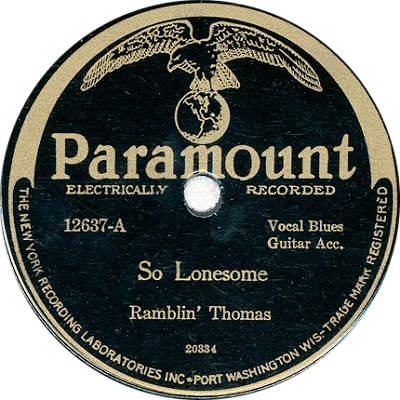
The Texas Blues #5 – So Lonesome – Ramblin’ Thomas

It’s Monday morning, so I expect some of you have the blues! & here’s some Monday Morning Blues on Robert Frost’s Banjo to help you sing them away.

Today’s post is a continuation of the rather ambling & meandering Texas Blues series—we’re still very much in the acoustic portion of the proceedings, & still very much in the 1920s. Today’s featured artist, Ramblin’ Thomas, in fact recorded one of my all time favorite blues: his version of “Poor Boy Blues,” which he waxed for Paramount in 1928.

But I’ve already written about his “Poor Boy Blues”—& other versions of that song (or concept) in the Poor Boy Blues series. Not wishing to re-invent the wheel, this is what I had to say about Thomas in my brief biography in that earlier post:

Ramblin’ Thomas was born Willard Thomas in Logansport, Louisiana in 1902.  Not a lot is known of his biography, tho the fact that his younger brother, Jesse “Babyface” Thomas was “re-discovered” in the 1970s (& lived until 1995) did fill in some gaps about his life.  We know that Ramblin’ Thomas moved to the Deep Ellum neighborhood of Dallas sometime in the late 1920s, & that his considerable travels also brought him to Chicago & other points in the midwest.  He recorded 16 of his existing 20 sides in Chicago in 1928 during two separate sessions for Paramount—the first was in February, the second in November.  The fact that Paramount brought him back for a second session suggests that they considered his material to be commercially viable.  He also recorded four songs for Victor in Dallas in 1932.

Since I’d already written about his recording of “Poor Boy Blues,” I decided I choose another song for this series, & I decided on “So Lonesome,” a song I’ve played around with myself. It’s a much more straightforward piece, as it follows more closely what we think of as the standard 12-bar blues structure.  Still, it displays the characteristic sparseness of Thomas’ playing—lots of single string notes, minimal chording, & virtually no accompaniment while he’s actually singing. It is, of course, a slide guitar piece played in the “Vestapol” tuning—typically either open D or open E—tho this recording is in the key of F, achieved presumably with a capo (tuning all the way up to F in “Vestapol” tuning would not only be hard on the strings but on the guitar neck itself.)  “So Lonesome” was recorded at the same February 1928 Paramount session as “Poor Boy Blues,” & was an “A side” backed with “Lock & Key Blues.”

Enjoy!

Monday, August 13, 2012

The Texas Blues #4 – Dark Was the Night, Cold Was the Ground – Blind Willie Johnson

Happy Monday, friends. We’re here with a new edition of the Monday Morning Blues, & as we’ve been doing lately, we’re taking a trip to the Lone Star state for some Texas Blues.

 “The blues” covers such a diverse range of music; indeed, it’s used as a catch-all phrase for much of early 20th century African American music, ranging stylistically from the east coast ragtime-influenced stylings of Blind Blake to the deep south one-chord modal music of King Solomon Hill; from the banjo & jug driven sound of Cannon’s Jug Stompers to the heavy slide sound of Son House & others in the Mississippi Delta region. In addition, we tend to categorize African American sacred music from this time period in with the blues, so that for instance Reverend Gary Davis is found in the blues music racks, & Blind Willie McTell’s “I Got to Cross the River Jordan” is generally packaged right along side “Mama Tain’t Long fore Day” or “Brokedown Engine Blues.” Thus, one of the greatest of the early gospel singers & musicians, Blind Willie Johnson from either Brenham or Temple, Texas, is generally classified as a “blues” musician, tho his repertoire, at least based on the 30 sides he recorded between 1927 & circa 1930, consisted solely of spiritual or gospel songs.
 Johnson’s biography, insofar as it’s known to us, is a harsh tale of a hard life. Apparently blinded at age seven in an incident of appalling child abuse, he mostly made his way in the world as a street singer & preacher. He settled in Beaumont, Texas & sang & preached there (presumably there was no actual distinction between his singing & his preaching.) Johnson was married to Willie B. Harris, who sang on some of his records, & may later have been married to Angeline Johnson; but no marriage licenses have ever been discovered. Not too much should be made of this fact, since official record-keeping on the southern African-American population was not very painstaking in the first part of the 20th century.

J
ohnson’s home in Beaumont burned in 1945, & because he was a pauper, he continued to live in the burned-out house until he died from malarial fever later that year at age 48. Angeline Johnson tried to bring him to a hospital, but he was refused admission—reports vary as to whether this refusal was because he was black or because he was blind.“Dark Was the Night, Cold Was the Ground” is a song about the Crucifixion. Johnson hums & moans, while playing some of the most beautiful slide guitar you will ever hear. The song is played in open D, & it’s reported that Johnson used a knife as the slide—not an uncommon practice in those times. In 1977, Johnson’s 1927 Columbia recording of the song was chosen as one of 27 pieces of music (along with various natural sounds) to be placed on a recording on the Voyager Golden Record to be sent on the Voyager spacecrafts into deep space.  Carl Sagan, who was among those who chose the selections, said “Dark Was the Night, Cold Was the Ground” was selected because "Johnson's song concerns a situation he faced many times: nightfall with no place to sleep. Since humans appeared on Earth, the shroud of night has yet to fall without touching a man or woman in the same plight."

The song also served as the basis for Ry Cooder’s soundtrack to Wim Wender’s film, Paris, Texas. Cooder has called this "the most soulful, transcendent piece in all American music."

A special piece of music & a transcendent performance indeed.


All images link to their source
Image of Blind Willie Johnson is from bluesnexus.com. According to Wikipedia, which uses a cropped version of this image, the photograph is in the public domain
Image of the 1927 Columbia "Dark Was the Night, Cold Was the Ground" record is from Wikipedia. They claim fair use
Image of the Voyager Golden Record is from Wikipedia. This NASA image is in the public domain

Monday, July 23, 2012

The Texas Blues #3 – Black Snake Moan – Blind Lemon Jefferson

Welcome back to the sporadic & spasmodic posting schedule of Robert Frost’s Banjo. Will wonders never cease: I actually have a Monday Morning Blues post for you folks!

If you remember back a ways, I’ve been slowly constructing a series of notable Texas Blues artists & songs. Since there’s been some lapse, I’ll refer you back to the first two installments on Henry Thomas & Texas Alexander.

Today’s featured artist is seminal, whether you’re talking about Texas blues, acoustic blues, or just the blues in general. Blind Lemon Jefferson was one of the biggest stars of his day, & was the first male blues singer who could compete with the so-called Blues Queens such as Bessie Smith, Ma Rainey, Ida Cox & others in terms of popularity. Although the white blues audience has since revised the history of the early blues such that it seems the lone guitarist-singers were the major figures, in fact this wasn’t true for audiences in their own time. Jefferson was an exception; there were a few others like Lonnie Johnson & Tampa Red, but the performers we know think of us most significant, like Charlie Patton, Blind Willie McTell & Robert Johnson, at best enjoyed a regional fame.

Lemon Jefferson was born in 1893 in Coutchman, Texas. Blind from birth, he began playing guitar in his early teens, & in addition to playing the picnic & party circuit, he also began a career as a street musician. Around 1910, he began traveling to Dallas, & particularly the Deep Ellum section that was the center of a growing blues scene. He moved to Deep Ellum in 1917, & it was at that time he got to know T-Bone Walker, who he taught blues guitar in exchange for Walker’s services as a guide. Leadbelly & Lightnin’ Hopkins also knew Jefferson during his time in Dallas.

Jefferson’s recording career—almost exclusively with Paramount—lasted only three years, from 1926-1929, but during that time he recorded a number of hits & also songs, like “Black Snake Moan” that have become classics, not only in his original recorded versions, but in many covers & imitations. Jefferson’s songs were typically bawdy & filled with double entendre; musically, his accompaniments are complex, featuring intricate single note runs interspersed with his chords. Once you become familiar with Blind Lemon Jefferson’s sound, his songs are among the most easy to identify, even during the instrumental passages.

Simply amazing music—& great fun too! Enjoy!


Image of Blind Lemon Jefferson links to its source at wikimedia.org

Monday, June 4, 2012

The Texas Blues #2 – “Levee Camp Moan” – Texas Alexander & Lonnie Johnson

Good morning! & yes, folks, it’s an actual edition of the Monday Morning Blues here on Robert Frost’s Banjo.

If your memory is good, you may recall that I’d just started a series on the Texas blues way back in early April. Then my season of blog malaise set in, & the series was put on the shelf. But it’s back. For the foreseeable future, I envision posting Monday Morning Blues & Banjo Friday in alternating weeks—I think that was the plan awhile ago, but this time I’m going to try to stick to it!

One of the most singular of the early blues musicians was a man named Alger “Texas” Alexander; in his recording career, he invariably went by “Texas Alexander.” Alexander was born in 1900 in Jewett, Texas, & came up as a street performer & a performer at parties. It’s said that he performed with Blind Lemon Jefferson, presumably during Jefferson’s time as a performer in Dallas.

Alexander was a singer, pure & simple—he didn’t play any instrument. As a singer, he was accompanied by some stellar instrumentalists, including guitar greats Eddie Lang,  Lonnie Johnson & “Little Hat” Jones, pianist Clarence Williams, & cornet player King Oliver. As I understand, he also used Lightnin’ Hopkins as an accompanist later in his life, & there is some speculation that the two were cousins.  Alexander also recorded with the immensely popular Mississippi Sheiks.

Texas Alexander was no smooth blues crooner, however. As you’ll hear in his great “Levee Camp Blues,” his style & delivery owed a lot more to field “hollers” & work chants than to melodious popular song. Given this fact, pairing him with great jazz players like Johnson, Land, & Oliver is itself singular—& indeed, most of his accompanist’s agreed that it was challenging to follow him, as he would often stretch the time, add beats, & even change keys while singing! Nonetheless, his duets with Lonnie Johnson are considered masterpieces of their kind, with Johnson—a guitarist who’s very underrated these days—was able to weave counterpoint accompaniments that meshed perfectly with the singing. An unlikely duo, certainly—but one that produced unique & memorable music.

This recording of “Levee Camp Moan” is from an August, 1927 session for Okeh, made in New York. Alexander made over 50 recordings for Okeh & Vocalion in the 1920s & 30s; but he was convicted of murder in 1939, & was in the Paris, Texas penitentiary thru 1945. He continued recording until 1950 with a group called Benton’s Busy Bees, & died of syphilis in 1954.

This is really quite amazing music—I know you’re going to enjoy it!


Pic of Texas Alexander links to its source

Monday, April 2, 2012

The Texas Blues #1 – “Don’t Ease Me In” – Henry Thomas

Happy Monday, folks—we’re here to drive away your Monday Morning Blues—& also to start off a new series that’s going to be running for some time.

The music that we know as the blues sprang up in the southern U.S., tho no one knows exactly where or when. What we do know is that there were blues “centers”—places around which the music seemed to be particularly concentrated & which each had—to some extent at least—regional characteristics in terms of the particular blues “sound.” There was a sound associated with Atlanta & the east coast, & certainly a sound associated with Mississippi, as well as with Memphis & New Orleans, tho those cities also figured in other associated types of music as well—jazz, certainly, but also string band & jug band music. Later, blues became centered in Chicago as blacks migrated out of the south—in many ways, the Chicago blues sound post World War II was an extension of the Mississippi sound, thanks to the Illinois Central Railroad & such Mississippi stalwarts as Howlin’ Wolf, Sonny Boy Williamson I, & Muddy Waters all moving there.

But there was another center as well, & one that has in its own right been as fundamental to the blues sound as even Mississippi—& that’s the Lone Star state, Texas. Now when you think of Texas, you may think of cowboys & 10-gallon hats, of Bob Wills & Jerry Jeff Walker. But the fact is that many of the greatest blues musicians also hailed from Texas; so many, in fact, that what was going to be a 10-part series has expanded far past that, & will move in rough chronological order from the oldest “blues” musician we have on record right thru to contemporary electric guitarists.

Henry Thomas—who often recorded under the name “Ragtime Texas” was born in 1874 in Big Sandy, Texas. Given Thomas’ age, we can be pretty sure that he was around to witness the development of the blues from whatever its ultimate sources were, & he is often referred to as a “songster,” meaning that he didn’t specialize in blues, but played in a number of genres. Of course, that’s deceptive, because there’s strong evidence that many early musicians who we think of as playing blues exclusively also played widely in other genres too, but when it came time to record, they were mostly encouraged to draw from their blues repertoire.

In any case, we’re lucky to have Thomas’ music on record, as he disappeared not long after his 1929 sessions, & is presumed to have died in the early 1930s. Between 1927 & 1929, however, he recorded 23 sides for Vocalion.

Probably Thomas’ best-known song is “Fishing Blues,” a double-entendre, slightly ragtime tune that was famously covered by both the Loving Spoonful & Taj Mahal. Thomas’ own version is the final cut on Harry Smith’s Anthology of American Folk Music, & it includes one of Thomas trademarks—his solo on the quills, an African-American instrument that’s essentially a panpipe. A guitarist like Thomas could play the quills while he accompanied himself on guitar with the means of something like a harmonica rack. Although I didn't choose "Fishing Blues" for today's song, it worth a listen for sure. You can find it on YouTube  here.

Today’s song doesn’t have the quills, but it may be Thomas’ second best known tune, not so much because of his performance but because it was covered by the Grateful Dead  & was a concert staple.

It’s been conjectured that “Don’t Ease Me In” is a close relative to “Alabama Bound,” which was a hit for Papa Charlie Jackson in the mid 20s, & in different forms found its way into the repertoire of such diverse artists as Jelly Rolly Morton & Leadbelly. The Grateful Dead re-wrote some of the lyrics; in the original Thomas sings, “It’s all night long, Cunningham, don’t ease me in,” which is apparently a reference to the owner of a large sugar cane plantation in Sugar Land in Texas, who leased much of his labor from state prison farms.

This is great music! Hope you enjoy it. & stay tuned, because next month there will be a new installment in The Texas Blues.


Photo links to its source