One of the central tenets of Robert Graves’ two-volume The Greek Myths
is the idea that the myths change depending on who tells the story; the
same images, in fact, can lead to vastly different narratives. Graves
called the process by which this happens iconotropy—the “turning” of
images. Thus, for instance, a representation that the patriarchal
Dorians might have “read” as the Judgment of Paris would have been
originally, in Graves’ reading, a representation of the Triple Goddess.
Graves actually postulated these ideas first in The White Goddess, which was published in 1948, seven years prior to The Greek Myths.
One of the central tenets of Robert Graves’ two-volume The Greek Myths
is the idea that the myths change depending on who tells the story; the
same images, in fact, can lead to vastly different narratives. Graves
called the process by which this happens iconotropy—the “turning” of
images. Thus, for instance, a representation that the patriarchal
Dorians might have “read” as the Judgment of Paris would have been
originally, in Graves’ reading, a representation of the Triple Goddess.
Graves actually postulated these ideas first in The White Goddess, which was published in 1948, seven years prior to The Greek Myths.Graves’ theories in their specifics are at the very least controversial; Classical scholars have found errors of attribution, as well as what seem like willful misreadings used to buttress his points; this is particularly true of The White Goddess & the interpretive sections of The Greek Myths. But I do think that the idea of iconotropy is a useful one, whether or not Graves was correct in many of his specifics; it encodes the notion that the teller recreates the mythic material in a way that corresponds to a world-view; & just as that could be the case with the same mythic material in the stories of the Dorian Greeks versus the stories of the Minoans, so it is also true in the stories of individual mythographers: the Dionysus of the Homeric Hymns is not exactly the Dionysus of Euripedes’ The Bacchae, just as Jane Harrison’s Dionysus is not the same as Robert Graves’.
& of course this all relates to baseball!
Literary critic Leslie Fielder wrote, “we have always been, insofar as we are Americans at all, inhabitants of myth rather than history.” Within this U.S. landscape, a handful of baseball players carry cultural meaning typically reserved only for politicians & movie stars—whether or not you are a baseball fan, the names Babe Ruth, Willie Mays & Jackie Robinson are imbued with meaning for you, a meaning that springs initially from their prowess in playing the game, but which has since accrued significance beyond that. One player whose mythic status remains resilient (especially in his native Puerto Rico & Latin America overall) is the great Roberto Clemente—a player who still remains larger than life to me.
 Clemente
had many achievements within the game: in brief, he finished his career
with a .317 batting average & led the National League in batting
four times in an 18 year career; he also accumulated 3,000 lifetime
hits. In addition, he was National League MVP in 1966 & World Series
MVP in 1971—a series in which he was a truly dominant player—& won
12 consecutive Gold Gloves for fielding excellence—indeed, Clemente is
acknowledged to be one of the greatest fielding outfielders ever. Not
only did he demonstrate great skill in tracking down balls, he also
possessed an uncannily strong & accurate throwing arm. Legendary
Dodgers announcer Vin Scully once said, “Clemente could field the ball
in New York and throw out a guy in Pennsylvania.” Mythic indeed.
Clemente
had many achievements within the game: in brief, he finished his career
with a .317 batting average & led the National League in batting
four times in an 18 year career; he also accumulated 3,000 lifetime
hits. In addition, he was National League MVP in 1966 & World Series
MVP in 1971—a series in which he was a truly dominant player—& won
12 consecutive Gold Gloves for fielding excellence—indeed, Clemente is
acknowledged to be one of the greatest fielding outfielders ever. Not
only did he demonstrate great skill in tracking down balls, he also
possessed an uncannily strong & accurate throwing arm. Legendary
Dodgers announcer Vin Scully once said, “Clemente could field the ball
in New York and throw out a guy in Pennsylvania.” Mythic indeed.Clemente’s death in an airplane crash on New Year’s Eve 1972, while trying to bring supplies to earthquake victims in Nicaragua of course added to the mythos; in Latin countries he achieved a martyr’s status. Following his tragic death, the Hall of Fame waived the usual five-year waiting period, & he was inducted in 1973. In eulogizing Clemente, Baseball Commissioner Bowie Kuhn said, "He gave the term 'complete' a new meaning. He made the word 'superstar' seem inadequate. He had about him the touch of royalty."
& I would say: more than a touch of the mythic. So I was interested to notice that the third most popular search phrase leading to my old baseball blog, Beer League Box Score is “Why do sabermetrics devalue Roberto Clemente?” I found this fascinating, & on more than one level: first, I asked myself, is this true? Is Clemente “devalued” by sabermetric measures?

Then I looked at his defensive wins against replacement, which is a component of overall WAR. Now defensive WAR is one of the most controversial parts of the measure, because it is truly difficult to assess a player’s defensive contributions by means of statistics. There are a number of systems for doing so, but they all have their limitations & faults, along with their strengths. Also, the farther back in time one goes, the more limited the information becomes.

Clemente’s career defensive WAR is 12.0, which ranks 154th all-time. This initially struck me as too low until I looked at the players ranked ahead of him. Defensive WAR favors the critical “up the middle” positions of catcher, shortstop & second base, & centerfield. Third base is also given quite a bit of weight. It makes sense then, that the first 153 players are overwhelmingly middle infielders, catchers, & third basemen, with a handful of centerfielders as well. The highest rated outfielder is Andruw Jones, whose defensive WAR stands at 24.1. The other outfielders who rank above Clemente (again, all of these including Jones are centerfielders) are Paul Blair (18.6); Willie Mays (18.1); Devon White (16.1), & Jimmy Piersall (15.2). Clemente ranks the highest of any corner outfielder, & that seems appropriate. It does seem that the top 150 contains a lot of 19th century & very early 20th century infielders, & it’s counter-intuitive to me that all of those players’ skills should put them in such lofty company, but I have nothing to back that up. Looking at his ranking among outfielders, I’d say Clemente’s position is fair.
Of course, WAR is far from the only sabermetric measure, but it is widely accepted in the sabermetric community as measure for getting a general sense of a player’s comparative value. & as a Roberto Clemente fan, I can’t say that WAR devalues his achievements. I also don’t say this as an apologist for either sabermetrics in general or WAR in particular (neither am I a detractor—I say the more stats the better!)

But sabermetrics also place a high value on statistics related to on-base percentage & slugging percentage. It is true that Clemente didn’t take a lot of walks, & that there was never a significant spread between his batting average & his on-base average. Of course, Clemente was able to maintain excellent on-base percentages on the strength of his hitting. Still, in comparison with other hitters who are ranked among the greatest of the great, Clemente’s OBP is low: lifetime, he posted a .359 mark, which ranks 463, tied with Rocky Colavito—a good player, but not elite. Ted Williams leads in all-time OBP with a truly majestic .481—Williams reached base an astounding 48% of the time during a 19 year career! In fact, the first 58 hitters in all-time OBP all accrued figures of .400 or higher.
 It’s
also true that Clemente wasn’t a slugger; while he was capable of
hitting for power (he did hit 29 home runs in 1966, & that was a
good number during that time period), he himself said, “I am more
valuable to my team hitting .330 than swinging for home runs.” But as a
result his lifetime slugging percentage was only .475, which ranks 216th all-time, between Leon Durham & current Arizona outfielder Justin Upton. These figures would affect statistics like FanGraphs wOBA (weighted on-base average) & wRC+ (Weighted
Runs Created +), which are considered key evaluative numbers by the
sabermetric community; in fact, Clemente’s career wOBA & wRC+ are
366 & 129, which are not elite figures. Still, it should be noted
that FanGraphs does award Clemente a 91.0 lifetime WAR.
It’s
also true that Clemente wasn’t a slugger; while he was capable of
hitting for power (he did hit 29 home runs in 1966, & that was a
good number during that time period), he himself said, “I am more
valuable to my team hitting .330 than swinging for home runs.” But as a
result his lifetime slugging percentage was only .475, which ranks 216th all-time, between Leon Durham & current Arizona outfielder Justin Upton. These figures would affect statistics like FanGraphs wOBA (weighted on-base average) & wRC+ (Weighted
Runs Created +), which are considered key evaluative numbers by the
sabermetric community; in fact, Clemente’s career wOBA & wRC+ are
366 & 129, which are not elite figures. Still, it should be noted
that FanGraphs does award Clemente a 91.0 lifetime WAR.Do I dispute these statistics & measures? No. They are statistics—I understand what they mean & how they’re derived. I think they complicate our picture of Clemente, & that this is not necessarily a bad thing at all. While Robert Graves may have believed the Dorian iconotropic reconfigurations of Bronze Age matriarchal myths marked a definite point in the West’s great decline into patriarchy (& I don’t argue with the view that patriarchy has a lot to answer for—practically everything!), I don’t see the “new statistics” as representing a decadent interpretation of baseball—but they are certainly a retelling of the stories. Also, as revealing as statistics may be (& I believe sabermetric stats offer good information & an interesting perspective), I would also say that it’s impossible to completely quantify any human performance in formulas & equations.

I’m not a young man, & as such, I stand vulnerable to the charge of being a curmudgeon. To me, the glory days of baseball were the 1960s through the 1970s, because those were my formative years—though I acknowledge this is entirely subjective, I also realize all the baseball myths for me are filtered through the mythography of that particular era. An older person who watched baseball in the 1940s & ‘50s would be subject to an earlier mythographic filter, & in turn a younger man or woman raised on the game more recently understands the game on a transformed mythic field. The great players’ names remain the same—their mythic meaning shifts.
When I think of the myth of Clemente, I don’t think as much about his statistics. I think of his pride & passion, of the difficulties he faced as a black Puerto Rican in an era when baseball was still in the early phases of integration—in fact, in Clemente’s rookie year of 1955, three clubs had yet to integrate at all (the Phillies, Tigers & Red Sox); I think of how he was devalued even during his own career by baseball people & sportswriters who saw his pride as “uppitiness” & who ascribed his missing games due to injury as malingering. I think of his transcendent play in the 1971 World Series, a truly seminal event in my own history as a fan—& of his tragic death. Clemente himself said, "I want to be remembered as a ballplayer who gave all he had to give,” & I think that is his legacy indeed—except one might say “man,” not “ballplayer.”
So I encounter the Clemente I knew, because that was the Clemente I learned from the mythographers of my formative time; I knew him from reading, from baseball cards (my 1970 Clemente baseball card is one of my cherished possessions), from the World Series & playoffs & NBC Game of the Week on a black & white TV, & from memory. I don’t begrudge a later generation their re-assessments, & in fact I enjoy the profusion of stats—& after all, how many baseball fans now really consider the greatness of Tris Speaker (to give an example—& I certainly include myself in that!)—yet in his heyday & for long afterward, he was considered one of the greatest players ever. Myths are elastic—we can only marvel how they allow for their constant re-shaping, whether the myth is a story surrounding a Greek deity or a human ballplayer whose exploits seemed to accrue meaning pointing far past the quotidian.

Images link to their source
- Roberto Clemente: http://www.medinahost.com
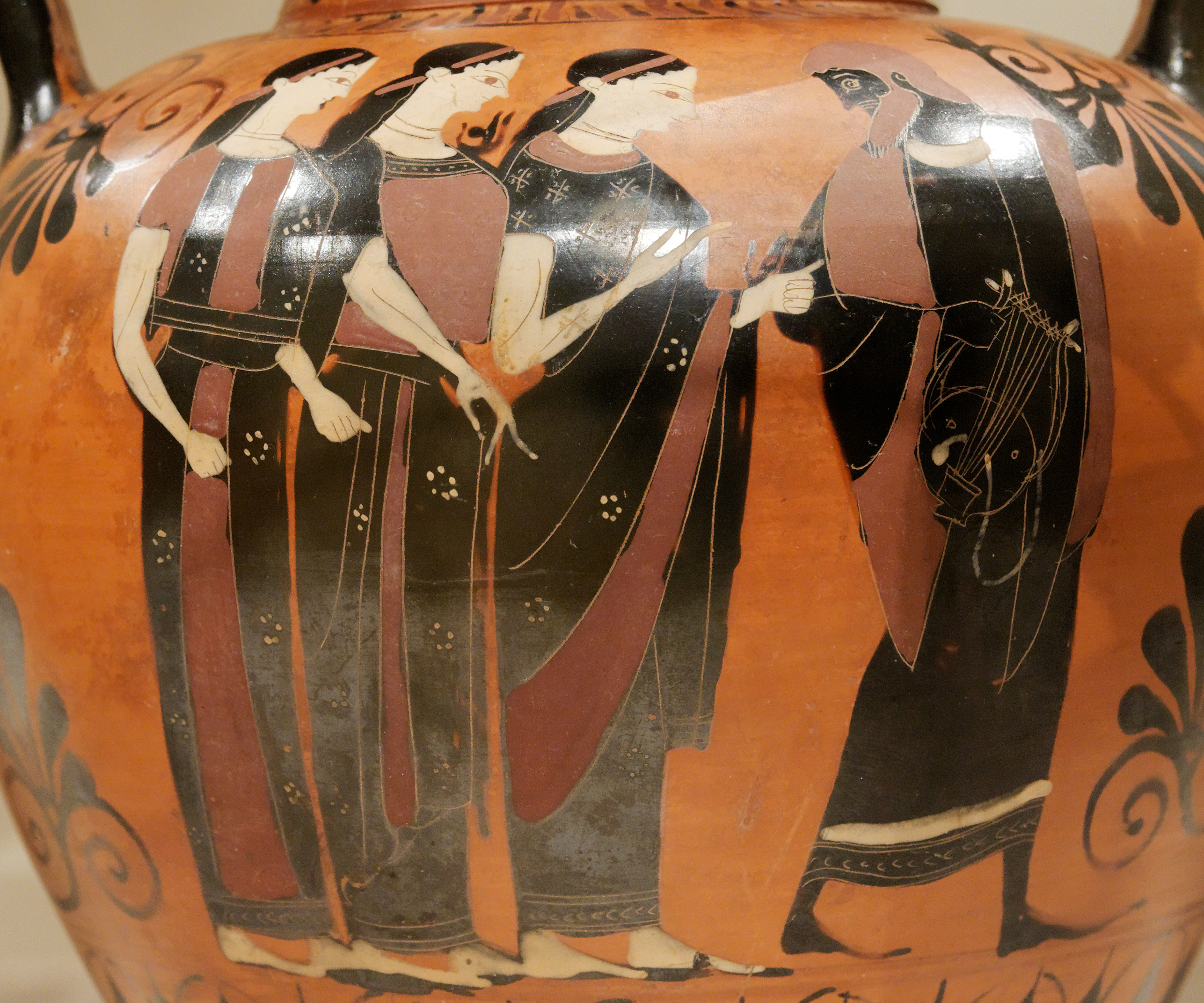
- The judgement of Paris, side B from an Attic black-figure neck amphora (ca. 540-530 BC): Wiki Commons - photo by Marie-Lan Nguyen, who publishes it under the Creative Commons Attribution 2.5 Generic license.
- Clemente makes a catch: http://rnishi.files.wordpress.com, tho this image is found on many online sites.
- Oedipus (on the right), the Sphinx (on the middle) and Hermes (on the left). Attic red-figure stamnos, ca. 440 BC. [another myth Graves claims was subject to iconotropy]: Wiki Commons - photo by Wiki User:Jastrow, who makes it available under the Creative Commons Attribution 3.0 Unported license.
- A sequence showing Clemente making a catch: from timesonline.com
- Clemente stands on second base after getting in 3,000th career hit, a double in his last game ever: http://rnishi.files.wordpress.com
- Clemente batting: : http://rnishi.files.wordpress.com
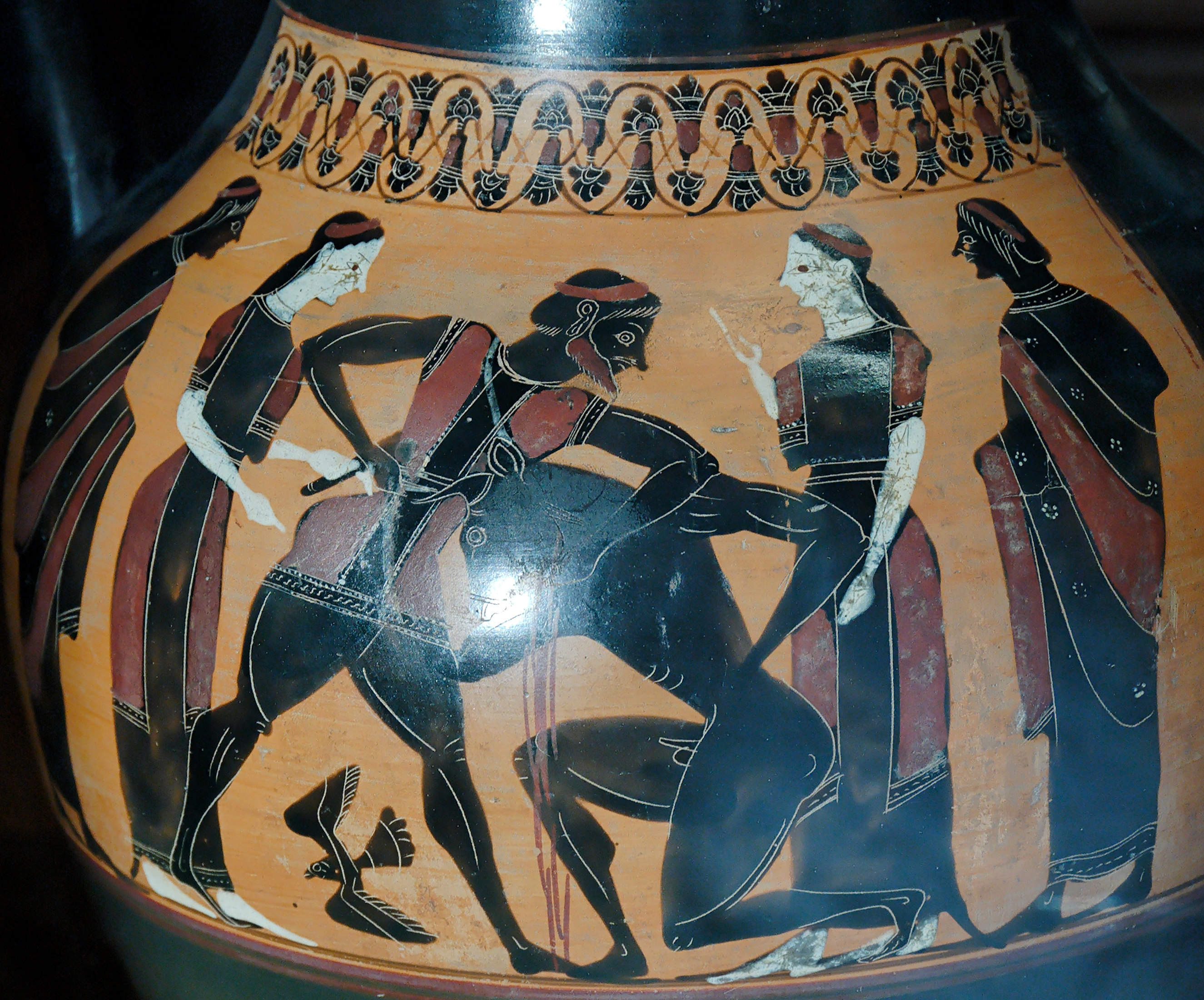
- Theseus and the Minotaur. Side A from an black-figure Attic amphora, ca. 540 BC. [another myth Graves claims was subject to iconotropy]: Wiki Commons - photo by Wiki User Jastrow, who releases it into the public domain worldwide.
- Yours truly with 1970 Topps Roberto Clemente baseball card!
- Clemente scores a run in 1958: from http://90feetofperfection.files.wordpress.com
Full disclosure: this post previously appeared on my currently dormant "Beer League Box Score" blog.