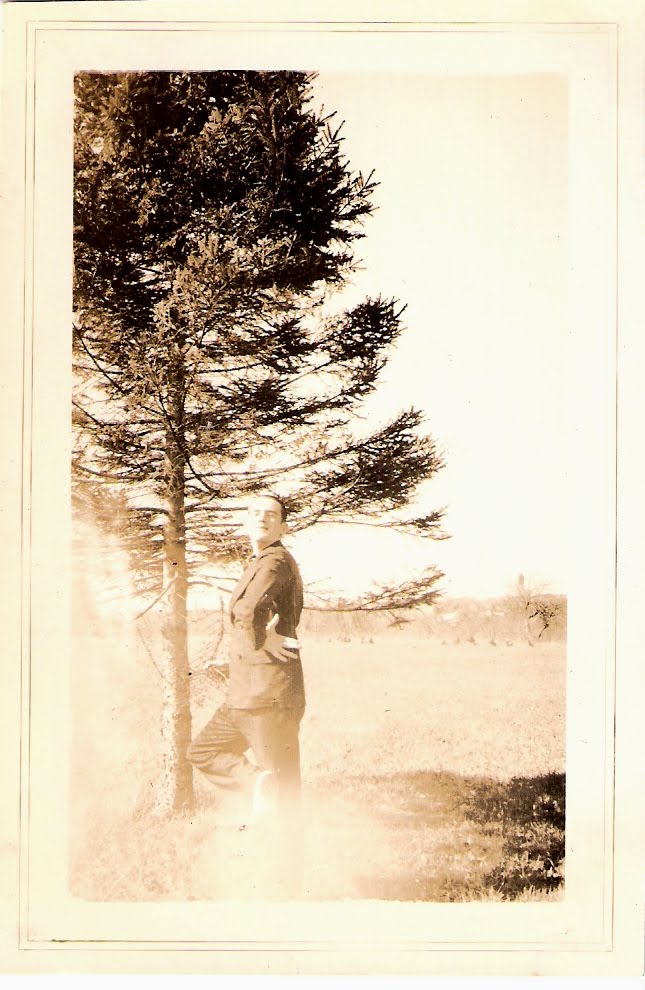
Happy Sepia Saturday, folks! This may be the last of the CCC themed posts, as I seem to have culled the best of those images from my Dad’s album. But never fear: I have lots more old family photos to share on upcoming Sepia Saturdays.
 As the last in the CCC series, I thought I’d offer a little background information about the Civilian Conservation Corps. It’s almost 70 years since the program was disbanded, so its history has faded—& I’ve been pleased to see that blogmates from other countries have expressed interest in knowing more about the CCC. The information in this post comes from Wikipedia.
The Civilian Conservation Corps (CCC) was a public work relief program for unemployed men, providing vocational training through the performance of useful work related to conservation and development of natural resources in the United States from 1933 to 1942. As part of the New Deal legislation proposed by U.S. President Franklin D. Roosevelt, the CCC was designed to aid relief of the unemployment resulting from the Great Depression while implementing a general natural resource conservation program on federal, state, county and municipal lands in every U.S. state, including the territories of Alaska, Hawaii, Puerto Rico, and the U.S. Virgin Islands.
The CCC became one of the more popular New Deal programs among the general public, providing economic relief, rehabilitation and training for a total of 3 million men. The CCC also provided a comprehensive work program that combined conservation, renewal, awareness and appreciation of the nation's natural resources. The CCC was never considered a permanent program and depended on emergency and temporary legislation for its existence. On June 30, 1942 Congress voted to eliminate funding for the CCC, formally ceasing active operation of the program.
During the time of the CCC, volunteers planted nearly 3 billion trees to help reforest America, constructed more than 800 parks nationwide that would become the start of most state parks, forest fire fighting methods were developed and a network of thousands of miles of public roadways and buildings were constructed connecting the nation's public lands.
 Hope you enjoy the pictures & the background info on the CCC. Please be sure to visit other Sepia Saturday participants. You can find links to all participating blogs here.
Info on the photos:
- Shorty Gentile [R]; John Barbosa [L]; John E Hayes [m]; July 1935, Townsend, Vermont [in my Dad’s handwriting on the back—he would have been 21 at that time]
- The completed stone house
- Walter Mack; Stephan Danko; John E Hayes; Victor Burnett – Hayes’ crew – masonry 1935-36 [again, in my Dad’s writing. I don’t know if this was supposed to read from L to R or R to L, but I can tell you my Dad is second from the left]
Happy Sepia Saturday folks! This time around I’m only posting one photo, but I believe it’s an interesting one. The photo shows what I assume to be all the men in my dad’s CCC unit—145 Company. As I’ve mentioned in previous posts, 145 Company was assigned to build a stone house in the Townsend, VT state park.
 According to blog friend Jacqueline T. Lynch, whose post on the CCC in western Massachusetts should be required reading for anyone interested in the corps, a “class photo” of this type may be somewhat unusual. I had the opportunity of sharing this photo album with Jacqueline when we had a chance to meet for lunch in Chicopee, Massachusetts during my recent cross-country trip.
The photo has faded with age, as have quite a number of images in the album. Still, it shows the men generally in what appear to be high spirits. There are also a few interesting nicknames—“Homebrew,” “Pirate” (yes, that’s my dad), “Cop” & “Black Jal” (or should that be “Black Jack”—I don’t suppose we’ll ever know). I suspect the man called “Needham” was nicknamed after his home town (Needham, Massachusetts), but it could be a surname.
I’d love to see a contemporary version of the CCC employed to work on public infrastucture projects—the condition of many roads & bridges in the U.S. are really quite woeful—but sadly, in our current political climate any such “radical” idea would probably have very little chance of success. I do know that the people I’ve known who were working class young adults under the Roosevelt administration all believed very much in his programs & credited him with pulling the U.S. out of the Depression. I also know that some folks from that time who were from wealthier backgrounds despised Roosevelt. These days I hear from some conservative folks that Roosevelt prolonged the Depression—I’m not an economic historian, but I can say this was not the belief of the working class folks who actually lived thru it.
There is a CCC legacy in several programs, mostly serving teens & people in their early 20s. Those who are interested can read more about them on Wikipedia’s CCC page (toward the bottom) or at Wikipedia’s National Civilian Community Corps page. I’m pleased to say that my home state utilizes one of those organizations, the Vermont Youth Conservation Corps.
Please be sure to check out other Sepia Saturday participants at this link!
 If it’s Saturday, it must be Sepia, right? & as I mentioned in last week’s post—when I failed to read the directions & sort of hosted a Sepia Saturday of one—my mother gave me three more family photo albums during my recent trip east, so I’m well stocked on old photos for some time.
I also wrote a bit about my dad’s time in the Civilian Conservation Corps, or CCC, during the Depression & New Deal years—dad was a lifelong Democrat & Roosevelt admirer, proving that contrary to contemporary wisdom, it is possible to be a blue collar worker, veteran & outdoor sportsman & still hold some very liberal opinions.
But then, dad was a complicated & private man—he had the clearsightedness to see how capitalism stacks the deck against the worker, yet he also held some very benighted opinions, particularly when it came to racial issues & women’s issues. & there’s much about him I don’t know—even my mother only has a limited knowledge of his childhood, which was spent in an impoverished & apparently quite dysfunctional family. Then, too, there were glimpses that we only just caught—I recall once during his last years how he told Eberle & me that he’d really wanted to be a stone mason. Somehow that had surprised me, because he’d always worked with wood & tinkered with machines—his passion for stone had never been on the surface.
 However, I was able to get a bit more understanding of this from the photo album that has pictures from his CCC days. His CCC unit’s task was to build a stone house at the Vermont State Park in Townsend—that’s the building in the tinted photograph; my dad wrote February 1935 on the back as a point of reference. During construction, however, the CCC crew lived in a tent village—see the bottom photo.
I wonder if those were happy times for my dad—he looks quite sprightly in a number of photos from that album, & he looks quietly happy in the photo leading off this post, where he kneels with hammer & cold chisel. He met my mother during his days at Townsend—she & her mother came there for an outing, tho apparently my grandmother didn’t necessarily approve of this Irish catholic worker paying attention to her daughter!
The photos fill in some of the story—but there are gaps that can’t be filled in now. What do we know of another?—the stream of another consciousness, the moment by moment feelings, the aspirations, the disappointments…. We can know “facts,” but in a twist on an old saw, “facts are not feelings.” Still, these old photos are a window at least to look thru & meditate upon.
For more Sepia Saturday participants, please check out this link!

 NOTE: In my haste to get this posted, I neglected to notice that there is no "Sepia Saturday" as such this week! But hope you enjoy the pix anyway.
Happy Saturday everybody—I’m a bit late posting this, but am still dealing with the results of a “freak” injury that happened last Monday. In short: yes, it is possible to injure yourself while reading in bed, especially if the reading is done on an air mattress!
& as my father always used to say, “It’s hard to fly on one wing” (tho he meant something very different from a muscle pull when he said that!), but here’s my Sepia Saturday post at last (see note at top!). As some of you know, I recently concluded a cross-country road trip during which I visited my mother in Massachusetts. Much to my delight, & much to the benefit of upcoming Sepia Saturday posts, my mother gave me three old photo albums while I was there—two of my father’s, & one of her family. My father’s albums date from the 1930s, while my mom’s dates from the ‘teens & 20s!
I’m starting out with images from one of my father’s  albums—this one has a number of images from the time when he worked in Townsend, VT for the Civilian Conservation Corps in the mid 1930s—in fact, I plan on using some of the CCC images for next week’s post. But for today, I thought I’d show three images of my dad—as a “card” (as my mother would say), hamming it up, barefoot & in a sport coat; sitting in his apartment holding the very photo album from which these photos are taken; & as a CCC worker. These three images sum up a lot about him—tho I must say, he was a snappier dresser in the 1930s than he was in later life.
By the way, those of you who are interested about the CCC—to my mind, a great program, & one that could be copied to the general profit these days, given the unemployment rates & the major infrastructure problems facing the country—I’d recommend reading Jacqueline T. Lynch’s post “CCC Company 1156 – Chicopee, Mass” on her excellent New England Travels blog—Jacqueline is one of the bloggers I had a chance to meet on my cross-country odyssey.
Hope you enjoy the pix!

Happy Saturday again, folks! I’m back with some of my dad’s photos he took during a trip in 1939 to see the New York World’s Fair. In case you didn’t know—I certainly did not—the fair’s theme that year was “Dawn of a New Day,” & with “the eyes of the Fair…on the future,” it focused on “World of Tomorrow.” Interestingly, to me at least, none of the photos I have show the fair itself. Until I see some other photos when visiting my mother next month, I can’t say for sure whether this was just “luck of the draw” on the photos I received or if my shutterbug dad actually didn’t take photos at the fair. That seems rather unlikely.
 The fair ran from April to October in both 1939 & 1940; this pretty well dates my father’s photos to September 1939, since he wrote “Fall ‘39” on the back of each. He was one of 44 million visitors to the exhibition, which has since been memorialized in such diverse works as Alfred Hitcock’s Mr & Mrs Smith, E.L. Doctorow’s World’s Fair, & Aimee Mann’s Fifty Years After the Fair—just to name a few.
 The shots of New York City my father did capture say quite a bit about his interests. Both the photo of the Henry Hudson Parkway & the photo of the George Washington Bridge are structural, & my father was most certainly a builder at heart. He built everything from houses, boats & cabinets to clocks, wooden marble runs (I forget the German name for these), limberjacks, & whirlygigs or windmills (the wooden contraptions with a propeller that can be a man chopping wood or a woman churning butter). In fact, he was accepted to the Colorado School of Mining with the intent of obtaining an engineering degree, but was unable to attend due to his family’s poverty. There’s little doubt that he had the mind of an engineer.
 The photo of the boats on the Hudson shows another of my father’s most keen interests—boating, & especially boating with the intent of fishing. I have never known anyone as obsessed with fishing as my father! He continued to fish until he was around 90 years old in fact, by this time having relocated to Florida & fishing in the Gulf. One upshot of this was that my family ate inordinate quantities of fish when my sister & I were growing up, & neither of us cares much for fish at this point! He used to talk about sailing when he was stationed in the Phillipines during World War II—one of his pleasant war memories, & one of the few that he’d talk about. He also built a wonderful boat that we used for fishing & waterskiing & pleasure rides—it was called the “Off We Go,” driven by an old 30-horsepower Evinrude outboard motor.
Hope you enjoy the photos!
 Howdy, folks, & welcome to Sepia Saturday, Robert Frost’s Banjo annex. I’ve been checking out the old photos on some favorite blogs over the past few Saturdays & feeling a little chagrined that I’d used up my store of Dad’s Photos—photographs my father took in the 1930s & very early 1940s—before this event hit blogland.
But as is so often the case, it turned out I was mistaken—there are more photos! & in fact it sounds like I may have access to even more during my visit to my mom next month. There’s a wrinkle, tho—typically, the Sepia Saturday posts are portraits or wedding pictures or group shots—they have recognizable people in them. Not so here—but the photos do tell a story.
In 1939 my dad took an excursion from his Vermont digs to New York City for the World’s Fair. Turns out he asked my mom to accompany him, but for whatever reason (she wasn’t clear on this when she told the story), she declined. It is true that they weren’t married until late in 1941—less than a month before Pearl Harbor Day.
 So, where’s the story? My dad has passed on, so I can’t get the story of his time in New York City from him or from any of his friends or from his two brothers. They were all part of a generation that’s disappearing. This is the story: while I can’t tell you the details of his trip—I can only show you a handful of images that he found interesting enough to photograph—I can say that these photos, along with the many I posted in the Dad’s Photos series have given me some insight into a man who was very private & not forthcoming about his autobiography. But in these photos I’ve come to see a glimpse of an adventurous young man, & a young man who loved a good time—perhaps a bit more than was good for him, but still—he was only 25 when he took these shots, not even half my current age: very much different than the man I knew as a small child when he was well into his 40s.
Things happened: a World War, in which he served as a non-combatant in the Seabees, but still in some very harrowing conditions—the Seabees would come onto islands after the battles to build airfields & other infrastructure, & their camps were subject to air raids. He lost his best friend at an early age—because there were too many “good times” for that man. & I think, in retrospect, he wasn’t comfortable with children: not surprising, since he grew up in an atmosphere of poverty & neglect.
But here’s a young man from quaint early 20th century Bellows Falls, VT in the big city—New York, NY—for a World’s Fair. I can imagine the excitement, because at his best, well into his last years, my father was capable of a sort of delightful childi-like excitement that mostly counter-balanced the temper & the withdrawal. Today's three photos show me his excitement at Times Square.
 I suppose in some sense any photograph is somehow a portrait of the photographer. I can see my dad in these.
 OK, you may ask how this is Dad’s Photos #25 when the previous installment was #22? I went back thru my records & found that my numbering has been a tad defective, & that I actually have had two more posts than I realized (it appears there were two posts each numbered 11 & 12). In any case, this is the final installment; the series has lasted a full year, with the initial Dad’s Photos being posted on January 4th. I do have some more old photos available, & I’ll be posting those as well, but this batch of pix brings us to an end of the specific photo album you see in the photo leading off the post.
As I’ve mentioned over the past few posts, my father seems to have lost his captioning inspiration toward the end of the album, so I can only guess at the context of these pictures. The last few may have been taken in Massachusetts, but he also worked in a restaurant in Newfane, VT, so that’s far from certain. As far as the flood pictures go, again, these could be more pictures from the hurricane of 38, but the area of Vermont where my father lived & where I grew up is in the Connecticut River’s flood plain, & the fact that they’re mixed in with other images I believe are from Vermont makes me think these all may be from his home state. The flood pictures easily could show parts of Westminster, VT that lie near the Connecticut River.
It’s been my great pleasure to make these photos available, & the fact that you have been so generous & enthusiastic about them has simply increased that pleasure many times over. My father would no doubt have been amazed to find that his work captured so many peoples’ interest & imagination.
Hope you enjoy these, & thanks again!
 The Big Top! Looks like a real 3-Ring Circus
 Unidentified flood photo. If you compare this with the fourth photo, you’ll notice a similar (or the same) step-like structure to the right; however, I can’t seem to figure how these two images might relate to each other spatially
 More of the flood—this landscape seems very much like southeastern Vermont
 Although it’s a bleak scene, this is one of my favorites among my father’s photos
 Unidentified cook in unidentified kitchen
 Waiter, likewise
 What’s cooking?
 Another view of the kitchen


We’re back with the penultimate installment of Dad’s Photos, having worked our way thru his old black photo album with shoestring binding in just under a year (the first installment was January 4th 2009, & the last is tentatively scheduled for Sunday, December 27th.
As I mentioned a few installments back, my father apparently ran out of captions at a certain point, & I can only guess at the actual locations of most of the remaining pictures. I will try to pinch-hit on the captions, however, with my best guesswork! There are also fewer photos this time around, simply because the remaining photos didn’t divide neatly into two sets.
Hope you enjoy them.
 Car in a driving snowstorm—a Ford?
 Same car, parked on a town street; I’m tempted to say both of these were taken in Vermont—especially the first one
 Boat on sawhorses—again, I’m betting on Vermont, but I have no idea what/whose house this may be. My father had a lifelong love of boats & especially of fishing from boats!
 Again, I’m thinking this is in Vermont—possibly the Saxtons River, which runs thru Westminster & empties into the Connecticut at Bellows Falls. The figure sitting on the rock is small, but it sure looks like my Dad, so someone else may have taken this. Was he fishing?!?
 A drive thru the woods—lots of pines, so almost certainly northern New England
 This could be the Saxtons River—again, it looks very much like Vermont to me
 Happy Sunday! I’m moving kind of slow after the Thanksgiving revelry, but I do have another installment of Dad’s Photos for your viewing pleasure. Also, for those of a more poetical bent, you can visit my Days of Wine & Roses blog for the poem post.
There will be two installments of Dad’s Photos in December, & that will bring the series to a close. The photos were taken at the “International Ski Jumping Tournament, Brattleboro, VT, February 18th 1940” (my father’s only caption for the set.) When I first looked at these images, I didn’t find them particularly compelling—these days we’re used to zoom images of sporting events, so the fact that the images are miniaturized & not in the very sharpest focus seems a liability. On the other hand, the more I examined the photos, the more I liked them—most of them display a sense of composition in the overall layout, & there are pleasing details, like the spectators who’ve climbed trees for better viewing. These really will be enhanced by enlargement, which you can do of course by clicking on the image.
I’m not adding captions, tho I will say that I believe you’ll see my mother in the center of the last photo. I hope you enjoy them, & that everyone had a pleasant holiday!


 Hope you enjoy the pictures & the background info on the CCC. Please be sure to visit other Sepia Saturday participants. You can find links to all participating blogs here.