Showing posts with label foreign films. Show all posts

Saturday, July 31, 2010

Agnès Varda - Gleaner of Everyday Life

All film buffs know the French Nouvelle Vague (or New Wave) of course—even more casual enthusiasts are familiar with the works of Goddard, Truffaut, Demy et al.  But there is one of the New Wave who’s still with us, tho she isn’t as well known by the public at large.  That relative obscurity is a shame—at least—because her works are as filled with high artistry & inspiration as those of her more famous colleagues.  That filmmaker is Agnès Varda.


Eberle & I have been on an Agnès Varda spree of late—a whirlwind of beautiful & inspired films.  Actually, until a few months ago, neither of us had seen any of Varda’s films except for Sans toit ni loiVagabond as it’s called in the States or Without Roof or Law (a literal translation) in other English speaking countries.  We both saw the film at Vinegar Hill Theater in Charlottesville, VA; I recall that I found the film beautifully made & powerful—but so powerful as to be harrowing.  Eberle says quite straightforwardly that Vagabond changed her life.  I found it quite interesting that when we saw Varda’s 2008 cinematic autobiography, Les plages d'Agnès (in English, The Beaches of Agnes), she talks about how Sans toit ni loi was born out of rage—rage at the marginalized & oppressed condition of women (it’s telling that Varda discusses the film against a filmed backdrop of women’s rights protests), but also about her marginalization as almost the only woman, along with Marguerite Duras, within French cinema. 

There is no question that Sans toit ni loi is a great film, but it may not be the best introduction to Varda’s work—at least in my opinion (Eberle might disagree with me on this).  During our recent Varda watching spree, we’ve seen La Pointe-Courte (Varda’s debut film in 1955), L'opéra-mouffe (The Diary of a Pregnant Woman, 1958), Cléo de 5 à 7 (Cleo from 5 to 7 from 1962), Les glaneurs et la glaneuse (The Gleaners & I, 2002) & Les plages d'Agnès.  In these films we were struck by Varda’s focus on the ordinary objects & appurtenances of everyday life—her eye for detail—& a focus that can morph readily from surreality to candid realism.  Varda’s films also celebrate process, whether following the real time movement of a woman awaiting a possibly serious diagnosis in Cléo de 5 à 7 or her detailing the process of gleaning in Les glaneurs et la glaneuse—in case you don’t know, gleaning is picking up what is left over after a harvest.  & despite her treatment of serious themes, her films are always inviting to watch.
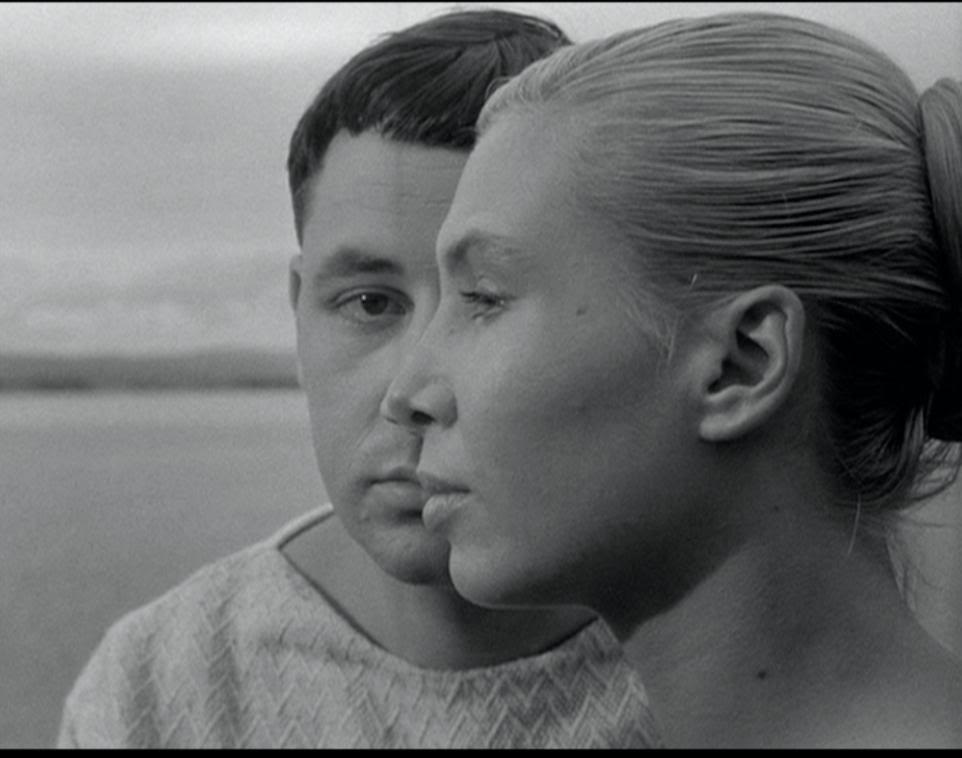
Agnès Varda began her artistic career as a photographer, & you can see this background in the composition of her shots—many stills from her films would be art photographs in their own right.  She combines this with a thorough feminist vision & a fierce love of life combined with a keen sense of social justice.  I’ve added four clips from her films—I know that’s a lot, but I’ve selected short ones (& sorry—the definition on the Vagabond clip isn’t so great.)  The clips should give at least some sense of these characteristics.

Some of Ms Varda’s 47 films are available on DVD.  The Criterion Collection has issued a must have set called 4 by Agnès Varda (La Pointe Courte, Cléo from 5 to 7, Le bonheur, Vagabond), & The Beaches of Agnes, The Gleaners & I & Vagabond also are available.  All of these except for Le bonheur are also current NetFlix selections.

Hope you find the clips intriguing, & please do check out the marvelous films of Agnès Varda.


Sunday, October 25, 2009

Octoberflix #3 – “Alphaville”

At long last, here’s the latest Octoberflick for your consideration! What better for an October evening than a tale of a mad scientist who’s seeking world—even intergalactic—domination thru a super computer & enslavement of the population? Of course this brings to mind any number of 1950s B-movies; but it also describes Jean-Luc Godard’s Alphaville.

In fact, Alphaville combines the sci-fi genre with the hard-boiled detective genre in a way that pre-figures films like Blade Runner—the latter film even echoes Alphaville in some of its plot elements, especially in the underlying love story. Alphaville’s narrative concerns Secret Agent Lemmy Caution’s mission to destroy the super computer Alpha-60 & capture or kill its creator, Professor Von Braun. In the course of this, he meets & falls in love with the Professor’s daughter Natasha (played by Ana Karina). Looked at in its bare bones, the storyline indeed could be taken from a B-movie—which is pa
rt of Godard’s scheme: he places his character Lemmy Caution in a direct line with Dick Tracy & Flash Gordon during a dialogue between Caution & an older agent Henri Dickson (played by Akim Tamiroff).

But while Lemmy Caution (played by Eddie Constantine, who made a career out of portraying this character in film &
television) is a gun-toting, tough-talking agent in a trenchcoat & fedora, a machismo hero who engages in gunplay & car chases, his weapon for destroying Alpha-60 & for saving Natasha is poetry, specifically surrealist Paul Eluard’s Capitale de douleur (this is translated as both “Capital of Pain” & “Capital of Sorrow” in the sub-titles, & both are correct—“douleur” does mean pain in an emotional sense). When he’s interrogated by Alpha-60, they don’t exchange dialogue in typical science fiction fashion—instead, they speak in quotes from Borges & Pascal. At this point, we’ve moved a long way from the realm of genre films.

Reams have been written about Alphaville—it’s the sort of film that actively invites interpretation, & my goal here is to give rather briefly a flavor of the work, not to say anything new & insightful—after all, I’m a musician, not a semiotician. I would say, however, that the
world of Alphaville is not easily reducible to plot summaries or other quick summation. It is in fact a world in which action erupts in erratic bursts—as does Paul Misraki’s score or any number of strange beeping sound effects. The dialogue is also “interrupted” in a sense—fragmentary, koan-like (Eberle’s characterization, which I like), with characters’ speech seemingly inhabiting hermetic spaces—this is notable in the dialogue between Caution & Natasha even in the midst of what could be a romantic breakfast in his hotel room—she has said the forbidden word “why” & is obsessed by remembering when she said it, while Caution is obsessed with her remembering her own past in the “Outlands” (“les pays exterieur,” the other “planets,” such as Tokyorama & Nuevo York, where Caution has come from).

In fact, memory is one faculty that is forbidden in Alphaville: Alpha-60 repeats that no one lived
in the past & no one will live in the future; there is only the present, which is made of iron (this is a quote from Borges’ essay A Refutation of Time, which also provides the language for the film’s opening, as well as Alpha-60’s “dying” speech). Words are also forbidden: "tenderness," "redbreast," "conscience"—Natasha finds that "conscience" has recently been removed from “the Bible,” which is in fact the continuously updated dictionary (a bellhop brings a new edition when he brings their breakfast). We see in this scene, before the breakfast, that Natasha can be saved, as she admits fondness for these excised words; we also see it when she cries a single tear, made almost luminous in a fade to black, when Caution has been beaten by the Professor’s henchman. She cries this single tear—apparently unnoticed—despite the act that weeping is a capital offense, & they have just gone to witness a public execution—actually a bizarre sporting event in which the condemned are gunned down from a diving board & then pursued thru a swimming pool by knife-wielding bathing beauties. Natasha's tear also reminds us of the Tamiroff character’s dying words to Caution: “Save those who weep.”

I must say something about the film’s mise en scène, because it’s rather remarkable—not
remarkable, as we might expect in a contemporary film by being graced with elaborate sets & special effects, but remarkable in fact for the very opposite: Alphaville was filmed in Paris, & Godard transforms the City of Light into a cold, stygian darkness only illuminated with neon signs & fluorescent lights—at one point while Caution is being escorted by the police away from the interrogation chamber, banks of fluorescent lights come on & a policeman remarks: “It’s day.” There is very little natural light in the entire film; sometimes, as in the image to the left, the film is "solarized" to produce a "negative." I believe someone once described the Caution character not as a man of the present in a city of the future, but as a man of the past in a city of the present. Also, tho the film is set at some indeterminate future point, there are a number of references to what was the recent past in 1965: Los Alamos (commentors also point out the connection between “A”-bomb & “Alpha”ville) & Guadalcanal; of course, Professor Von Braun also reminds us of Werner Von Braum, the German rocket scientist. In the final scene, as Caution & Natasha are escaping Alphaville, they are driving thru “intersidereal space” in a Ford Galaxie driven along a nighttime freeway.

This film is difficult—although I’ve watched it many times, Caution’s obsession with
photographing everything still puzzles me (just as a for instance)—but to my mind its strengths far out-weigh its opacity—& to a great degree, arise from aspects of this opacity. While it won’t be to everyone’s taste, I recommend giving it a try. You can get a bit of an idea of the film from the clip below, in which Karina recites from La Capitale de la douleur, enumerating those qualities that can provide salvation from the human/inhuman monstrosity of Alphaville—it is crucial I think to the film to remember that this isn’t a story about a good hero toppling an evil villain, but about the struggle between our own “humanity” & “inhumanity.”

Alphaville isn’t scheduled for Turner Classic Movies in the foreseeable future, but it is a Netflix
selection & should be available at video rental stores with a good foreign films section. What better time to journey to this city of the “dead,” where people (in Eluard’s words) “die of not dying” (“mourir de ne past mourir”) than this season, when our cinematic thoughts often turn to death & monsters: the death & monsters of Alphaville are indeed the most frightening of all: in potential, ourselves.


submit to reddit

Friday, October 9, 2009

OctoberFlix #1: "Throne of Blood"

One more Halloween-themed series for your reading enjoyment! It occurred to me that it might be fun to look at some films that really fit the Halloween “mood,” but that aren’t thought of so much as the typical Halloween horror fare.

& what better place to start than a movie containing a witchy evil spirit, at least one ghost, a “cobweb” forest & castle, & two characters descent into
murderous madness. This is Macbeth set in a feudal Japan filled with Samurai warriors: namely, Akira Kurosawa’s Throne of Blood.

Kurosawa is without doubt one of my very favorite directors, & for me & a number of other folks, Throne of Blood is one of his best films. Shot in stark black-&-white, the characters often shrouded in swirling fog in a forbidding mountain landscape, the tone of austere tragedy is set from the beginning with shots of a wasteland, while singers intone a dirge-like song about the vanity of ambition—one of the film’s central themes. I should add that while Masaru Sato’s soundtrack is used very sparingly, it is always used to chilling effect. When there is no music, we hear the wind, or the sharp rustle of a silk skirt across the floor, or the crows cawing; this time viewing the film I really was struck by the use of these sounds—combined with silence—in creating an aural backdrop; these are punctuated by Sato’s score, which is built on eerie flute & ominous drum.

It is interesting to consider Throne of Blood both as it relates to Macbeth & in the ways it is very different. Although the plot line is quite similar almost to the dénouement, the most radical difference is that Macbeth is woven of words, & Throne of Blood is woven of images & sound. There are many periods of brooding silence—when the characters do engage in dialogue, it’s laconic & formal, whether it’s the language of retainers advising their lord or exchanges between the “Macbeth” & “Lady Macbeth” characters, Taketori Washizu (played by frequent Kurosawa leading man, Toshirô Mifune) & Lady Asaji Washizu (played by Isuzu Yamada). This terseness & formality works to underline even more those scenes where the dialogue reaches emotional peaks—when Washizu & Miki encounter the evil spirit in the woods, when Washizu erupts from a catatonic trance to a bloodthirsty frenzy following his murder of Lord Tsuzuki, or when Lady Asaji hysterically describes trying to wash both the blood stains & the blood odor from her hands.

In a sense, this contrast between tense, formal speech & emotional eruption i
s echoed not only in the contrast between silence & sound; it’s also enacted in the contrast between the many scenes in which characters are virtually frozen in tableau & those (actually infrequent) times when they explode into frenetic activity. This begins as soon as the sung prologue concludes, with the frantic arrival of the first messenger—after his emotional statement, we see the Lord & his retainers holding stoic poses as if in a still picture—the camera pans in front of them, but they don’t move at all. This contrast is perhaps most effective in the banquet following Miki’s murder; Washizu, Lady Asaji & all the retainers maintain stiffly erect poses; when the serving man pours wine for the retainers, he moves in the most deliberate fashion. However when Washizu sees Miki’s ghost (which no one else can see) he bursts into violent action, shouting & swinging his sword wildly as he careens about the hall.

Movement also conveys so much meaning in Throne of Blood (as in other Kurosawa films); whether it’s th
e stiff formal gestures used between the samurai or the wildly choreographed battle scenes. One particular motion that’s central to the film’s theme is circling—this begins when Washizu & Miki are lost in the cobweb forest after their impressive victory over rebel forces. They believe an evil spirit is “blocking” them, & no matter how fiercely they try to batter their way thru, they can’t make headway. Finally, they come to the hut of the “evil spirit” herself, where she sits singing & spinning thread; obviously, the wheel is of primary significance, since her song is a sort of sinister take on “vanity of vanities.” Worldly ambition seeks to move in a line—it seeks to construct a forward-moving narrative to explain itself, even as Lady Asaji constantly seeks to construct a narrative to spur on Washizu’s ambitions; the “evil spirit” on the other hand “spins” a narrative that isn’t linear, a narrative that shows how ambition itself ends in dust. The spirit states this is man’s lot, & Washizu’s attempts to break free of this ultimate circle only precipitate the doom he finds in “fulfilling” the spirit’s prophecy.

There are some truly remarkable scenes in this film. Both scenes in which
Washizu encounters the spirit (officially billed in English as “the Ghost Woman,” & played by Chieko Naniwa) are very powerful. The scene following Lord Tsuzuki’s murder, in which Yamada, as Lady Asaji moves with frantic energy, her silk robes scraping the floor, while Mifune’s Washizu sits unmoving with a fixed stare is also unforgettable.

In short, Throne of Blood is a film you really should see—it’s not scheduled on TCM, but it is available thru Netflix & no doubt your better neighborhood video stores—& what better time for it than a cold October evening when perhaps there’s a bit of wind whistling outside your own window?


submit to reddit

Friday, February 20, 2009

“Babette’s Feast”

I’m writing today about a film I love—sometimes not the easiest task, to transform that experience into black & white; & the film isn’t one of the screwball comedies Eberle & I enjoy so much. It’s a much more recent film, tho it was released over 20 years ago. As the post title says, it’s Babette’s Feast.

We were all much younger in 1987 when Babette’s Feast was released. I recall seeing the film at Vinegar Hill Theater in Charlottesville, VA in the late 80s, & I recall being moved, not just by Isak Dinessen’s tale of redemption, but by the film’s amazing lyricism, its invitation into a sort of adult fairy tale.

For those who haven’t yet experienced Babette’s Feast, the story involves two sisters, great beauties in their youth, who’ve followed the teachings of their strict Lutheran father, a pastor who has created his own sect of followers along the coast of Jutland. Although the sisters are courted in their youth & have two admirers in particular, they remain unmarried & continue to do good works & maintain their father’s teachings among an aging group of followers. A French woman, fleeing from the revolutionary bloodshed in late 19th century Paris comes to them, recommended by one of their old suitors, & becomes their cook. When this woman—Babette of the title, played with wonderful bearing & deep feeling by Stéphane Audran—wins the French lottery, she persuades the sisters to let her cook a real French gourmet dinner in honor of their father. Tho the sisters agree to this, they grow increasingly distressed at the sumptuous ingredients Babette is using, & even fear that the dinner may become “a witches sabbath.” One of the sisters gathers the small congregation together to express her fears, & they all agree not to find any pleasure in the food & drink.

Of course what happens is far different than that, because the story is about redemption, reconciliation, overcoming regret at the deepest level. As I’ve grown older, this aspect of the film speaks to me more & more; as I wander here on the north side of age 50, I can sometimes wander into the “land of regret” (a phrase used by Kimy of the delightful blog Mouse Medicine in a comment here once, & a phrase I think about quite often). Although I generally see myself as a man who is happy in his life & who believes that he’s been fortunate to come to this point, there’s always that stretch of past time filled with decisions—as the Catholics say, “what I have done & what I have failed to do”—that can arise almost insensibly in the heart; because as much as our physical existence is linear, moving from point to point, our experience as thinking & feeling creatures is repetitive & circular—a fact underscored by Babette’s Feast, which resonates with echoed scenes. One of the most noteworthy of these is General Lorens Löwenhielm’s moving speech about mercy & truth. General Löwenhielm courted one of the sisters, Martine, when he as a dashing young cavalry officer. Now having come to a position of worldly power, but also evincing a deep world-weariness as he returns to the home of his love after many years, we see the feast transform him. His speech runs as follows:

Mercy and truth have met together. Righteousness and bliss shall kiss one another. Man, in his weakness and shortsightedness believes he must make choices in this life. He trembles at the risks he takes. We do know fear. But no. Our choice is of no importance. There comes a time when our eyes are opened and we come to realize that mercy is infinite. We need only await it with confidence and receive it with gratitude. Mercy imposes no conditions. And lo! Everything we have chosen has been granted to us. And everything we rejected has also been granted. Yes, we even get back what we rejected. For mercy and truth have met together, and righteousness and bliss shall kiss one another.

This is such a moving moment; it actually echoes a scene from earlier in the story when young Löwenhielm was courting Martine, & Martine’s father made a short speech containing some of the same phrases. But while the world of that earlier time seemed full of impossibilities (as Löwenhielm tells Martine at the time), now it seems that “all things are possible” (as the older Löwenhielm tells Martine after the feast). The concept that we have been granted both what we’ve chosen & what we’ve rejected is profound, & while this obviously can be seen as pointing towards an after-life, I believe it also points toward life in the here & now—this seems clear from Löwenhielm’s statement: “in this beautiful world of our
s, all things are possible.” The film has a profound spirituality which stands apart from any specific belief system—both Eberle & I (a Catholic & a non-Christian) find the film equally affirming.

Part of this affirmation is the act of creation itself. Interestingly, both cookin
g & singing are ephemeral arts, & this underscores the doubling between Babette & the other sister, Fillipa. Fillipa is a gifted singer, & as a young woman she was courted by a famous French baritone who’d traveled to Jutland for a retreat into solitude. This man, Achille Papin, was very drawn to Fillipa both because of her beauty & also because of her amazing voice, & he offers to give her singing lessons. These lessons continue until the two sing the seduction duet from Don Giovanni—following this, Fillipa decides she can’t continue, & Papin leaves, heartbroken.

But it’s Papin who sends Babette to the sisters, & Babette, like Fillipa, is a woman whose artistry has been suppressed by circumstance—even, one might say, by fate. Without giving too much away, the film’s final moments—an interchange between Babette & Fillipa—echoes a scene between Fillipa & Papin, & underlines the redemptive power of art.

There are many lovely moments in this film, which i
s quiet both in terms of its deceptively simple story & also literally—there isn’t a lot of dialogue, so when characters speak, their words gather that much more weight. Henning Kristiansen’s cinematography is beautiful, & the film moves at a crisp pace under Gabriel Axel’s direction. Babette’s Feast won the 1988 Oscar in the Foreign Film category, & also won the British Academy of Film and Television Arts (BAFTA) award for a non-English language film.

Those who are interested in the gourmet menu can find more information here & here.

If you haven’t seen Babette’s Feast, I’d strongly reco
mmend it; if you have, I can say this is a film that rewards repeated viewings. It's art that works its way into the heart.


& finally, many thanks to our dear friend Margot who gave us the DVD as a gift to replace our dearly departed VHS copy!

Tuesday, October 28, 2008

Vampyr

Halloween is a great season for catching up on classic horror films—needless to say, I suppose. These days (those of us well into middle age need remember) the term “classic” also includes films, music, etc. from our young adulthood; a slightly disorienting fact, but true nonetheless.

But I’ll be using the term “classic” in my own sense, which means I’m going a ways further back. There are more recent horror flicks that Eberle & I both enjoy: The Lair of the White Worm is a fun, if somewhat campy romp—Amanda Donohoe is both très sexy & très droll as the vampire—but generally we explore much earlier films come Halloween; & some of these are “classics” in the sense that everyone is (or should be) familiar with them: the Lugosi Dracula & the Karloff Frankenstein, both from ’31; the silent masterpieces The Cabinet of Dr Caligari (’20), Nosferatu (’22—though I’m also a big fan of Herzog’s ’79 version), & the ’25 Lon Chaney Phantom of the Opera—this list could, of course, be expanded a lot. However, one of the best of the early horror films isn’t as widely known as the others I listed—that’s the 1932 Vampyr, by Swedish director Carl Dreyer.

The images & atmosphere of Vampyr are truly haunting—& haunted. From the opening shots of a silhouetted angel above a hotel sign & an old man shouldering a scythe while ringing a bell until the final shots of flour cascading down in a mill, the film is a swirl of eerie imagery. We see disembodied shadows, a man witnessing himself in a coffin (partly shot from the perspective of looking up thru a small window in the coffin), we move thru the claustrophobic but beautiful rooms of a chateau— & the objects populating the film, from chairs to a clock without a face to painted doors, are all photographed in such a way that they exude aura.
Frequently both the viewer & the characters are looking thru windows—as the protagonist Allan Gray is looking thru the window of his own coffin in a dream state. The film opens with Gray looking thru the lighted windows of an inn—& the lights are then immediately extinguished. Shots of windows proliferate throughout the film—tall windows in the chateau, a room in which the heroine is imprisoned seen thru a reinforced window, etc. At a certain point, we ask—“Which side of the window are we on?” This is “mirrored” as it were by the shadow figures—an evil peg-legged soldier who exists independently both as a body & a shadow; a shadow catching shovelfuls of earth as he “digs” in reverse; shadow dancers swirling across a room. At one point, we see an assassin’s shadow, & we ask, “Is this one of the shadow figures, or is this an actual shadow?” At another point, we see young Leone, who’s been victimized by the vampire, staring up from her sickbed in a shot that echoes our view of Gray looking up from his coffin.

This in itself mirrors the film’s initial description of Gray—a young man who has studied vampirism & the occult until the boundary between fantasy & reality have become blurred. Indeed, the plot of this very dream-like movie isn’t easy to follow; one is constantly questioning the “reality” of the onscreen fiction; how many fictive layers can there be? What does it mean in terms of “real” plot when Gray leaves his body to witness his funeral? What does it mean earlier when Gray awakens in his locked room at the end to find the Lord of the Manor there, leaving Gray a package inscribed, “To be opened at my death?” It’s the sense you might experience when you dream that you’re dreaming….
Vampyr was originally shot as a silent film, & it’s embued with the atmosphere I associate with silents. Though it was released as a sound picture, the added dialogue is sparse (my favorite line: when the heroine Gisèle asks, “Why does the Doctor always come at night?”) As with the better silents, the film’s world is much more visual than aural. The score by Wolfgang Zeller is, however, masterful. While never overwhelming the onscreen action (something those of us who work with silent film music should always keep in mind), it constantly supports & advances the story. The photography is haunting, & the effects (the disembodied shadows, for example) never seem cheap or gimmicky. Apparently parts of the film were shot thru a gauze filter, rendering the scenes indistinct, & again, illustrating the unsettling dream aspect.

Dreyer often used non-professionals as the actors in
his films, & Vampyr is no exception. Only two roles are played by professionals—the role of Leone (by Sybille Schmitz) & the role of the Lord of the Manor (by Maurice Schutz). While the performances by the actors all “work” well in the film, the atmosphere surrounding the action is the real star & the real story. Dreyer apparently told his cameramen: “Imagine we are sitting in an ordinary room. Suddenly we are told that there is a corpse behind the door. In an instant, the room we are sitting in is completely altered: everything in it has taken on another level; the light, the atmosphere have changed, though they are physically the same. This is because we have changed... This is the effect I want to get.” Alfred Hitchcock said Vampyr is “the only film worth watching… twice.” (interesting that Hitchcock, who was so disdainful of actors would be so taken with a film mostly made with non-professionals)Our copy of Vampyr was taped off TCM a few years back; however, I understand it’s now available on two 2008 DVD editions showcasing the beautifully restored version—these are put out thru The Criterion Collection (in the US) & The Eureka Masters of Cinema Collection (in the UK). It was shown on TCM this month, but sadly, it was before this posting; sorry ‘bout that (my personal pick from the TCM upcoming line-up: White Zombie from 1932 with the great Bela Lugosi—it’s being shown on October 31st at 2:15 p.m. Eastern Time). Netflix is listing Vampyr as a future choice; they don’t have it available to queue, tho it can be “saved.” It does appear to be available in its entirety at YouTube (the first 20 seconds or so are an intro added by the user, but after this the film begins as it should—I didn’t watch the entire film on this site, but the run length seems correct. For what it’s worth, I don’t believe the user is correct when she claims that the film is public domain, but that's none of our business. From what I watched of the YouTube version, the visuals lost a fair amount in the transfer, but it does have the virtue of being free & available; the video has been on YouTube since ’06; the same copy also appears here on Google media. The Criterion Collection edition is available from Amazon.

If you can get your paws on this for Halloween viewing, I don’t think you’ll be disappointed. This is true psychological horror, & chilling without relying at all on cheap thrills—a masterpiece of the genre.