Sunday, September 10, 2017

A Flock Descends Into the Pentagonal Garden


We return with music for your Sunday, & continue with our September feature on composer Toru Takemitsu.

Today’s selection is the Bournemouth Symphony Orchestra’s rendition of Takemitsu’s 1977 composition, “A Flock Descends Into the Pentagonal Garden”. Gene Tyranny, writing for the Allmusic site, described the composer’s inspiration as follows:

This beautifully titled composition for orchestra was inspired by a dream in which the composer saw a flock of white birds, led by a single black bird swirling around and then descending into a pentagonal or star-shaped garden. The garden, however, turned out to be the star on the back of artist Marcel Duchamp's head in the famous photograph by Man Ray.

I’d encourage you to read the entire Allmusic entry on “A Flock Descends Into the Pentagonal Garden”, which can be found at the link given above, as well as the essay on the piece at this link.

Hope you enjoy the music.


Image links to its source on Wiki Commons:
“A painting  of birds and  flowers”: Kitayama Kangan(1767 - 1801). Circa 1800.
Public domain.


Thursday, September 7, 2017

And don’t tell me anything


And don’t tell me anything


And don’t tell me anything,
that someone can kill perfectly,
since, sweating ink,
someone does all he can, don’t tell me…

We’ll come back, gentlemen, to see ourselves with apples,
the creature will pass by late,
Aristotle’s expression armed
with grand wooden hearts,
and that of Heraclitus grafted onto that of Marx,
that of the gentle pealing roughly…
It’s what my throat told me:
someone can kill perfectly.

Gentlemen,
kind sirs, we’ll come back without parcels;
until then I demand, will demand of my frailty
the day’s stress, which,
as I see, was already waiting for me on my bed.
And I ask my hat for memory’s ill-fated analogy,
because sometimes I assume my immense mournfulness with success,
because sometimes I drown in my neighbor’s voice,
and endure
numbering the years on kernels of corn,
brushing off my clothes to the a dead man’s tune,
or sitting drunk in my coffin…


César Vallejo, “Y no me digan nada”
Translation by Jack Hayes
© 2017


Image links to its source on Wiki Commons:
“Héraclite” (“Heraclitus”): Johannes Moreelse; circa 1630.
Public domain


Wednesday, September 6, 2017

Two Octets from Late August


Amazing Grace Octet
(8/23/17)

this morning's overcast has wound up shredded;
from the next block a hammer’s thud, a nail gun’s

staccato echo an invisible world—
the engine of a parked car turns over

but it doesn't seem to catch the attention
of that lonesome crow perched on the wire

as usual—twin sunflowers try to find
their place amidst unmade clouds—I once was lost


The Time Octet
(8/24/17)

the future exists already but like so
many other places I haven't been there—

autumn comes to call on the avenue this
noon; one red petunia petal falls from

the balcony, pretending to be a leaf;
outside the tea shop a woman pulls on her

sweater; the bus comes, either late or early:
my shadow moves ahead of me, to the side


Jack Hayes
© 2017

Tuesday, September 5, 2017

Dao De Jing 18


Dao De Jing 18


When the Great Way was abandoned, humaneness & morality became abundant;
Wit & cleverness emerged, & hypocrisy abounded;
When harmony no longer held through the six close kinships*, filial sons grew abundant;
When the nation was benighted with disorder, loyal ministers grew plentiful.

Laozi, 道德經
Translation by John Hayes
Unlike with my original poetry & poetry translations, I don’t asset a copyright claim on my translation of the Dao De Jing. It may be freely used under the terms of the Creative Commons license.


Note:
* 六親 [liù qīn]
six close relatives, namely: father 父[fu4], mother 母[mu3], older brothers 兄[xiong1], younger brothers 弟[di4], wife 妻[qi1], male children 子[zi3]


Image links to its source on Wiki Commons:
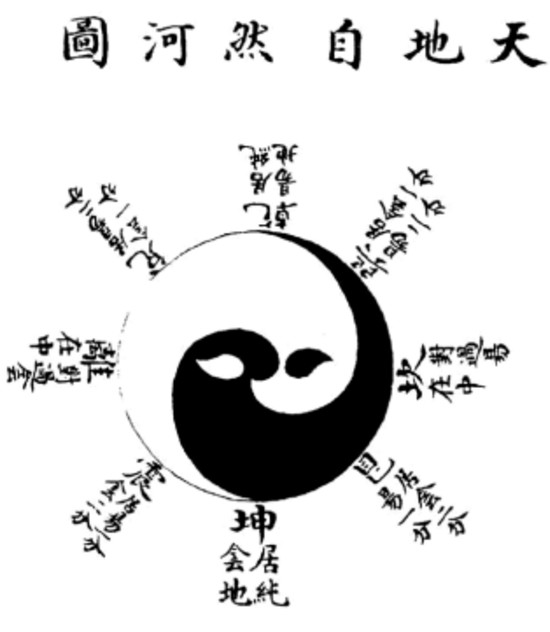
“Bagua diagram by Zhao Huiqian ("River Chart spontaneously [generated] by Heaven and Earth" 圖河.自地天). This image may in fact be a reproduction of the diagram by Hu Wei in his Yitu mingbian (‘Clarification of the diagrams in the book of changes’), dated 1706.” circa 1370; 1706. Public domain.

Sunday, September 3, 2017

Eclipse (For Biwa And Shakuhachi)


Welcome back to the Sunday music feature. In September we’ll be featuring the music of Toru Takemitsu.

Takemitsu is a major composer & a few blog posts over the course of a month can serve only as the most cursory introduction & exploration of his music. I’d strongly encourage those who are interested in what they hear to seek out more information at the links given with each post & also to seek out more of Takemitsu’s music, which is readily available.

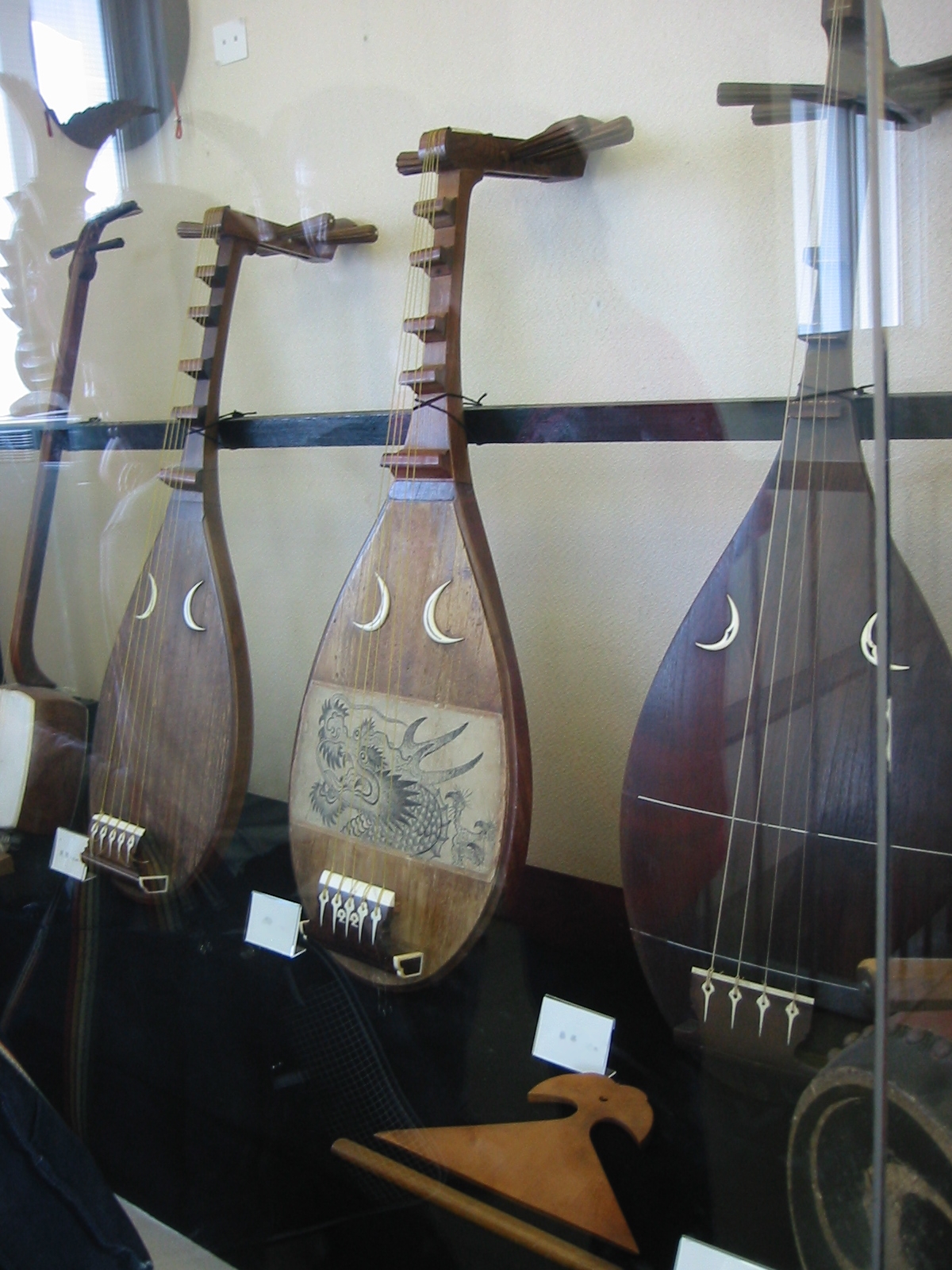
We begin the series with Takemitsu’s 1966 composition, “Eclipse. This is scored for traditional Japanese instruments, the shakuhachi & the biwa. The former is a bamboo flute, while the latter is a type of lute.
Although Takemitsu was strongly influenced by Western music (Debussy, Messiaen, & Webern particularly) & indeed at one point expressed an aversion to traditional Japanese music—because it reminded him of World War II militarism—he began incorporating elements of Japanese music into his compositions under the influence of John Cage beginning in the early 1960s. Takemitsu’s 1967 composition “November Steps” for biwa, shakuhachi, & orchestra is related to “Eclipse”.

Hope you enjoy the music


Images link to their sources on Wiki Commons:
  1. “Performer playing shakuhachi in 60th Himeji oshiro festival, 2009”. Photo by Wiki user Corpse Reviver, who makes it available under the Creative Commons Attribution-Share Alike 3.0 Unported license.
  2. “A selection of biwa in a Japanese museum”. Photo by Wiki user Jnn, who makes it available under the Creative Commons Attribution 2.1 Japan license.


Friday, September 1, 2017

I am going to speak of hope


I am going to speak of hope

I don’t suffer this pain as César Vallejo. I don’t grieve now as an artist, as a man or even as a simple living being. I don’t suffer this pain as a catholic, or a muslim, or an atheist. Today I only suffer. If I weren’t called César Vallejo, I’d still suffer this same pain. If I weren’t an artist, I’d still suffer with it. If I weren’t a man or even a living being, I’d still suffer with it. If I weren’t a catholic, an atheist or a muslim, I’d still suffer with it. Today I suffer from further down. Today I only suffer.

I grieve now without explanations. My pain’s so deep it has neither a cause nor the lack of a cause. What would its cause be? Where is that thing of such importance it might leave off being the cause? Nothing is its cause; nothing has been able to leave off being its cause. From what has this pain been born, by itself? My pain’s from the north wind & the south wind, like neutered eggs that some rare birds lay conceived from the wind. If my bride were dead, my pain would be the same. If they’d sliced my throat to the root, my pain would be the same. If life were, in short, some other way, my pain would be the same. Today I suffer from higher up. Today I only suffer.

I look at the hungry man’s pain & see that his hunger walks so far from my pain that if I starved myself to death, a blade of grass would turn up at my grave at least. The same with the lover. How generative his blood is, unlike mine without spring or consummation.

I used to believe that all things in the universe were, inevitably, fathers or sons. But here’s my pain today, neither father nor son. It lacks a back for nightfall, just as it has too much chest for daybreak & if they put it in a bright room, it wouldn’t cast a shadow. Today I suffer, come what may. Today I only suffer.


César Vallejo, “Voy a hablar de la esperanza”
Translation by Jack Hayes
© 2017


Image links to its source on Wiki Commons:
“Schieles Wohnzimmer in Neulengbach” (“Schiele's Room in Neulengbach”): Egon Schiele. oil on panel; 1911.
Public domain.


Thursday, August 31, 2017

August Moon


(8 quatrains)

1. new moon

chrome hubcap complete with bolts lies on blacktop
as if about to set below the curb’s rise—

yucca stalks against white sky, blossoms faded:
moon’s blank disc invisible past the pink clouds

2. waxing crescent

twilight’s losing its cobalt blue momentum;
it comes down to three red lights suspended in

a horizon silver as that one stopped car:
pinprick planet next to this swelling crescent

3. half moon

bare chestnut limbs a character inked on this
violet sky—what does their radical mean?

white musk odor of Queen Anne’s lace on the lawn:
half moon bowing its head in recollection

4. waxing gibbous

those nameless trees on the side street look that much
darker than the sky; bus stop shelter absorbs

the red light’s spill, but is otherwise empty—
moon out of round against a purple curtain

5. full moon

three moths flash off & on, eccentric spirals
through the security light’s high amber heat—

out of sight between dark houses, cars murmur:
moon catches metallic sun in empty night

6. waning gibbous

the Siamese cat materializes
from the patio shikimi, blending with

patched concrete, parched grass, illuminated leaves:
moon rises past the roof without commotion

7. last quarter

this sun highlights the galvanized downspout’s joints;
the hummingbird feeder, dangling from a beam,

is filled with sugar water, & plums shine ripe,
but the half moon’s upturned bowl sinks into clouds

8. waning crescent

the parking strip sunflower’s grown too heavy
to look up at the black & white prop plane as

it circles that crow standing in Queen Anne’s lace;
this moon has grown so faint you’d need to look twice


Jack Hayes
© 2017