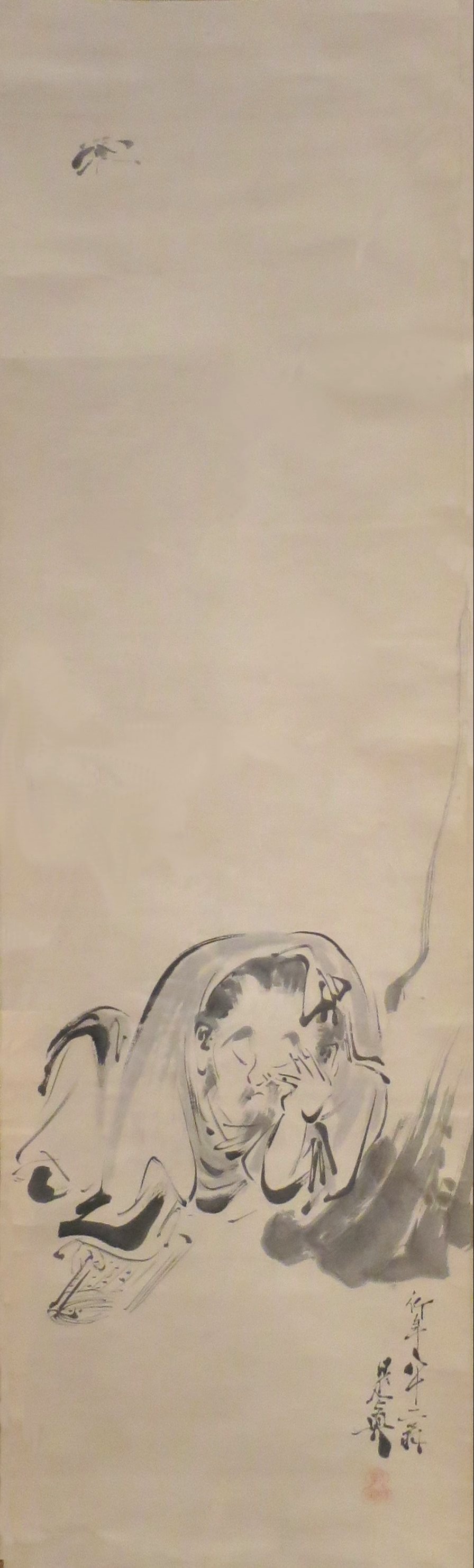
ancient air #9
when Zhuang Zhou dreamed he was a butterfly
did the butterfly become Zhuang Zhou?
in one body’s effortless metamorphosis
the ten thousand things appear in endless virtue
you know eastern seas pass the isle of immortals
to flow as a clear shallow stream from the west
the man who plants his melons outside Ch’ing Gate
at one time held sway as Lord of Dongling—
the same law governs riches & fame:
abuzz, disquieted, what is it we seek?
Jack Hayes
© 2015
based on Li Bai: 古風 (九)
gǔ fēng (jiǔ)
Image links to its source on Wiki Commons
Zhuangzi Dreaming of a Butterfly: Shibata Zeshin, 1888, ink on paper, Honolulu Museum of Art, accession 13879.1
Public domain
(the name 莊周 has been Romanized in various ways: Zhuang Zou & Zhuangzi are typical contemporary versions using the simplified pinyin system, while under the older Wade-Giles system the name was typically Chuang Tzu or Chuang Chou)

IN THE NORTHERN DARKNESS there is a fish and his name is K'un. The K'un is so huge I don't know how many thousand li he measures. He changes and becomes a bird whose name is P'eng. The back of the P'eng measures I don't know how many thousand li across and, when he rises up and flies off, his wings are like clouds all over the sky. When the sea begins to move, this bird sets off for the southern darkness, which is the Lake of Heaven.
The Universal Harmony records various wonders, and it says: "When the P'eng journeys to the southern darkness, the waters are roiled for three thousand li. He beats the whirlwind and rises ninety thousand li, setting off on the sixth month gale." Wavering heat, bits of dust, living things blowing each other about-the sky looks very blue. Is that its real color, or is it because it is so far away and has no end? When the bird looks down, all he sees is blue too.
If water is not piled up deep enough, it won't have the strength to bear up a big boat. Pour a cup of water into a hollow in the floor and bits of trash will sail on it like boats. But set the cup there and it will stick fast, for the water is too shallow and the boat too large. If wind is not piled up deep enough, it won't have the strength to bear up great wings. Therefore when the P'eng rises ninety thousand li, he must have the wind under him like that. Only then can he mount on the back of the wind, shoulder the blue sky, and nothing can hinder or block him. Only then can he set his eyes to the south.
The cicada and the little dove laugh at this, saying, "When we make an effort and fly up, we can get as far as the elm or the sapanwood tree, but sometimes we don't make it and just fall down on the ground. Now how is anyone going to go ninety thousand li to the south!"
If you go off to the green woods nearby, you can take along food for three meals and come back with your stomach as full as ever. If you are going a hundred li, you must grind your grain the night before; and if you are going a thousand li, you must start getting the provisions together three months in advance. What do these two creatures understand? Little understanding cannot come up to great understanding; the shortlived cannot come up to the long-lived.
How do I know this is so? The morning mushroom knows nothing of twilight and dawn; the summer cicada knows nothing of spring and autumn. They are the short-lived. South of Ch'u there is a caterpillar which counts five hundred years as one spring and five hundred years as one autumn. Long, long ago there was a great rose of Sharon that counted eight thousand years as one spring and eight thousand years as one autumn. They are the long-lived. Yet P'eng-tsu alone is famous today for having lived a long time, and everybody tries to ape him. Isn't it pitiful!
Chuang Tzu (Zhuangzi) – translated by Burton Watson
Image links to its source on Wiki Commons:
"Dapeng" (a mythological bird in China) from the Kyōaka Hyaku-Monogatar Japanese picture) 1853
Chuang Tzu and Hui Tzu were strolling along the dam of the Hao River when Chuang Tzu said, "See how the minnows come out and dart around where they please! That's what fish really enjoy!"
Hui Tzu said, "You're not a fish—how do you know what fish enjoy?"
Chuang Tzu said, "You're not I, so how do you know I don't know what fish enjoy?"
Hui Tzu said, "I'm not you, so I certainly don't know what you know. On the other hand, you're certainly not a fish—so that still proves you don't know what fish enjoy!"
Chuang Tzu said, "Let's go back to your original question, please. You asked me how I know what fish enjoy—so you already knew I knew it when you asked the question. I know it by standing here beside the Hao."
Chuang Tzu (Zhuangzi) – translated by Burton Watson
Image links to its source at metmuseum.org
The Pleasure of the Fishes - Zhou Dongqing, late 13th century
Public domain