Showing posts with label Wheel River Collection. Show all posts

Tuesday, November 21, 2017

Huazi Ridge


Huazi Ridge


birds fly off into the infinite;
on the mountain range autumn color returns—
walking up, walking down along Huazi ridge:
do grief & regret ever reach an end


Translation by Jack Hayes © 2017
based on Wang Wei: 華子 岡
huá zĭ gāng


Image links to its source in Wiki Commons:
Landscape attributed to Southern Song artist, Yamato Bunkan, Nara, Japan.
Public domain.


Wednesday, July 26, 2017

Cornel Dogwood Grove


Cornel Dogwood Grove


bearing fruit it’s vermilion & green,
as if its blossoms opened anew—
to keep your guest in these mountains
offer him this hibiscus cup


Translation by Jack Hayes © 2017
based on Wang Wei: 茱萸沜
zhū yú pàn


Image links to its source in Wiki Commons:
Cornus officinalis's fruits; photo by Dalgial, who makes it available under the Creative Commons Attribution-Share Alike 3.0 Unportedlicense.


Wednesday, May 24, 2017

Meng Wall Gap


Meng Wall Gap


a new house by the Meng Wall gate;
of the ancient trees, fading willows remain—
who will live here in later days?
his grief will be vain for him who came before


Translation by Jack Hayes
© 2017
based on Wang Wei: 孟城坳
mèng chéng ào


Image links to its source on Wiki Commons:

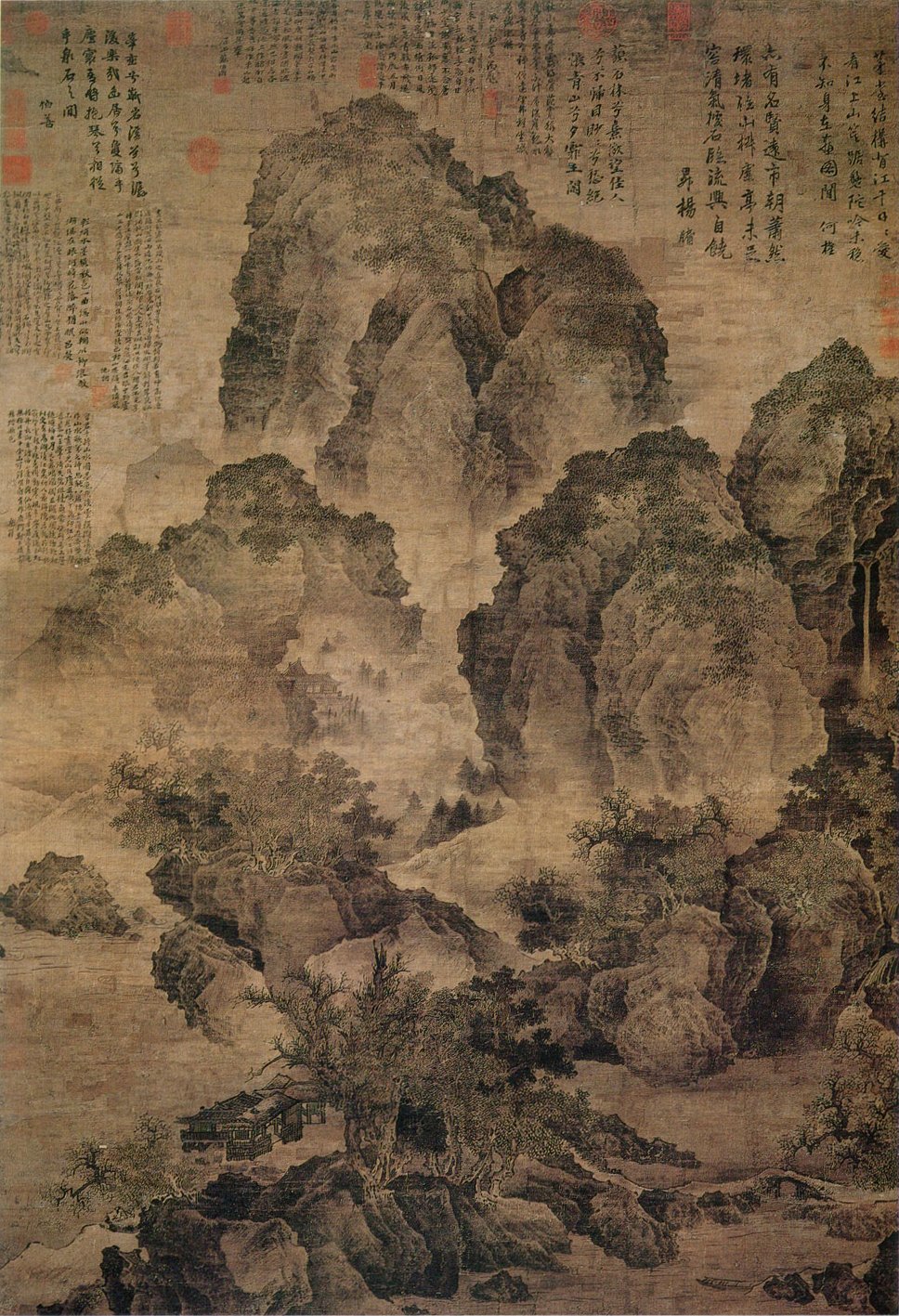
“Sitting Alone by a Stream”: Fan Kuan. 11th century; hanging scroll - light color on silk.

Public domain


Monday, June 20, 2016

deer park

deer park


empty mountain: no one to be seen
but the sound of voices does echo
sunset’s rays enter the forest depths
luminous again on green moss, highest


Jack Hayes
© 2016
based on Wang Wei:
鹿柴
lù zhài


day and night feel the cold mountain,
share the ease of its lone tenant—
with no knowledge of the deep groves
we have only the stone deer trail


Sheila Graham-Smith
© 2016
based on Pei Di:
鹿柴
lù zhài


Note: These poems are from the 辋川集 (Wǎngchuān jí) or “Wheel River Collection” composed by Wang Wei & Pei Di. As mentioned in previous posts, the “Wheel River Collection” consists of 20 paired poems, each one a jueju or quatrain, describing locations on Wang Wei’s estate in what is now Lantian County.

Readers who are interested in “deer park” should certainly consult Nineteen Ways of Looking at Wang Wei by Eliot Weinberger & Octavio Paz, a study of 19 different translations of Wang Wei’s quatrain. While there are many translations of Wang Wei’s “Wheel River” poems, the companion poems by Pei Di have not been well represented in English. There’s currently only one complete version of all 20 paired poems, & that’s in the now out-of-print Poems of Solitude by Jerome Ch’en & Michael Bullock. A collection of 13 of the 20 pairs can also be found in A Drifting Boat: Chinese Zen Poetry, edited by JP Seaton & Dennis Maloney; the translations themselves are by Jospeh Lisowski.

There is an interesting textual crux in the fourth line of the Pei Di poem. The line could read either但有鹿石跡 or但有鹿段跡, in other words, in literal English: “only have deer stone track” or “only have deer section track”. Sheila opted for the former reading in her translation (interestingly, the two existing English translation deftly avoid the problem by translating neither character). Her research turned up the fact that deer statuary often appears at Buddhist temples & in Buddhist sacred images; specifically, she found reference to the deer statues that gave the name to the Buddhist temple at Lumen Shan (Deergate Mountain), where poet Meng Haoran lived for a time. Meng Haoran was a friend of both Wang Wei & Pei Di.

Sheila writes, “My theory is that with deer park Pei Di is answering Wang Wei's abstract unknowable mountain with the direct advice that he feel the cold of it. That is, he brings the mountain back to a real and significant daily presence, a direct experience. The second line answers the absence of humans in Wang Wei's poem with the presence of the solitary guest on the mountain. In the second couplet he takes Wang Wei's remark about the return of the light to the forest (enlightenment) and claims no knowledge of the forest ways, then he take Wang Wei's final line about the sun striking the "single spot of life" and parallels it with what would be an obvious allusion in his time and context to the path of enlightenment, which is all he needs. It seems that a reference to Deer Gate would be immediately recognisable to any educated man in Wang Wei's society as an allusion to a secluded life of culture and spiritual pursuits. Wang Wei never mentions deer in his poem but Pei Di does, by the playful introduction of the stone deer on the path.”


Image links to its source on Wiki Commons:
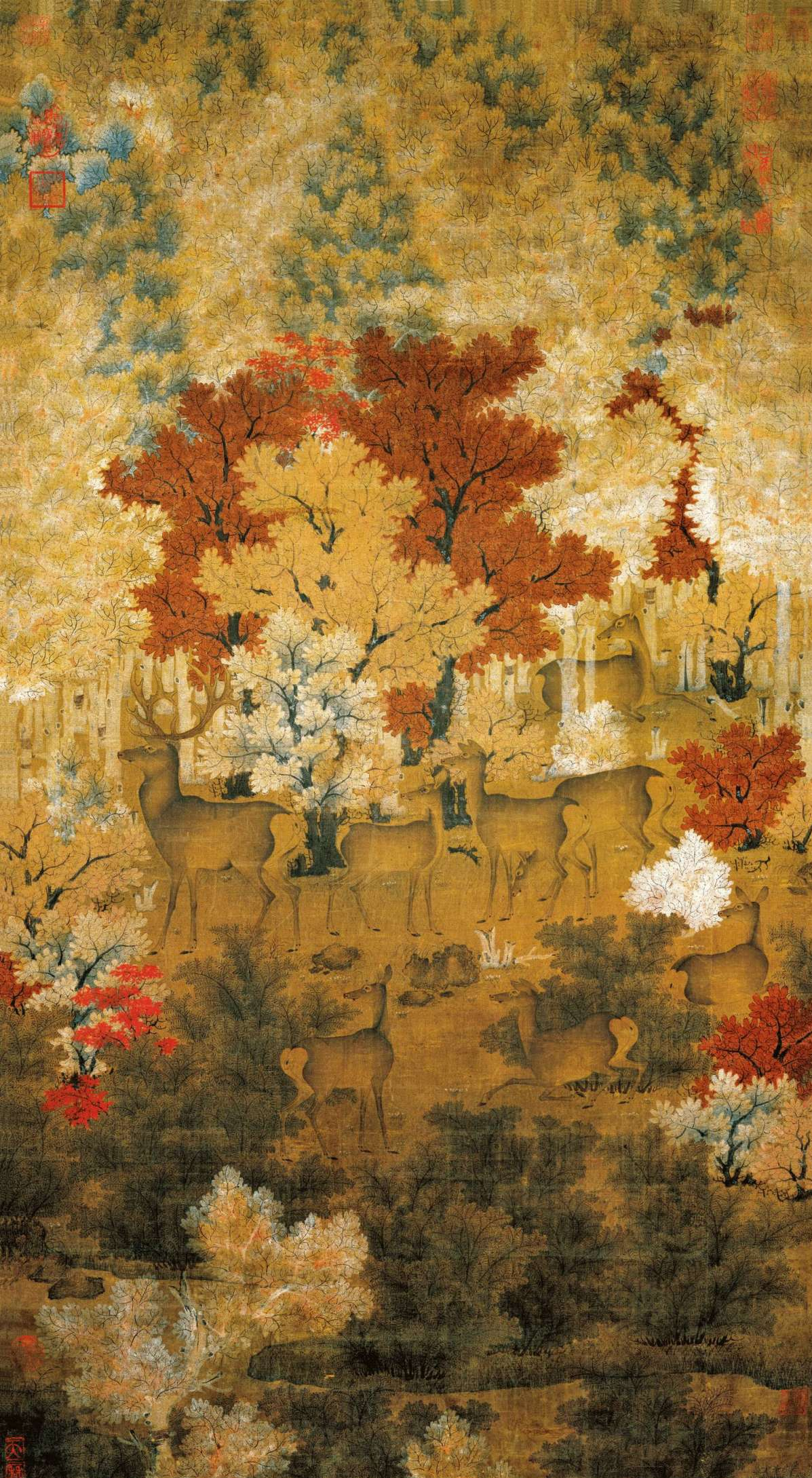
“Herd of Deer in a Maple Grove”: Anonymous

(丹楓呦鹿圖)
circa 951 A.D.-968 A.D.; ink and colors on silk

Monday, May 9, 2016

storied apricot pavilion


storied apricot pavilion 
 
storied apricot was cut to fashion the beams,
fragrant reeds knotted to fashion a cosmos—
are these rafters or the linings of the clouds?
a place apart for writing between the rains


Jack Hayes
© 2016
based on Wang Wei:
文杏館
wén xìng guăn


endlessly storied apricot pavilion
often rises to the height of the sun—
south mountain replenishes the lake; 
before looking ahead, repeatedly turn to consider


Sheila Graham-Smith
© 2016
based on Pei Di:
文杏館
wén xìng guăn


Note: Wang Wei collaborated with his friend Pei Di on a collection of 20 paired poems known in English as the Wang River Collection, or the Wheel River Collection or Wheel Rim River Collection (Wangchuan ji; 辋川集). Each poem is a quatrain (a jueju; 絕句) describing a setting on Wang Wei’s country estate in the foothills of the Qinling Mountains, south of Chang’an in what is today Lantian County.

The poems describe various locations around the estate; pavilions, fenced in enclosures, terraces, & the like. It is important to note that the poets elaborated on the details of the actual locations.

Wang’s poems are very well known—he is one of the most famous of the great Tang Dynasty poets. Pei Di’s poetry on the other hand, including his contributions to this collaborative work, is considerably less well known outside of China. To date only one English translation of the entire Wheel River Collection has been done. This was by Jerome Ch’en & Michael Bullock in their collection Poems of Solitude, published in 1960 & now out of print.

Sheila Graham-Smith & I have produced translations of one pair of poems from the sequence, & we hope to do more in between the Du Fu & Li Bai! You can read my versions of two other poems in the sequence here & here.


Image links to its source on Wiki Commons
"Poetic Feeling in a Thatched Pavilion": Wu Zhen, 1347, ink on paper, handscroll.
Public domain. 

Wednesday, December 9, 2015

in the bamboo lodge


in the bamboo lodge

alone, sitting in this dark bamboo grove,
I pluck the qin, whistle long & shrill
;
in this deep forest unnoticed by any
the bright moon comes to share illumination

Jack Hayes
© 2015
based on Wang Wei:
竹里館
zhú lǐ guǎn


Image links to its source on Wiki Commons
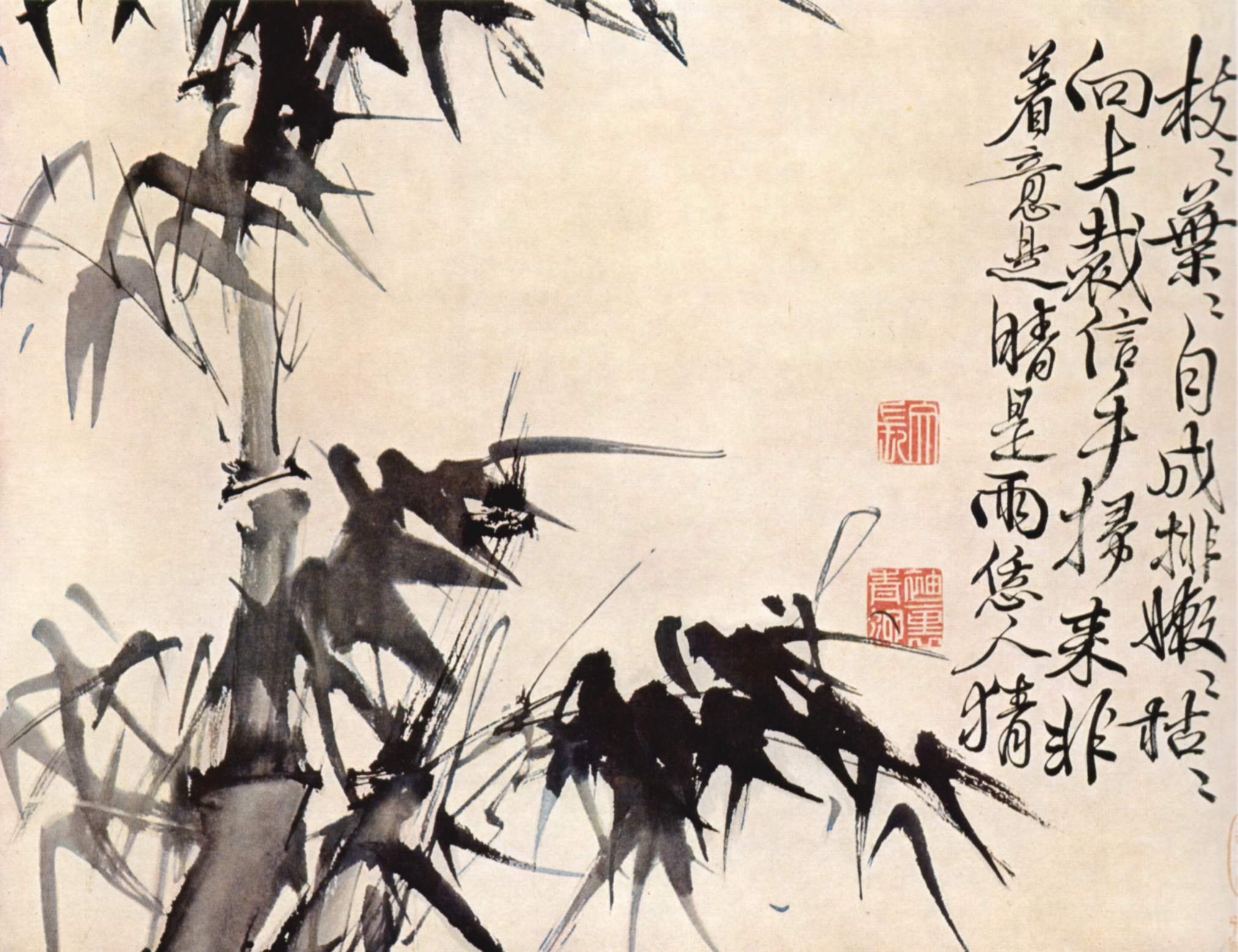
Bamboo: Xu Wei, c. 1540-1590, ink on paper
Public domain

Wednesday, December 2, 2015

lily magnolia park


lily magnolia park

autumn hills keep day’s leftover light:
bird darts after its departing mate
kingfisher-green gleams just an instant:
sunset mist without any fixed place


Jack Hayes © 2015
based on Wang Wei’s
木蘭柴
mù lán chái


Image links to it source on Wiki Commons

Autumn Colors on Rivers and Mountains: anonymous Northern Song Dynasty painter, ink and color on a silk handscroll

Public domain