Showing posts with label blues. Show all posts

Thursday, March 10, 2016

“Get Right, Church” (the song)


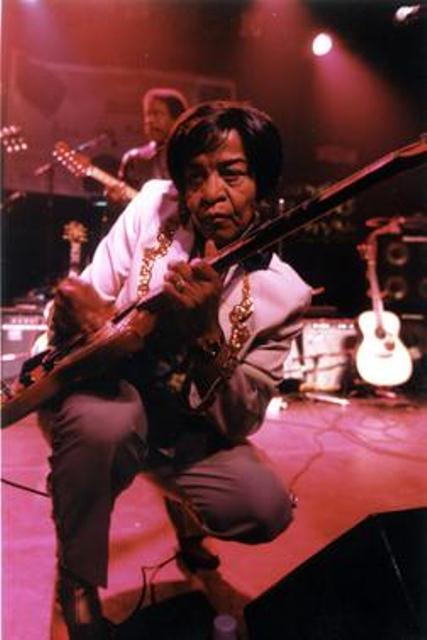
It’s been quite some time since I featured a blues number on Robert Frost’s Banjo, but there’s a great one for you today: Mississippi Fred McDowell’s version of the old gospel tune, “Get Right, Church.” This one is the late career, electric guitar Mississippi Fred McDowell, with Tom Pomposello on bass, recorded live at the Gaslight in Chicago in 1971, though not released until 2000 on the Grapeshot Media label.

McDowell recorded “Get Right, Church” on other occasions, as well, notably as a duet with his wife Annie, who took the lead vocal on a 1965 recording made at their home in Como, Mississippi. [https://www.youtube.com/watch?v=vPk27dyudTY] The Como recording features McDowell’s acoustic playing.

Some powerful music indeed.


https://www.youtube.com/watch?v=AuzXMrRdZS0

Image links to its source on Wiki Commons:
Postcard photo of the Illinois Central train "Panama Limited".
Date     circa 1940s to 1950s. This train is diesel powered but the freight train next to it is a steam locomotive. The Panama Limited no longer ran as an Illinois Central train after the 1971 Amtrak takeover of passenger rail service.
This work is in the public domain because it was published in the United States between 1923 and 1977 and without a copyright notice.


Monday, December 31, 2012

Any Woman’s Blues #27 – Natalia Zukerman


It’s Monday, & the final day 2012. What better way to celebrate than with this month’s edition of Any Woman’s Blues?

The featured artist for December is Natalia Zukerman, an exciting up & coming performer who is comfortable in any number of genres, & blends them all in her strong songwriting. But blues—& slide guitar, which is always near to my heart—is a sound & form that underlies much of her work, as you will hear in evidence in the two video selections.

Natalia Zukerman comes from Manhattan, & she was raised in a musical family: both her parents are virtuoso performers (her father is violinist/conductor Pinchas Zukerman & her mother is flutist Eugenia Zukerman), while her sister Arianna is an opera singer.  Given her background, it’s not at all surprising that Zukerman draws from a number of genres & styles when she composes, utilizing not only blues, but also rock, bluegrass, jazz & classical.

She is a talented singer & songwriter, but make no mistake: her guitar chops are also impressive. The New Yorker proclaimed, “Natalia’s voice could send an orchid into bloom while her guitar playing can open a beer bottle with its teeth.” Her playing is indeed gritty when need be, but she is able to wield a full dynamic palette in her fingerstyle playing.

To date, Natalia Zukerman has released five cds, beginning with her 2001 debut, Mortal Child on Talisman. She followed that up in 2003 with On a Clear Day & Only One in 2006, both on Talisman, then moved to Weasel Records for her 2008 release, Brand New Frame (title track is the second video below) & the 2011 Gas Station Roses (first video is the title track.)

Natalia Zukerman also plays lap steel guitar & electric guitar as well as her acoustic Guild. She’s definitely a significant talent & someone to watch for—in fact, she’s starting to announce dates for her 2013 tour, so check her out if she passes through your town—I certainly will!

In the meantime, enjoy some great songwriting, singing, & guitar playing on these two videos.


Photo of Natalia Zukerman links to its source

Monday, December 3, 2012

The Texas Blues #7 – DeKalb Blues – Lead Belly


Monday is here, folks, & you know what that means (at least some of the time): The Monday Morning Blues here on Robert Frost’s Banjo!

We’re back to Texas this week for our continued series on blues artists who called that state home. & today’s featured artist is a true figure, not just in the blues, but in the general history of the folk revival from the 1930s through the 1950s, & indeed, in the larger history of mid century U.S. popular music. I’m talking about Lead Belly, Hudie Ledbetter. Although Lead Belly was born around Mooringsport, Louisiana in either 1888 or 1889, his family moved to Bowie County, Texas when he was five.

Lead Belly began performing while in his teens in the red light district of Shreveport, Louisiana. At first he accompanied himself with the accordion (& he did play the accordion on some of his later recordings), but he eventually moved on to his signature 12-string guitar, tuned down from standard tuning by a fourth (at least that’s the consensus on the tuning.)  He moved to Dallas, & performed with Blind Lemon Jefferson, especially on the streets in the Deep Ellum section of the city.

But, as the story goes, Lead Belly was in & out of jail, often stemming from fights caused or at least made worse by his notorious temper. In 1918 he was jailed for murder following one of these fights in the Sugar Land Penitentiary near Houston—but he was pardoned after a minimum seven-year sentence after appealing to Governor Pat Morris Neff in a song. Then in 1930, he was again in prison for murder following a knife fight, this time in Louisiana’s notorious Angola Prison Farm. This is where Alan & John Lomax first found him, recorded him, & eventually persuaded the governor to pardon him, again after Lead Belly had served the minimum sentence.

Lead Belly traveled with the Lomaxes & later became a celebrity in the New York folk scene. He performed with Pete Seeger, Woody Guthrie, Brownie MacGhee & Sonny Terry, & he was championed by novelist Richard Wright. He recorded for RCA, the Smithsonian& Moe Asch of Folkways during a relatively short but successful career. He was diangosed with amyotrophic lateral sclerosis, or Lou Gehrig's disease, while on tour in France in 1949 & died later that year.

As this brief bio will tell you—if you didn’t know already—Lead Belly was larger than life in many respects, & while the blues underpins his music, he certainly moved beyond the blues into other folk genres—for instance, he was particularly fond of cowboy songs (as was Muddy Waters!) & had some hopes of becoming a singing cowboy in films. His sound is very distinctive—between his powerful tenor voice & the drive & growl of his Stella 12-string, you simply can’t mistake a Lead Belly song!

Here’s “DeKalb Blues,” one of his most straightforward blues numbers, from one of the Lomax recording sessions at Angola Prison Farm. A powerful piece of music—enjoy!


Image of Leadbelly links to its source on Wiki Commons. Wiki Commons states that this photo is in the public domain because it was created between 1923 & 1963 & the original copyright was not renewed.

Monday, November 26, 2012

Any Womans Blues #26 – Beverly “ Guitar” Watkins

A happy Monday, friends! We’re here with the Monday Morning Blues, Any Woman’s Blues edition, & we’ve got some smoking hot guitar playing.

Beverly Watkins has had a long career as a blues guitarist, but for much of life she’s plied her trade in obscurity. While still in high school, she began playing guitar with Piano Red & toured with his band the Meter-tones until the combo broke up in 1965 (the group was also known as Piano Red & The Interns, Dr. Feelgood & The Interns, & Dr. Feelgood); following this she performed with such groups as Eddie Tigner & the Ink Spots, Joseph Smith & the Fendales, & Leroy Redding & the Houserockers.

Watkins’ solo career didn’t really take off, however, until she became associated with the Music Maker Relief Foundation in the 1990s. This wonderful organization, which we learned about also in an earlier post on guitarist Precious Bryant, describes its mission as follows:

Music Maker Relief Foundation preserves and promotes the musical traditions of the American South. Since 1994 we have partnered with traditional artists over 55 years old who survive on a yearly income of less than $18,000, sustaining their day-to-day needs while building their careers. Through Music Maker, our rich heritage of folk music will not be lost with the passing of time.

Beverly Watkins is a truly remarkable musician. Still rocking hard in her 70s, she sings & plays guitar with great power, verve & energy. Watkins says of her music:

My style is real Lightnin’ Hopkins lowdown blues. I call it hard classic blues, stompin’ blues, railroad smokin’ blues.

Since joining Music Maker, Beverly Watkins has released three albums, & her 1999 debut Back in Business was nominated for the Blues Foundation’s W.C. Handy Award.  She has followed that up with The Feelings of Beverly "Guitar" Watkins & The Spiritual Expressions of Beverly “Guitar” Watkins. Watkins keeps up an active touring schedule.

Why is her middle name “Guitar”? Just watch these videos & you will find out! Enjoy!


Image links to its source at theuntitledmag.tumblr.com

Monday, November 12, 2012

The Texas Blues #6 – Lone Wolf Blues – Oscar “Buddy” Woods

A happy Monday from the rainy Pacific Northwest! The Monday Morning Blues will be transporting us to Texas today, at least for the three minutes & 14 seconds of our featured song.

It’s a commonplace, of course, that slide guitar is a staple of the blues sound; it’s also true that while several of the best known slide players lived in the Mississippi Delta area, slide blues styles were found throughout the south in the first half of the 20th century.  However, in most cases the guitarists played blues while holding the guitar “Spanish style”—in other words, in the conventional manner. But slide guitar is also played “lap style,” with the guitar across the player’s lap, but while this style was common in Hawaiian music & in early Country (where it eventually developed into the related playing of dobro on one hand & pedal steel on the other), it was rather uncommon for blues guitarists to play slide in this manner (though blues historian Steve Calt claims that lap style, using a knife as a “bar,” actually pre-dated “Spanish style” slide playing.) Certainly many of the common riffs & figures in slide blues require the use of fingers fretting strings, & this really isn’t possible in lap playing—all the noting & chording is done with the bar itself. Of course the slide itself for lap playing is also different—it’s not practical to use a bottleneck or a copper tube, so usually players opt for a solid piece of metal (I have seen a video of Booker White playing lap style with a railroad spike!) 


In any case, Oscar Woods is now thought of as one of the first players to popularize lap style playing in the blues. Although Woods hailed from  Natchitoches, Louiana, near Shreveport, he was part of the Dallas music scene in the 1930s, & even backed Jimmie Davis of “You Are My Sunshine” fame on several recordings between 1930 & 1932. He also recorded with such bands as the Shreveport Home Wreckers, Kitty Gray & her Wampus Cats—& had one recording session with Peetie Wheatstraw, the “Devil’s Son-in-Law” himself.  Wood also was a mentor of Buck Turner, AKA “the Black Ace,” who was another notable lap guitar Texas bluesman—& one who will soon appear in this series.  It's also clear that Robert Johnson was familiar with Woods' work, as one verse of his song "Love in Vain" was taken from the Shreveport Home Wreckers' "Flying Crow Blues."

But Woods also made a dozen records in which he performed either solo with just his voice & his slide guitar playing, or as the front man. Perhaps the best known of these is today’s selection, “Lone Wolf Blues,” which he recorded for Decca in New Orleans in 1936. “Lone Wolf Blues” was the A side, backed by “Don't Sell It - Don't Give It Away.”

“Lone Wolf” is played in open G, but not the common open G tuning that was used so much on the Delta (&, interestingly, in Hawaiian slack key playing, in which it’s called “Taro Patch”); here the guitar is tuned GBDGBD, which means that the low string is brough all the way up from an E to a G.  These days this tuning is usually only used on squareneck guitars, because of the stress put on the neck by this string (& to some extent by the low A string coming up to B.)

Enjoy!


Image links to its source on http://4.bp.blogspot.com. That isn’t a photo of Oscar Woods on the album cover—no photos of Woods are known to exist. I believe that’s the Black Ace.

Thursday, November 1, 2012

“The Gun in Your Hand” – Danielia Cotton

In the wake of a howling guitar chord & drum roll,& over the top of a jagged & funky guitar riff, Danielia Cotton’s voice roars into the opening of her new album, Gun in Your Hand: “Somebody save me.” This voice come from someone who may be wounded, but is clearly not defeated; it’s s strong voice, a voice that asserts itself even in the face of a world that stops making sense.  Danielia Cotton has said that the message of “survival” is what she’d like people to take away from her latest album, & survival is clearly a central theme—but there’s a lot of salvation here too, even if under the surface. A voice that can rise up to sing “Save Me” in the face of tribulation knows: rock & roll can save your soul.

Make no mistake: while The Gun in Your Hand employs a wide sonic palette in painting its music pictures of loss, survival & salvation, it always rocks. Even its quietest songs, like the plaintive & acoustic “Boy Blue,” appear out of the silence with an underlying rhythmic urgency; at the other extreme, there’s the deliciously hardcore “Deep Dark Love,” with its lyric about Jesus & Mary Magdalene broken down by the side of the road, & a nod to Willie Dixon’s great “Spoonful.” One of the great interpreters of “Spoonful” was Howlin’ Wolf, & while Danielia Cotton is not a blues artist in a strict sense of the word, she absolutely can marshal the kind of elemental power that the great Wolf deployed!

But there’s so much here to discover. It’s an album that asks for salvation, for love, for understanding, but that also teaches: in fact, that also seems to be a central concept. & I don’t mean that Gun in Your Hand is didactic or preachy in the least; it rocks far too much for that, & the songwriting is far too good. Seven of the album’s 12 songs were either written or co-written by Danielia Cotton, while producer & musician Kevin Salem wrote or collaborated on six, & both are strong songwriters both in terms of lyrics & music. In addition, Cotton covers two standards: “Purple Rain,” one of the greatest rock songs ever written, & the haunting & disturbing “Strange Fruit,” known from the great versions by Billie Holiday & Nina Simone. The standard versions of these two songs are masterpieces in their genres, unquestionably; but Cotton truly produces exquisite versions that are completely her own & can stand alongside the best. 


To return to the teaching theme: in her song “Smile,” Danielia Cotton sings the apparently simple line, “In a good life there’ll be hard times.” This statement seems crucial to the album, which is so much about hard times & navigating them, even when the waters seem overwhelming; for instance, in the beautiful love ballad, “The Only Reason,” the lover may indeed be “the only reason anything good happens at all”—but the crucial point is that there is a reason in the midst of all the chaos & unreason. These thoughts don’t only apply on a personal level either; Cotton asks us to put ourselves in the place of lost souls in “Boy Blue”; she sings about the struggle for social justice in “Long Days”; the whole arc of the album, from the very personal “Save Me” through the historic & cultural touchstone of “Strange Fruit,” not only places suffering in various contexts, but it continues to raise a strong voice as a way of surviving & seeking a real form of salvation.

The Gun in Your Hand was co-produced by Kevin Salem, Cotton, & the band, & the production is simply superb. Salem & the others know when to layer on heavy sound, as in “Deep Dark Love” or “Save Me,” & when to pull back & let Cotton’s truly amazing voice stand out against a spare backdrop. This is done so effectively in the two cover songs, “Purple Rain” & “Strange Fruit.”  The playing throughout the album is top-notch; riff-driven, exact, clear gestures, even when the distortion is turned up highest on the guitars.

I highly recommend this album, & I predict it’s one that will stand up as time passes. Indeed, the sound is classic, without ever being dated. The Gun in Your Hand is available at iTunes & is also going into release today, November 1st, so do check out your local music shop—listen, learn, enjoy, be moved.


Images links to their source on Danielia Cotton's website

Monday, October 29, 2012

Any Woman’s Blues #25 – Odetta

Happy Monday, friends! & welcome to the October edition of Any Woman’s Blues! But before we get to today’s featured artist, I’d like to announce some exciting news! I’ve been contacted by the publicist for last month’s featured artist Danielia Cotton, & as a result, Robert Frost’s Banjo will be featuring a free download of her song “Easy” from her new album The Gun in Your Hand, scheduled for release this very Wednesday, October 30th!  I’ll also be reviewing that album as Thursday’s post here.

It’s difficult to do justice to today’s featured artist, Odetta, in the scope of a blog post & through two videos. Indeed, the breadth of her music expands well beyond the scope of the blues as well: she sang—& made her own—songs from many traditions, & her version of the lovely Irish air, “I Know Where I’m Going” is every bit as moving as her singing of the African-American song “Take this Hammer.”  Odetta was born in Alabama, but raised in Los Angeles. Blessed with a remarkable voice, Odetta began operatic training in her early teens, & she seemed destined for a career in opera, given the beauty, power & range of her singing. However, while in San Francisco in 1950 (on tour with Finian’s Rainbow!) she became involved in the city’s burgeoning folk music scene, & decided that was the artistic path she would follow.

Early in her career, Odetta performed solo, accompanying herself on the guitar, or in partnership with banjoist Larry Mohr (as Odetta & Larry.) Seminal recordings from this time include Odetta Sings Ballads & Blues on Tradition & The Tin Angel/Odetta & Larry on Fantasy (Original Blues Classics.) The latter title refers to her gig at San Francisco’s Tin Angel nightclub near Fisherman’s Wharf in 1953-1954.

Later, Odetta moved beyond the solo or duet format, & began to sing with the band backing; as a result she broadened her repertoire still further, moving into jazz & blues with a much “bigger sound.” A good example of this from her later career is her version of Leadbelly’s “Jim Crow Blues,” which you can view on YouTube here.  All in all, Odetta released close to 30 albums, counting both studio & live recordings.

In the tradition of folk music, Odetta was politically active, & not only sang about struggle, but put her considerable talent & energy to work for the Civil Rights movement, not just during the 1960s, but throughout her career, right up until she passed away in December 2008. A history of Odetta’s career looked at from this perspective can be found here at workers.org.

I’ve broken a bit with Any Woman’s Blues tradition in today’s videos. Although one is a live recording, there is no live footage of Odetta in either (though again, check out the link above for that!) The reason for this is simple: Any Woman’s Blues focuses on performers who not only sing but also play guitar, & most of the live videos of Odetta currently available are all so recent that they don't feature her excellent guitar playing (however there is also this very fun video of her with Tennessee Ernie Ford.) So we have two early songs in which she performs with guitar. One is the African-American work song “Waterboy,” & the second is the beautiful lullaby “All the Pretty Horses,” which also has an African-American heritage (though it may or may not have European elements as well—but of course, much of American folk song combines the two.)

Hope you enjoy these beautiful & powerful performances by a truly amazing & singular artist!


Image links to its source

Civil Rights March on Washington, D.C. [Entertainment: Vocalist Odetta.] – Wiki Commons – Public Domain as a US Government work

Monday, October 22, 2012

“John the Revelator”

Well, it’s Monday, it’s music, & it didn’t take too long to return to the blues! Or at least to two men who are typically classified as blues artists, Blind Willie Johnson & Son House. In fact, “John the Revelator” is a gospel or spiritual from the African American tradition. Blind Willie Johnson was a street preacher as well as a street musician—a common combination in the early to mid 20th century (the Reverend Gary Davis is another well-known figure who combined the two roles), while Son House was himself a preacher before he succumbed to the power of the blues!

The two versions are quite different, musically & lyrically. Johnson is accompanying himself on guitar & has his wife, Willie B. Harris, as back-up singer. Son House on the other hand, always dispensed with his National guitar when he performed this song & sang it a cappella. Johnson’s version was recorded for Columbia in New Orleans on December 11, 1929 (the A side, backed by “You’re Gonna Need Somebody On Your Bond”), & was also included as a selection on Harry Smith’s Anthology of American Folk Music. Son House’s version was recorded for The Legendary Son House: Father of Folk Blues (Columbia, 1965).  Another stirring version by House was released on Delta Blues & Spirituals (Capitol, 1995), & was recorded at a show at the 100 Club in London, England on July 14, 1970.

This post is dedicated to my dear friends Sheila & Mairi. Enjoy!


Lyrics

The lyrics below are Blind Willie Johnson's version of "John the Revelator" as found in the Anthology of American Folk Music. Subsequent versions feature a variety of substituted verses and different interpretations of Johnson's lyrics, all quoting passages from the Bible, in the tradition of African American spirituals.

    [call] Well who's that writin'? [response] John the Revelator
    Who's that writin'? John the Revelator
    Who's that writin'? John the Revelator
    A book of the seven seals

    [call] Tell me what's John writin'? [response] Ask the Revelator
    What's John writin'? Ask the Revelator
    What's John writin'? Ask the Revelator
    A book of the seven seals

    Well ooh ooh why me, thousands cried holy
    Bound for some, Son of our God
    Daughter of Zion, Judah the Lion
    He redeemeth, and bought us with his blood

    [Repeat verses 1 & 2]

    John the Revelator, great advocator
    Get's 'em on the battle of Zion
    Lord, tellin' the story, risin' in glory
    Cried, "Lord, don't you love some I"

    [Repeat verses 1 & 2]

    Well Moses to Moses, watchin' the flock
    Saw the bush where they had to stop
    God told Moses, "Pull off your shoes"
    Out of the flock, well you I choose

    [Repeat verses 1 & 2]

These are the lyrics for Son House's 1965 recording version, which explicitly reference three theologically important events: the Fall of Man, the Passion of Christ, and the Resurrection.

    [call] Who's that writin'? [response] John the Revelator
    Tell me who's that writin'? John the Revelator
    Tell me who's that writin'? John the Revelator
    Wrote the book of the seven seals

    [call] Who's that writin'? [response] John the Revelator
    Tell me who's that writin'? John the Revelator
    Well who's that writin'? John the Revelator
    Wrote the book of the seven seals

    You know God walked down in the cool of the day
    Called Adam by his name
    But he refused to answer
    Because he's naked and ashamed

    [Repeat verses 1 & 2]

    You know Christ had twelve apostles
    And three he led away
    He said, "Watch with me one hour,
    'till I go yonder and pray."

    [Repeat verses 1 & 2]

    Christ came on Easter morning
    Mary and Martha went down to see
    He said, "Go tell my disciples
    To meet me in Galilee."

    [Repeat verses 1 & 2]

Monday, September 24, 2012

Any Woman's Blues #24 – Danielia Cotton

Happy Monday, & welcome to a somewhat belated Monday Morning Blues—it is actually still morning here in Portland, at least as I begin typing this! It’s the final Monday of September (unbelievably enough), so it’s time for this month’s edition of Any Woman’s Blues.

Some may say that Danielia Cotton’s music belongs more in a discussion of soul, funk or rock than in a blues series—but the fact is, all of these genres spring from the blues an an ultimate source; & at various points in the past, no distinction was made between what we now call “soul” music & what we now think of as “blues”—the category “rhythm & blues” included Ray Charles & Ike & Tina Turner right alongside Howlin’ Wolf & John Lee Hooker.

& however one might quibble about genres in terms of Cotton’s music, there is one main point that can’t be disputed: this is powerful stuff indeed. Indeed, Cotton’s singing has been favorably compared with Tina Turner’s & Janis Joplin’s (two truly great artists who also formed a synthesis between blues, rock & “R&B.”) Cotton came from a musical family—her mother is jazz singer Wenonah Brooks, & jazz singers Jeannie Brooks & Carol Brooks-Meyners are her aunts. Danielia Cotton was given an acoustic guitar as a gift when she was 12 years old, & she took to the instrument quickly; she also began singing with her mother & aunts in a gospel group around this time. Her great vocal abilities won her a full scholarship to Bennington College, where she focused on theater, & she studied at the Royal Academy of Dramatic Arts in London during her senior year.

Music became her career, however; Cotton released a self-titled EP in 2004 thru Hip Shake Music, & then she released her debut full-length album, Small White Town in 2005 on the Thirty Tigers label. This was followed this up with Rare Girl on Adrenaline in 2008 & the Live Child EP in 2009 on Cottonwood. A new album, The Gun in Your Hand, is scheduled for a release next month.

In the context of her own band, Cotton plays rhythm guitar, & switches between a Gibson jumbo (acoustic) & a Fender Telecaster Thinline (semi-hollow Tele!) depending on the overall sound she’s seeking. I do notice she's playing a Rickenbacker on the cover of Small White Town.

Hope you enjoy this powerful music!


Image links to its source

Monday, September 10, 2012

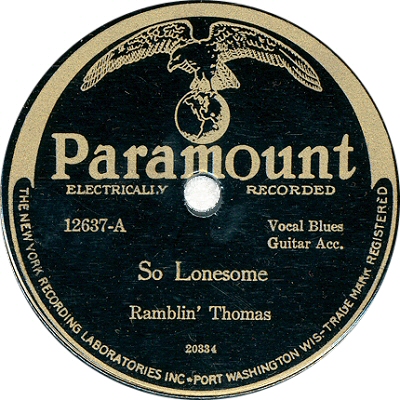
The Texas Blues #5 – So Lonesome – Ramblin’ Thomas

It’s Monday morning, so I expect some of you have the blues! & here’s some Monday Morning Blues on Robert Frost’s Banjo to help you sing them away.

Today’s post is a continuation of the rather ambling & meandering Texas Blues series—we’re still very much in the acoustic portion of the proceedings, & still very much in the 1920s. Today’s featured artist, Ramblin’ Thomas, in fact recorded one of my all time favorite blues: his version of “Poor Boy Blues,” which he waxed for Paramount in 1928.

But I’ve already written about his “Poor Boy Blues”—& other versions of that song (or concept) in the Poor Boy Blues series. Not wishing to re-invent the wheel, this is what I had to say about Thomas in my brief biography in that earlier post:

Ramblin’ Thomas was born Willard Thomas in Logansport, Louisiana in 1902.  Not a lot is known of his biography, tho the fact that his younger brother, Jesse “Babyface” Thomas was “re-discovered” in the 1970s (& lived until 1995) did fill in some gaps about his life.  We know that Ramblin’ Thomas moved to the Deep Ellum neighborhood of Dallas sometime in the late 1920s, & that his considerable travels also brought him to Chicago & other points in the midwest.  He recorded 16 of his existing 20 sides in Chicago in 1928 during two separate sessions for Paramount—the first was in February, the second in November.  The fact that Paramount brought him back for a second session suggests that they considered his material to be commercially viable.  He also recorded four songs for Victor in Dallas in 1932.

Since I’d already written about his recording of “Poor Boy Blues,” I decided I choose another song for this series, & I decided on “So Lonesome,” a song I’ve played around with myself. It’s a much more straightforward piece, as it follows more closely what we think of as the standard 12-bar blues structure.  Still, it displays the characteristic sparseness of Thomas’ playing—lots of single string notes, minimal chording, & virtually no accompaniment while he’s actually singing. It is, of course, a slide guitar piece played in the “Vestapol” tuning—typically either open D or open E—tho this recording is in the key of F, achieved presumably with a capo (tuning all the way up to F in “Vestapol” tuning would not only be hard on the strings but on the guitar neck itself.)  “So Lonesome” was recorded at the same February 1928 Paramount session as “Poor Boy Blues,” & was an “A side” backed with “Lock & Key Blues.”

Enjoy!

Monday, August 13, 2012

The Texas Blues #4 – Dark Was the Night, Cold Was the Ground – Blind Willie Johnson

Happy Monday, friends. We’re here with a new edition of the Monday Morning Blues, & as we’ve been doing lately, we’re taking a trip to the Lone Star state for some Texas Blues.

 “The blues” covers such a diverse range of music; indeed, it’s used as a catch-all phrase for much of early 20th century African American music, ranging stylistically from the east coast ragtime-influenced stylings of Blind Blake to the deep south one-chord modal music of King Solomon Hill; from the banjo & jug driven sound of Cannon’s Jug Stompers to the heavy slide sound of Son House & others in the Mississippi Delta region. In addition, we tend to categorize African American sacred music from this time period in with the blues, so that for instance Reverend Gary Davis is found in the blues music racks, & Blind Willie McTell’s “I Got to Cross the River Jordan” is generally packaged right along side “Mama Tain’t Long fore Day” or “Brokedown Engine Blues.” Thus, one of the greatest of the early gospel singers & musicians, Blind Willie Johnson from either Brenham or Temple, Texas, is generally classified as a “blues” musician, tho his repertoire, at least based on the 30 sides he recorded between 1927 & circa 1930, consisted solely of spiritual or gospel songs.
 Johnson’s biography, insofar as it’s known to us, is a harsh tale of a hard life. Apparently blinded at age seven in an incident of appalling child abuse, he mostly made his way in the world as a street singer & preacher. He settled in Beaumont, Texas & sang & preached there (presumably there was no actual distinction between his singing & his preaching.) Johnson was married to Willie B. Harris, who sang on some of his records, & may later have been married to Angeline Johnson; but no marriage licenses have ever been discovered. Not too much should be made of this fact, since official record-keeping on the southern African-American population was not very painstaking in the first part of the 20th century.

J
ohnson’s home in Beaumont burned in 1945, & because he was a pauper, he continued to live in the burned-out house until he died from malarial fever later that year at age 48. Angeline Johnson tried to bring him to a hospital, but he was refused admission—reports vary as to whether this refusal was because he was black or because he was blind.Dark Was the Night, Cold Was the Ground” is a song about the Crucifixion. Johnson hums & moans, while playing some of the most beautiful slide guitar you will ever hear. The song is played in open D, & it’s reported that Johnson used a knife as the slide—not an uncommon practice in those times. In 1977, Johnson’s 1927 Columbia recording of the song was chosen as one of 27 pieces of music (along with various natural sounds) to be placed on a recording on the Voyager Golden Record to be sent on the Voyager spacecrafts into deep space.  Carl Sagan, who was among those who chose the selections, said “Dark Was the Night, Cold Was the Ground” was selected because "Johnson's song concerns a situation he faced many times: nightfall with no place to sleep. Since humans appeared on Earth, the shroud of night has yet to fall without touching a man or woman in the same plight."

The song also served as the basis for Ry Cooder’s soundtrack to Wim Wender’s film, Paris, Texas. Cooder has called this "the most soulful, transcendent piece in all American music."

A special piece of music & a transcendent performance indeed.


All images link to their source
Image of Blind Willie Johnson is from bluesnexus.com. According to Wikipedia, which uses a cropped version of this image, the photograph is in the public domain
Image of the 1927 Columbia "Dark Was the Night, Cold Was the Ground" record is from Wikipedia. They claim fair use
Image of the Voyager Golden Record is from Wikipedia. This NASA image is in the public domain

Monday, July 30, 2012

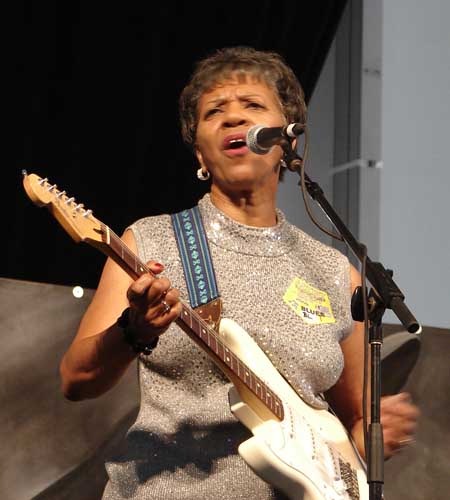
Any Woman’s Blues #22 – Barbara Lynn

Welcome back to our first edition of Any Woman’s Blues in quite some time! It’s one of my own favorite series here, & I’m happy to begin posting it again. From now on, I’ll endeavor to get back to monthly installments of this.

This month’s featured artist is Barbara Lynn, a fantastic singer & guitarist whose career dates back to the early 1960s (as evidenced by the first video below.) Ms Lynn hails from Beaumont, Texas, & she really hit the scene in 1962 with the #1 Billboard R&B hit, “You’ll Lose a Good Thing” (later covered in a country version by Freddy Fender!) You can follow this link to hear Lynn play this tune—I opted against including here because I believe the two videos I chose showcase her guitar-playing more effectively.  In addition, her song "Oh Baby (We've Got A Good Thing Goin')" was covered by the Rolling Stones on their 1965 release The Rolling Stones Now! After recording on the Jamie & Tribe labels thru much of the 1960s, she was signed by Atlantic in 1967 & produced yet another hit, “"This Is the Thanks I Get."

Following her marriage (around 1970—can’t find the exact date), her career went mostly on hold as she devoted herself to family for most of the next two decades, with only occasional nightclub appearances. But towards the end of the 1980s, she returned to her musical career, signing with the Iciban label & releasing You Don’t Have to Go in 1988. Lynn also has inked recording deals with Antone’s & Dialtone, & now has 11 albums to her credit. She’s also touring, & as you can hear in the second video—her beautiful cover of “Misty Blue,” both her guitar & vocal chops are as impressive as ever.

Lynn’s guitar style mixes solid rhythm featuring lots of damped & accented upstrokes with very direct & compelling leads & fills. You’ll notice that she plays fingerstyle, using a thumbpick—unusual in general on electric guitar, tho it is used by some blues artists (for example, Lynn’s fellow Texan Lightnin’ Hopkins.) Early in her career her standby guitar was a Fender Esquire, but these days she seems to favor the Stratocaster.

Hope you enjoy the music by this truly wonderful artist!


Pic by Wiki use Masahiro Sumori. This file is licensed under the Creative Commons Attribution-Share Alike 3.0 Unported license. 

Monday, July 23, 2012

The Texas Blues #3 – Black Snake Moan – Blind Lemon Jefferson

Welcome back to the sporadic & spasmodic posting schedule of Robert Frost’s Banjo. Will wonders never cease: I actually have a Monday Morning Blues post for you folks!

If you remember back a ways, I’ve been slowly constructing a series of notable Texas Blues artists & songs. Since there’s been some lapse, I’ll refer you back to the first two installments on Henry Thomas & Texas Alexander.

Today’s featured artist is seminal, whether you’re talking about Texas blues, acoustic blues, or just the blues in general. Blind Lemon Jefferson was one of the biggest stars of his day, & was the first male blues singer who could compete with the so-called Blues Queens such as Bessie Smith, Ma Rainey, Ida Cox & others in terms of popularity. Although the white blues audience has since revised the history of the early blues such that it seems the lone guitarist-singers were the major figures, in fact this wasn’t true for audiences in their own time. Jefferson was an exception; there were a few others like Lonnie Johnson & Tampa Red, but the performers we know think of us most significant, like Charlie Patton, Blind Willie McTell & Robert Johnson, at best enjoyed a regional fame.

Lemon Jefferson was born in 1893 in Coutchman, Texas. Blind from birth, he began playing guitar in his early teens, & in addition to playing the picnic & party circuit, he also began a career as a street musician. Around 1910, he began traveling to Dallas, & particularly the Deep Ellum section that was the center of a growing blues scene. He moved to Deep Ellum in 1917, & it was at that time he got to know T-Bone Walker, who he taught blues guitar in exchange for Walker’s services as a guide. Leadbelly & Lightnin’ Hopkins also knew Jefferson during his time in Dallas.

Jefferson’s recording career—almost exclusively with Paramount—lasted only three years, from 1926-1929, but during that time he recorded a number of hits & also songs, like “Black Snake Moan” that have become classics, not only in his original recorded versions, but in many covers & imitations. Jefferson’s songs were typically bawdy & filled with double entendre; musically, his accompaniments are complex, featuring intricate single note runs interspersed with his chords. Once you become familiar with Blind Lemon Jefferson’s sound, his songs are among the most easy to identify, even during the instrumental passages.

Simply amazing music—& great fun too! Enjoy!


Image of Blind Lemon Jefferson links to its source at wikimedia.org

Friday, June 15, 2012

“Ten Million Slaves”

As you may know, next Tuesday is the Juneteenth holiday, commemorating the end of slavery in the state of Texas in 1865.  Specifically, it’s understood as the date that the Emancipation Proclamation was recognized as law in Texas, & as such was a watershed day for the Proclamation becoming the law of the land not just in woird, but in action. While the holiday originated in Texas, it is now recognized as either a holiday or an “observance” in 41 states in addition to the District of Columbia.

Despite that official recognition, Juneteenth isn’t widely known, but it certainly deserves our attention. As my own small way of doing this, I wanted to bring it up in the context of Banjo Friday—because the banjo, with its African origin, followed by initial descriptions in which various European writers find it hardly “musical” at all, to its appropriation for mistrel shows & later morphing into a bluegrass instrument—is in itself a potent object that can teach a lot about shifting race relations & racial identity in the US.  A great place to start exploring this is Picturing the Banjo (which I wrote about some time ago.)

One arc traced in Picturing the Banjo is the history of the African American community turning away from the banjo & the string music associated with it, because these were seen as hearkening back to slavery. Other writers on the history of the blues have conjectured that the development of this music around the turn of the 20th century was itself a reaction to the older music associated with the fiddle & the banjo, again because of the slavery connection. In this reading, the blues became a revolutionary music, a turning away from the past.

The reality is never quite that simple, of course. As we know from the great Carolina Chocolate Drops, the string band tradition never completely died out in the African American communities, especially in the south, & there were plenty of popular musicians who continued to incorporate fiddle & banjo music into the blues & some of its relations (like hot jazz & jug band music) thru the first few decades of the 20th century.

But while that arc isn’t true in anything like an absolute sense, it is generally true in terms of an overall trend. & not only was that a cultural trend within the black community; it also describes the musical development of a talented & intriguing musician named Otis Taylor, who’s made a name for himself over the past 17 years as a blues musician & composer of considerable talent & vision (in fact, Taylor also was a performing musician as a young man in the 1970s, but he walked away from it for almost 20 years.)

Taylor’s first instrument was the banjo; however, when he learned about its history of appropriation & minstrelsy, he put the instrument aside in favor of the guitar. However, in recent years, Talor has returned to the banjo, & in fact released Recapturing the Banjo on Telarc in 2008, a seminal contemporary banjo album on which Taylor is joined by the likes of Alvin Youngblood Hart, Keb’Mo’ & several other notable black blues artists to produce an album of reclamation.

Only in retrospect do we know both how much & how little was accomplished on June 19, 1865. There was the absolutely necessary implementation of the Emancipation Proclamation, & a literal end of the horrific institution of slavery; yet this was followed by the implementation of Jim Crow & the feudal sharecropping system. & let’s not delude ourselves that these problems were restricted to the south; in Boston, once the center of the abolition movement, school integration turned ugly even in the late 20th century. Also, while we’ve advanced culturally to the point that we can elect a black man as president, it’s disturbing to witness the unconscionably disrespectful treatment he’s received from a significant portion of the population, including elected officials at almost every level. We still have far to go.

Hope you enjoy the music, & hope you take the chance to follow some of the links & learn more about Juneteenth, Otis Taylor, & the banjo!


The photo shows the Juneteenth committee from 1900 in Austin, Texas. The image is in the public domain.

Monday, June 4, 2012

The Texas Blues #2 – “Levee Camp Moan” – Texas Alexander & Lonnie Johnson

Good morning! & yes, folks, it’s an actual edition of the Monday Morning Blues here on Robert Frost’s Banjo.

If your memory is good, you may recall that I’d just started a series on the Texas blues way back in early April. Then my season of blog malaise set in, & the series was put on the shelf. But it’s back. For the foreseeable future, I envision posting Monday Morning Blues & Banjo Friday in alternating weeks—I think that was the plan awhile ago, but this time I’m going to try to stick to it!

One of the most singular of the early blues musicians was a man named Alger “Texas” Alexander; in his recording career, he invariably went by “Texas Alexander.” Alexander was born in 1900 in Jewett, Texas, & came up as a street performer & a performer at parties. It’s said that he performed with Blind Lemon Jefferson, presumably during Jefferson’s time as a performer in Dallas.

Alexander was a singer, pure & simple—he didn’t play any instrument. As a singer, he was accompanied by some stellar instrumentalists, including guitar greats Eddie Lang,  Lonnie Johnson & “Little Hat” Jones, pianist Clarence Williams, & cornet player King Oliver. As I understand, he also used Lightnin’ Hopkins as an accompanist later in his life, & there is some speculation that the two were cousins.  Alexander also recorded with the immensely popular Mississippi Sheiks.

Texas Alexander was no smooth blues crooner, however. As you’ll hear in his great “Levee Camp Blues,” his style & delivery owed a lot more to field “hollers” & work chants than to melodious popular song. Given this fact, pairing him with great jazz players like Johnson, Land, & Oliver is itself singular—& indeed, most of his accompanist’s agreed that it was challenging to follow him, as he would often stretch the time, add beats, & even change keys while singing! Nonetheless, his duets with Lonnie Johnson are considered masterpieces of their kind, with Johnson—a guitarist who’s very underrated these days—was able to weave counterpoint accompaniments that meshed perfectly with the singing. An unlikely duo, certainly—but one that produced unique & memorable music.

This recording of “Levee Camp Moan” is from an August, 1927 session for Okeh, made in New York. Alexander made over 50 recordings for Okeh & Vocalion in the 1920s & 30s; but he was convicted of murder in 1939, & was in the Paris, Texas penitentiary thru 1945. He continued recording until 1950 with a group called Benton’s Busy Bees, & died of syphilis in 1954.

This is really quite amazing music—I know you’re going to enjoy it!


Pic of Texas Alexander links to its source

Monday, April 30, 2012

Any Womans Blues #21 – Debbie Davies

A happy Monday, friends! It’s time for this month’s edition of Any Woman’s Blues.

Today’s featured artist, Debbie Davies, has an impressive resume & the chops to back it up. Davies grew up in Los Angeles in the 1950s & 60s, & was introduced to music at the earliest age by her two professional musician parents. On her website, Davies notes that she found herself attracted to the blues sound when still quite young, being drawn to Ray Charles’ music. Later, she came under the spell of the electric blues thru the music of the British Invasion, & specifically thru Clapton’s work with John Mayall’s Bluesbreakers.

Drawn to the sound of the electric blues, Davies settled on electric guitar as her instrument early on, despite the fact that in those days, the electric guitar was seen as very much a “male instrument.” After some time playing in the San Francisco blues scene, Davies headed back to Los Angeles in the early 80s & played with Maggie Mayall & the Cadillacs, the all-woman band fronted by John Mayall’s wife. Then a big break came in 1988, when she began touring & recording with Albert Collins. Davies says,

“I stepped through a door into the real blues world when I joined Albert’s band. It’s one thing to listen to the records and pull off the licks, or sit in the audience watching these artists play. But actually going out and touring with one, turned the blues into something completely three-dimensional for me.”

Davies also had a stint with Fingers Taylor & the Ladyfinger Revue, but also began a solo career in the 1990s, signing a contract with the great blues label, Blind Pig.  She has released a dozen albums, starting with Picture This in 1993, with the most recent being Holdin’ Court from Little Dipper in 2009.

Davies won the coveted W. C. Handy Award for Best Contemporary Female Artist in 1997, & followed that up with the 2010 Blues Music Award for Best Traditional Female Artist. Her guitar playing has won kudos from critics & her fellow musicians alike, & she plays a fierce, hard-edged style on a Fender Stratocaster.

We have two videos as usual to enjoy Davies’ playing; the second is an instrumental number that’s a tribute to the great Otis Rush! 


Monday, April 16, 2012

The Stratocaster: Fender, Fender, Fender!

Wangin' and a twangin, sounding so tough
Fender Stratocaster
And the kids in my corner, they can't get enough
Fender Fender Fender
Like the wind in your hair when the top is down
Like taillights headed for another town
Fender Stratocaster, well there's something about that sound.

Jonathan Richman

Welcome to the Monday Morning Blues—& as you probably have guessed, today’s post is a tribute to a great & iconic guitar, the Fender Stratocaster.

Of course, while I’m posting this in the series on great blues guitars, the fact is that the Stratocaster’s impact isn’t confined to any one genre—it’s also one of the classic rock guitars, & can be heard in practically all genres of popular music. Still, the list of blues & blues-oriented Stratocaster players is impressive: Eric Clapton, Robert Cray, Rory Gallagher, Buddy Guy (see first video below), Jimi Hendrix (don’t discount Hendrix’ blues orientation!), Bonnie Raitt (see second video), Ike Turner (again, a player with deep blues roots), & Stevie Ray Vaughn, just to name some of the best known. It’s also worth mentioning that, although he’s not really thought of as a blues player, Ry Cooder’s use of the Strat for slide playing has helped popularize its use in this style.

Leo Fender—who you may recall from my post on the Fender Telecaster—George Fullerton & Freddie Tavares designed the Stratocaster in the early 1950s & began marketing the
model in 1954. Interestingly, Fender himself believed the instrument to be ideal for country music—he designed the instrument with western swing guitarist Bill Carson in mind—the instrument quickly moved into the rockabilly scene, & from there into rock & roll “proper,” with its popularity being aided by Buddy Holly’s appearance on Ed Sullivan playing a Strat in 1957.

The Stratocaster was Fender’s third instrument (if you count the prototypical Broadcaster & the Telecaster as the same); the Precision Bass, another revolutionary instrument, also preceded the Strat. In comparison with the Telecaster, the Stratocaster was designed specifically with comfort in mind—it’s more contoured than the earlier model, which is no small thing as electric guitars can be a bit heavy; after all, the whole principle of how they sustain involves vibration thru a hardwood block that forms the guitar’s body.

But in addition, the Stratocaster also involved two major innovations: a third pick-up was added in the “middle” position to increase the instrument’s tonal range beyond that of the Telecaster (like the Telecaster, the Strat is equipped with single coil pick-ups, which account for its characteristic bright & biting sound.) The third innovation was the Stratocaster tremolo bridge—the “whammy bar”—which was originally intended to allow the player to imitate the sounds of a pedal steel guitar. Of course, as history has shown, the Stratocaster tremolo has been employed for an array of effects far beyond what Leo Fender & his collaborators could have envisioned!

The videos will demonstrate the Stratocaster’s blues power in the hand of master players. By the way, I picked the Raitt song specifically because she’s doing a Stevie Ray Vaughn song—my way of “covering” two fantastic Strat players in one video!


Photo of the Fender Stratocaster links to its source

Monday, April 2, 2012

The Texas Blues #1 – “Don’t Ease Me In” – Henry Thomas

Happy Monday, folks—we’re here to drive away your Monday Morning Blues—& also to start off a new series that’s going to be running for some time.

The music that we know as the blues sprang up in the southern U.S., tho no one knows exactly where or when. What we do know is that there were blues “centers”—places around which the music seemed to be particularly concentrated & which each had—to some extent at least—regional characteristics in terms of the particular blues “sound.” There was a sound associated with Atlanta & the east coast, & certainly a sound associated with Mississippi, as well as with Memphis & New Orleans, tho those cities also figured in other associated types of music as well—jazz, certainly, but also string band & jug band music. Later, blues became centered in Chicago as blacks migrated out of the south—in many ways, the Chicago blues sound post World War II was an extension of the Mississippi sound, thanks to the Illinois Central Railroad & such Mississippi stalwarts as Howlin’ Wolf, Sonny Boy Williamson I, & Muddy Waters all moving there.

But there was another center as well, & one that has in its own right been as fundamental to the blues sound as even Mississippi—& that’s the Lone Star state, Texas. Now when you think of Texas, you may think of cowboys & 10-gallon hats, of Bob Wills & Jerry Jeff Walker. But the fact is that many of the greatest blues musicians also hailed from Texas; so many, in fact, that what was going to be a 10-part series has expanded far past that, & will move in rough chronological order from the oldest “blues” musician we have on record right thru to contemporary electric guitarists.

Henry Thomas—who often recorded under the name “Ragtime Texas” was born in 1874 in Big Sandy, Texas. Given Thomas’ age, we can be pretty sure that he was around to witness the development of the blues from whatever its ultimate sources were, & he is often referred to as a “songster,” meaning that he didn’t specialize in blues, but played in a number of genres. Of course, that’s deceptive, because there’s strong evidence that many early musicians who we think of as playing blues exclusively also played widely in other genres too, but when it came time to record, they were mostly encouraged to draw from their blues repertoire.

In any case, we’re lucky to have Thomas’ music on record, as he disappeared not long after his 1929 sessions, & is presumed to have died in the early 1930s. Between 1927 & 1929, however, he recorded 23 sides for Vocalion.

Probably Thomas’ best-known song is “Fishing Blues,” a double-entendre, slightly ragtime tune that was famously covered by both the Loving Spoonful & Taj Mahal. Thomas’ own version is the final cut on Harry Smith’s Anthology of American Folk Music, & it includes one of Thomas trademarks—his solo on the quills, an African-American instrument that’s essentially a panpipe. A guitarist like Thomas could play the quills while he accompanied himself on guitar with the means of something like a harmonica rack. Although I didn't choose "Fishing Blues" for today's song, it worth a listen for sure. You can find it on YouTube  here.

Today’s song doesn’t have the quills, but it may be Thomas’ second best known tune, not so much because of his performance but because it was covered by the Grateful Dead  & was a concert staple.

It’s been conjectured that “Don’t Ease Me In” is a close relative to “Alabama Bound,” which was a hit for Papa Charlie Jackson in the mid 20s, & in different forms found its way into the repertoire of such diverse artists as Jelly Rolly Morton & Leadbelly. The Grateful Dead re-wrote some of the lyrics; in the original Thomas sings, “It’s all night long, Cunningham, don’t ease me in,” which is apparently a reference to the owner of a large sugar cane plantation in Sugar Land in Texas, who leased much of his labor from state prison farms.

This is great music! Hope you enjoy it. & stay tuned, because next month there will be a new installment in The Texas Blues.


Photo links to its source

Monday, March 26, 2012

Any Womans Blues #20 – Roxanne Potvin

Happy Monday, friends! The Monday Morning Blues this morning is coming at you with another exciting performer in our Any Woman’s Blues series.

Roxanne Potvin is I believe the youngest musician profiled so far in the series—not quite 30 years old as of this posting. But despite that fact, she has already amassed an impressive resume as guitarist, singer, & songwriter. Potvin has released four albums, beginning with her self-produced 2003 release, Careless Loving, which contained a half dozen original numbers, as well as covers of tunes from the likes of Dinah Washington & Etta James. She followed this up with the 2006 The Way It Feels on Alert Canada, an album on which she was joined by several notables, including Bruce Cockburn & John Hiatt, & which also featured a cover from one of her guitar heroes
her version of Freddie King’s “Your Love Keeps Working On Me.”  This was followed by No Love for the Poisonous in 2008, also on Alert Canada, which was released to glowing reviews, & the 2011 release, Play in which Potvin moved more in the directions of folk & pop. Play was released on the Black Hen Music label.

In addition to those releases as a solo artist, Roxanne Potvin also collaborated with Sue Foley & Deborah Coleman (two guitarists who’ve been featured in previous Any Woman’s Blues installments) on the 2007 album, Time Bomb on Ruf Records. Time Bomb featured each guitarist as a soloist, & then brought the three women together to combine their impressive guitar chops on the final cut, “In the Basement.”

As one might assume based on her label, Ms Potvin is Canadian, born in Regina, Saskatchewan in 1982. Her family moved to Ottawa when she was two, & she began singing as a young child. When she took up guitar in her teens, she was drawn to a number of noted blues players—Freddie King, whom she names as a special influence, as well as Muddy Waters, Jimmy Reed & Lonnie Johnson—but also to artists from other genres as well, including vocalists Aretha Franklin, Sarah Vaughn & Dinah Washington, & also John Hiatt & Elvis—& in recording her most recent album, she notes she found herself “going back to the Beatles & Beck.” She is currently based out of Gatineau, Quebec; her website is maintained in both English & French, & Potvin is herself bilingual.

We’ve got a couple of videos to showcase Roxanne Potvin’s talent, & I know you’ll enjoy them. The first video, “A Love that’s Simple,” focuses more on her wonderful vocal ability, while the second, “Caught Up,” not only features another great singing performance, but also some really nice guitar work. As you can see, Potvin plays a Telecaster. I’ve also seen photos & videos of her with an acoustic, but I’m unable to identify the brand or model. She gets a great tone out of the Telecaster; I really enjoy her direct playing style.

Happy Monday & enjoy the music!


Photo links to its source

Monday, March 19, 2012

Poor Boy Long Way from Home #12 – The Black Keys

Happy Monday to you all! I’m changing up the schedule a bit here on the Monday Morning Blues & using this post to bring the Poor Boy series to a close. Yes, this is the twelfth & final post in a series that has enabled us to see a blues song in various states of transformation from Bo Weavil Jackson’s 1926 recording to this almost contemporary version released in 2004 as “The Moan” on their EP of the same name by The Black Keys.

The Black Keys are a guitar & drum duo that hail from the U.S. Rust Belt—Akron, Ohio, in fact, & who bring a heavy duty, roots-based attack to a repertoire of mostly original material—but they do include interesting covers of diverse musicians, including Louisiana blueman Robert Pete Williams, the Stooges, the Sonics, & Mississippi Juke Joint bluesman Junior Kimbrough. Speaking of Mississippi Juke Joints, “The Moan” to my ear is heavily influenced by RL Burnside’s “Poor Boy Long Way From Home.”  The band members are Dan Auerbach on vocals & guitar & Patrick Carney on drums.

Recently, the Black Keys have won some relatively mainstream recognition, as their song “Tighten Up” won a Grammy for “Best Rock Performance by a Duo or Group with Vocal,” & was also nominated for “Best Rock Song.” In addition, Brothers, their 2010 Nonesuch release on which this song appears won both “Best Alternative Music Album” & “Best Recording Package”—the latter refers to an album’s artwork, not to the actual recorded performances.

Auerbach & Carney bring a lot of energy to their version of the song (they actually claim writing credits for “The Moan”—I’ll just let you draw your own conclusions on that), & their grunge/punk-inflected version of old blues is one of the more interesting from a white band since Captain Beefheart’s massive deconstruction/reconstruction of blues—both covered & original—during his heyday. 

Next month there will be some changes in the Monday Morning Blues line-up—two new features will debut, & in addition to the Poor Boy series ending, the Blue Notes blues/jazz series also is going to go away, tho to some extent it may be incorporated into one of the new features
—stay tuned for details! Any Woman’s Blues will continue (at the rate of one post per month, I could keep this feature going a couple of years more at least!) & the Blues Guitar series will go at least one more month, tho I’m running a bit low on ideas of guitars that are very associated with blues performers.

In the meantime, enjoy The Black Keys & “The Moan”!