Happy July 4th! I thought a brief banjo interlude might be just the thing for the day, & what says Americana better than a Scottish & French sextet playing a composition by an African American composer on various forms of an African instrument that has been considerably altered in the Americas?
The Auld Alliance Banjo Sextet is a spin off from Rob McKillop’s Scottish Classic Banjo Quartet, which features McKillop on gut-strung banjo along with his students, Alasdair Dewar (banjorine), Alan Ramsey (banjo), & Cat Campbell (cello banjo). McKillop has been featured several times on Robert Frost’s Banjo. He’s a classical guitarist, a lutenist, a uke player, & a wiz on various forms of the banjo. In the sextet version of the group, he’s added accomplished French players Eric and Pat Stefanelli.
“The Calliope Rag” was composed by James Scott. Scott is less well-known than Scott Joplin, but he was a major composer in the ragtime tradition who published a number of pieces between 1903 & 1922. In fact “The Calliope Rag” was published posthumously & didn’t become available until 1966!
For those of you celebrating the Fourth of July, hope you have a wonderful day & evening. & for those of you not in the States, hope you have a lovely day!
Image links to its source on Wiki Commons
"Calliope, the wonderful operonicon or steam car of the muses", advertising poster, 1874
Library of Congress. Public domain

A happy Banjo Friday to you!
Today we wrap up our monthly series on Vess Ossman, the “classic style” banjoist who made some of the first ragtime recordings & also some of the first banjo recordings. As far as I can determine, Ossman’s earliest recordings date to 1897, when he recorded “The Smiler” & Sousa’s “Stars & Stripes Forever.” In fact today’s recording, “Ragtime Skedaddle” (with piano accompaniment to Ossman’s banjo) dates to 1899.
Recordings at that time were made on cylinders—the disc record was still several years away. The cylinders were first made of wax, but later were made of celluloid, & were marketed as “indestructible.” Fortunately, a number of them proved to be, & there are organizations like the Cylinder Preservation Project (link here to their home page, & here to their Facebook page), which are making an effort to preserve the actual cylinders & digitize the music they hold. There are a number of recordings on the Project’s website, all free to listen to (obviously, all this music falls in the public domain.)
In referring you to the site, I probably should note that a fair number of music titles from this era, including several recorded by Ossman himself, contain offensive racial epithets. Sadly, the banjo has always had a fraught history in this country in terms of its symbology as an instrument that began with black/African origins & was co-opted by white/European culture.
It’s a deep subject, & one that would require more space than I have here to treat. Those who are interested in reading more about the banjo’s social history in the U.S. really should check out the fine Picturing the Banjo, which I reviewed on the blog some time ago.
In the meantime, this is delightful music, & I hope you enjoy it! Back next month with a new series.
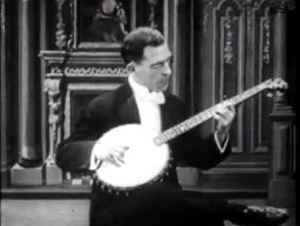
The photo of Vess Ossman links to its source on violafair.com. It appears to be a still of Ossman from an early film. In any case, since Ossman died in 1923, any photographic image of him must of necessity be in the public domain.

A happy Banjo Friday!
Today’s post will be brief, as it’s being done on the fly, but it’s another selection from this month’s featured artist, Vess Ossman. If you’ve missed the previous two posts, Ossman was a master banjo player in the late 19th & early 20th centuries, a star of the vaudeville circuit, & also an early recording artist.
“The Buffalo Rag” was recorded in 1905 or 1906 (I find conflicting dates on the web.) This is a departure from the first two recordings I’ve featured, in that one of those was a solo & the other played with just a backing piano. In this case, Ossman is playing with his full “orchestra,” presumably a combo similar to the one in the photo above.
Now 1905 was in the days of cylinder recording (by that time, mostly the “indestructible” celluloid cylinders), & more to the point, it was years before the advent of mult-tracking. In order to “balance” the instruments’ sound, the recording engineer had only one expedient at his disposal—get the loud back-up instruments as far from the mike as necessary! Now a 5-string banjo is relatively loud, but remember, Ossman was playing a banjo strung with gut-strings, which are not as loud as the steel strings used by most players now, & he was playing with his bare fingers, not with fingerpicks. In addition, based on the photographs I’ve seen, his banjos all were open-backed, & not equipped with a resonator, such as you see on banjos set up for bluegrass. All of those would combine to make an instrument that had a more mellow tone, & also one that projected less sound—so getting its sound to come through the brass would be a challenge. I do note that the diameter of the head on Ossman’s banjo is fairly large, & that would help give a somewhat more full sound.
Hope you enjoy it! It’s fun music.
Image links to its source at soupgreens.com. Given that Ossman died in 1923, which is the cut-off year for public domain in the United States, any photograph of him must necessarily be in the public domain.

Hey, it’s Banjo Friday! Hope your week is coming to nice end & that you’re looking forward to the coming weekend. What better way to start it than with some banjo music?
If you stopped by last week, you know that this month’s featured artist is Vess Ossman, a master banjoist who played in the late 19th through the early 20th century, & made some very early recordings of banjo music, both as a soloist as in today’s selection & as a leader in an ensemble. Ossman played the 5-string banjo with gut strings, in what is now called the “classic style,” namely in an approximation of the right-hand technique used for classical guitar playing. This style has lost favor over the years, & most people these days encounter the banjo either in a bluegrass context, where the Scruggs style finger rolls are the underlying technique or in an old-time music, where the banjo is typically played in the frailing style. But there are still players these days who like the “classic style,” & I’ve featured it a good deal lately on the blog, since it interests me quite a bit.
Ossman recorded “Dill Pickles Rag” in 2008, & it’s a cylinder recording as you will see in the video. Phonograph cylinders are quite a story in themselves. Edison’s first recording cylinders used tin foil, but within a couple of years he had patented the wax cylinder, which actually could be used for home recording, as well as commercially. However, by the early 20th century, the “indestructible” celluloid cylinders were developed, & these came into mainstream use. Actually, by the time Ossman recorded “Dill Pickles Rag,” the cylinders were already in decline in favor of the disc. It is interesting that the cylinders were thought to have better audio reproduction than discs—so apparently, the downhill curve that we note in our own time in audio reproduction from LPs downward to CDs & still further down to mp3s, had already started in the early 20th century! We should have stuck with the cylinders.
Hope you enjoy this lively & fun recording.
The image of the Edison Cylinder Records links to its source on Wiki Commons. It dates from 1910 & is the public domain
A happy Banjo Friday! The month of February is upon us, & I have some exciting series planned for this month—with one caveat. I have been having some computer woes, & these have affected the posting schedule a bit (e.g., no Any Woman’s Blues in January.) But I hope to have the problem straightened out before too long, & also hope that I can keep things going with some degree of normalcy in the interim.
I think Banjo Friday works best when there’s a theme or featured artist, & we do have one for February. Vess Ossman was one of the most popular banjo players at the turn of the 20th century, & also was an early recording artist, including recordings made on cylinders in the latter part of the 19th century—in fact, today’s recording “A Bunch of Rags,” was made in 1898! One source claimed that this is the first ragtime recording, but according to the Red Hot Jazz website, it was actually the third.
Ossman played in what is now called the “classic banjo” style: he fingerpicked the instrument in a way that’s similar to playing a classical guitar, & he used gut strings. His repertoire featured a number of rags & rag-inflected pieces. In addition to making many recordings, he toured the vaudeville circuit, & enjoyed considerable fame both in the States & abroad; at one point he made a tour of Great Britain.
This is wonderful music, & while the mainstream banjo sound has developed in different directions, musicians like Ossman played a key role in popularizing the instrument.
Hope you enjoy “A Bunch of Rags.”
Photo of Vess Ossman (circa 1900) links to its source on Wiki Commons & is in the public domain
Welcome once again to Banjo Friday, final edition of 2012!
Today we wrap up our series with December’s featured artist Rob MacKillop, as he performs another Frank Converse tune, this one dating from 1886 & played on a gut-strung Luke Mercier banjo. MacKillop’s playing is always first-rate both in terms of technique & feeling, so I’d encourage you to check out more of his music—he also performs on classical guitar, lute (in its various manifestations) & ukulele. MacKillop has also authored several books of arrangements for both banjo & ukulele, & those look really interesting. Please see Rob MacKillop’s website for details on his recordings, performances & books.
Have a happy Friday, friends! Hope this lovely & playful banjo tune adds to your day.
Image links to its source at robmackillop.net
Welcome to the all-time latest edition of Banjo Friday ever—"latest" in every sense of the word. Really, I’m a bit sheepish to post this when Friday is almost become Saturday back east. But it will remain the top post on the blog all day tomorrow. I’m also confident we won’t encounter another snafu with this piece as we did with Thursday’s ill-fated Guitarists We Like post; that video, featuring John Fahey’s singular version of “It Came Upon the Midnight Clear,” was blocked by UMG & wouldn’t play on the blog, despite the fact it had played on YouTube itself the evening before.
This evening—or tomorrow, or whenever you come across this—we have more classic banjo with this month’s featured artist, Rob MacKillop, & another piece from late 19th century banjoist & composer Frank Converse, whose works are a staple among classic banjo enthusiasts. It really is a lovely, delicate piece, played with great sensitivity by MacKillop on a Thomson and Odell banjo from Boston, dating to around 1890. MacKillop is using Aquila Nylagut strings, a brand with a good reputation not only with nylon string banjo players, but with uke players as well.
Enjoy!
Image of Mr MacKillop links to its source at banjocrazy.com

Welcome, friends, to Banjo Friday! We sure do have a couple of pretty banjo tunes for you today.
If you’re a regular here, you know that this month’s featured artist is Rob MacKillop, a Scottish banjoist who excels in the classic banjo style (when he’s not excelling on various lutes, the classical guitar, the uke or the 4-string varieties of banjos!) & if you’re a regular you also know that the so-called classic style has its origins in the 19th century, & has two defining characteristics: it is typically played on a gut strung (or nylon/synthetic gut-strung) instrument, & it is played by plucking the strings in the same way as a fingerstyle guitarist, with bare fleshy side of the fingers & thumb. In this, it contrasts quite sharply with the two most prevalent styles in contemporary banjo playing—the so-called 3-finger Scruggs or bluegrass style, which also features “up plucks,” but builds melodies on syncopated patterns & is always played with fingerpicks & thumbpicks & on a banjo fitted with steel strings & a resonator; & the frailing or clawhammer style, which covers a host of techniques, but typically involves striking down on the strings with the fingernail of either the index or middle finger, which then alternates in various patterns & configurations with the thumb. The Scruggs style emphasizes the banjo’s brightness & volume; frailing emphasizes its percussiveness.
But the classic banjo style is a whole different thing altogether, & really makes for fun listening! I’ve always found it most natural to “fingerpick” the banjo myself, coming as I do from playing fingerstyle guitar, though I admit I’ve yet to actually put nylon strings on mine. Some day.
The “Gumbo Reel” & “The Pequod Galop” both come from Frank Converse’s 1865 New & Complete Method for the banjo, & features just the sort of pieces folks love to play in the classic style. As is his wont, MacKillop presents delightful versions for our listening pleasure.
Enjoy!
Image links to its source at classicbanjorm.com

A happy Friday, friends! & a Banjo Friday at that.
A new month is upon us, & so we have a new featured artist. After a fun month with the innovative Danny Barnes in November, we’re going back to the “classic banjo” sound with master Scottish banjoist (& lutenist, guitarist & uke player) Rob MacKillop (& see also this link.) MacKillop has appeared in previous posts here, & I’m a big admirer of his work in genres ranging from early music on the theorbo to Scott Joplin on the banjo!
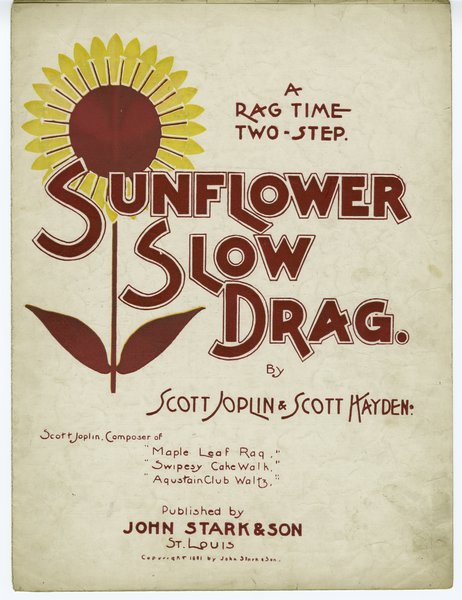
Obviously, Scott Joplin needs no introduction—he’s one of the truly great American composers, a man who really brought the ragtime form to its true artistic heights. Of course, Joplin’s compositions were written for piano, the banjo is also a great vehicle for expressing his pieces—in skilled hands, the banjo can produce the delicacy of the compositions, while also lending its characteristically “American” sound. The “Sunflower Slow Drag” was co-written by Joplin & Scott Hayden & was copyrighted in 1901. It is a ragtime two-step.
As is typical of “classic banjo” playing, MacKillop is using a gut-strung instrument. His playing is precise, but at the same time is always marked by the sort of verve & panache that’s necessary to truly animate the tune.
I know you’ll enjoy this one!
Image links to its source on Wiki Commons – public domain
.jpg/767px-Calliope_-_The_Wonderful_Operonicon_(1874).jpg)