A miscellany like Grandma’s attic in Taunton, MA or Mission Street's Thrift Town in San Francisco or a Council, ID yard sale in cloudy mid April or a celestial roadmap no one folded—you take your pick.
Showing posts with label Early Music Sunday. Show all posts
Showing posts with label Early Music Sunday. Show all posts
The guitar as we know it today was most certainly not an instrument used in early music. The modern classical guitar (& all its various descendants) is in many ways a 19th century invention, a thorough re-working of an instrument that lacked many of its current properties, especially in terms of sound projection.
Of course there was the baroque guitar, which is an ancestor of our modern instrument, without question, but there were a number of dissimilarities, & also the baroque guitar was primarily a continuo instrument, & as such its voice often was not featured. Of course, the classical guitar as we know it today is primarily a solo concert instrument.
Still, much music from the Baroque period & even earlier has been adapted for the classical guitar. The repertoire of Gaspar Sanz, Sylvius Leopold Weiss & Robert de Visée, who all wrote for both baroque guitar & lute, is often adapted, as are works by the well known Baroque composers—obviously, Bach, whose cello & lute works in particular have been transcribed & often performed, but also other well known composers of the time, such as Vivaldi, Handel & others. & so, rushing in where angels fear to tread, I’ll be featuring classical guitar performances of Baroque music this month on Early Music Sunday.
Here we have guitar virtuoso John Williams' performance of Domenico Scarlatti’sSonata in D minor, K. 213, originally written either for harpsichord or the early form of the pianoforte. If you’re curious, you can hear this piece played on a piano at this link.
Domenico Scarlatti was Italian by birth, but lived much of his life in Spain & Portugal, where he was music master for both royal families. He was the son of Alessandro Scarlatti, who was a renowned composer himself, especially in terms of the early opera.
Scarlatti arrived in Lisbon in 1719, & became music teacher to Portuguese princess Maria Magdalena Barbara. After spending some time in Italy in the later 1720s, he moved to Sevilla in 1729, & in 1733 he traveled to Madrid to be rejoined with his pupil Maria Barbara, who had since married into the Spanish royal house. He is thought to have composed most of his keyoboard sonatas during his years in Madrid, where he stayed until his death at age 71 in 1757. Scarlatti, like Johann Sebastian Bach’s son, Carl Phillip Emanuel Bach, is seen as a composer who bridged the Baroque & early Classical periods.
A lovely version of this lovely piece of music—enjoy!
Image links to its source on Wiki Commons Retrato de Domenico Scarlatti (Portrait of Domenico Scarlatti), Domingo Antonio Velasco, 1730 – public domain
Sorry this week’s Early Music Sunday post is late & short—I’ve been dealing with a nasty cold all week, & am just now starting to feel marginally like a member of the human race again.
This month’s featured artist has been harpsichordist Chiara Massini, & each Sunday post has brought you her performance of one of the 48 sets of preludes & fugues that make up Bach’s Well-Tempered Clavier. While I’d intended to go a bit more in depth in these posts, circumstances conspired against me. But the music is the main thing, & I know you will enjoy today's selection. If you’d like to learn more about Massini, all her relevant information is given in the four previous posts, which can be found here.
Hope you have a lovely Sunday.
Image of Chiara Massini links to its source at chiaramassini.com
A happy Sunday, friends. I have some wonderful music for you today—& a very short post to accompany it.
My life is busy these days, & I haven’t been able to put the time into the blog or the whole blogging process that I used to. Still, I continue to be happy that Robert Frost’s Banjo exists & that people still enjoying visiting it!
If you’ve been following along Sundays in March, you know that I’m featuring the music of Chiara Massini, a remarkably gifted harpsichordist, & specifically focusing on her performances from the set of 48 Bach preludes & fugues that we call The Well-Tempered Clavier. Today’s selection is from the second set of 24 (each book of the two sets, which were published 20 years apart, feature a prelude & fugue set in each major & minor key.)
I enjoy Ms Massini’s playing a great deal, & you can hear more of her on her fine YouTube channel, as well as follow her on Facebook—though the latter page is in Italian—still, it does keep you up to date on her new videos. Finally, Chiara Massini has two albums available at CDBaby.
Hope you enjoy this splendid music & that you have a lovely Sunday.
Photo of Chiara Massini’s harpsichord links to its source at chiaramassini.com
Last week I promised a short post for Early Music Sunday & then went on a bit at length about Bach’s Well-Tempered Clavier & the question of enharmonic notes in meantone & well temperaments. But today’s post really will be short!
Our featured artist on Early Music Sundays in March is harpsichord player Chiara Massini. While Massini performs a diverse selection of harpsichord literature, she has made many recordings of Bach pieces, so I’m featuring her performance of various preludes & fugues from the collection of 48 by Bach now called The Well-Tempered Clavier. Today’s selection comes from Book 2, the later collection that was compiled in 1742, 20 years after the original Das Wohltemperierte Klavier. Since the second compilation, like the first, takes us through all 24 major & minor keys, we again find ourselves in D minor.
Chiara Massini’s playing is a real delight. I invite you to visit her website as well as her fine YouTubechannel, where you can hear a much wider range of her work than we can cover in five Sundays!
It’s late Saturday evening—& as we all know, with the time change it’s later even than it seems. As a result, I will make the Early Music Sunday post brief.
Our featured artist on Sunday this month is harpsichordist Chiara Massini, & the videos will feature her performances of five preludes & fugues from Bach’s masterpiece The Well-Tempered Clavier, which as it now existsis made up of two collections Bach compiled 20 years apart, with the Well-Tempered Clavier (Das Wohltemperierte Klavier) being compiled in 1722, & a book Bach called Twenty-Four Preludes & Fugues compiled in 1742. These collections are now considered book one & book two of the overall collection of 48 preludes & fugues—in other words, in each book one prelude & fugue in all 24 major & minor keys.
Bach wasn’t the first composer to create a sequence of works that traveled through all keys, though his was early, coming at a time when tuning was shifting from a system we call meantone temperament to what is called well temperament, itself a precursor of the standard equal temperament used by modern Classical orchestras—not to mention midi & a high percentage of western musicians.
The problem well-temperament was trying to address had to do especially with a quirk in the meantone system. If you’ve ever taken piano lessons, you probably recall that the black notes can have more than one name—so the black note directly to the right of a C can be called C sharp or D flat. On a modern piano, the tones are identical, & that is the convention in western music overall; we call them "enharmonic" tones. However, that isn’t the case in all tuning systems, including meantone, in which it especially affected the enharmonic keys D sharp & E flat & also G sharp & A flat. Thus, to avoid dissonant intervals, one would need to retune a keyboard instrument when changing keys, especially in going from keys with several sharps to keys with flats. Well temperament addressed this issue, as displayed by Bach’s work—interestingly, the eighth prelude & fugue set in book one has the prelude written E flat minor, while the fugue is in D sharp minor, highlighting this.
Today, however, we just have regular old D minor, but played beautifully by Chiara Massini!
Image of Chiara Massini (with tuning wrench) links to its source at chiaramassini.com
A happy Sunday to you friends! I have a fun series lined up for Early Music Sunday in March, & I feel sure you’re going to enjoy it.
If you search on YouTube, especially along lines that stray from the pop & rock hegemony, you can make some marvelous discoveries—in many ways, most of the content on this blog as it’s been configured for the past year or two has been predicated on that. You can find in abundance artists like Jordi Savall, who is a major figure in a relatively obscure field; or you can find someone like harpsichordist Chiara Massini, an artist who’s much better known in her native Italy & elsewhere on the European continent than in the United States, but is overall an up & coming performer who’s making good use of social media to increase her exposure.
Of course, simply being active in social media is one thing; in Ms Massini’s case, however, she has the talent & the chops (if one can use that term in describing the technique of a harpsichordist!) to back it up. Her playing sparkles with delight & expressiveness. I know that some commentators on YouTube (often not the most savory group of people, nor a group always with the best of intentions) have criticized her use of rubato in playing Bach, but while I am no expert, the music sounds beautiful to me. & I’m reminded of an injunction I saw years ago in a piano instruction book as part of an introduction to a Bach piece. It noted something like “Bach is always musical, & should always be played as such.” Indeed, it seems to me that Bach’s music is not some mathematical problem waiting to be solved, but glorious music. It is expressed in complexity, but I know no aesthetic rules that state complex art forms should be shorn of expression.
There’s not a lot of English language information about Chiara Massini, but I’ll try to relay the major points during the five Sundays of March. Each Sunday I’ll feature her playing a Prelude & Fugue from Bach’s Well-Tempered Clavier (& will also write about this master work.) For now, I can tell you that Chiara Massini has a website, which includes an English version, as well as versions in Italian & German. In addition, you can find her on Facebook, though most of these posts are in Italian, & she has a very active YouTubechannel (if you want to read ahead so to speak!) Finally, her recordings are available both on iTunes & CDBaby.
Greetings! I have some lovely early music for you on this final Sunday of February—which means of course, that the month of duets on Early Music Sunday is drawing to a close.
Our final duet is quite intriguing, & that’s one reason I had no qualms about posting a piece that was posted not that long ago in solo performance, namely Kapsberger’s “Toccata Arpeggiata.” We had the pleasure of listening to David Tayler’s version of it as a theorbo solo back in mid January, & I’d refer people who are interested in background on Kapsberger & the piece itself to that post. What I’d like to focus on in today’s text portion is one of the instruments in this duet performance, because it’s unusual even in early music circles.
The instrument is the lirone, the bass member of the lira family of instruments, hence related to the (slightly better known?) lira da braccio, which is a descendant of the medieval vielle, a proto-violin. The lira da braccio is held on the shoulder, not exactly in the way a modern violinist holds her/his instrument, but in the ballpark. According to Wikipedia, the lira da braccio “was used by Italian poet-musicians in court in the 15th and 16th centuries to accompany their improvised recitations of lyric and narrative poetry.” Again according to Wikipedia, the lirone was devloped in the 16th century as a bass version, to be used in continuo playing, & played “da gamba”—held between the knees like a cello or viola da gamba. The lirone could have as many as 16 gut strings!
In today’s video, the lirone is being played by Lucas Guimaraes Peres, a Brazilian native who re-located to the European continent to pursue his interest in early music. I do note that his website doesn’t list any performances since 2007, & there is very little information about him online. In Wikipedia’s article on the lirone, it notes that there are very few musicians who play the instrument, & he is not one of the “notable performers” cited in the article.
The theorbo is played by master lutenist Eric Bellocq, whose website is here (in an English version), & who also has the YouTube channel MMEBellocq, where you can find some other excellent early music performances, & some fun items as well—such as a snippet of bossa nova on the Renaissance lute!
This recording is from a performance at Souvigny in October 2006. It’s a beautiful piece of music beautifully rendered—enjoy!
Just as there aren't many lirone players, there aren't many images of the instrument. The image above is from Wiki Commons, is derived from a German postage stamp, & is marked by Wiki Commons as being in the public domain. Image links to its source.
A happy Sunday, friends! There’s some really delightful music for you today.
The name Gaspar Sanz is not known to the general public, but he was one of the most important composers for the baroque guitar. Sanz lived from 1640-1710 in the area of Madrid, Spain, where he studied & later taught at the University of Salamanca. In addition to his work in music, he also wrote poetry, though his poems have not proved as durable as his compositions.
Sanz is noteworthy for three published books that were designed as instruction & song collections for the instrument we know call the baroque guitar. Typically, the baroque guitar has either 10 strings in four double string courses, or nine strings, with four double courses & one single (usually the treble string.) Often this was tuned (from lowest sounding string to highest ADGBE, with the doubled D strings (& sometimes the A strings) actually be an octave apart—but as guitar players will see, this is like the standard modern guitar tuning without the low E string. Sanz, however, used a different tuning: GABDE. This strikes me as quite unusual, as the top two strings are only a whole tone apart.
“Canarios” is one of his best known pieces—presumably based on music from the Canary Islands. It’s here given a wonderful interpretation by a duo known as Luteduo (yes, this is duet month, as you will remember!) Luteduo is Anton Birula on lute or theorbo (as in this video) & Anna Kowalska on baroque guitar or lute. They have recorded four cds, & also have a number of videos up on YouTube. I think I’ve listened to all of these, & they are excellent without exception. This particular performance—in which they deftly interpolate themes from Bach’s cello suites into "Canarios"—was given at the Bialystok Early Music Festival in Poland in July 2009.
Hope you enjoy this lively & enchanting music as presented by the talented Luteduo!
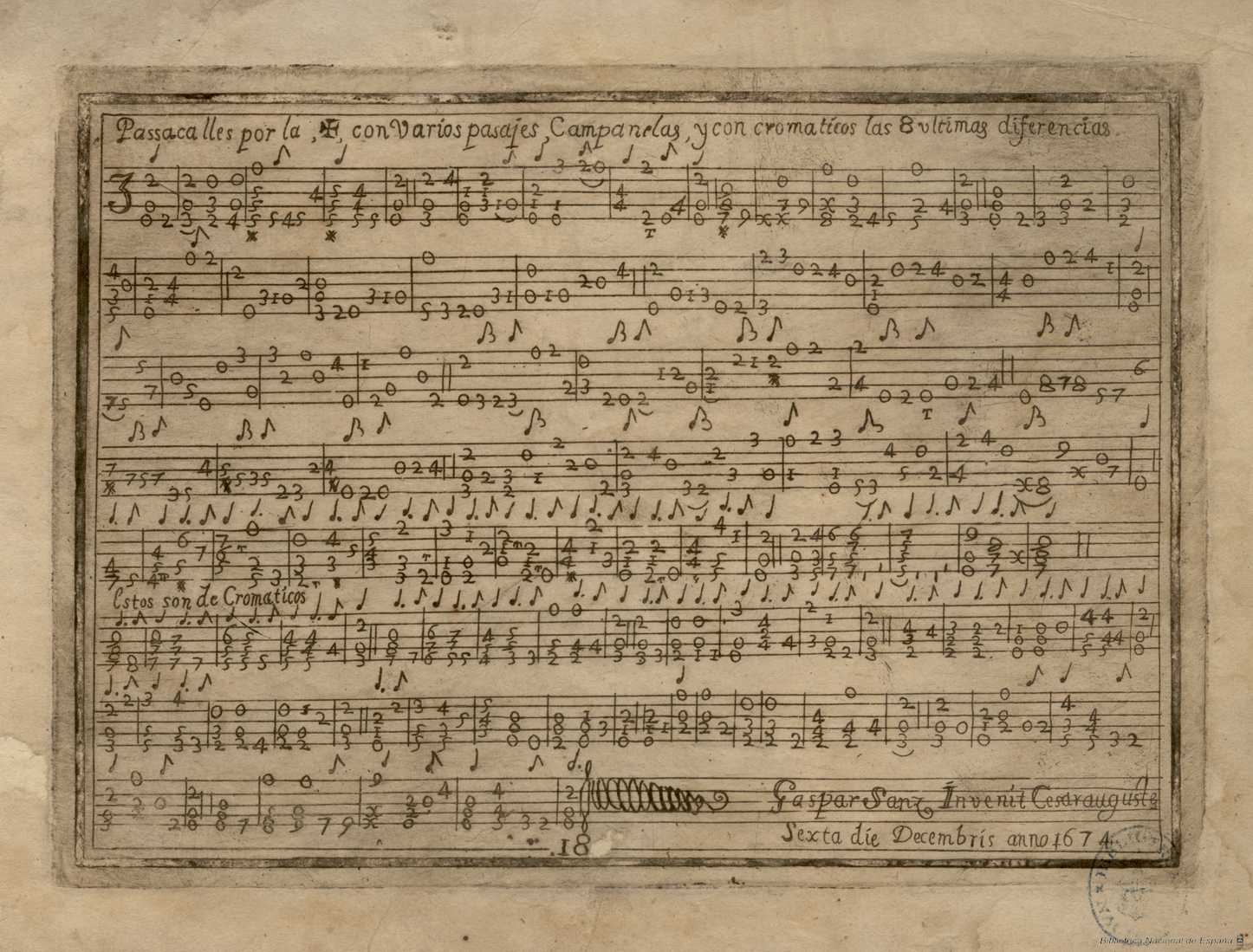
Image links to its source on Wiki Commons Example of tablature manuscript from Instrucciòn de Mùsica sobre la Guitarra Española by Gaspar Sanz, 1674 – public domain
I have a lovely piece for your enjoyment this morning, & in keeping with the February theme for Early Morning Sunday, it is indeed a duet. Bach composed this work in 1720 for harpsichord & viola da gamba; it was one of a trio of sonatas for those instruments; BWV 1027 is in G major, while BWV 1028 is in D & BWV 1029 is in G minor. Bach later re-arranged this sonata as a work for flute trio with basso continuo.
Of course the selection here is only the first movement of the piece, the Adagio—which if you are up on either your Italian in general or your Italian as it pertains to music, you know means “slow.” Actually, it comes from the expression “ad agio,” which means “at ease,” & that is a fruitful way of thinking of the tempo—relaxed as opposed to lugubrious.
The two performers are both leading figures in early music. Harpsichordist Hanneke van Proosdij is both a premier soloist & continuo player on harpsichord & baroque organ, as well as being a virtuoso recorder player. She plays regularly with the Philharmonia Baroque Orchestra, Festspiel Orchester Goettingen, Voices of Music (of which she is co-director), Concerto Palatino, Magnificat & American Bach Soloists. She has appeared as a guest artist with Hesperion XX, Concerto Köln, Chanticleer, Orchestre d’Ambronay, Leipzig Gewandhaus Orchestra & the Arcadian Academy.
Joanna Blendulf is also an accomplished performer both as a soloist & also as a continuo player; the viola da gamba assumes both roles in early music. Ms Blendulf is a member of Seattle’s Baroque Northwest, though she also performs with the Portland Baroque Orchestra, the Indianapolis Baroque Orchestra, Musica Angelica Baroque Orchestra & American Bach Soloists. She has also participated in a number of chamber music groups.
This is a beautiful piece of music, played by two top-notch musicians—enjoy!
Image links to it source on Wiki Commons: This is the “Bach harpsichord” in the Musikinstrumenten-Museum Berlin. According to Wikipedia, “Possibly formerly owned by Wilhelm Friedemann Bach, who is supposed to have inherited it from his father J.S. Bach. There is no proof for this story however.”
A happy Sunday, friends. It’s a new month, & I have a fun theme for February’s Early Music Sunday posts: duets. Yes, here in the Valentine’s month we’ll be having our early music each Sunday from a pair of musicians.
The two musicians this Sunday are both major figures in the early music field. Arianna Savall is the daughter of Jordi Savall & Montserrat Figueras. As a member of the Savall family, she has participated in Hespèrion XXI, Le Concert des Nations & similar projects—& Arianna Savall brings her own formidable musical talent to both these settings & to her solo work. Besides being a virtuoso harpist, she also is a singer with operatic tone & range & a truly beautiful voice. In addition, she is a talented composer.
Pedro Estavan is a percussionist of the first rank, who is considered a premier player both in his ensemble work—& he has collaborated in a number of the Savall projects—as well as performing as a concert soloist. He has done much work in early music, but he also is a master of contemporary styles & African percussion. I always enjoy listening to the parts he plays as he is a most sensitive player who can support & respond in ways that are always highly musical.
This particular piece was performed in 2002 at the Festival de Lanvellec, & is from the same concert of Folías de España as the Antonio Martín y Coll “Diferencias sobre las folias” piece I posted earlier. In fact, the full concert can be seen on YouTubehere; it’s about 53 minutes long, but I recommend it highly for anyone who finds themselves intrigued by early music. As far as today’s piece go, I love the interplay between the harp & the tambourine; it is one of my very favorite duets.
Lucas Ruiz de Ribayaz was a Spanish composer & guitarist who flourished in the mid 17th century; the link, by the way, will take you to French Wikipedia, as there seems to be almost no information on Ribayaz in English—& very little in any language for that matter! At any rate, it seems Ribayaz was assigned to the court of the Viceroy of Lima in Peru around 1675, & after he returned to Europe he published a work known as Luz y Norte Musical, which contained pieces in tablature for both harp & Renaissance guitar, as well as information about playing techniques. The “Tarentela” comes from that publication.
This is very lovely music—hope you enjoy it.
Image links to its source at http://simplearp.free.fr; it shows a section of harp tablature from Luz Y Norte
We started January out with a piece featuring the viol, & so I thought we would bring the month to a close with the same, though this is a “bigger sound,” with the tenor viola da gamba backed by harpsichord & joined by recorder.
The musicians are part of the ensemble Passacaglia, which is based in Great Britain. Passacaglia is made up of Louise Bradbury, Oliver Webber, Robin Bigwood, Annabel Knight, Reiko Ichise; Bigwood is playing harpsichord here, while Knight plays recorder & Ichise the viola da gamba. Passacaglia is an active group, & I notice they have some concerts coming up in February that our friends in the UK may enjoy.
Besides this piece’s obvious musical charm, it’s also interesting because it was attributed to Vivaldi for quite some time. Nicolas Chédeville was a musette player & maker, as well as a composer—the musette is a form of the bagpipes that was used frequently in baroque music. The story of his impersonating Vivaldi runs as follows (from Wikipedia):
In 1737 he made a secret agreement with Jean-Noël Marchand to publish a collection of his own compositions as Antonio Vivaldi's op. 13, entitled Il pastor fido. Chédeville supplied the money and received the profits, all of which was attested to in a notarial act by Marchand in 1749. This may have been an attempt to give his instrument, the musette, the endorsement of a great composer which it lacked.
It seems that Monsieur Chédeville was not only a composer of delightful music, but a man with a healthy sense of humor!
Hope you enjoy this lovely piece, which is so beautifully rendered.
Happy Sunday! I have some lovely music for your enjoyment today.
If you’ve been following along on Early Music Sunday, you’re at least somewhat familiar with the looks & sound of the theorbo, a rather over-sized member of the lute family that was developed in the 17th century & had its heyday in the Baroque period, with its role diminishing through the 18th century. There were several notable composers for the instrument; we heard a piece by Johannes Kapsberger last week, & this week we are hearing a “Chaconne” by Robert de Visée, a composer & musician in the court of Louis XIV, though there is speculation that he was Portuguese by nationality. In fact, de Visée wrote music not only for lute & theorbo, but also for the guitar, though of course this means the baroque guitar which differed from what we know as a guitar in several respects—it was smaller, had doubled strings (like a modern 12-string or a mandolin) & had only five string courses (either 9 or 10 strings total, because the highest pitched string often wasn't doubled), while the conventional modern guitar has six strings with no doubling.
The Chaconne is an interesting form. Although the name is French (or ciaconna in Italian) it is thought to be Spanish in origin, & there’s some speculation that the Chaconne form ultimately derived from Native American music. It is, in the words of Wikipedia:
a type of musical composition popular in the baroque era when it was much used as a vehicle for variation on a repeated short harmonic progression, often involving a fairly short repetitive bass-line (ground bass) which offered a compositional outline for variation, decoration, figuration and melodic invention.
We encountered the “ground” or “ground bass” recently when listening to the venerable “Greensleeves.” In essence, the Chaconne in its baroque manifestation was an opportunity for improvisation.
Today’s performer is Xavier Diaz-Latorre, who specializes in early instruments such as the theorbo, baroque lute & baroque guitar. He studied with the renowned Hopkinson Smith, & has performed with period ensembles such as Hespèrion XXI & Le Concert des Nations, as well as with other respected European orchestras & consorts.
Enjoy!
The image of Xavier Diaz-Latorre links to its source at www.br.de
A happy Sunday, friends. It’s been a bit slow here on Robert Frost’s Banjo so far in 2013, & especially last week, but I’m hoping to get up to a more full posting schedule this coming week.
I have a wonderful piece of music for your enjoyment today: David Tayler’s rendition of Kapsberger’s “Toccata Arpeggiata,” played on the instrument for which it was written, the theorbo. Yes, the instrument really is that big! I had the great pleasure of seeing the Oregon Renaissance Band performing at Portland Community Music Center on New Year’s weekend, & one of the program highlights was hearing (& seeing) “Toccata Arpeggiata” performed as a solo piece by lutenist Hideki Yamaya on theorbo.
David Tayler is, as his website bio states, a member of Philharmonia Baroque Orchestra, the Arcadian Academy, the Festspiel Orchester Gttingen & Parnassus Avenue. In addition to appearing with a number of other ensembles, he is also co-director of Voices of Music along with Hanneke van Proosdij, & Tayler has made a number of high definition videos featuring that ensemble's work, which are uploaded to the Early Music HD channel on YouTube. I recommend this channel to anyone who is interested in Baroque & Renaissance music, & really to anyone who just loves good music. The performances & the videos of them are all first rate.
“Toccata Arpegiatta” is perhaps the most standard piece for the theorbo. It was composed by Johannes Hieronymous Kapsberger, who lived from around 1580 to 1651. Although his family was certainly German, he probably was born in Venice, where his father, a colonel in the Imperial Army of Austria, had settled. Kapsberger himself lived in Italy, moving from Venice to Rome in the early 17th century, & was both a virtuoso performer & a prolific composer, known particularly for his lute & theorbo pieces.
David Tayler gives a beautiful reading of the piece. Enjoy!
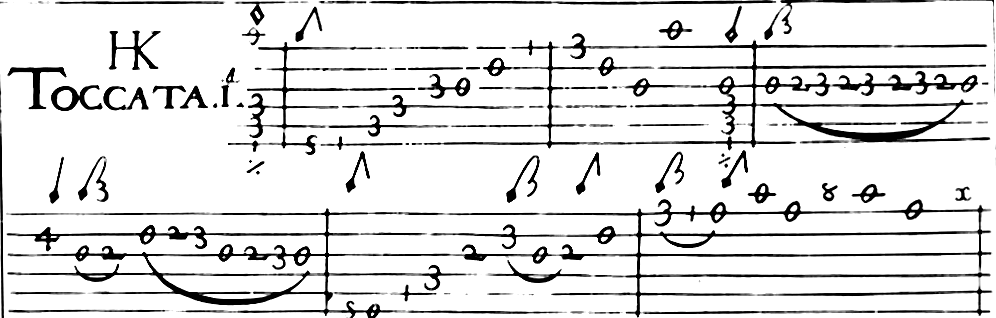
Image links to its source on Wiki CommonsFirst measures of the tablature of the first tocatta of the libro primo d'intavolatura di chitarone ("first book of chitarone tablature") by Johannes Hieronymus Kapsberger published in Venezia 1604 Public domain
Happy Sunday, friends! As you may or may not be aware, today is Epiphany, the final day of the Christmas season—Twelfth Day.
I wanted to acknowledge that fact on Early Music Sunday, but for a while I just couldn’t find a piece of early music that seemed right. I considered the Epiphany section of Bach’s Christmas Oratorio, but it’s over 20 minutes long & as far as I can tell, one would have to embed three videos to get all 11 movements. So it just seemed unwieldy for a humble blog post.
Then I stumbled across a video of Jordi Savall & Rolf Lislevand performing “Greensleeves,” & it struck me as somehow perfect, because the tune is associated with Christmas through the carol, “What Child is This,” but also is an interesting piece of music in itself that dates to the 16th century (as the Wikipedia article points out, this tune has been associated with various Christmas season lyrics all the way back to the 17th century.) The Savall video describes Greensleeves as a “ground,” which Wikipedia defines as follows:
Ground bass or basso ostinato (obstinate bass) is a type of variation form in which a bassline, or harmonic pattern (see Chaconne; also common in Elizabethan England as Grounde) is repeated as the basis of a piece underneath variations.
Wikipedia goes on to compare “Ground bass” with riffs that are repeated by a jazz rhythm section while the soloists improvise on the main melody or “head.” It’s a similar idea, & both Renaissance & Baroque music were frequently improvisational.
Jordi Savall is familiar to folks who follow early music—he is a virtuoso on the viol (in all its various sizes), & he & his late wife Montserrat Figueras founded such seminal early music groups as Hespèrion XX, La Capella Reial de Catalunya, & Le Concert des Nations. Rolf Livesland is a lutenist who is a frequent collaborator with Savall; he he provides the bass accompaniment on the theorbo.
Enjoy!
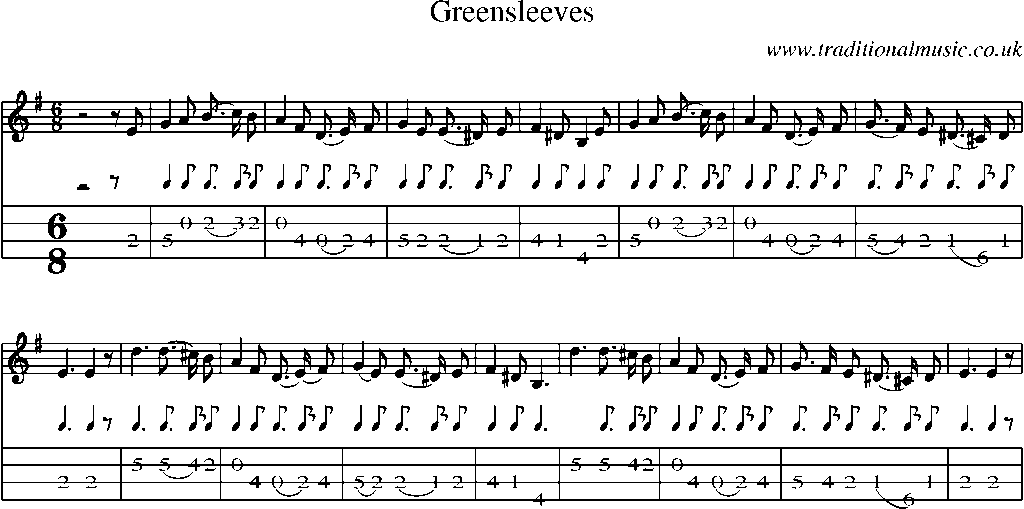
Image showing the melody line to “Greensleeves” links to its source at traditionalmusic.co.uk. Mandolin tab, too, so you mandolinists get busy with that!
A happy Sunday, friends. December is winding down to its close.
But I hold by the 12 days of Christmas, which means the season is far from over. So once again, we have the remarkable singer Montserrat Figueras, this month’s featured artist, with a seasonal lullaby, the Portuguese “José Embala O Menino.” It really is a remarkable song—as I understand the lyric, Joseph cradles the baby Jesus while Mary does washing at Bethlehem’s fountain. As she washes, she sings, & as she sings, she weeps—anyone familiar with the overall mythos will recognize she is weeping already for the Christ’s Passion. Montserrat Figueras delivers the song against a very spare backing with an unerring melodic, emotive & lyrical reading. This is a superlative performance, taken from her 2003 Alia Vox release, Ninna Nanna, ca. 1500-2002.
Montserrat Figueras passe3d away in November 2011, at the far too young age of 69. Still, her music lives in its vibrancy & vitality through her recordings, & her legacy in early music is also carried on by her husband, Jordi Savall, her daughter Arianna Savall & son Ferren Savall, as well as by the other members of various early music ensembles she helped to form, including Hespèrion XXI. You can learn more about this talented musician at the Alia Vox website.
Next Sunday we will wrap up the Christmas themed music, though this is the last post in the Montserrat Figueras series. Hope you have a wonderful Sunday.
Image links to its source: “Christ’s Nativity” from the Niederwildungen Altarpiece (1403): Conrad von Soest Wiki Commons – public domain
A happy Sunday, friends. Christmas is drawing near, & today’s Early Music Sunday post celebrates that fact.
All month we’ve been enjoying the remarkable voice of Montserrat Figueras, & today we have a ten minute extract from one of her most splendid pieces, “El Cant de la Sibil-la.” According to the Wikipedia entry:
The Song of the Sibyl (Catalan: El Cant de la Sibil·la is a liturgical drama and a Gregorian chant, the lyrics of which compose a prophecy describing the Apocalypse, which has been performed at some churches of Majorca (Balearic Islands, Spain) and Alghero (Sardinia, Italy), and some Catalan churches, in Catalan language on Christmas Eve nearly uninterrruptedly since medieval times. It was declared a Masterpieces of the Oral and Intangible Heritage of Humanity by UNESCO on November 16, 2010.
The original form of the Sybil’s prophecy was a Greek acrostic poem written by the Arian bishop Eusebius of Caesarea, & later incorporated by St Augstine in his The City of God. The song itself dates around the 10th or 11th century in a Latin form named “Judicii Signum” (“Sign of Judgment”), & then was translated into both Provencal & Catalan by the 13th century. Montserrat also performed “Judicii Signum,” & you can listen to that here.
Wishing all of you who observe the holiday a joyous Christmas.
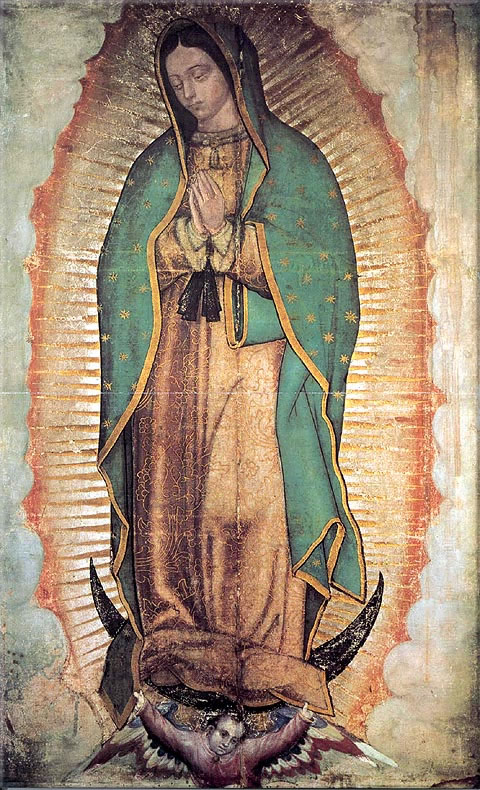
Image of the the Virgin of Guadalupe links to its source on Wiki Commons; it is in the public domain. The Virgin of Guadalupe is associated with the woman mentioned in the Book of Revelation, 11:19—12:1-18
We have another beautiful song today, sung by the incomparable soprano, Montserrat Figueras. “Berceuse de Noël” comes from her 2002 Alia Vox album, Ninna Nanna: Lullabies (1500-2002), which also features the accompaniment of her husband, violist Jordi Savall (though not on this track) & her daughter, harpist Arianna Savall, as well as other members of the early music consort, Hespèrion XXI. The song was written by Estonian composer Arvo Pärt, & it is truly beautiful. The lyrics are Russian, but I haven’t been able to find a translation—no matter: Montserrat’s voice & the music itself imbue them with meaning.
The musicians on “Berceuse de Noël” are listed as follows: Begoña Olavide (Psaltery), Dmitri Psonis (Santur), Arianna Savall (Triple Harp), Sophie Watillon (Viola da gamba), Sergi Casademunt (Viola da gamba), Montserrat Figueras (Soprano).
I know you will enjoy this beautiful piece.
Image links to its source: “Geburt Christi” (Birth of Jesus) by Geertgen tot Sint Jans, c. 1490 Wiki Commons – public domain
A happy Sunday, friends. We’re here again with some beautiful early music from this month’s featured artist, Montserrat Figueras.
“O Lux-Prosa: Flavit Auster” (“Flavit Auster” is Latin for “the south wind blew”) is taken from the early 14th century manuscript, the Codex Las Huelgas, which comes from the Cistercian convent of Santa María la Real de Las Huelgas in Burgos, Spain. According to the Wikipedia article:
The manuscript was intended for use in performance, and raises questions regarding performance practice of the pieces it contains, especially the polyphonic repertory. The monastery had a choir of 100 women at one point in the 13th century, and it is believed that this choir of women performed the polyphonic works in the manuscript, despite the Cistercian rules against the performance of polyphonic music.
“Flavit Auster” is a responsory related to Mary Magdalen, & as such is a bit of a departure from Advent/Christmas music, but Montserrat Figueras’ part against the background of the supporting choir members is haunting & beautiful, & it seems an interesting piece to include. The recording comes from Figueras’ 2006 Alia Vox release, Lux Feminae 900-1600—highly recommended, as is all of her music.
A happy Sunday, friends, & the first Sunday of Advent at that.
I have a very special series planned for this December on Early Music Sunday: songs sung by the incomparable Catalan vocalist Montserrat Figueras, who passed away in November 2011 at age 69—far too young. For those of you who don’t know, Montserrat Figueras was married to Jordi Savall (who appeared in an earlier video, playing viola de gamba, along with their daughter, harpist Arianna Savall), & along with Savall founded the early music group Hespèrion XX (now Hespèrion XXI), as well as La Capella Reial de Catalunya and Le Concert des Nations. Montserrat Figueras also recorded extensively as a solo artist (though typically with backing by members of her other groups.)
Figueras’ singing is as nearly elemental as any I have heard. In the New Yorker in 2005, Alex Ross stated that her “voice falls somewhere between grand opera and rural folk singing, and combines the best aspects of both.” But Montserrat Figueras didn’t rely solely on the native power of her voice—she was also a learned student of early music.
Jordi Savall wrote recently on the anniversary of her passing:
L’âme de Montserrat continuera de nous inspirer toujours, dans toutes les musiques que nous réaliserons et ensemble avec tous ceux qui dans le monde se sont assouvis de son chant, nous continuerons, en travaillant avec ses chers idéaux de paix et d’harmonie, à maintenir son souvenir toujours vivant.
Montserrat’s soul will forever continue to inspire us in all our music-making, and together with all those everywhere who have been nourished by her song, we will continue to keep her memory alive as we are guided by the ideals of peace and harmony that she held so dear.
Both the original French & the English translation are from the Alia Vox site, where you can read the entire text of Savall’s statement, on a memorial page for Montserrat Figueras maintained by the Alia Vox recording label. The page plays selections from her extensive catalog.
Today’s selection is an anonymously composed Catalan lullaby titled “La Mare De Déu,” (the Mother of God) which seems a fitting selection for today. The recording comes from her 2003 Alia Vox release, Ninna Nanna: Lullabies (1500-2002).
This is amazing music by a truly extraordinary artist.
(By the way, here’s a rough English translation of the Catalan by yours truly—only possible because I found a French translation! However, I can find no source to explain the "Garindo, garindeta" line; that's left intact from the Catalan in the French translation as well)
The Mother of God
The Mother of God When she was young Went to school To learn to read With her pillow & her little basket
In the basket She had four apples A slice of bread And also some hazelnuts And she had walnuts And many raisins
The angels were singing "Garindo, garindeta !" Later, when she retired To her small bedroom The angel entered Through a little window
God save you, Mary, You are full of grace, On Christmas night, You, a virgin, will give birth, You will bear a son, beautiful as a star, He will be your son, The son of a virgin.
And the name they will give him. And the name they will call him Will be Savior Of Heaven & Earth He will be called Jesus King of Heaven & Earth.
A happy Sunday, friends. We of course have some lovely music for you here on Robert Frost’s Banjo.
Bach’s Suite for Cello in G Major, BMV 1007, is a staple of any Baroque repertoire & is probably the best known of his six cello suites. Typically we hear these performed on the modern cello, but the contemporary instrument actually differs in some significant ways from the cello of Bach’s day. First, contemporary instruments use metal strings, while the baroque cello is always strung with gut strings; this has a significant effect on the sound. There are other differences in construction as well—perhaps the thing most noticeable when one sees is that the baroque cello doesn’t have an endpin to balance it on the floor—the instrument is secured solely by the cellist’s knees.
Tanya Tomkins is an extraordinary musician & a virtuoso on both the modern & baroque cellos. She performs with San Francisco’s Philharmonia Baroque and Portland Baroque (! —in fact, she’s performing here this weekend, but sad to say, I will miss the show); in addition, she performs as a soloist & with other ensembles, & teaches at Juilliard, the San Francisco Conservatory of Music, & San Jose State University; she also serves on the faculty of the American Bach Soloists Summer Academy.
I’ve chosen her performance of the Allemande from Cello Suite No. 1 in a 2009 performance for the Great Artist Series presented by San Francisco Early Music Ensemble Voices of Music; however, you can hear her perform the entire G Major Cello Suite on YouTube here.
Enjoy the music & your Sunday!
Image of the baroque cello links to its source on cello.org