Showing posts with label fiction. Show all posts

Tuesday, May 20, 2014

The Birth of Tragedy from the Spirit of Bernard Malamud

Shoeless Joe Jackson (r), Ty Cobb (l) c. 1913
“I have read now and then that I am one of the most tragic figures in baseball. Well, maybe that's the way some people look at it, but I don't quite see it that way myself.”
“Shoeless” Joe Jackson: from WikiQuote, & ultimately from Sport Magazine, 1949
"Jackson's fall from grace is one of the real tragedies of baseball. I always thought he was more sinned against than sinning."
        Connie Mack, also from WikiQuote

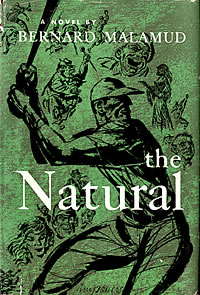
Major league baseball—Arthurian Legend—the Hall of Fame in Cooperstown—T.S. Eliot’s The Wasteland—organized crime—& of course, Bernard Malamud: these are some of the elements of a rare & strange tale!

If you know baseball history, you know that the 1919 Chicago White Sox—later nicknamed “the Black Sox”—threw the World Series against the Cincinnati Reds. Chicago went into the Series as heavy favorites—the White Sox had won in 1917, & although they’d posted a losing record in 1918, that was directly attributable to their losing some star players to the service in World War I. In ’19, those players—including the great Joe Jackson—were back with the club, & the White Sox fielded a strong line-up that also included future Hall of Fame second baseman Eddie Collins & such hitting stars as right fielder Nemo Leibold & first baseman Chick Gandil. In addition, the White Sox had two of the best pitchers in Eddie Cicotte & Lefty Williams. Cicotte threw his “shine ball,” essentially what we call a knuckleball today, tho I understand that Cicotte actually used his knuckles to grip the ball rather than the fingertips, as in the current usage. In fact, the White Sox had star players at pretty much every position, as well as a couple of fearsome hitters on the bench.
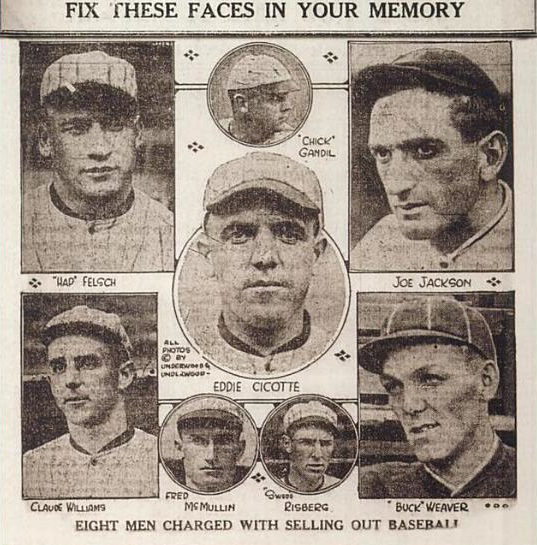


I won’t re-tell the Black Sox story here, tho it is a fascinating tale. If you don’t know about it, Eliot Asinof’s Eight Men Out is a well-known tho controversial examination of the story, but actually the Wikipedia page about the 1919 scandal is a good overview. Briefly, Asinof’s book got its title from the fact that eight members of the Chicago team were implicated: Jackson, Gandil, Cicotte, Williams (not Collins or Leibold), as well as center fielder Happy Felsch, third baseman Buck Weaver, shortstop Swede Risberg, as well as utility man Fred McMullin, who apparently only got in by accident, finding out about the plot & demanding to be included or else blow the whistle on the whole scheme. Although this was never proven, it was alleged that the plot originated with mob kingpin Arnold Rothstein—in The Godfather saga, character Hyman Roth claims to have been inspired by Rothstein, “who fixed the 1919 World Series."

Arnold Rothstein

Two of the eight claimed they actually weren’t part of the fix: Joe Jackson & Weaver. While Jackson admitted at least initially that he took money, he claimed that he did nothing to contribute to losses, & in fact there are a statistics that give this argument weight: he batted .375 & compiled 12 hits during the Series’ eight games, & he also was credited with no fielding errors & threw a man out at home from his right field position. The 1919 Series was a best 5 of 9 format, unlike the best 4 of 7 that’s in use now (& for quite some time.) Weaver, meanwhile claimed never to have taken any money at all, but he did admit to knowing that the plot was in place.
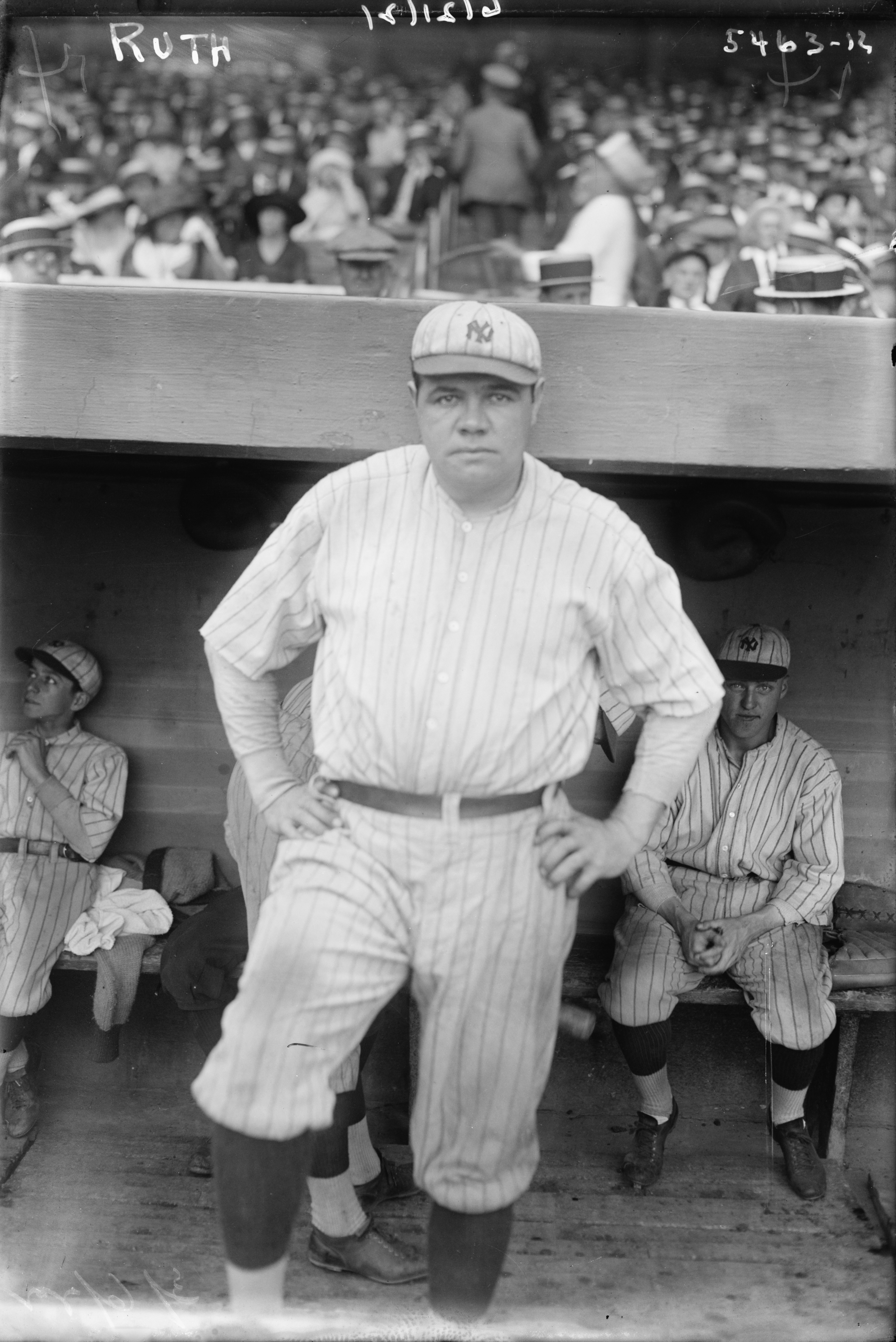
Babe Ruth, 1921
But these days, we’re most concerned with “Shoeless” Joe Jackson, because he is a mythic figure in the game’s history, one whose mythic potency is almost comparable to the likes of Ruth or Mays or Mantle or Jackie Robinson or Koufax. Jackson may indeed have been the premier hitter of the deadball era. Between 1908 & 1920, Jackson compiled a lifetime .356/.423/.517 slash line, with 307 doubles, 168 triples & 54 home runs (players’ home run totals only rarely reached the teens in the deadball era.) Jackson’s career Wins Above Replacement, as calculated on Baseball Reference, was 59.6, with his best year by that formula being 1912: a WAR of 9.3, when he batted .395/.458/.579 with 44 doubles, a league leading 26 triples (!) & 90 runs batted in. He also recorded a 9.0 WAR in 1911, hitting .408/.468/.590.

Obviously—at least to baseball fans among you—these are Hall of Fame caliber statistics, & Jackson was consistently among the best hitters of his generation. Testimony from three contemporary Hall of Fame players:

Joe Jackson hit the ball harder than any man ever to play baseball.
Ty Cobb


He was the greatest natural hitter who ever lived.
Tris Speaker


I copied Jackson's style because I thought he was the greatest hitter I had ever seen, the greatest natural hitter I ever saw. He's the guy who made me a hitter.
Babe Ruth


But there’s no plaque in the Cooperstown Hall of Fame for Jackson because following the scandal, Commissioner Kennesaw Mountain Landis declared all eight players to be on the ineligible list, & he remains there to this day.


Judge Landis (c) signs agreement to become Commissioner, 1920

If you’ve heard the saying, “Say it ain’t so, Joe,” that refers to Joe Jackson. According to Charley Owens of the Chicago Daily News, a young boy approached him as he left the courtroom & said, “Say it ain’t so, Joe.” Actually, the original was: "One urchin stepped up to the outfielder, and, grabbing his coat sleeve, said: 'It ain't true, is it, Joe?' 'Yes, kid, I'm afraid it is,' Jackson replied.”

Of course you remember the great ending of Bernard Malamud’s Great American Novel, The Natural:

Roy handed the paper back to the kid.
“Say it ain’t true, Roy.”
When Roy looked into the boy’s eyes he wanted to say it wasn’t but couldn’t, and he lifted his hands to his face and wept many bitter tears.

Roy Hobbs—not Robert Redford triumphing over the forces of evil in the mangled & mendacious film version
more like Robert Ryan, the tormented & magnetic film noir anti-hero. Roy, like Joe, is a “Natural”—not just a natural baseball player, but a “natural man” in the old sense of the word—a simpleton of sorts, in the great tradition of Sir Percival, the questing knight who, in Arthurian Legend, fails to heal the Fisher King during his Grail quest because he fails to ask a question. Critics have drawn close parallels between the Perceval/Fisher King story & Malamud’s novel—of course, that story was very much “in the air” in the first half of the 20th century due to Eliot’s use of it in The Wasteland. After all, one of the main relationships in The Natural is between Hobbs & Pop Fisher. & there are many who claim that Jackson’s country ways & apparent illiteracy were factors in his involvement in the scandal—that he too, in a sense was a “natural man” beyond being a “natural hitter.”

T.S. Eliot, 1923 - A Red Sox fan

The failed questing knight: “On Margate Sands./I can connect/Nothing with nothing./The broken fingernails of dirty hands.” Joe Jackson: broken perhaps. But how would he have “cured” the Fisher King or rendered a Wasteland verdant? Indeed, it was in the aftermath of the Black Sox scandal that baseball could have become a Waste Land—until the triumphant home runs of Babe Ruth led us away from the post war bleakness into the impossible 1920s—impossible culture hero, impossible home runs, impossible economy. Baseball always looks to the home run to save it from scandal—look at the late 1990s & early 2000s when baseball tried to obliterate the bitter scandal of the 1994 World Series shutdown; & in doing so, it would seem, struck a new Faustian bargain, as it turned a blind eye to rampant use of “performance-enhancing drugs” until it saw its most hallowed records fall; & then turned against at least the most famous of the perpetrators, both those who were “alleged” & those who admitted to the use of various anabolic steroids & hormonal treatments. More on this at another time.


Joe Jackson, in the longer version of the quote that begins the post, said he’d accomplished all he wanted to in baseball, & so the ban didn’t matter to him. He was 32 years old in 1920, his last season prior to being declared ineligible, so it is likely that Jackson was past his peak—though he did put up a .382/.444/.589 slash line, & also record a league leading 20 triples & a career high 12 home runs that year. But that’s Jackson the man not Shoeless Joe the legend. Not the legend who morphs into Roy Hobbs, embodiment of American grandiosity & eventual fall not only from innocence, but clear into damnation—the most American of damnations: the star baseball player whose records are expunged; the celebrity who becomes unknown & indeed unknowable.

The stuff of deep legends—on the superficial level of the film Field of Dreams, or on a deeper level where the exaltation & subsequent debsement of those we hold up to the iconic light of celebrity becomes a national fixation; or on an even deeper level yet where the exploits & foibles of these celebrities & sports stars somehow intertwine with deep myths. Shoeless Joe Jackson was among the first of these in our ongoing myth cycle; he is not the last, not even from the myth cycle of baseball.


Everything he hit was really blessed. He could break bones with his shots. Blindfold me and I could still tell you when Joe hit the ball. It had a special crack.
 Wiki Quote: Ernie Shore, as quoted in Baseball America (2001) by Donald Honig, p. 107

All images link to their source on Wiki Commons/Wikipedia. All images are in the public domain except the cover image of The Natural, for which Wikipedia claims fair use.

Full disclosure: this post previously appeared on my currently dormant "Beer League Box Score" blog.

Saturday, April 30, 2011

“Beside the Still Waters”

Stories: history—myths—dreams.  The dreams we inhabit, either individually or collectively, & thru which we try to find our way; the dreams that seem to open into a larger reality & the dreams that enclose us; even the dreams we refuse to share & the dreams that threaten to destroy us.  These dreams are the stuff of Jacqueline T Lynch’s fine ebook novel, Beside the Still Waters.  The ebook, one of four published by Lynch, is available thru Amazon, Amazon UK, Barnes & Noble, & SmashwordsThe Smashwords edition, it should be noted, doesn't require a Kindle or Nook; it can be read as a PDF or in other formats on any computer.

The novel is a family saga, following the Vaughn family of Massachusetts Swift River Valley from the turn of the 20th century until just before the onset of World War II.  The family history is indeed compelling: the brothers John & Eli who almost enact a sort of Jacob & Esau story, but with the twist that in this case, neither wins the inheritance; their cousin Alonzo who clings to a doomed way of life & an obsessive love; & Eli’s high-spirited daughter Jenny, whose coming of age is a central focus.

But as much as Beside the Still Waters is a saga about a family, it’s also a saga about Massachusetts—about its Puritan past, on thru its wars with Native Americans & its own brief, late 18th century civil war, the Shays Rebellion; in fact this latter conflict, which pitted the farmers of western & central Massachusetts against the new state government & urban merchants, looms large as a backdrop to the novel’s own story.

That story involves the creation of the Quabbin Reservoir, which was completed in 1939.  The Quabbin Reservoir is the largest inland body of water in Massachusetts, & is the primary water source for the city of Boston & much of the Boston metropolitan area.  The Reservoir was one of the many large-scale public works of the 1930s, & an impressive undertaking from an engineering viewpoint.  Its creation, however, caused the “discontiuation” (to use Wikipedia’s word) of four towns: Dana, Enfield, Greenwich & Prescott, all agricultural communities & all firmly ensconced in a 19th century world even as Massachusetts’ urban centers moved into the 20th century, with its electrification, cash economy, immigration & automobiles.

Beside the Still Waters then is also a fable about culture & its mutability.  Early in the narrative, we read about a Native American who would make an annual pilgrimage to the Greenwich Cemetery: 

The old man would come one day in the spring, and just sit there in the cemetery all day long, still and quiet, until the sun had set behind the Prescott ridge.  Then he would leave, to return the next spring. This last was nearly twenty years ago.  The old Indian was probably dead now…. “He gave me the shivers,” Sam had said, rubbing his hands together, “like he was saying, my people are gone. We thought we would be here forever, but now we are gone.  So, don’t be too sure of yourselves, you can go this way too.”

We recall this anecdote later in the story as the old cemeteries of the four doomed towns are moved—bodies exhumed, markers uprooted—so that the human remains won’t contaminate the water.  In the end, there are only ghosts:

Even fifty years later rumors would pervade to the effect that if one looked deep into the clear water of the reservoir during a period of drought when the water level was low, one could see whole houses standing there like bitter ghosts. It was not true. Only the ghosts were there.

The characters of Beside the Still Waters are indeed haunted: Eli Vaughn is haunted by the land of the Swift River Valley, specifically, his father’s Prescott farm, which he’s doomed never to inherit—even by the orchard he could never plant.  That land also haunts his older brother who forsook his inheritance for urban life & a “fast” lifestyle, but who is inexorably drawn back to a landscape he can only possess thru the mediation of a camera lens.  & the Prescott farm haunts Alonzo Vaughn, Eli’s cousin, who inherits it by default & whose bound to the land eventually becomes an obsessive & destructive bondage.  He refuses to relinquish the farm (which, ironically, is not legally his) to the State, & continues to live there as a hermit as all the other residents inevitably sell out; in the course of this, the farm itself goes to ruin.  Late in the novel, a kindly old doctor tries to make Alonzo see reason:

You’re doing terrible things to y’self, son. You’re going to be living here like an old ghost in a graveyard soon....”  “The graveyards,” Alonzo said with a sneer, “are empty.”

Against the backdrop of this haunted generation, we have the character of Jenny Vaughn, who we watch from childhood thru early adulthood.  She has “promise”—she is strong, both physically & mentally, intelligent & grows into an attractive young woman.  The men of the older generation “read into” her—John Vaughn sees Jenny’s promise as a reflection of his own, which he threw away for drink; Eli sees Jenny’s willfulness not as a mirror of his own, but as a headstrong rejection of the heritage he holds so dear—her ambition to attend college seems selfish; & Alonzo sees her as a potential fantasy wife who will share his own fictionalized life in a world that no longer exists.

Beside the Still Waters is a great read: Ms Lynch has a thorough grasp of the historical back story, & the novel provides a fascinating narrative of the Quabbin Reservoir project.  Ms Lynch also has a firm grasp of the New England landscape, both historical & natural—her descriptions of the fields & woodlands & towns are vivid & true.  Consider this:

In every New England town it seems there is a hill, even if only metaphorically. At
the top of this hill, there is a plain, white Congregational church. Pristine and quiet,
painted and photographed, emblazoned upon Christmas cards and revered in the hearts of even New England Catholics, this architecture stands for New England the way cranberries and autumn foliage does. It has become a symbol. The gospel according to Currier and Ives.

Lynch’s observation about the church is not only accurate in the most real sense, but also opens up the idea of symbolic landscape, which is so important to the narrative—how the landscape provides meaning, how it gives life & how it potentially can destroy us. 

You can find out more about Jacqueline T Lynch on her website, or on any of her fine blogs: Another Old Move Blog, New England Travels, & Tragedy & Comedy in New England.  You can also read Jacqueline T Lynch’s entertaining Writers Talk interview right here on Robert Frost’s Banjo.

Lovers of historical fiction, of New England, or of just good writing will enjoy Beside the Still Waters.  Lynch's style is clear & assured & highly readable; her background as a playwright certainly comes across in her facility with dialogue, & as I've mentioned, her descriptive skills & characterizations are strong.  I recommend it! 

Sunday, January 30, 2011

"The Alchemy of Chance"

Do you believe in serendipity?  If so, Peter Brooks’ fine first novel, The Alchemy of Chance is for you.  In fact, what better term than “the alchemy of chance” might be used to describe the principle of serendipity?  We’re struck by the magic of coincidence, the happenstance that makes us say, “there is some meaning, some force behind these events.”

Mr Brooks’ novel, the initial offering by Tangerine Tree Press, follows the paths of several young people in both France & England during the spring & summer of 1977.  They are all seekers: looking for love, family, belonging.  The narrative presents a complex weave, as the tales of these seemingly independent quests twine together to form a pattern.

At the center of this pattern, we find the story of Aurélie, a young French woman who has suffered from blindness since being in a car accident that claimed the life of her mother.  The doctors can find no cause, yet Aurélie’s world has become a blur of indistinct light.  On the other hand, her other senses have become heightened—the world of sound, smell, taste & touch are accentuated to Aurélie, as well as to us thru Mr Brooks’ considerable powers of description.  We don’t only see the landscapes of her travels: we hear them, we smell them & taste them.  Taste indeed: in fact, among its many virtues, The Alchemy of Chance is a foodie’s delight, filled with vivid descriptions of wonderful meals (I caution against reading this while hungry!), culminating in an improvised feast in a British shore town. 

Aurélie is able to adapt—adaptation being an undercurrent thru the novel, particularly in the form of improvisation, whether that involves music, cooking or solving clues to a real-life puzzle.  She develops her independence, relying both on her intact senses & her formidable memory, & is able to move around with a great deal of independence—so much so in fact, that she decides to take a journey by herself into the south of France to re-connect with friends & family & places she knew in her youth. 

At the same time, Dafydd a Welch filmmaker is traveling to the same region in search of his brother Sean, who has gone missing in France for 10 years—estranged from the family, Sean has left his trail only thru a series of enigmatic postcards, which Dafydd must try to piece into coherency—make into a map, as it were, as maps are an important motif in the novel—Aurélie is fascinated by maps & one of her prized possessions is a map of the London Underground.  Early in the novel, her father Didier converts this into a tactile map for her by inserting a push pin in each station; this action is duplicated—or twinned—later in the novel when Dafydd, who now has Aurélie as a companion & blind navigator on his search for Sean, constructs a map for her with an elaborate series of pins & wires. 

But maps, as Aurélie knows, aren’t the only guides we have in this world.  She is a gifted astrologer & has both Braille astrology books &, again with the help of her father, various tactile devices that make it possible for her to do sightless readings.  She uses this skill to aid Dafydd in his quest for Sean—despite Dafydd’s skepticism.

But it should be noted that Aurélie’s astrology is not thoroughly deterministic—to call it this would be to impose an alien logic to it—a “male logic,” as she points out to Dafydd.  It’s instead a set of opportunities, like a map—or like music.  Again the notion of improvisation which, as musicians know, is a “tangible” instance of serendipity.  Aurélie is also a musician in fact—a cellist—& we see (or I should say, hear) her skills as an improviser in a memorable scene in which Aurélie sits in with a “jug-rock band” in a Breton bar:

Aurélie stood up and stepped forward, discarding the bow, which she thrust down her waistband, and the dark glasses, which she stuffed down her white Indian shirt inside her bra.  Her legs slightly apart, her knees slightly bent, a towering six-footer on the edge of the stage in a flowing white gypsy skirt, plucking a four-foot bright white cello strapped around her neck like a guitar, she led the band into a spine-tingling intermediate cadence, minor to major….She moved her left foot forward to tease up the pedals and slowed her playing right down, this time bending the notes like a jazz sax-player.  Long and high, they soared across the room above the audience’s heads, echoed round ceiling corners and wall joints, returning to pierce the backs of their necks and shiver their spines.  Then she made a quarter-turn in the direction of the bass-player, with a silent invitation to fill some empty spaces.

I quoted this at length not only because I believe it’s a fine example of Mr Brooks’ descriptive abilities, but also because it shows his belief in the power of transformation; not only does Aurélie’s improvisation transform the audience, it transforms her & the very space they all inhabit.  But—& this is a crucial point in the novel—this transformation isn’t effected by Aurélie alone, but by her working in concert with the other band members.  In the same way, the disparate lives come together in the narrative as a whole with transformative power.

The Alchemy of Chance is vivid—although I’ve never visited the places it describes, I feel as tho I can see them in my mind’s eye as I travel thru its pages.  Its characters are vivid as well—redolent with the mixture of hope & pain we associate with young people of a certain age—mid to late 20s, say, as they are poised between the vestiges of youth & full adulthood.  They know pain & loss—real pain & loss, whether it’s the loss of sight or a brother or mother or twin sister (the concept of twinning is crucial to the narrative)—but they also exist in a world that’s open to opportunities, whether for exploration in a geographical sense or an emotional one.

Mr Brooks’ first novel is a success—beyond his descriptive abilities, he is able to navigate a rather complex & multi-layered plot with aplomb.  His characters are “real”—we feel we know them, & I would say especially Aurélie, who makes the narrative sparkle whenever she enters.  This is a novel that will move you & delight you, & I most certainly recommend it wholeheartedly.

The novel is available directly from Tangerine Tree Press at this link; it may also be purchased thru Amazon here or Amazon UK here.


Finally, thanks to Sheila Graham-Smith of Tangerine Tree Press for giving me the opportunity to explore The Alchemy of Chance.

Thursday, January 27, 2011

Writers Talk with PJ Kaiser

Happy Thursday, folks, & welcome to another edition of Writers Talk.  Before I introduce this week’s interviewee, I’d just like to acknowledge the fact that this post is the 1000th on Robert Frost’s Banjo!  I think it’s fitting that we’re hosting a guest for the 1000th post, because from the very beginning I hoped that the blog could feature the words & music of others, & I’ve been gratified that it’s been able to do that indeed. 

Today’s writer is PJ Kaiser, a real presence in the Twitter & blogging writing communities & a wonderfully supportive person as well as a talented writer.  It's been my observation that Ms Kaiser has a good grasp of how to utilize social media in her career as an independent writer, & I believe she has a lot to teach others who are looking to make a mark in fiction or poetry outside the traditional publishing model.


P.J. Kaiser stays at home with her two young children and finds time to write – generally in thirty-second increments. She writes mostly flash fiction and serial stories in a variety of genres. Several of her stories have appeared in print and electronic publications. Two of her stories - “The Request” and “The Foot of the Bridge” have appeared at Soft Whispers. Her story “The Turtle Dove” appeared in the anthology 12 Days 2009. “Halloween Guests” was selected for the Best of Friday Flash Volume 1 anthology. Her micro-fiction “Ditz Alert” was selected for the chapbook Dog Days of Summer 2010 – Not From Here, Are You?. She also assisted with editing the anthology 50 Stories for Pakistan, which includes her story “Arthur’s Emptiness.” In early 2010, she won the February writing challenge at Write On! Online with her story “Waiting for Spring.” She also has stories forthcoming in 100 Stories for Queensland and in Nothing but Flowers:  Tales of Post-Apocalyptic Love,  a publication of Emergent Publishing.  She can be found hanging around at her blog Inspired by Real Life.  P.J. is also the co-moderator of Tuesday Serial, a weekly collection of links to the latest installments of some of the web’s best online serials. P.J. is working on publishing a collection of her stories and is working on her first novel. P.J. lives with her family in Hoboken, New Jersey.

Don’t forget to check out PJ Kaiser’s story “Nine Ladies Dancing” on The Writers Talk blog!

When did you first realize your identity as a writer?

In high school I had an assignment to write a short story.  So I wrote the story, but I wasn’t sure of the ending.  So I kept writing.  And writing.  It was, of course, complete drivel, but I had great fun writing it and I began to think that maybe one day I would like to learn how to write “for real.”  I’ve always been an avid reader and I think most avid readers harbor dreams of being a writer.

We lived in Mexico for several years and while we were there I met a woman originally from Germany.  She told us the most fascinating stories about her life and I told her she should write her memoir.  She dismissed the idea since she had no interest in writing.  So I decided to take up the challenge.  I spent a summer interviewing her and gathering information for the book and then unfortunately we lost touch.  So the book will be fiction but very loosely based on a real story. 

I decided that I had to learn how to write properly in order to do her story justice and it’s been a fascinating journey for me.  This first novel is in very rough draft stages right now (I won NaNoWriMo 2009 with it) but in the meantime I have enjoyed learning how to write short stories and serial fiction.  I’ve experimented with a wide variety of genres, but haven’t yet found one with which I want to be monogamous. 

Describe the creative process involved in any one piece you’ve written—this could be book, a story, a poem, an essay, etc.

My most recent serial story “Rainy Rendezvous” was inspired by a friend’s Facebook update.  He commented that he enjoyed going kayaking alone because it was so peaceful.  I commented that would be a great inspiration for a story…and no sooner had I made the comment than my mind began churning on an idea and within a week I had drafted five installments of a serial story. 

Recent short stories have been inspired by seeing a woman fall on a street corner next to a crossing guard, getting a pedicure, and going swimming (not all at once ;-).  And several stories have been inspired by dreams.  Nearly all of my stories are inspired by something from my real life, even if it’s just a tiny nugget of real life.  Hence the name of my blog “Inspired by Real Life.”

Could you describe your relationship to the publishing process? (this can be publishing in any form, from traditional book publishing to blogging, etc)

My main publishing activity at the moment is blogging, apart from a few short stories that have been published.  I began writing in the summer of 2009 and my main focus at the moment is on improving my craft rather than publishing.  I am, however, beginning to pull together and polish some of my stories in hopes of publishing an e-book collection.

My blog recently crashed and I am in the process of reconstructing it.  So, because it’s fresh in my mind, I can tell you that I have written 71 stories – including flash fiction and serial installments.  Twenty-four of these, by the way, will not be carried over to the new blog (or anywhere else); they are being “retired.”

How has being a writer affected your relationships?

Most of my family thinks I’ve been pursuing a strange little pastime.  That might have changed a bit when I gave each of them a copy of “50 Stories for Pakistan” which includes one of my stories. ;-)

How would you describe the community of writers you belong to—if any?  This may be a “real” or “virtual” (in more than one sense) community.

I don’t have a “real” writing community because I can never seem to leave the house without my two children.  But my virtual community more than makes up for its absence.  I got the bug to write originally from people I encountered on Twitter and my writing community has grown organically through Twitter.  I participate off and on in various Twitter chats such as #writechat and #litchat and my main writing communities come from #fridayflash and #tuesdayserial.  I can’t even begin to describe the friendships that I’ve made and the things I’ve learned from my friends in my virtual writing community – they’ve been indispensible. 

What are your future goals in terms of writing?

At the moment, my goals are very loose.  I want to keep writing short stories and serial fiction as I have bits of time here and there.  I want to continue to improve my writing by taking classes and working with editors.  Eventually I want to finish my novel.  I find that if I put too many deadlines or milestones on my plans, then I get too stressed out and I turn away from writing.  So, keeping things low-key allows me to continue to enjoy it and stay with it.

Bonus Question: If your writing were a musical instrument, what would it be?
Hmmm, I’m going to say a piano.  When it works, the sound is fantastic.  Every now and then, though, I strike a clunker that sticks out like a sore thumb.  I am just trying to work on striking clunkers with less frequency.

Thursday, January 13, 2011

Writers Talk with Caroline Hagood

It’s my pleasure to introduce this week’s writer, Caroline Hagood.  Ms Hagood is yet another writer I’ve meet in the Twitterverse—you writers out there who aren’t on Twitter, I must say you’re missing out on lots of smart & supportive folks.  Since meeting Caroline on Twitter, I’ve also begun to follow her excellent Culture Sandwich, an aptly named blog that I recommend highly.  Ms Hagood’s writerly bio reads as follows:

Caroline Hagood is a poet and writer who spends way too much time on the internet. She teaches English and writing at St. Francis College in Brooklyn. She has written on arts and culture for The Guardian, Salon, the Huffington Post, and her own blog, Culture Sandwich, among others. Her poetry has appeared in Shooting the Rat (Hanging Loose Press), Movin' (Orchard Books), Huffington Post, Angelic Dynamo, Ginosko, and Manhattan Chronicles. She has also written a collection of poetry and a novel. She's always looking for adventure, the perfect slice of pizza, and new creative projects.

& now, on to the interview:

When did you first realize your identity as a writer?

As a weird little girl who thought everything should be either magical or funny, and when it wasn’t, decided to write it that way.

Describe the creative process involved in any one piece you’ve written—this could be book, a story, a poem, an essay, etc.

Whenever I’m working on anything, the equation seems to be writing with a side order of life. So my typical Sunday would look something like this: Writing with brief interludes of eating anything in the chocolate family; watching old Twilight Zone episodes; crying over little things; laughing over little things; going people-watching; reading some big book that I feel I should have read already; calling my friend to tell her something funny; and googling for entirely too long.

Could you describe your relationship to the publishing process? (this can be publishing in any form, from traditional book publishing to blogging, etc)

I should really hatch some green plan to recycle all my rejection letters into something extraordinary. Yet my relationship to the publishing process remains…hopeful. I’m certainly grateful to all the people who have agreed to publish my poems and articles.

Actually, publishing takes on a whole new meaning when you start your own blog. I remember being nervous at first, then hesitantly sending my words out into the blogo-verse. Suddenly, I got to assume all the roles in the little play of my own publication. I had a place to air my interests and found myself with more of them than ever. Having a blog is like being able to place each of your orphaned ideas in loving homes. It’s pretty powerful.

How has being a writer affected your relationships?

It’s a wonder my husband hasn’t left me. Just kidding (I think). I like to think that my all-encompassing fixation brings new things to the lives of those I love. This is true on good days. On bad days, I can be a moody one—one of those horrible writer stereotypes that’s true, in my case.

How would you describe the community of writers you belong to—if any?  This may be a “real” or “virtual” (in more than one sense) community.

At this point, it’s definitely more virtual because most of my in-flesh friends aren’t writers. Of my cyber-writing-squad, I’d say we’re an obsessive, lonely, self-deprecating, goofy, excitable bunch, in love with information and putting together and taking things apart with our minds, who can take out a box of donuts in one sitting, oh wait, that last one is just me.

There’s one blogger in particular, Hansel Castro over at Hallucina, whose blog I love. I befriended him in the first flush of my blogging life, but have never met him, at least not in that boring, real-world sense.

What are your future goals in terms of writing?

Besides taking over the writing world and reinventing language? No, but seriously, I would like to be able to complete the writing projects on my exceedingly long to-do-list, which I revise in my mind pretty much all the time, but especially while on stopped subways, in boring movies, or while being chewed out by authority figures, which happens more than you might think. It would also be nice to have those writings be appreciated by the public, but that might be asking too much.  At this point, with Manhattan real estate being what it is, I might just settle for a room of my own.

Bonus Question: If your writing were a musical instrument, what would it be?
It would definitely be a trombone. No doubt about it. I was never one for subtle.

Thursday, January 6, 2011

Writers Talk with Laura Eno

Happy Thursday, one & all.  We're back with the first Writers Talk interview of the New Year, & it's my pleasure to introduce Laura Eno, a fiction writer with numerous publicationsher Goodreads author page lists five novels & eight fiction anthologies.

Laura Eno lives in Florida with a very tolerant husband, three skulking cats and an absurdly happy dog. She has a pet from the Underworld named Jezebel and a skull called Mr. Fluffy who help her write novels late at night. Please visit her strange imagination at A Shift in Dimensions.  Links to all of Laura Eno's published work can be found on her blog.  In addition, you can read an excerpt from Ms Eno's novel Don't Fall Asleep: A Dream Assassin Novel over on the companion Writers Talk blog.  Please do check that out!

I have to thank Karen Schindler, whose Writers Talk interview appeared here last month for connecting Laura with Robert Frost's Banjo.  The result was the following delightful interview:

When did you first realize your identity as a writer?

I think it was when the voices in my head tied me to a chair and demanded a venue of their own. Since then, we've enjoyed an uneasy truce; they speak and I write down what they say. If I ignore them, my sleep is severely disrupted and the arguments become verbal. It's not a pretty sight.

Describe the creative process involved in any one piece you’ve written—this could be book, a story, a poem, an essay, etc.

I will jot down story ideas, creating a simple outline, but the characters grow rather organically from there. They have much to say when I shut up and listen to them, weaving intricate stories of wonder.

Could you describe your relationship to the publishing process? (this can be publishing in any form, from traditional book publishing to blogging, etc)

Ah, relationships… First, and foremost, I have a relationship to my story. For that reason, I am an indie author. That means I have complete control and responsibility over content. My readers are the only ones judging my story's worth.

How has being a writer affected your relationships?

Being a writer has strengthened my relationships. I'm happier for having the outlet and my family can now put a label on my strangeness. "Well, she's a writer" as explanation smoothes over many a faux pas—especially if I'm staring off into space or examining a knife with a maniacal look on my face.

How would you describe the community of writers you belong to—if any?  This may be a “real” or “virtual” (in more than one sense) community.

Blogging, Twitter and Facebook have opened a wonderful world of like-minded friendships for me. Many writers are introverts and I am no exception. The online community feeds my soul and understands me in a way that I've never encountered before. I'm no longer sitting in the dark, afraid to reach out.

What are your future goals in terms of writing?

I plan to keep writing, both short stories and novels, always looking to connect with my readers. Bringing laughter and tears to those who would immerse themselves in my work is the ultimate thrill for me. It is what keeps me breathing.

Bonus Question: If your writing were a musical instrument, what would it be?

Definitely drums. The beat of a heart, the pounding of fear, the light tap of laughter—all pulsating in the rhythm of life.

Thursday, December 2, 2010

Writer’s Talk with Karen Schindler

Karen Schindler writes even when she's not writing. A wonderer, a cherisher of experiences, she lives life with gleeful abandon and pulls others into her wake.  Karen has been or is about to be published at Eclectic Flash, Voxpoetica, WeirdYear, 52 Stitches, Flashes in the Dark, InkNode, Negative Suck, Blink/Ink and various other ezines and print anthologies. You can find Karen and more of her work at Miscellaneous Yammering, or visit her hanging out as the managing editor of Pow Fast Flash Fiction when she's not busy ghostwriting and editing for a living.

Karen says: "Be sure to visit me at Miscellaneous Yammering where there's always something to make you smile."  I concur; & I add: don't forget to check out Karen's poem "Counter Clockwise" over on the Writers Talk blog!

How would you describe the community of writers you belong to?

Oh my gosh, I love the online writing community. I remember the day when I first connected with a group of people who were as prone to flights of fancy as I am. There was a big multi- part fast and furious conversation going on and smack dab in the middle of it, I stopped, dumbstruck with the joy of the experience and said aloud to an empty room “ My god, I’ve found my people.” It was like being struck in the head by lighting, or suddenly falling in love. Or it might have been a bit like those people who snap and run through their old workplace with an uzi….but I think it was more like the first two scenarios.

Describe your creative process?

Most days I feel like there is a meteor headed toward my house and the words, much like rats fleeing a sinking ship, have to get themselves onto the page before the impact. Then there are days where there are no words at all. On those days I go to the park and hug trees. It's a win/win situation.

When did you first realize your identity as a writer?

I’ve been writing my whole life, but I didn’t describe myself as a writer until the last couple of years. These days I introduce myself at gatherings as a writer/editor. The only problem with that is people now pitch me ideas, or ask if they can just “send me a little something to look at” when I have a minute. When that happens it makes me think that I might know a little bit about how a doctor feels when he gets backed into a corner at a cocktail party so the person can show him their rash.

Could you describe your relationship to the publishing process?

I think anything that’s been released into the world whether electronically or in print has been published. I don’t understand the hesitation that people have when they hedge their credits with the words “but it was only published online.” There are an amazing amount of opportunities to get your work read on the web. Some print publications have a smaller audience than a lot of ezines. If you create it, and they come to read it, you’ve done the job you set out to do. You’ve unleashed your words into the reader’s imagination, and that’s publishing as far as I’m concerned.

How has being a writer affected your relationships?

There are two things that I have to watch out for A) noticing the glassy eyed stare of the poor trapped civilian [read: “non writer”] I’ve button holed and duct taped to a chair to make them, once again, listen while I discuss my latest WIP  and B) writing people I know into my stories either consciously or unconsciously before the statute of limitations runs out on whatever it was that they did.

What are your future goals in terms of writing?

My long term goal is to one day have my best selling novel on the shelves of the paperback department of any grocery store that I go into. If the buyer who provides books to Giant Eagle has heard of you, then you’re pretty much a household name.

And….most importantly…. in my book jacket cover I want to be on a pony.

Bonus Question: If your writing were a musical instrument, what would it be?

A flugelhorn.

Thursday, November 4, 2010

Writers Talk with Jacqueline T. Lynch

I'm very happy to introduce today's featured Writers Talk interviewee, Jacqueline T. Lynch.  Before getting into Ms Lynch's curriculum vitae, I want to say on a personal note that Jacqueline is one of the first cyber friends I made thru the Robert Frost's Banjo blog, & she has remained a steadfast supporter of the blog & my various ventures.  When I drove to New England this spring I even had the pleasure of meeting Jacqueline!

Jacqueline T. Lynch has published articles and short fiction in regional & national publications, including the anthology “60 Seconds to Shine: 161 Monologues from Literature” (Smith & Kraus, 2007),  North & South, Civil War Magazine, History Magazine & several plays with Eldridge Publishing, Brooklyn Publishers, & Dramatic Publishing Company, one of which has been translated into Dutch & produced in the Netherlands.    Her novel “Meet Me in Nuthatch” is now available as an ebook through Amazon.com & Smashwords.

She also writes three blogs:

Another Old Movie Blog: A blog on classic films.

New England Travels: A blog on historical and cultural sites in New England.

Tragedy and Comedy in New England: A blog on theatre in New England, past and present.

website: www.JacquelineTLynch.com
 

Please check out Chapter 1 of Jacqueline T. Lynch's novel, Meet Me in Nuthatch on the Writers Talk blog.  & so: here's Jacqueline!

When did you first realize your identity as a writer?

I was about 14 years old.  It was a Thursday.  No, wait, a Friday.  I don’t remember.  The realization came to me unexpectedly, because I can be kind of obtuse.  I always wrote from a very young age: stories, poems, notes on things that interested me.  But, for all that, I never intended to be a writer.  When I was a child, I wanted very much to be a zoologist.  I was a devotee of Mutual of Omaha’s Wild Kingdom and I loved its host, Marlin Perkins.  I think it was that dapper white mustache and the squared-off handkerchief in his breast pocket.   Sexy.  Then I saw myself as Jane Goodall, sitting on an African hillside at dawn in my khaki shorts and shirt, taking notes on chimpanzees.

It was the note-taking, the analysis that appealed (besides the whole animal thing).   I did it all the time.  I’m still a chronic jotter-down of things.  I actually wrote compositions on things that interested me as a child, just for fun, not for school.  It was how I explained things to myself, how I explored the world.

Then when I was 14 I graduated to the adult section of the city library from the children’s department, and started in on their shelf of Agatha Christie and Ellery Queen.  I got hooked on mysteries, and starting writing one myself, longhand on notebook paper.  I don’t think I ever finished it.  It was harder than I thought it would be.  But something clicked, something blew me away about the process of setting, and character, and dialogue, people doing and saying things that I could control, but could never say and do myself. 

I wanted to do that for the rest of my life. 

So here I sit, in my khaki shorts, typing a play script on a laptop, with one eye cast towards the male house sparrow sitting on my neighbor’s fence.   I have an urge to note it in a logbook.

Describe the creative process involved in any one piece you’ve written—this could be book, a story, a poem, an essay, etc.

One slapstick comedy I wrote called “Delusions of Grandeur” sprang purely from a comment I’d heard about a parent telling her teenager that the she had to be out of the house when she reached 18.   I suppose I could have found more serious and socially conscious message here, but instead, I found silliness.  Deadlines can be funny when they’re not scaring the socks off you.

Writing a play is probably like surfing or riding a roller coaster.  I say probably, because I neither surf nor ride roller coasters, but the excitement is immediate, the need for balance crucial, and you get right into the action.  There is no slow development as you get through a novel; you have to hit the ground running knowing everything about the characters and expressing it through their own voices, which must be unique and individual.  Every action on stage must be deliberate and for a specific reason.   It’s all the character as expressed through dialogue, the author gets no omniscient voice.  And because the play never really comes alive until the director and the actors get a hold of it, the writer becomes suddenly part of a team.   That’s the most thrilling of all.

Could you describe your relationship to the publishing process (this can be publishing in any form, from traditional book publishing to blogging, etc)
 

I’ve been a published and produced playwright for several years.   I’ve enjoyed working with my editors and publishers very much.  I would like to publish a novel, and by the time this piece is posted, I will have likely self-published as an e-book a humorous novel called “Meet Me in Nuthatch.”

The traditional publishing process is formal, a many-layered, highly structured game.  There are many advantages to having the support of editors (and obviously, the support of a marketing and publicity department).  My preference for publishing a novel would be through traditional publishing, but self publishing as it is gaining momentum today is intriguing.  I am interested, and would like to be part of, both processes.

Blogging is personal, and its immediate communication to the readership makes it appealing for the sense of freedom it gives.  I enjoy the immediacy of blogging and use it for a kind of writing practice.  It’s also an outlet for other interests.  I write three of them:
Another Old Movie Blog: A blog on classic films.
New England Travels: A blog on historical and cultural sites in New England.
Tragedy and Comedy in New England: A blog on theatre in New England, past and present.

How has being a writer affected your relationships?  
I don’t think it has.  Though I’ve enjoyed working and socializing with colleagues, most of the people closest to me are not writers.  Some of them are awfully good storytellers, though.

How would you describe the community of writers you belong to—if any?  This may be a “real” or “virtual” (in more than one sense) community. 

Since I don’t belong to a writer’s group, I suppose we go back to blogging here.  It’s a delightful community of diversity in experiences and interests.   I visit many blogs, though I regret there isn’t time to comment on all of them as often as I’d like.

What are your future goals in terms of writing?  

I just take life one manuscript at a time.

Bonus Question: If your writing were a musical instrument, what would it be? 

An oboe, I think.  It has a distinct, oddball sound, but one that can be very pleasing, and easily recognizable.   It seems like a minor chord, a less emphatic sound, not flashy or attention-getting, but it still manages to stand out from the rest of the orchestra just by doing its thing, a poignant mixture of somberness and silliness.

I might say a cello, too, for the low undercurrent of the minor chord aspect, but cellos have a greater timbre, and are much harder to take on a bus or subway.  My writing, conversely, does not have as much timbre as a cello, but I’m pleased to say it is much easier to bring with you on public transportation.

Thursday, October 28, 2010

All Knees Shall Bend And Every Tongue Shall Vow (part 5)

[Here's the conclusion of B.N.'s story]
 

May G-d Bless And Keep You Always
   
Inez stood for an instant in the kitchen door, dressed only in Julian’s black silk robe.  Claude was already up drinking coffee and there was someone named Patrick involved in preparing a very elaborate—something

“Nutmeg?” he said cheerfully over his shoulder.

“In the cabinet over the stove.” Claude said not looking up from the paper.  Claude cleared a place for Inez. 

“He believes breakfast is the most important meal of the day,” Claude said to Inez. 

“It is.”  Patrick responded brightly, as he spun around cradling a bowl while whisking away the contents.  He looked just like Tin Tin in the cartoon.   Claude had moved into middle age somewhat gracefully she thought—perhaps not as gracefully as Julian but he seemed less strident, calmer.  For years he had often struck her as facile and easily stirred—reading some new pop psych idea and applying it all over the room—the chairs, the door, the sink—everything would have a ridiculous reason something he read and just applied freely—this was honest, that was not—Robert Bly—beating a drum, half naked, or buck, inner children, howling men, sweat lodges, howling at the moon, nursing old wounds—facile—as useless as applying a band aid to the spurting jagged stump of the torn off limb.  The question that pushed to the front of Inez' mind was why was he still here, living in the back of the house.  But by all rights why not ask her why she was still in Flatbush, living over Mrs. Mermelstein.
   
At the exact moment Inez poured her mug full of coffee, Patrick started listing all the violations he had endured; immediately it was proving to be very tedious.  With singsong authority he was explaining his issues in the work place; Inez doubted he had the need to work, or even a particular aptitude for anything.  He may well have been merely showing up everyday to attend to the issues.  The right to marry whom he chose, which Inez thought a remote possibility given what she was seeing—but she was not a morning person.  He talked with strain, like he was pitching words over a fence.   Long story short, he struggled, at a summer camp in the Berkshires and again at boarding school in Vermont.  “It was painful very painful.”  Oh God, Inez thought.  Where’s Patrick, weren’t you watching him?   Was the gate up?  He just toddled out to stand out in the wide dangerous world—a four-lane highway.  Had he never even seen a photograph of let’s say Babi Yar, Rwanda?  Did he not also jump out of his skin when a jet passed overhead? 

Her head was shot through with painful hoofs stamping—wild beasts.  He looked at Inez for a response—which she had none, save to turn to Claude. “Tylenol?” she said flatly.  “Hall medicine cabinet. I’ll get it,” he said. 

Patrick kept talking.  Enough, she thought, please, little one—shut the fuck up.   Had she just said that, or just thought it.  She was not sure.  She looked at him to try to read a response—his eyes radiated the self-importance of a nocturnal creature that had just stepped into the night and had the whole jungle to himself—aroused glandular eyes—black and gold—shining. 

He’s high. Inez thought.
   
She gulped the pills, chasing them with coffee.  As they were standing side by side next to the kitchen counter Inez could not help but assess the age difference between Patrick and Claude.  It was vast, decades.  It made her feel grim and sad.  In the never ending conversation that her mother had about this country, the city, and all the flaws of the American people, the goyim mostly, the neighbors sometimes, she had once turned to Inez when they were out walking and a man who had been feeding pigeons approached them.  At that moment as he passed them on the sidewalk her mother added an item to the list: In America nobody seemed to notice that there was nothing in this life sadder than an old faygale.   Her mother always used age as the great equalizer.  Actually, Inez could think of a few things but for the first time in her life Inez had reason to recall the statement.

“So where’s Julian already?” Patrick asked smoothing the pocket of his light green pants.  “Breakfast is done and I need to be pushing off.  Tell him I left the shirt in the closet—it didn’t work for me.  I’ll call him—have fun, gotta give her credit she keeps trying.” 

When the door closed behind him, Claude turned to Inez and said,  “You can tell Julian the coast is clear he can come out now.  I am sorry.  I better go check on Miranda.”  He made “the reefer” sign with his fingers to his lips.

Her face went hot with hurt.  No, Nathan was not the last blow. 

In her room Miranda played on email

Ya ya sistas & bros—made it to Dad’s. Bored crazy.  Aunt’s wedding—love my dress, shows da girls in their best light—ha ha.  Gotta find something/somebody to do here.  Hpe there are gr8 guys at the wedding—for real
I’m hot you’re not
Lov ya all.

She hit send.  The machine made a whoosh sound. 

Claude knocked at the door holding a sleeve of cookies two paper cups and a jug of milk.  He sat at the bottom of the unmade bed. “Cookies for Breakfast?” Miranda flopped back against the bed.  “They’re your favorite,” he says twinkling a cookie between his fingers.  She felt for an instant outside herself—like she was outside her window and not actually in the room.  She noticed she gets this feeling whenever she smokes that stuff that Emily bought from that guy on West 86th.  It made her watch herself at a distance.  Then, she feels like she is in an old TV sitcom, canned laughter, applause— Claude wanted her to just start pouring her heart out and then they’ll hug.  Yup the whole tedious story right there on the tip of her tongue—like her mother wasn’t on the phone to her father, like her father just happened to forget to tell Claude—Miranda here forever.  Mom is getting treatments so she may not die.  She burst out laughing—“where’s the remote.”  Laughter filled the room—like fistfuls of gold confetti.

“Oh by the way, I will play private chauffer to your SAT.” Claude said as he playfully tossed a stuffed toy rabbit from the dresser to Miranda.

The wedding was in the gardens of a former estate, a gray stone mansion up on a hill that overlooked the water.  Julian walked Cleo down the aisles.  At the reception the settings were ludicrous when they only meant to be witty.  There was a long white tent stretched out on a lush green lawn.  The reception felt subdued and dreamy—women gliding by with pastel pink and green drinks.  Handsome waiters bearing trays of champagne.   The tablecloths were trimmed in gold trim to match the guests.  Miranda bounced and skipped on the sweeping lawn next to the elegant white tent.   She was holding a glass of champagne and laughing a loud dirty laugh.  Each time Inez looked she was gripping her father’s elbow and then reaching for a greedy grab at trays as they passed.  When Inez stood next to them, Miranda leaned over and hugged Inez across the chest and placed her hard candy mouth right next to Inez’s ear.

Inside the tent Julian sipped the wine and watched dust sparkle in a diminishing patch of sunlight on the lawn.  Maybe it was the wine.  These small sips gave him time to reflect—sometimes he could catch a glimpse of himself, as he was, as he thought he was—either way they were nothing like who he had expected to become—all the photographs in his mind—untaken.  Great art and artifacts had passed through his hands.  Relics surely people had died for and some that had rescued others.  Once he held in his hand a tiny Ruben, its sale saved a whole Jewish Family.  Another time, he found behind the frame of minor Flemish painter a stash of letters—yes, lives were lived in his “transactions”

He was older this night, last week and a year ago, than his father had been when he died.  What had this age given him anyway?  Not new worlds—Not love, even that was a bawdy, freakish parade float of money or politics.  He refilled the glass and his thoughts loosened a bit more—what we believe today we may not believe tomorrow or the day after.  Surely, somewhere, he thought someone is on the brink of a very large truth, a new reality.  In the bright light of the future a new truth will be spoken —one without hurts or wounds.  He could hear sounds falling out of the darkness—the rustling of some beast crouching at the door.  Pointless.  Nobody knows. What makes anyone love her and not her, or him and not him?  The truth for now is that we don’t want to know either.

With relief he thought that soon Claude would be stepping off the ferry onto the little island where the trees were knotted and stunted by the sea air.  Tonight there would be parties with sangria and bluefish salad.  Miranda would come crashing through the door—all that spun confection. He would let her into the world, just not yet.  Cleo and her new husband would rise and fall to each other. 

He listened to the music.  Horses horses, imagined hoofs on the cobblestones—Fear?  No, just footfalls.

In the back of the imposing gray Mansion there was a large bluestone terrace looking out over the water.  Inez rounded a corner and went through an archway of pink fairy roses, a bower with the last bits of daylight breaking through.  It stretched like a hallway and lush flowers hung like strings of beads, bits of costume jewelry.

What had the child said to her?

“You’re all up in the Kool-Aid and don’t even know the flavor. Don’t think my father is going to sleep with you.  You’re not his type.” That’s what she said, leaking irony from both corners of her red mouth.  All the coarse bravado, the carnal insight slashed Inez across her face like a straight razor.   

Yet in this moment there were still the tender night noises, and the vista.  Actually the view was maybe the most beautiful thing she had ever seen.  The water so wide and dark, she knows she can’t cross over.  The boats, sails waving like the banners of ancient tribes.  Inez loosened her shoes and freed her feet to rub her toes out and hung the green silk scarf over the back of a chair.  She waited, for the sea change, a hundred little crayon colored sailboats drifting past.  How the boys gravitated toward her now, held in that orbit.  Would there be many or few?  Who could know?  Which would stay, if any?  Poor girl, little mouse, will be all alone.  Inez waited; soon night would darken the world into an unrecognizable form.  Tonight meteors, not planes streaking past would hiss and sputter as they hit the water.


B.N.
© 2010

Wednesday, October 27, 2010

All Knees Shall Bend And Every Tongue Shall Vow (part 4)

[Here's part 4 of B.N.'s story]
If You Lick My Heart You Would Die Of Poison
The house was on tree lined well-tended quiet street in Cambridge.  It was narrow and creamily quaint in the last moments of daylight.  The wooded twin doors were huge,  heavy.  Inez blinked in the entranceway.  On the table was a half a glass of ice tea with mostly melted ice—she looked around for the owner.  A shirt was draped over a chair with a tie.  There were fruit bowls the color of mercury—fluid shapes filled with bright citrus.  There was a note on the side table under the gilt mirror—Call Adelstein back.

Julian stood in the doorway of the bedroom and when Inez turned around he was unbuttoning his shirt.  It wasn’t unexpected, hadn’t it been hoped for, in part why she came.  With his finger her traced her collarbone and laid his head on her shoulder.

“Its been a long time, I’m sorry you’re unhappy,” she thought he said.

“Do you remember the first time, at my parents house, my mothers bed?” he asked.

She remembered her apartment, a day at the lake, in the stacks late at night in the library.  His mother’s house? 

“We were alone, nobody home,” Julian said.

“Put on the dress, leave your underwear off, that dress is so lovely on you.” He sighed and said softly.  Julian slides his hands over the dress and then under.  “Lie back” he whispered.

“Don’t forget you need to call Adelstein,” she said before they were too far along.  Then he pulled her down to the bottom of the bed and positioned her legs on his shoulders.  His forearms looked sculpted and elegant.  She was grateful he wanted the dress, such a kindness for him to not expect her now after so long to stand or even lie naked.

She must have drifted off to sleep.  For an instant she could not remember where she was.  The cocoon-like softness of unfamiliar sheets against her skin.  She dreamt of the Rabbi, several in fact bearded in black hats and frock coats.  They were shouting at her to jump.  She was standing on a ledge with granite angels on either side of her.   What had awakened her?  The fear of falling.  Voices?   From where, the kitchen?   The hall outside her room?

“Just go if you said you were going.” She was sure she heard that.   The voice was rubbery and bounced in her range of awareness.  Like when she was a child tugged out of bed in the middle of the night holding the frayed end of her parents' hushed voices behind the closed door.  Out in the hall standing only in a robe she found hanging in the closet. 

“Does it mean anything?  Why? You always do this.” 

“Can’t it wait?” she heard Julian’s voice trail off.    She heard the rush of tap water.

“Patrick is going to be here any minute.”  

“So just go”

Then. “Hallo—anybody home?  Come out come out wherever you are.”

She heard a door close at the front of the house. Inez went back into the room and sat on the bed and then quickly, blessedly fell back asleep.  Again she was on a ledge of the very high building.  So high that now she could see into the windows of planes as they flew past.  She could see the confused terrified expressions on the passengers’ faces, mouthing words to her.  She was trying to read their lips, but could not make out what they were saying.  The granite angels were crying, tear stained, and a lone tiny Rabbi very far below was gesturing at her to jump.

In the morning she awoke early to the sound of water moaning through the pipes.  Julian stepped out into the hall wrapped in a towel and shook his mane like a lion emerging onto a riverbank.  In the small guestroom Inez took the dress from the closet and held it against her body—letting it fall, just so against her shins. She closed her eyes, in gratitude, in prayer, in fear. After all these years there was still possibility.  Julian had insisted, insisted that she get that dress.

Light from the bay window was just starting to seep into the living room. She picked up a framed photograph from the piano.  Julian and somebody blurry in sun glasses, the Taj Mahal in the background.  “Oh India last Fall, that flesh color spot— Claude.  Julian startled her— had he been sitting in the chair all night?

“What a nightmare, a hell hole, animals in the street, huge crowds, heat, smells, I got so uncomfortable that I just left the whole continent and went to sit in rainy Amsterdam to medicate and attend my stomach cramps with modern plumbing.  Claude stuck it out—All that local color—he even went trekking.  The Sherpa would have had to carry me to base camp and back.  He clamed to have a good time.” 

Over the years Inez constructed Claude in her mind in several ways.  Claude, poor old, good old, hope-against-hope Claude.  He had been an adjunct since their first week of school freshman year.  She remembered how he appeared in the dorm hallway holding an imported beer and wearing a mock colligate outfit—a blue and gold University sweat shirt, chinos, right down to the brown deck moccasins with no socks.

How was it Claude ended up there, now it seemed he had always been there, or nearby, waiting in the hall, on the library steps, in front of restaurants?— she had to force herself back to the chronology—there was law school at Columbia, then the opportunity at the Kennedy School, like his father and brother, also clerking for a judge—something had happened, was it a scandal or a heartbreak?  Then a job at firm in a high glass tower—paper in, paper out. 

Julian had the house, huge.  Suddenly, the crazy Vera left him with baby Miranda, gone so fast there was not even a vapor trail.   She recalled that in New York, nightly Claude would fold himself like an origami swan into the small jeweled, velvet lined lacquered box that was his apartment.

“Move to Brooklyn” she would tell him.  Brooklyn is the new Manhattan—No, he wanted to see himself reflected in the dilated pupils of so many men like himself.  Then poof—Vera was gone—like a gate opened wide.  He saw it as a sign—so mistaken, it was a sign—that Vera was very very unstable. No, he wasn’t crazy.  At times Julian seemed responsive— sure there were women too of course but everybody had those, well almost everybody.  Claude thought with time Julian would settle the matter and Claude would be the settlement.  Oh god how absurd his imaginings must have been in retrospect, coupling, partnership, Julian—whatever it would have looked like or been called.  How long did it take him to realize that Julian was, let’s say, limited in his partnership potential and abilities in human interaction?  Well, once he was there not that long, but longer than it should.  Julian was content, more than content with a good fuck every so often but even those become sad, torn down often drunk exchanges.  Oh the mornings, pure hell.  What did she remember?  Claude had told her years ago that when he had called, Julian’s voice was etched with something dark—shock maybe. 

So earnestly Claude had said “I’m worried” and with that took her into his confidence in her at a dinner in Queens, “really he can’t handle an infant alone” then Claude pulled out of his brief case a copy of Your Infant, Your Toddler, Your Child—“good stuff in here” he said.  She said not a word.

In truth, Claude at twenty seven did not need to be offered twice— As far as she knew what Julian had said was, “Yes a large back room, just till you get your own place—I have room, 15 to be exact—know how to change a diaper.”

Nothing ever happened—well of course some things happened sometimes but it never became the blossoming flower Claude had hoped for and neither did it crawl away to die.   After time Claude was forced to think that maybe Julian was content to fill his clients lives with articles confiscated from people with inner lives. Maybe Julian was his own best client.  Sometime, rarely, Claude still imagined that there was a chamber of Julian’s heart filled with shadows like photographic negatives—the image is in the absence of the image—a perfect celadon bowl, a mortar and pestle, two young men.  Then for many years there was Miranda sucking her thumb—“ducky ducky,” Claude would quack as he toweled her freshly washed hair.  Julian off someplace buying something to place on someone’s shelf or wall.  Still some hope.  But there were the photos of little Miranda—a bobble head infant all tipsy and fat.  She looked so much like her mother Vera in dark complexion and the black eyes, but had Julian’s bone structure.  No Claude there.

Little Miranda pranced like a trained pony in and out of rooms.    Her manicured nails clicking out everything she wanted and all her parents’ failings on some invisible table.   Her forearms stacked with thin bangles that clicked and clanked with every wave of her hand.

No doubt it was a bad time, maybe the worst for Claude to just bow out.  He could smell the smoke on Miranda’s hair and clothes see her bloodshot eyes.  He knew she was tearing it up with sullen neck tattooed boys that hunched waiting across the street or in the park.  What he wanted to do or say was not even possible.  He had watched Julian turn into more of hoax each year.  “Julian, you are a fraudulent honking goose, a condensing puff of bad breath.”   The silent pantomime of waiting first for Vera to return to sanity, then for the right woman and then filling in the gaps.   Now, it was rare that Claude remembered what it had been like when it seemed to be close to perfect.  What he understood is that perfect leads to nothing.

Nobody would have called it innocent at Julian's parents large white house while they were away.  They were just twenty and had been drinking.  Music was blasting Van Morrison from a stereo downstairs and they were in of all places Julian’s mother’s bedroom.  Claude had maneuvered the whole weekend into being like a master strategist.  By Saturday afternoon Julian came all over his mother’s bedspread and again on the green velvet settee and against Claude’s neck.  Then, not a word was spoken about his mother’s bedroom, or Claude’s apartment or the motel rooms.  No more strategies were ever needed.   Ah be careful what you wish for. 

Claude let go his expectations like a kite string.  The back of the house was enough for him. As for Miranda, she could not remember her parents “together” nor even imagine it.  Summer visits, airports, tickets, that whole rigmarole.   All those times her father was away on buying trips.  Claude had read her Madeline, privately she used to imagine getting sick in the middle of the night and being rushed, wrapped in a blanket, to the hospital.  And then walking after a very dangerous surgery to her parents—worried, smiling, loving.  Real parents, not these misshapen creatures that try to reach out towards her like lurching ghouls in some old movie.  Her parents were both such hypocrites—sad, really.  Her mother running around with a pack of Euro trash half her age—all claiming to be political.  Whatever.  Then she stopped taking care of herself—poof, she would walk around in sweatpants and gray tee shirts, 3 to a pack, that were so long they fell mid thigh. Her hair hung in thin strings around her yellowing face.  Her mother seemed to be shrinking.  Miranda almost pleaded with her at times, to wear something else.  All the hair on her legs and armpits.   It got to the point that she could never bring a friend home.  Her father with his good straight American teeth— who was he kidding, did he think she was an idiot?
   
The curtain lifts and the play begins. 

Her father bringing a different woman to every possible occasion, and some not so possible occasions.  All so hopeful, with their cute ears pitched forward like little forest bunnies—pick me, pick me, they cried silently and in unison.

The way she saw it after smoking some of her new stash of loud, and what she told her friend Rena when they were hanging out in her bedroom last week was that her parents were like her hamsters—sniffing and scratching rodents.  They did ridiculous things, anybody could see that.  For example that guy Alex that her mother brought home, OMG he was half her age and wanted to “protect,” “save” whom? From what?  Seals, snowy owls.  What he really wanted was to stand naked in his black ankle socks while her mother held him and stroked his hair.   For real, that’s what he wanted—all he wanted.  Next time mom you may want to shut the door.  The sad thing is her mother did not even . . . not an idea, not a clue.  Oh that’s her mother.  She cooked and preened for him until one day in the market she saw him—acting normal, laughing and juggling lemons for a young blonde girl.

When Julian opened the front door that morning of the wedding there was Adelstein lying on the matt.   All over the morning paper—a lawsuit brought by his sisters, a pair of Gonerils with hair sculpted into king cobras’ mantles.  Julian had been stocking their homes with expensive, rare and above all special objects, that if hadn’t been for how much they paid would have been more appreciated and better understood at the bottom of a well.  The sisters were quoted as saying—it's not the money, but the principle—they looked like eels flashing the muddy bottom.   Julian noted that some people, more that you would think, just don’t embarrass—as he read over the paper he wondered if they were so obtuse as to imagine anybody could ever mistake them as “principled” by any definition of the word. What was it Adelstein wanted?— or wanted more of, and how much would he pay?  Julian left the paper on the kitchen table and went into his study.  He picked up the black cordless phone, no, bad idea, he realized, still too early, could get touchy—he opted to email 

Adelstein had undergone a recent religious awakening and wanted Judiaca.  18th century German and Holy Land antiquities.  Did this correspond in any or all ways with his current “troubles”?  The man could no doubt afford the Sarajevo Haggadah and he wanted menorahs—Kiddush cups that held a quart adorned with tumorous clusters of grapes, clay oil jars.  It was better when he just wanted a floral still life by Degas or worse, cubist dancers—you know he said—those ballerinas.  Are you fricken kidding me, Julian had thought.  Julian ran his hand over the smooth cool of his own bent wood chair—so simple and perfect in design.

B.N.
© 2010

[Please check back for the story's conclusion tomorrow]