Some music for your Friday; & some heartbreakingly beautiful music at that.
It’s no secret that I’m a big admirer of Tom Waits’ music, & today’s selection has been a long-time favorite of mine. Waits recorded “On the Nickel” for his 1980 Asylum release, Heartattack and Vine. His next studio project was the album Swordfishtrombones, released on Island in 1983, & that signaled a major departure from the sound Waits had perfected from the mid 70s through Heartattack & Vine.
“On the Nickel” actually was part of the soundtrack Waits composed for the 1980 film of the same name. “The Nickel” of the title is 5th Street in Los Angeles—skid row—& Waits has described the song as a “winos nursery rhyme.” The lyrics are dense with imagery, & they contain some memorable lines: “I know a place where a royal flush can never beat a pair; & even Thomas Jefferson is on the nickel over there” is one of the best examples. Actually, the lyrics Waits sings on Heartattack & Vine are not the original words, which I generally like even better, especially the great line: “You’ll never know how rich you are till you haven’t got a prayer.”
Just as the songs lyrics pack a lot of punch, the music is notable for modulating up by full steps before taking an unexpected turn at the end. Starting out in the key of F#, the song then progresses through A-flat, Bb, & finally resolving in the key of G; since Gm is the relative minor of Bb, & is a chord used prominently during the Bb section, the resolution to G almost has the effect of a Picardy third. Waits’ gravelly vocal, hovering between melody & speech rides beautifully on top of a piano & strings arrangement.
In the cover version I’ve selected, we get to hear another singer I’ve long admired, Carla Bozulich. Bozulich has fronted a number of bands & has been a long time fixture in the Los Angeles punk & indie scene, but I know her best for her work with one of the great cow-punk bands, The Geraldine Fibbers. When they released Lost Somewhere Between Earth & My Home in 1995 I couldn’t get enough of it, & their sound & lyrics certainly were an inspiration to the poetry I was writing at the time. After the breakup of the Geraldine Fibbers, Bozulich has kept busy with a number of projects, performing in Bloody Claw, the Night Porter, in a duo with Ches Smith, as a solo artist, & perhaps most notably in her ever-morphing group, Evangelista.
I love Bozulich’s interpretation of “On the Nickel.” She stays close to the spirit of Waits’ original with the lush string background, but the short bursts of dissonance that punctuate throughout are a perfect accent. Although Bozulich is known as a singer who can belt out a song with the best of them, her voice is almost fragile as she sings these lyrics; a more melodic singer than Waits, Bozulich uses that fragile sound to convey the “winos nursery rhyme” sensibility of the song, & also to deliver its poignancy in an understated but very immediate way. It’s simply a beautiful recording.
Hope you enjoy it.
Image links to its source at Wiki Commons
Photo of Carla Bozulich: Michelle Cottam. Original uploader was Trobik at en.wikipedia
This file is licensed under the Creative Commons Attribution-Share Alike 3.0 Unported license.
 "I've found it's next to impossible to have an original thought, with so many people thinking." So says the Venerable Kusala Bhikshu. Sometimes he gets more specific, & amends this to “seven billion people thinking.”
Indeed. This strikes me as a deep thought, & it can lead me in a number of directions. Being a musician of sorts myself, one direction it takes me to is contemplation of that red-haired stepchild of popular music, the “cover version.”
What is all the hullabaloo about originality anyway? Does it all go back to the Romantic Movement in the arts, transmogrified but still going strong some two hundred plus years along? Does it have to do with the American mythos of the individual & the current manifestation of that into a concentrated cult of self? Can it be laid at the feet of the corporate powers that run a music industry fueled by rampant greed? What about the omnipresence of recorded music, which makes the “original” always at hand for the purposes of invidious comparison? It’s really quite amazing that within the history of human civilization, which dates back 5,000 to 8,000 odd years depending on your point of reference, the mass distribution of recorded music has supplanted live performance as the main source of music “consumption” for the majority of people except those in very isolated circumstances in less than a century.
It’s probably all these things & more. After all, nothing in culture really happens for any one reason. But it seems to me a shame that such an opportunity for artistic creation—because in its own way, interpretation is creation—is given short shrift. In my own little way of redressing this, I’ve decided to post a series of “cover versions” that I particularly like. There will be no schedule, as is the norm around here these days—& no, it won’t take the place of the “Jazz on Nylon” series, which will continue (& which in its own way also involves “cover versions”!) But this series will focus on popular music, because unlike jazz, classical, or traditional music, popular music no longer has a set of “standards.” Is that a loss? It’s not my place to say. But I can say that some artists are able to transform popular songs into something rich & strange.
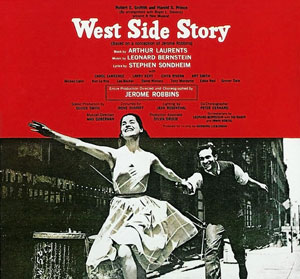
 What better place to start than with Tom Waits’ version of Leonard Bernstein & Stephen Sondheim’s “Somewhere”? In the original context of West Side Story, the song is a hymn to a time when society can move beyond racial & ethnic prejudice; a beautiful melody that plays against a complex chord structure, with the final resolution moving inexorably & startlingly into another key a dominant seventh above the original key center.
Waits’ Blue Valentine, released in 1978 on Asylum, is a highly poetic & in its own way a highly romantic exploration of the wild side of life—it tells the story of skid row bums, petty criminals, prostitutes, runaways, the halt, the lame & the lost—even the haunted lover of the album’s final cut & title song—with a mixture of humor, insight, pathos, charged language & a tattooed heart worn for all to see with the sleeve rolled up. In that context, Waits transforms “Somewhere” into a fitting prelude to the album—it’s the opening song, & as an old friend of mine used to say, “What a voice to come out of the silence.” That Crown Royal & Chesterfields baritone, with its 3:00 a.m. growl that sings about hope against hope against an improbable but perfect string chorus. “Somewhere” becomes the song for all the misfits & the lost who will people the remaining original songs. Although the song wasn’t written by Waits, he makes it integral not only to his larger vision, but also to the specific & organically unified vision of the album. We can hear any of those characters singing softly to himself or herself: “Someday, somewhere, we’ll find a new way of living; we’ll find a way of forgiving, somewhere.” This is beautiful music & beautiful poetry combined.
Until next time.
What better place to start than with Tom Waits’ version of Leonard Bernstein & Stephen Sondheim’s “Somewhere”? In the original context of West Side Story, the song is a hymn to a time when society can move beyond racial & ethnic prejudice; a beautiful melody that plays against a complex chord structure, with the final resolution moving inexorably & startlingly into another key a dominant seventh above the original key center.
Waits’ Blue Valentine, released in 1978 on Asylum, is a highly poetic & in its own way a highly romantic exploration of the wild side of life—it tells the story of skid row bums, petty criminals, prostitutes, runaways, the halt, the lame & the lost—even the haunted lover of the album’s final cut & title song—with a mixture of humor, insight, pathos, charged language & a tattooed heart worn for all to see with the sleeve rolled up. In that context, Waits transforms “Somewhere” into a fitting prelude to the album—it’s the opening song, & as an old friend of mine used to say, “What a voice to come out of the silence.” That Crown Royal & Chesterfields baritone, with its 3:00 a.m. growl that sings about hope against hope against an improbable but perfect string chorus. “Somewhere” becomes the song for all the misfits & the lost who will people the remaining original songs. Although the song wasn’t written by Waits, he makes it integral not only to his larger vision, but also to the specific & organically unified vision of the album. We can hear any of those characters singing softly to himself or herself: “Someday, somewhere, we’ll find a new way of living; we’ll find a way of forgiving, somewhere.” This is beautiful music & beautiful poetry combined.
Until next time.
The images of the cover art for Blue Valentine & West Side Story link to their sources on Wiki Commons, which claims “fair use.”