Friday, December 22, 2017

Three Poems for Chang’e


Chang’e


on the candlelit mica screen, a distant shadow;
Heaven's River ebbs slowly, the morning star sinks low—

Chang’e must regret stealing the elixir of life:
blue of sea, blue of sky, her dark heart, night after night


translation © Jack Hayes 2017
based on Li Shangyin: 嫦娥
Cháng'é

Mid-Autumn Moon


insects hidden under grass, frost atop the leaves;
a vermilion balcony presses against the bright lake—

the Rabbit chilled, the Toad cold, the Cassia blossoms white:
this night must be gut-wrenching for Chang’e


based on Li Shangyin: 月夕
yuè xī


Frost Moon


once expeditionary geese are heard, cicadas fall silent;
the hundred-foot tower connects river and sky—

Blue Maiden and White Lady both can endure cold;
in the moon, within frost, they compete in beauty


based on Li Shangyin:  霜月
shuāng yuè 

 
Notes:
This set of translations would be more appropriate for the Mid Autumn Festival, Zhōngqiū Jié, which is the full moon closest to the Autumn Equinox. But rather wait until next September, I’m posting them now.

We have no way of knowing whether Li Shangyin intended these poems as a complementary set or as distinct & individual compositions. James JY Liu in his seminal work on the poet, The Poetry of Li Shang-yin: Ninth-Century Baroque Chinese Poet, does place the poems together & discuss them as a group. Poet David Young also places the poems together under the title “Three for the Goddess of the Moon” in his Five T'ang Poets. Since Young is a poet & not a Sinologist, I assume in grouping the poems together he is following Liu either directly or at second or third hand.

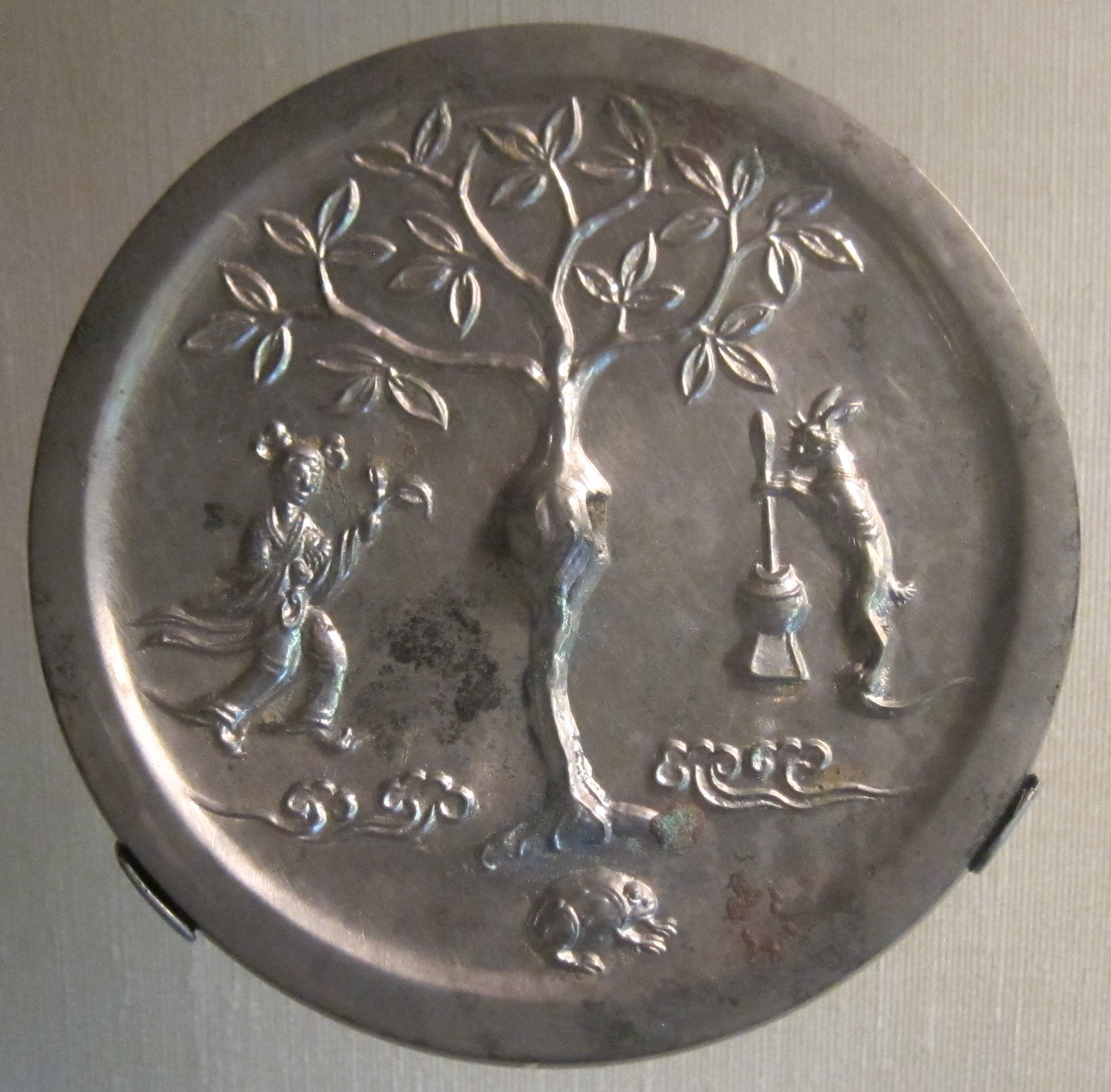
For more information on the Chang’e myth, see the Wikipedia page. Briefly, Chang’e stole the elixir of immortality & flew to the moon, where she lives with a rabbit (or hare) who pounds herbs into the elixir of immortality with a mortar & pestle & a three-legged toad. There is also a cassia tree on the moon in this myth. Chang’e is the “White Lady” mentioned in the third poem (素娥, sù é), while the Blue Maiden (青女, qīng nŭ) is Qing Nu, the Goddess of Frost & Winter.

As is the case with almost all the Chinese translations, grateful acknowledgment is due to Sheila Graham-Smith, who did a marvelous job of elucidating the first line of the first poem.


Image links to it source on Wiki Commons:
Chang'e flees to the moon: from Yoshitoshi’s 100 Aspects of the Moon. (1885-1892)
Public domain.


Monday, December 18, 2017

In the Classical Style


In the Classical Style


this lifetime passes, a wandering guest;
this death, like someone who returns home—

an upstream journey between earth and heaven,
then the grief of dust across ten thousand years—

the moon rabbit grinds the elixir in vain,
the tree of life already turns to kindling—

white bones lie desolate, without voice,
while dark pines rejoice, sensing springtime—

ahead there’s sighing, behind there’s sighing too:
this glory of a brief day, what’s it worth


translation © Jack Hayes 2017
based on Li Bai: 拟古
nĭ gŭ


Note:
This poem has been titled “Old Dust” in other English translations, though that isn’t the meaning of the characters passed down in Chinese tradition as a title: 拟古. It’s worth noting in this context that Li Bai has a series of fifty poems titled古風 (gŭ fēng), which might be translated as “Antiquity”, or “Ancient Airs” or “After the Classics” or some similar phrase. Victor Mair has translated the whole sequence in his excellent Four Introspective Poets, & Paula Varsano has translated a number of the poems in her study, Tracking the Banished Immortal: The Poetry of Li Bo and Its Critical Reception. My sense is that Li Bai in this poem is also deliberately looking back to his classical predecessors.


Image links to its source on Wiki Commons:
Sunset at Mt Tai in Shandong province, China, January 2005. Photo by Wiki Commons user Pfctdayelise, who makes the image available under the Creative Commons Attribution-Share Alike 2.5 Generic, 2.0Generic & 1.0 Generic licenses.


Friday, December 15, 2017

Moon


Moon


in the fourth watch the mountains spew up the moon,
in night’s remains, waters illuminate the tower—

in essence, a dusty case revealing a mirror,
curtains raising themselves in gusts to the topmost hook—

the Rabbit ought to ponder my crane-white hair,
but the Toad only longs for my sable coat—

I mull over the Widow Lady Chang-E,
how she bears the chill of the ninth month


translation © Jack Hayes 2017
based on Du Fu:
yuè


Note:
Chang-E is the Moon Goddess, & her companions are the Jade Rabbit (or Hare), who pounds herbs into the elixir of immortality, as well as a Toad, often depicted with three legs. Chang-E pilfered the herbs of immortality from her husband, the mythical archer Yi, & flew to the moon. In poetry, she is often a figure for loneliness.


Image links to its source on Wiki Commons:
Tang dynasty (618-906) bronze mirror with moon goddess and rabbit design. Photo by Wiki user Hiart [link provided on Common is empty], who publishes it under the following license: This file is made available under the Creative Commons CC0 1.0 Universal Public Domain Dedication.


Tuesday, December 5, 2017

The Locomotive


is no bigger than my thumb,
a tree’s straight-grained
fragment milled to a shape
implying dynamics,
but parked on the bookshelf
it doesn't budge an inch,
except as we all do in earth’s
thousand mile per hour spin—

the locomotive’s out of proportion
with the globe’s caravels
sailing two-dimensional seas;
the wall clock above,
with scalloped blossom edge, forms
a sort of compass rose,
& the ballast of books below—
                                             there’s not enough time to

read everything & still set foot on
a sailing ship bound for purple
mists on the horizon between Yachats &
Ise Jingu when the wind blows
from the west in summer filled with
invisible kanji & the steps of
Basho in the snow as he lost himself in
eternity beside sun & moon—

Asian pears in a bowl in the
kitchen; I could fetch one here
but I’m typing instead in syncopation
with the clock, thinking about painting
these walls light green perhaps;
the Anglo-Saxon grammar
on the bottom shelf & the crow
outside the window discuss winter—


beyond the carved

boxwood Guanyin on

the sill green

rhododendrons

lean in to listen


Jack Hayes 
© 2017

Friday, November 24, 2017

The Book


the book has boundaries without boundaries;
in that sense the book resembles a house: you

are born & die there again & again, you
hoist it on your back, you shrink into it, you

listen to raindrops tapping the skylight when
morning is gray & the chestnut burrs drop at

random onto the driveway & the blue car—
in every book a blue tandem bike waits parked

on its kickstand in the basement for that one
spin through the park on a blue & yellow June

afternoon; in every book a French press
stands half full on the counter; the sun breaks

through clouds to shine on the paperbark maple
next to the backyard swing—you are the perfect

reader, sleeping until the alarm clock chimes,
walking downstairs as if turning the pages


Jack Hayes
© 2017

Wednesday, November 22, 2017

Dao De Jing 19


Dao De Jing 19


Reject sagacity, abandon expertise
& the people will benefit a hundred times over;
reject altruism, abandon morality,
and the people will return to benevolence;
reject ingenuity, abandon profit,
& thieves will no longer steal.
But these three are superficial & not in themselves sufficient.
Thus follow this directive:
manifest simplicity, embrace modesty,
diminish self-interest, curtail desire.


Laozi, 道德經
Translation by John Hayes
Unlike with my original poetry & poetry translations, I don’t asset a copyright claim on my translation of the Dao De Jing. It may be freely used under the terms of the Creative Commons license.


Image links to its source on Wiki Commons:
“Xuan Yuan Inquires of the Dao”, scroll, color on silk, 32 x 152 cm. Xuan Yuan is the given name of the Yellow Emperor. This painting is based on the story that the Yellow Emperor went out to the Kongtong Mountains to meet with the famous Daoist sage Guangchengzi. Ming Dynasty.
Public domain.


Tuesday, November 21, 2017

Huazi Ridge


Huazi Ridge


birds fly off into the infinite;
on the mountain range autumn color returns—
walking up, walking down along Huazi ridge:
do grief & regret ever reach an end


Translation by Jack Hayes © 2017
based on Wang Wei: 華子 岡
huá zĭ gāng


Image links to its source in Wiki Commons:
Landscape attributed to Southern Song artist, Yamato Bunkan, Nara, Japan.
Public domain.