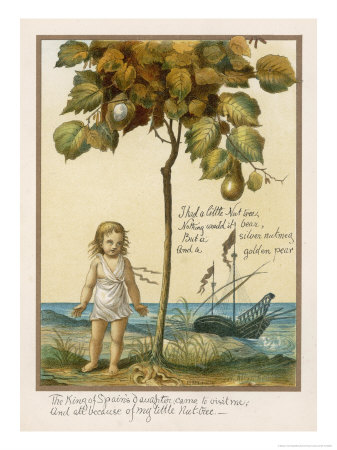
Aftermath
I had a little nut tree, nothing would it bear
but a silver nutmeg and a golden pear.
So many shades of copper tinted orange,
orange tinted red, red washed out to evening’s
pink tints, late light in the breach,
and certain long shadows missing from the lawn.
Golden light on finches in and out of the hedgerow,
golden leaves of birch just turning,
golden edges of frost burnt hostas…
A point in time – now, for instance –
compression of desire. A point in space –
here, with a third quarter moon rising through
the maple and cows waiting at the gate –
expansion of desire. The walnut, still green, still
bearing pale, unripe fruit, sprawls on the grass, trunk split,
branches fractured; safe there from wind.
SGS
© 2016
Image links to its source:
The image was found at poemshape.wordpress.com. The image is by Eleanor Vere Boyle & dates to the 19th century; thus it’s in the public domain.
For more information on the epigraph, please see this link.
partridge sky
this winter sun—dreary so dreary—climbs past my locked window:
parasol trees must hate frosty nights returning—
wine’s all gone, better savor bitter tea instead;
& my dream’s cut short: borneol’s insistent, aromatic—
autumn’s already used up
but the days remain long:
like Zong Xuan’s homesick heart, but colder, more bitter—
it’s not as if happiness follows the intoxicating cup: don’t
forget yellow chrysanthemums budding by the eastern hedge
Jack Hayes
© 2016
based on Li Qingzhaho: 鷓鴣天
zhègū tiān
Notes:
Partridge Sky: This ci poem is set to an existing tune, which is "Partridge Sky".
Borneol: "Borneol is easily oxidized to the ketone (camphor). One historical name for borneol is Borneo camphor which explains the name.... Borneol is used in traditional Chinese medicine as moxa."
Zong Xuan: Also known as Wang Can, a Han Dynasty poet, who composed 七哀诗 qī āi shī, usually translated as "The Song of Seven Sorrows". In addition, the final line alludes to some famous lines by Six Dynasties poet, Tao Yuanming, here in Arthur Waley's translation:
I pluck chrysanthemums under the eastern hedge,
Then gaze long at the distant summer hills.
The mountain air is fresh at the dusk of day:
The flying birds two by two return.
In these things there lies a deep meaning;
Yet when we would express it, words suddenly fail us.
The poem is posted today to mark the 重陽節 Chóng yáng jié or Double Ninth Festival; this falls on the ninth day of the ninth month of the lunar calendar, & is also known as the 菊節 Jú jié or Chrysanthemum Festival.
Thanks as always to my partner Sheila Graham-Smith for her invaluable research & editorial work.
Image links to its source on Wiki Commons:
Chrysanthemums: Xue Wu, 17th century, ink and gold on paper, Honolulu Museum of Art, accession 2312.1
Public domain
three crows hunched on the chain link fence in drizzle;
black bicycle locked to the corner staple,
which is blue—seven of spades on a sidewalk
dry patch: unseen halo around this black moon
Jack Hayes
© 2016
_by_Emperor_Huizong.jpg)
autumn meditation #1
jade dew withers & maims the maple forest;
on Wu Mountain, in Wu Gorge, the air’s bleak & gloomy—
on the river, waves surge to meet the sky;
above the border pass, wind-blown clouds overshadow the earth—
chrysanthemums twice have brought on tears for the past;
a lonely boat the one link to my heart’s homeland—
reminders everywhere: winter clothes cut & measured;
over Baidicheng, twilight song of pounding stones
Jack Hayes
© 2016
based on Du Fu: 秋興八首 (一)
qiū xìng bā shŏu (yī)
Notes:
Over the next several weeks we’ll be posting our English language versions of Du Fu’s秋興, qiū xìng, or “autumn meditations” series. From a certain perspective, translation is always an impossible endeavor, & translating a poet as great as Du Fu should always be approached with humility. This is even more true when translating a major work like the 秋興, qiū xìng. I do hope our humble versions inspire readers to seek out other versions & also learn more about this truly remarkable poet.
The “meditations” are dense & packed with meaning & allusion, & so notes will be important. The series was composed in 766 while Du Fu had settled in Kuizhou, specifically in Baidicheng (literally “White Emperor City”) in what is now Chongqing. Du Fu had again moved south after further turmoil in Chengdu forced him to leave behind his “thatched cottage” there, & he spent two years in Baidicheng on the Yangzi, & near Qutang Gorge. During his sojourn in this area, Du Fu wrote around 400 poems, including many of his most notable works.
This is the “Three Gorges” region of the Yangzi, & Wu Gorge, mentioned in the first line, is to the east. It’s also referred to as the Great Gorge, & is the middle of the three. Wu Mountain is north of Wu Gorge. Also in the first line: “jade dew” is a common trope for autumn.
The fourth couplet is of particular interest: based our Sheila’s research, in our reading the preparations for winter are serving to underline Du Fu’s homesickness, already raised in the third couplet. The sound of mallets striking cloth laid out on the pounding blocks was also a trope in Classical Chinese poetry. It typically evokes the melancholy feeling of autumn, as it’s an activity linked to that season. In addition, it can evoke feelings of longing for a spouse who’s absent; for a male poet, it can bring up the idea of a lost domesticity, while for a female poet (or a female speaker written by a male poet) it can bring up feelings of longing for a husband who’s far away, especially one who’s serving as a soldier. In fact, both Du Fu & Li Bai wrote poems in the voice of a woman engaged in clothes pounding while yearning for her husband who’s away in the army, serving in the border passes.
As always, I’m indebted to Sheila for her research & editorial work. We are both indebted to the notes & writings of Burton Watson, Stephen Owen, & William Hung—to name three of the most prominent Du Fu translators—as well as to Tu Fu's "Autumn Meditations": An Exercise in Linguistic Criticism: Tsu-lin Mei & Yu-kung Kao. Harvard Journal of Asiatic Studies, Vol. 28 (1968), pp. 44-80.
Image links to its source on Wiki Commons:Court Ladies Preparing Newly Woven Silk: Cropped from a Song dynasty painting attributed to Emperor Huizong in the style of Tang dynasty painter Zhang Xuan. Between 1100 and 1133. Indian ink and color on silk
Public domain
broken boat
this whole life a heart set on rivers and seas,
long ago I outfitted a skiff—
not just for sailing up the black mountain stream
or drifting daily close by the brushwood gate—
then a panicked escape from the rebel troops:
heartsick in far lands for my home in the hills—
my neighbors have gone away now too;
only the wild bamboo grows taller, taller—
the boat’s wales no longer resound with my strikes:
it’s buried, cast aside, undergoing autumns—
I look up and watch the wings flying west;
below, I’m shamed by the stream as it flows east—
the old boat could be dug up again;
and a new one wouldn’t be hard to find—
this place of grief, fate has exiled me from it;
it’s hard to stay long in an empty house
Jack Hayes
© 2016
based on Du Fu: 破船
pò chuán
Notes: As always, grateful acknowledgement to my translation partner, Sheila Graham-Smith for her editing & research. Some points about the poem, much of which come from Sheila’s work.
Per Burton Watson, the poem dates to 764 when Du Fu returned to his thatched hut in Chengdu after fleeing a local rebellion. At this point it was eight years after the original An Lushan uprising, which had displaced Du Fu from Chang’an to the south. It’s difficult to comprehend the level of turmoil in China during this time period—not only were there shocking levels of death & destruction, actually approaching the appalling levels of our own time, but in addition there was a massive displacement of people, generally from the north to the south. One reason it’s difficult to assess the mortality levels during the series of revolts is simply because there was so much movement of the population.
Sheila pointed to two tropes within the poem. First, we wanted to underline the identification of the poet with the “broken boat.” The poem begins with Du Fu’s paraphrase of a passage from the Zhuangzi. Here is the passage in the public domain James Legge translation:
Prince Mou of Gong-shan spoke to Zhan-zi, saying, 'My body has its place by the streams and near the sea, but my mind dwells at the court of Wei - what have you to say to me in the circumstances?' Zhan-zi replied, 'Set the proper value on your life. When one sets the proper value on his life, gain seems to him unimportant.' The prince rejoined, 'I know that, but I am not able to overcome (my wishes).' The reply was, 'If you cannot master yourself (in the matter), follow (your inclinations so that) your spirit may not be dissatisfied. When you cannot master yourself, and try to force yourself where your spirit does not follow, this is what is called doing yourself a double injury; and those who so injure themselves are not among the long-lived.'
The turmoil in the wake of the An Lushan rebellion not only displaced Du Fu from his homeland, it also cost him his position at court. He, like the boat, has also been “buried” & “cast off”; in addition, he suffers shame at having run.
In addition, Sheila points to the “empty house” trope, noting that it occurs frequently as a metaphor for depression & heartbreak. Sheila writes, “the meaning of the empty house is double edged. It stands for the absence of a place in the world order, and also for some personal failing. It gives the end result - the man without context - and also gives the cause - his restlessness and inability to stay in one place, embodied in the boat) - in the same metaphor - the empty house.” She also referred to passages both from the great Tang poet Wang Wei & also the poet Zuo Si from the western Jin period.
Flap, flap, the captive bird in the cage
Beating its wings against the four corners.
Depressed, depressed the scholar in the narrow street:
Clasping a shadow, he dwells in an empty house.
Zuo Si, “The Scholar in the Narrow Street”, Arthur Waley translation
I sit alone sad at my whitening hair
Waiting for ten o’clock in my empty house
In the rain the hill fruits fall
Under the lamp grasshoppers sound
White hairs will never be transformed
That elixir is beyond creation
To eliminate decrepitude
Study the absolute.
Wang Wei, “Sitting alone on an Autumn Night”; GW Robinson translation
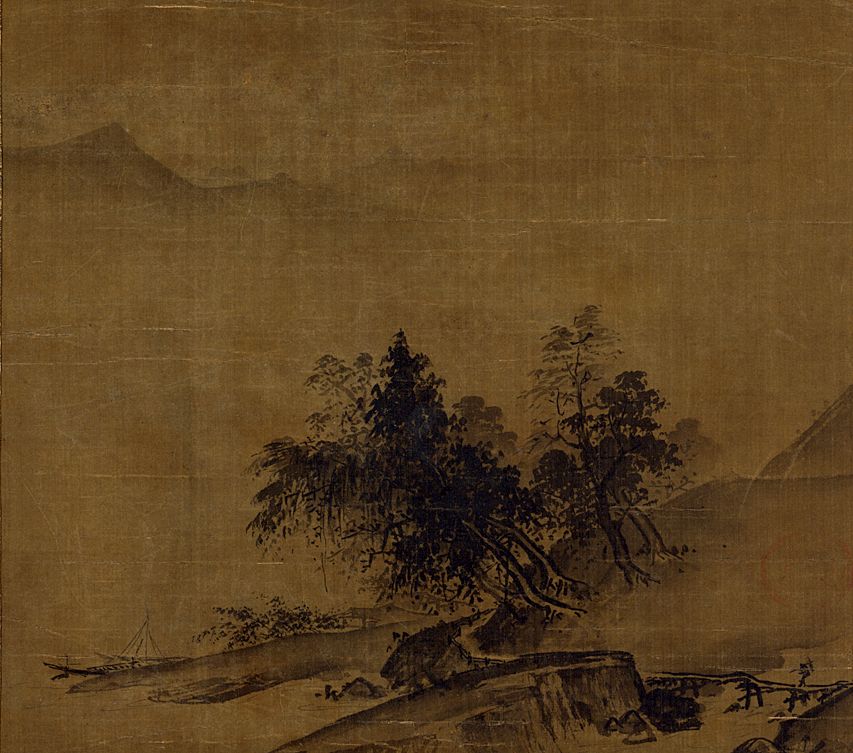
Image links to its source on Wiki Commons:
Untitled (Landscape): Xia Gui – ink and light colors on silk: Song Dynasty.
Public domain.
mid-autumn moon
evening clouds gather brimming on the horizon: clear, cold—
the silver galaxy, silent, arcs above the white jade plate
this beautiful life this beautiful night are not long:
next year where will I watch the brilliant moon
Jack Hayes
© 2016
based on Su Shi: 中秋月
zhōng qiū yuè
Note: Just as our English term "midsummer" traditionally refers to the summer solstice, the mid-autumn festival (中秋节, zhōng qiū jié) falls on the full moon closest to the autumnal equinox.
Image links to its source on Wiki Commons:
Autumn landscape from the set: Autumn and Winter Landscapes (絹本著色秋景冬景山水図) by Emperor Huizong of Song dated to 12th century Southern Song Dynasty. Color on silk. Public domain.
when I open the door dozens of crows fly,
they fly southeast on the diagonal—
three contrails smear the horizon
rose pink
inexplicably as I cross the street
you aren’t there—a black cricket scurries through
brown leaves & seedkeys—
I’m no different really—
above power lines the swallow zigzags its
silhouette frenzy—
you aren’t here: though the one
hawthorn, those drooping brown-eyed
Susans, a handful of
cirrus skimming east above high-rises:
company of sorts—
not to mention the many
materializing along the sidewalk:
& yes, I smile, walking south
& yes she smiles walking north—though
you’re right I’m not young:
in just a few minutes the planets will turn on,
scarlet phosphorescent metallic: a plane’s
just inches from colliding with Mars on high—&
magnolia’s cone fruit dangling above that
bus stop where
white blossoms once strewed the lawn &
you aren’t there as the southern
sky grays, the contrails blanch
wraith white in the west—though
at the market the woman weighs black
plums, calls me dear
& you aren’t there—back east
fireflies luminesce cold without ultraviolet before they
go extinct, here the ginkgo yellows ignoring the fact it’s
August & you aren’t here: still, tomorrow
two planets will coruscate incandescent love &
thunder over the park & plane trees’ leaves will
stretch out their big hands, you say—
okay: across the street those colored lights, frayed
prayer flags on a string & of course the dark:
the next step is bound to happen next
Jack Hayes
© 2016