Tuesday, January 31, 2012

Always Unfinished

[There’s a big announcement after the poem, so make sure to check it out after you’ve read this sweet poem by Barbie Angell!]
 
Always Unfinished


I try to piece together
This quilt of bits of time.
So I can sleep at night
With all I know is mine.
It will always keep me warm
And always keep me safe,
Those ragged little memories
Of the life I had to make.
And if you scan it closely
You’ll see that you are there
Among the stitched promises
And the empty cans of beer.
Amidst the tears and laughter
And the lovers that went wrong.
Somewhere in between
My countless favorite songs.
I’ve struggled all my days
To keep all the little scraps
Matchbooks and guitar picks,
An endless array of crap.
And I sorted through it all
And I weighed the good and bad
And I pretty much kept everything,
All the happy and the sad.
Yeah it’s taken me a lifetime
To be the girl I am,
And I refuse to live in bitterness
When life didn’t go as planned.
No I’ll take all that I’m given
And I’ll be better for it all.
I know it’s all just living
Every single time I fall.
I’m sure I’ve had it better
And I know I’ve had it worse,
But I’m not one to blame another
Or think my life is just a curse.
I want my quilt to span the globe
And cover everyone I’ve met.
I’d like to buy the world a coke
And toast a life of no regrets.
I want you all to sing with me
Some universal happy song.
And know that if you’re really you
Then nothing can be wrong.


Barbie Dockstader Angell
© 2009-present


It’s my great pleasure, friends, to announce that Robert Frost’s Banjo’s own Rockstar Poet in Residence Barbie Dockstader Angell will be publishing a book of children’s poems & illustrations later this year. Barbie’s book will be published by Grateful Steps out of Asheville, North Carolina, a first-rate publisher of children’s literature, & a real force for community building in western North Carolina.

You can get a preview of the book as it’s in progress at this link, & also leave comments there; I know for a fact that Barbie & Grateful Steps are looking to get folks involved in the process, & to my mind it’s a wonderful opportunity to interact with the work of a talented & unique poet. 

For myself, I’ll say that this news has made me very happy. Barbie is not simply a contributor to Robert Frost’s Banjo—she’s also a good friend & someone whose creativity I hold in high regard.  As a contributor to this blog, her poems & illustrations bring an added dimension that delights me & readers as well—in fact, since Barbie came on board as a contributor in May, her poems consistently have been among the most popular posts. 

So please join me in offering Barbie congratulations in a comment, & also please take some time to go to Barbie’s issu site & look at her wonderful book in progress!

Monday, January 30, 2012

Any Woman’s Blues #18 – Elizabeth Cotten

Happy Monday, folks! A belated edition of the Monday Morning Blues is coming your way at last.

I must admit I was a bit shocked to realize that I’d written almost 20 posts in the Any Woman’s Blues series without featuring Elizabeth Cotten.  If you’re familiar with Ms Cotten at all, you know that her playing has been highly influential & that she was a fixture in the 1960s folkie scene. To this day, her song “Freight Train” is the one tune that pretty much every fingerstyle guitar player learns.

Of course, when I say influential, I should note that many players have reproduced her overall sound, but in fact, very few imitate her actual playing style, as that was singular. Cotten was left-handed, & when she was young she picked up a guitar in the way that seemed natural to her—namely, what would be considered upside-down & backwards.  These days, they make left-handed guitars (tho depending on the degree of left-handedness, a number of left-handed folks also play “as if” they were right-handed), Elizabeth Cotten came to the guitar after learning the banjo at age seven (she learned on her older brother’s banjo); again, she played the banjo “upside-down & backwards.” 

A banjo has a quirk in that the string that would be typically played with the thumb by a right-handed person is a high-pitched drone.  It’s also true that old-time banjo styles the thumb plays a good deal of the melody.  So in that sense, her approach to the banjo was slightly less novel.  But when she started to play the guitar, she came up with the odd technique of playing the bass strings with her index finger & the treble strings with her thumb—exactly the opposite of how the instrument is typically played.

Despite or because of her unusual playing technique, Elizabeth Cotten grew to be a masterful guitar player.  She also was a precocious composer—Cotten wrote “Freight Train,” as a young teenager, not long after she’d scraped together enough money to buy a Stella guitar. She didn’t become a professional musician, however, & by the time she moved to the Washington, D.C. area she’d mostly put the guitar aside. 

Cotten was working in a department store one day when a young girl became lost.  Elizabeth Cotten helped the child, who was Penny Seeger—yes, of that Seeger family.  The upshot was that Cotten became the Seeger’s maid, & at a certain point young Mike Seeger discovered that Elizabeth Cotten could not only play the guitar but could really play the guitar.  He began taping her performances on reel-to-reel tapes, & these were later issued by Folkways Records.

Elizabeth Cotten, now in her 60s, became a fixture at folk festivals from the 1960s almost until her death at age 92 in 1987—in fact, she won a Grammy Award for best traditional album in 1985 (for her Live! on Arhoolie).  As far as guitars go, Cotten mostly played Martins after her “discovery,” switching between three sizes of the 18 model: 00, 000 & D. She also sometimes played a Gibson Jumbo.
 

Today’s two videos show Cotten’s musicianship on a total of three songs; the first (despite the video description, which references “Spanish Flang Dang) has her playing “Washington Blues & an untitled jig—this is a live video, so you can watch Cotten’s playing. The second is her version of the great folk-blues instrumental, “Vestapol” from her wonderful Smithsonian Folkways release, Elizabeth Cotten. Freight Train and Other North Carolina Folk Songs and Tunes.

Enjoy!


Sunday, January 29, 2012

Photo of the Week 1/29/12

MAX Yellow Line Light Rail Tracks
Seen From N Prescott St Station
N Interstate Avenue
Portland, Oregon
Saturday 1/28/12

Saturday, January 28, 2012

"Ruchama In Her Worn Nightgown,"

[Much gratitude to my friend Brittany Newmark for making this powerful poem available to Robert Frost's Banjo.]

Ruchama In Her Worn Nightgown,
               

1.

It has taken so long to arrive here, late,
                                              the dust in my shoes
                                              and my pockets
                                                                                turned out like some clown in a silent film. 


Sometimes it was like
Rowing across the lake where all the fish were named for saints
And feeling like you were not a tourist,
                                                                                (in other words feeling smug)
and then being slighted
And at last knowing, how fragile it is to belong.


Ruchama you had a white dress, before white dresses.
Do you remember it?
I do,

                                              on two counts,

1. it was so much more than I could have ever afforded, even now
and 2. It was braver than I have ever been, especially now.


 Nu, your feet are bare,
The wells of your clavicle filled with indiscretion. 
No need to worry the last bleeding cuticle
or to scour the teakettle at all hours of the night.

O you must be so cold,

Go, go back to bed.  What is happening will go on without you. 
It does not concern you.

Stay out of it.   No good can come of it.


I am sorry to say that there is no one left to comfort
or to betray. 

                                  Whatever beauty was
                                                            She has picked another hill to die on.

               
2

They were good times though,
                                                    those parties you used to throw,
                                                                                                  And how you served

                                                    entire meals of revenge, the sweet breads of ambition,
                                                    the small red fruits of petty resentment. 
                                                    You knew.

Really, what else can you offer to a room full of opportunists?
                With their hands outstretched like ghouls in a B movie

They got what they deserved
                                                    and that is so rare in this life. 
What did you tell me?
                            You had the salon repainted and the shutters opened wide
and even the workmen
yes especially the workmen thought
of bedding you,
                                                    it was hot repetitive work, 

they all imagined you
naked.  We all always imagined
you naked, with a pool of clothing at your feet.

That thought and those conversations
pure, like an American song on the green radio:

You don’t believe I love you,
            Look at the fool I’ve been.
You don’t believe I’m sinkin
            Look at the hole I’m in.


By that time, so many had abandoned their rituals, in the fields,
In the camps, in the gulags—


They understood oppression not as the boy in fawn colored pants
looking out of the French doors onto a garden,
but they knew it
                                  from a hut, the inside of a latrine.

Then there was the man, in the army greens
he waded through the canal
choked with corpses, both theirs and ours. 
And he told those stories over and over,

                                                    or the story was told around him
after he left.


Of course you know
He did not get separated from his unit
He walked away
                                                    at nineteen—armed to the teeth
We all know what happened from there, not pretty. 

And he left behind a lesson that would serve.

But even he went on to marry and have a life,
                                                            (meaning a wife and children)
Alongside a beach and striped umbrellas.
But of course you know that,


How else could he have slipped so neatly
between you and what could have been?
                                                How else was there always sand on your stone floors?

               
3

I am not sure if I fully understand the premise
                                                            But it interests me.
In each generation there are 36 righteous men.
I expect one or two must have been impulsive youths,
                                                                                              hellions in jaunty grey caps. 

Or just boys playing chicken on a long dark stretch of highway,
                                                                                                                                          and lost.
They are not angels these men, who may be fewer than 36
                                                            they may not even be righteous
But they carry a generation.
                              I can’t say how to manage the darkness or the isotopes of faith

You can no longer manage even the red scarf or the sassy quip,
they seem sad and ridiculous—old woman, ugly woman.

Because even if they are silent—long gone
the ghosts of guests are well positioned around the room,
                                                                                      just where you placed them
one in the blue velvet chair,
the other just leaning by the bookshelf.

They are not listening they do not look up from the papers they hold out in front of them. 
                              Ruchama, your hand,
                                                            you have a tremor.


In the hot wind of August
                                            and in another century
somebody on the fourth floor throws open the door and steps out onto the porch,


Ruchama, you are lovely with a belly full of loquats

                              that you picked up under the tree, just outside the gates.
Was it stealing? 

No more or less than the man, 

                                            what he took from you,
                                            he carried back to her
I suppose everybody needs to eat.


Brittany Newmark
© 2012

Friday, January 27, 2012

“Steam Powered Aereo Plane”

Welcome to Banjo Friday! It’s the final Friday of the month, so if you’ve been following along, you know what that means: Bluegrass!

Actually, today’s song & today’s artist probably both defy strict genre categorization. Let’s consider the artist first. Chances are, unless you are a fan of modern bluegrass, & especially the “Newgrass” movement, you may not have heard of John Hartford—or it’s possible that you know him for the one song that made his fortune—which was not a bluegrass song at all. John Hartford wrote the song “Gentle on My Mind,” & was the first to record it. His recording was a modest hit at best, but when Glenn Campbell recorded the song, it became a real chart-buster & ultimately a song that was covered by artists as diverse as Elvis Presley, Aretha Franklin, Dean Martin, Lucinda Williams & R.E.M., just to name a few. In fact, during the height of the song’s popularity, the royalties were bringing Hartford a cool $100k per year; according to his online biography, “Hartford often said that Gentle On My Mind bought his freedom. He used that freedom to explore his various creative curiosities, and was usually happy to take his friends along on the trip.”

John Hartford had an abiding love of country music & bluegrass, but he was about as far from a hidebound traditionalist as one could be, & he brought more than a little counter-culture sensibility to his brand of bluegrass music. In 1971, he released the album Aereo-Plain on Warner Brothers, & this is one of those truly innovative albums that a lot of the general listening public have never heard or even heard of.  Aereo-Plain didn’t sell well at the time of its release, & in fact Warner failed to promote his follow-up work as a result, which led to him asking for (& receiving) a release from his contract. But history, at least, was on Hartford’s side, as Aereo-Plain is considered seminal to the “Newgrass” movement that sprung up in the 1970s, 80s & beyond. 

One thing about Aereo-Plain: Hartford assembled a dream line-up of bluegrass musicians to make the album. In addition to Hartford playing banjo & taking the vocals, Norman Blake played guitar, Vasser Clements played fiddle, Tut Taylor played dobro & Randy Scruggs played electric bass.  Actually, the story is a bit more complicated, because Hartford played some fiddle & guitar, Blake also played mandolin, & Clements added in viola & cello(!) 


The album is largely comprised of Hartford originals, tho it does contain a cover of the old country gospel song “Turn Your Radio On,” as well as a Bluegrass version of the old fiddle tune “Leather Britches.”  Otherwise, there’s some great song-writing by Hartford, & great music-making by all involved. Listening to the album while preparing this post, I was reminded how much Hartford partook of the musical clown role—evident in both his lyrics & singing style at times, tho he could also be as straightforward & sincere as they come on numbers like “First Girl I Loved.”  Of course, the musical clown role has a venerable history amongst banjoists, dating to disturbing origins in the days of minstrelsy, but having been largely transformed thru the years in the stage personas of great players like Uncle Dave Macon, Stringbean & Grandpa Jones. I see Hartford very much as a part of that tradition. 

“Steam Powered Aereo Plain” is just sheer fun & great music. I know you’re going to enjoy it!

Thursday, January 26, 2012

Raintown #5

2 empty hopper bird feeders dangling
from bare limbs on N. Mason—2 broken
concrete blocks out of kilter cast down be-

side a trailer—it devastates me not to
know the trees’ names—black gnarled
limbs out of whack yet budding blood-

red in January—black crow leaning in-
to its caw from a power line—my shortness of
breath, breathing thru pursed lips ex-

haling trapped air— alveoli col-
lapsed—2 pink flamingoes skewer a
lawn past the deadheaded roses—a second

crow swoops down on the blacktop—chest
rale as if someone mumbles walking just a
few steps back—on a concrete block

wall on N. Vancouver Ave in careful white
paint: tonight I can write the saddest of all
 lines
—disturbing not to hear sparrows in

red willows become unadulterated
melody—as if someone walked a few steps back:
our death unswerving comrade

Jack Hayes
© 2012

Wednesday, January 25, 2012

Welcome to Rose City

Downtown Portland-taken from the Portland Aerial Tram
Happy Wednesday, friends, & welcome to Portland, Oregon! As I mentioned last week, Wednesdays here on Robert Frost’s Banjo will be featuring posts about my new hometown. I hope to explore various places, events, & landmarks, with possibly a bit of Portland history & fun facts thrown in. One thing I know will happen: restaurant reviews! This is a great foodie town, & I’ll be checking out some places that look likely to have both good food & fit in my tight budget.


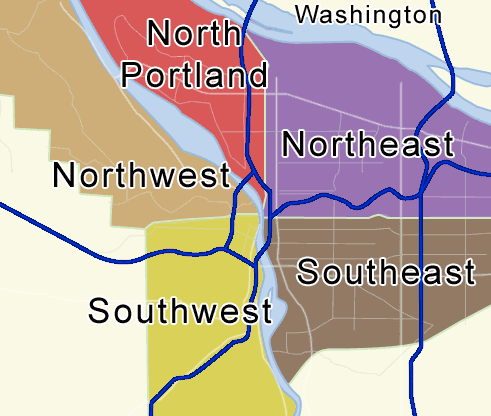
But today’s post is an overview & all about preliminaries—some of the “facts” here have been mentioned in previous blog posts, but as this is the beginning of the series, I think I may be excused for going over them again. Portland is divided into “quadrants,” as you can see from the graphic. The city is divided into “east” & “west” sections by the Willamette River, & divided into north & south sections by Burnside Street. Therefore, street names typically have the SE, NE, SW or NW tag, & people talk about their neighborhoods as being in “the Southeast,” “the Northwest,” etc. However, as you’ll notice from the map, there are actually five “quadrants,” because there’s also “the North.” & as I can’t seem to help being different, I live in that fifth quadrant.

Mississippi Studios - North Portland-my neighborhood
Portland Streetcar on SW Market in - you guessed it - Southwest Portland

Each of these quadrants—or for those who insist on mathematical corretness, sections—are divided into a number of neighborhoods, so it seems to me at least that it’s difficult to make sweeping generalizations about any one of the geographical designations—to say, “the Southeast is thus & so” or “the Northwest is like this.” Two things I should state, one a historical fact, the other personal. Portland originated on the west side of the Willamette, so from 1851 until 1891, the city existed solely on land that now falls within the Northwest & Southwest quadrants. In 1891, Portland absorbed Albina, Oregon & East Portland, Oregon, & these brought in parts of the current North, Northeast & Southeast sections; further expansion in 1915 gave the city most of its present-day territory.


Looking back toward Northwest Portland from the Steel Bridge

The Laurelhurst Theater on E. Burnside - the street that divides North & South

On a personal note? Fact is, I know the east side of Portland better than the west. In my almost 6 months of living here, I’ve been on the east side, & when I used to visit Portland while living in Idaho, I also spent most of the time in the east, & especially the Southeast, because that’s where many of my friends live.

Quonset Hut Bar - NE Alberta
Avalon Theater - SE Belmont

Other fun facts about Portland? It’s the 29th most populous U.S. city with a 2010 census population of 583,776, & the greater Portland metro area—which includes the city of Vancouver, Washington, as well as other areas in Washington just across the Columbia—numbers around 2,260,000, making it the 23rd most populous metro area. Tho Portland is Oregon’s largest city, both Seattle, Washington & Vancouver, British Columbia are larger cities within the Pacific Northwest. The climate? Per Wikipedia, “Portland experiences a temperate climate that is usually described as oceanic with mild, damp winters and relatively dry, warm summers.” Some might note that “damp” is a relatively mild term, & Portland does get a lot of rain, especially in the late fall thru the winter & into the spring. But as a result of its temperate & damp climate, it’s a great spot for gardening—hence, the nickname “Rose City” or “City of Roses.” 

The Portland Aerial Tram arriving at OHSU with the Willamette River in the background

Although Portland is a mid-sized city, it truly has a lot to offer, & I’m very happy & grateful to have the opportunity of living here.  Also looking forward to sharing it with you readers every Wednesday!


Here's the info on the neighborhood graphic: This file is licensed under the Creative Commons Attribution-Share Alike 3.0 Unported license by Wiki Commons user Sean Kelly