[L.E. Leone is never afraid to tackle the big questions in short poems—one of the many reasons we love her & her work both! Enjoy!]
CARMELLO
Apple falls exactly under
the apple tree, rolls a little
Stops.
Bees get into it.
You see a rotten apple, danger
dead dog, and say, “Amen.”
I see the light, a future tree,
and say, “Shit.”
Man, what’s the difference?
L.E. Leone
© 2011

Yes, it’s time for the monthly installment of the Any Woman’s Blues series, our own tribute to women blues guitar-slingers, & this month’s featured performer is truly electrifying. Ruthie Foster is probably thought of first & foremost as a singer, but she accompanies herself on guitar, & does so very well indeed. After all, for all that we think of many of the classic bluesmen as guitarists first, blues was historically vocal music—the notion of the blues as a vehicle for guitar pyrotechnics & virtousoic extended solos more or less came into the genre when it hybridized with rock. The genius of the country blues guitarists was not in their solos, but in their ability to accompany themselves in effective ways—the ability to build riffs & call & response that was the basis for so much playing that’s heard on early recordings. Of course, early recordings were restricted to a three minute format, & it’s quite possible that in actual performance there was a lot more soling. Still, when we read accounts of no less a blues personage than Charlie Patton, we learn that often when playing extended pieces for dances he would use the guitar essentially as a drum, beating out a rhythm on the soundboard to stretch out the music.
In any case, Ruthie Foster for my money most definitely belongs in this series. Of course, as a vocalist, she is nonpareil—her singing has been compared to that of both Ella Fitzgerald & Aretha Franklin, & in this case you can believe the hype—except as you will hear, Foster has a passion & power that’s completely her own.
Foster grew up in Texas in a family of gospel singers. She studied music McLennan Community College, did a stint in the Navy, & then in the 1990s began a performing career—including a recording contract with Atlantic—that was put on hold for a few years when she took time to care for her mother in her last illness. However, since the release of Full Circle in 1997, Foster has gone on to win acclaim as a performer, including the Blues Music Award as Best Traditional Blues Female Artist & the Blues Foundation’s Contemporary Blues Female Artist of the Year, both in 2010; Foster has also released at least eight other albums, with the most recent being Live at Antone in 2011 on Blue Corn Music.
Ruthie Foster keeps up a busy touring schedule, & if she’s in your area, make a point to check here out—you can find out her tour dates here. In the meantime, please enjoy these two great numbers—I know you will!
Apartment Interior
Mississippi Neighborhood
Portland, Oregon
Monday 11/21/11
Happy Saturday, friends! For those of you who haven’t yet gotten the news: I’m moving into my new apartment today.
Once things are starting to look home-like inside I’ll post some more interior pictures; in the meantime, here are a few of the unadorned space & environs, along with a big thank all of you who’ve been so encouraging here, on other online venues & in 3-D life! This has been a major adventure, with a number of highs & lows—as adventures are wont to have—& all the support I’ve received from folks in both the cyber & 3-D realms has meant a lot to me.
 Given the strain on resources & the social service funding cuts here in the States, I consider myself extremely fortunate to have found housing I can afford in a span of less than four months. Section 8, which allows low income/fixed income renters to get assistance with qualified units on the open market, is closed in Portland & many US cities due to funding cuts; that was a strike against me, because two rental possibilities came up early on that would have worked had Section 8 been available to me. A number of units also are available—theoretically, at least—where the rent is 30% of the person/family’s income. These are designated, of course, for low income people, including seniors & the disabled (I am in low income bracket, & also disabled; & by some definitions also a “senior,” since some properties class anyone 55 & up in that category.) This was the type of housing I wanted most to obtain, since it would have been the most affordable; unfortunately, the waiting lists for most of those units are closed in Portland (& other US cities), due to high demand. When the waiting lists are open, the wait time is typically years, not months.
My new place is for low income residents, tho within the complex itself there is some range in income—units vary in their cost depending on where the person or family’s income falls in relation to the median area income. I was extremely fortunate that one of the lowest priced units was available when my turn on the waiting list came up. Tho things will be tight, it is a rent that I can sustain with a very “no frills” lifestyle.
 The complex has a lot going for it—everything’s on the “ground floor,” including the laundry facilities. This is important to me, because with COPD, stairs are not my friend! The apartment itself is very trim & well maintained, & the grounds seem pleasant & well kept (even in the Portland November rain.) I also like the fact that the complex has a mixed population—families & younger people, as well as banged-up old codgers like me!
 One practical note in terms of the blog: I wasn’t able to schedule the wireless hook-up until Monday morning. As of this time I don’t anticipate any off-days; I’m expecting that I’ll be able to get the Photo of the Week & Monday Morning Blues features scheduled ahead of time. However, I may not be able to moderate comments using my phone, which will be the only ‘net access I have between Friday evening & Monday morning.
Thanks again, & hope you enjoy your weekend!

This month we’ve been listening to the banjo in unusual musical environments, & today’s video is no exception. When I heard Tony Trischka medley “Ticket To Ride,” “Lucy In The Sky With Diamonds,” “Drive My Car” & “Lady Madonna,” I knew this would be a fun way to wrap up the month, & a nice light-hearted post to come down off the Thanksgiving holiday.
If you’re not familiar with Tony Trischka’s work, it must be said that he is one of the best five-string banjo players going, & has also been influential as a teacher—Béla Fleck was one of his students!—who has produced a lot of instructional material, in both book & dvd form, & who now heads up the online Tony Trischka School of Banjo. But Trischka also has had a long & successful performing & recording career as a session player, solo artist & performer with bands like Country Cooking, Country Granola & Skyline. He has also been involved as a producer, & in fact was in charge of production of Rounder’s fun & successful 2011 Rare Bird Alert album featuring Steve Martin (yes, that Steve Martin, who can play some banjo!) & the Steep Canyon Rangers. Coincidentally, you can read an excellent review of Rare Bird Alert by Robert Frost’s Banjo’s Rockstar Poet, Barbie Dockstader Angell, here.
Trischka’s playing style is based on bluegrass techniques, but like Bill Keith & Fleck, he takes these techniques to whole new places. As an aside, I was fascinated to learn that Trischka first became interested in playing the banjo not by listening to Earl Scruggs or Ralph Stanley, but by hearing the Kingston Trio play “Charlie on the MTA!” The song does have a fun banjo part!
OK, folks: it’s late on Thursday evening, & my computer has already crashed once, taking much of the original version of this post with it. So let’s say: hope you enjoy the music—I know you will!
[I doubt that Barbie Dockstader Angell is ever really at a loss for words, but her persona claims to be here; a lovely, bittersweet poem from our favorite Rockstar-Poet-in-Residence!]
I Forgot….
I forgot who I was for a moment
And what I wanted to say,
But I’m certain that it was important.
The one thing so you’d want to stay.
Just look on the floor all around you.
Just check on the stairs and the ground.
‘Cause I know when you hear all about it,
You’ll be happy that I’m still around.
I remember the feelings you gave me.
They’re safe in my cigarette pack.
They’re the paste that’s holding my dreams.
I’m afraid that I can’t give them back.
I’ve misplaced the words that I wanted.
They’re the reason that I want to smile.
So search out the places around you.
I’m sure that I’ll be worth your while.
I forgot who I was for a moment.
I forgot who I wanted to be.
If you find that one phrase that I’m missing,
Please remember that it was from me.
Barbie Dockstader Angell
© 2009-present
[This will be the last post before Thanksgiving, so a very joyful holiday to all of our U.S. friends. See you on Friday—but please take a moment to say "hey" to Barbie Angell, our favorite Rockstar-Poet-in-Residence, in the comments!]
I
t’s the Monday Morning Blues here on Robert Frost’s Banjo—in case you can’t hardly find your Monday morning shoes.
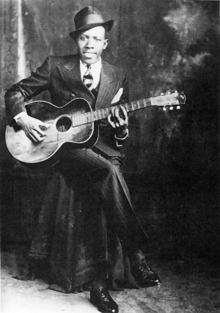
If you’re a regular follower of this series, you know that once a month we check in on one of the renowned guitar models that have helped shape the blues sound we know; & today’s model is a truly beautiful guitar that was played by a number of blues musicians—including one who has attained such a stature that if he’d been the only guitarist to play this instrument, it would still deserve to be included in the series. That one musician is Robert Johnson, & that guitar is the Gibson L-1. See pic below for famous studio portrait with the guitar in question, & pic above for a beautiful if well used 1928 L-1.
I should point out that Johnson was joined in using the Gibson L-1 by other well known blues players, including Scrapper Blackwell & Big Joe Williams, tho in those cases they are much more associated with other guitars (a National Triolian & various deformed Harmonys respectively). & some less well-known blues players used this—like Johnson—as their main instrument; these include John Henry Barbee, Bill Williams & Clifford Gibson (see second video below.)
As I understand it, Johnson played other guitars as well. His sometime playing & traveling partner Johnny Shines claimed he played a Kalamazoo, which guitar aficionados will know was a less expensive Gibson subsidiary—however, I had the pleasure of playing an old Kalamazoo in a guitar shop here in Portland, & I can tell you they are beautiful playing & sounding guitars! There apparently also is a rumor that he played a 7-string brass-bodied National—the high E string was reputedly doubled to increase volume! By the way, the site at that last link has been a major source in this whole series. I should also point out that—as far as I know—there's no definite proof Johnson used the guitar from the studio portrait when he made his recordings. But the consensus seems to be that the L-1 was his main instrument.
Depending on the condition, a Gibson L-1 from the series manufactured between 1926 & 1937  would cost you anywhere from $4,000 to $4,500 & up on the vintage guitar market. Those figures are based on 2009 estimates, by the way, & th guitars appreciate at about 5% per year! While I can’t readily find an original list price for the L-1, I can tell you that the very similar, if somewhat less fancy L-00 retailed for $25.00 around 1930. If we round that up to $30 for its somewhat more ornate sibling the L-1, we find that such a guitar would have cost the equivalent of $387.95 in 2010 dollars. Now, this is the price of a decent student model guitar these days: you can find some Recording King & Blueridge models in this price range, as well as several other very serviceable brands. Meanwhile, a new Gibson L-1 (Gibson reintroduced the line in ) retails for $2,100 & up—the actual list price is closer to $2,800.
Robert Johnson recorded 29 songs in his short lifetime, so of course there are 29 great choices for a video to illustrate here! I chose “Malted Milk,” which features some characteristic riffs but isn’t one of his better known pieces—I love it myself! & I’ve included Clifford Gibson & his L-1 telling us about “Blues Without a Dime” (recorded for Victor in 1929.)
Enjoy!


 would cost you anywhere from $4,000 to $4,500 & up on the vintage guitar market. Those figures are based on 2009 estimates, by the way, & th guitars appreciate at about 5% per year! While I can’t readily find an original list price for the L-1, I can tell you that the very similar, if somewhat less fancy L-00 retailed for $25.00 around 1930. If we round that up to $30 for its somewhat more ornate sibling the L-1, we find that such a guitar would have cost the equivalent of $387.95 in 2010 dollars. Now, this is the price of a decent student model guitar these days: you can find some Recording King & Blueridge models in this price range, as well as several other very serviceable brands. Meanwhile, a new Gibson L-1 (Gibson reintroduced the line in ) retails for $2,100 & up—the actual list price is closer to $2,800.

