Sunday, September 3, 2017

Eclipse (For Biwa And Shakuhachi)


Welcome back to the Sunday music feature. In September we’ll be featuring the music of Toru Takemitsu.

Takemitsu is a major composer & a few blog posts over the course of a month can serve only as the most cursory introduction & exploration of his music. I’d strongly encourage those who are interested in what they hear to seek out more information at the links given with each post & also to seek out more of Takemitsu’s music, which is readily available.

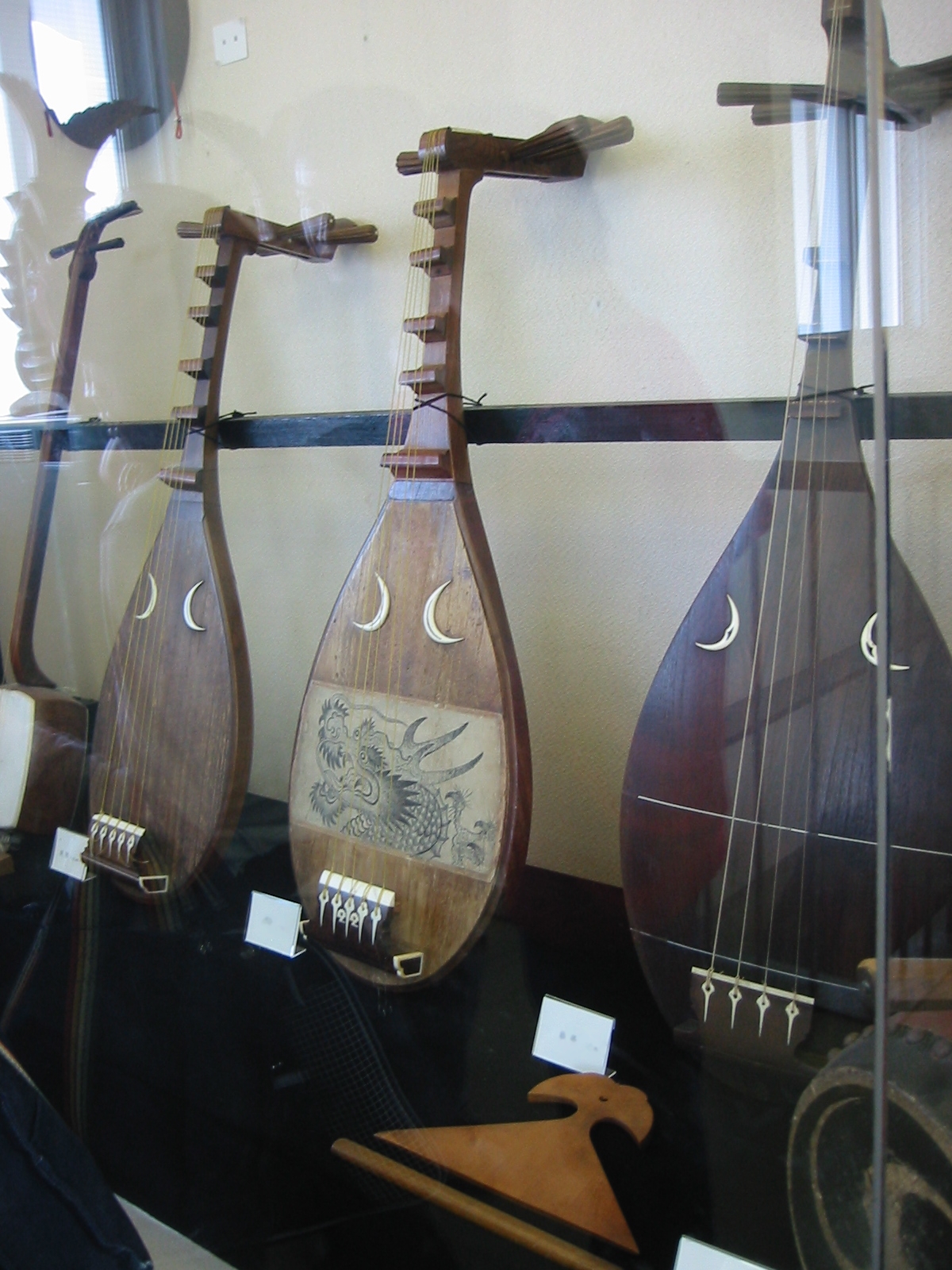
We begin the series with Takemitsu’s 1966 composition, “Eclipse”. This is scored for traditional Japanese instruments, the shakuhachi & the biwa. The former is a bamboo flute, while the latter is a type of lute.
Although Takemitsu was strongly influenced by Western music (Debussy, Messiaen, & Webern particularly) & indeed at one point expressed an aversion to traditional Japanese music—because it reminded him of World War II militarism—he began incorporating elements of Japanese music into his compositions under the influence of John Cage beginning in the early 1960s. Takemitsu’s 1967 composition “November Steps” for biwa, shakuhachi, & orchestra is related to “Eclipse”.

Hope you enjoy the music


Images link to their sources on Wiki Commons:
  1. “Performer playing shakuhachi in 60th Himeji oshiro festival, 2009”. Photo by Wiki user Corpse Reviver, who makes it available under the Creative Commons Attribution-Share Alike 3.0 Unported license.
  2. “A selection of biwa in a Japanese museum”. Photo by Wiki user Jnn, who makes it available under the Creative Commons Attribution 2.1 Japan license.


Friday, September 1, 2017

I am going to speak of hope


I am going to speak of hope

I don’t suffer this pain as César Vallejo. I don’t grieve now as an artist, as a man or even as a simple living being. I don’t suffer this pain as a catholic, or a muslim, or an atheist. Today I only suffer. If I weren’t called César Vallejo, I’d still suffer this same pain. If I weren’t an artist, I’d still suffer with it. If I weren’t a man or even a living being, I’d still suffer with it. If I weren’t a catholic, an atheist or a muslim, I’d still suffer with it. Today I suffer from further down. Today I only suffer.

I grieve now without explanations. My pain’s so deep it has neither a cause nor the lack of a cause. What would its cause be? Where is that thing of such importance it might leave off being the cause? Nothing is its cause; nothing has been able to leave off being its cause. From what has this pain been born, by itself? My pain’s from the north wind & the south wind, like neutered eggs that some rare birds lay conceived from the wind. If my bride were dead, my pain would be the same. If they’d sliced my throat to the root, my pain would be the same. If life were, in short, some other way, my pain would be the same. Today I suffer from higher up. Today I only suffer.

I look at the hungry man’s pain & see that his hunger walks so far from my pain that if I starved myself to death, a blade of grass would turn up at my grave at least. The same with the lover. How generative his blood is, unlike mine without spring or consummation.

I used to believe that all things in the universe were, inevitably, fathers or sons. But here’s my pain today, neither father nor son. It lacks a back for nightfall, just as it has too much chest for daybreak & if they put it in a bright room, it wouldn’t cast a shadow. Today I suffer, come what may. Today I only suffer.


César Vallejo, “Voy a hablar de la esperanza”
Translation by Jack Hayes
© 2017


Image links to its source on Wiki Commons:
“Schieles Wohnzimmer in Neulengbach” (“Schiele's Room in Neulengbach”): Egon Schiele. oil on panel; 1911.
Public domain.


Thursday, August 31, 2017

August Moon


(8 quatrains)

1. new moon

chrome hubcap complete with bolts lies on blacktop
as if about to set below the curb’s rise—

yucca stalks against white sky, blossoms faded:
moon’s blank disc invisible past the pink clouds

2. waxing crescent

twilight’s losing its cobalt blue momentum;
it comes down to three red lights suspended in

a horizon silver as that one stopped car:
pinprick planet next to this swelling crescent

3. half moon

bare chestnut limbs a character inked on this
violet sky—what does their radical mean?

white musk odor of Queen Anne’s lace on the lawn:
half moon bowing its head in recollection

4. waxing gibbous

those nameless trees on the side street look that much
darker than the sky; bus stop shelter absorbs

the red light’s spill, but is otherwise empty—
moon out of round against a purple curtain

5. full moon

three moths flash off & on, eccentric spirals
through the security light’s high amber heat—

out of sight between dark houses, cars murmur:
moon catches metallic sun in empty night

6. waning gibbous

the Siamese cat materializes
from the patio shikimi, blending with

patched concrete, parched grass, illuminated leaves:
moon rises past the roof without commotion

7. last quarter

this sun highlights the galvanized downspout’s joints;
the hummingbird feeder, dangling from a beam,

is filled with sugar water, & plums shine ripe,
but the half moon’s upturned bowl sinks into clouds

8. waning crescent

the parking strip sunflower’s grown too heavy
to look up at the black & white prop plane as

it circles that crow standing in Queen Anne’s lace;
this moon has grown so faint you’d need to look twice


Jack Hayes
© 2017

Wednesday, August 30, 2017

Dao De Jing 17


Dao De Jing 17


The one who ranks highest is scarcely known by the people;
The one who ranks second, they love & praise;
The one who ranks third, they fear;
The one who ranks fourth, they despise.
If you have no trust, no trust will be shown you in return.
The sage removes himself, as if his words are precious.
When the work is done & duties performed successfully, the people say: “We did this ourselves!”

Laozi, 道德經
Translation by John Hayes
Unlike with my original poetry & poetry translations, I don’t asset a copyright claim on my translation of the Dao De Jing. It may be freely used under the terms of the Creative Commons license.


Image links to its source on Wiki Commons:
Statue of a Taoist sage. 16th century. Photo by Wiki user BurgererSF, who makes it available under the Creative Commons CC0 1.0 Universal PublicDomain Dedication.

Tuesday, August 29, 2017

Sunflower Sky Octet


Sunflower Sky Octet
(8/17/17)
                        for Sandy

it’s August & the garden sunflower grows
heavy above the rosemary & the lawn’s

chaotic Queen Anne’s lace; it might even droop
away from unclouded sky—nothing to see

there except the sun & you can’t look at that
long—but see what it inscribes casting shadows:

this that weary glad hungry loving thee me—
look at the zenith! the pale yellow petals!


Jack Hayes
© 2017


Checking in on the poetry front with the title poem from the most recent collection, which will when finished in early October complete the trilogy started last autumn with Crow on the Wire. The second book, The High Lonesome Sound, should be available within the next couple of weeks. Thanks as always for your interest in my poetry.


Photo © 2017 by  Sandy Pullella. All rights reserved on poem & photograph.

Sunday, August 27, 2017

Myself When Young


Welcome back to Sunday music on Robert Frost’s Banjo—& this week it’s even posting on Sunday.

We’re wrapping up this month’s feature on Dorothy Ashby with the opening track from her 1970 Cadet album The Rubaiyat of DorothyAshby. This release not only features Ashby as a vocalist, but she also plays koto in addition to harp. The Allmusic review I’ve linked to the album title is well worth a read; reviewer Thom Jurek concludes his write-up with this statement: “For those who remain open, this may be her greatest moment on record.”

For those who are interested, here’s a Wikisource link to Edward Fitzgerald’s famous 19th century translation of “The Rubaiyat of Omar Khayyam”; the poems provide the text for Ashby’s songs.

Hope you’ve enjoyed this look at Ashby’s work & have been inspired to explore her music more thoroughly.


Image links to its source on Wiki Commons:

“This is the cover art for The Rubaiyat of Dorothy Ashby by the artist Dorothy Ashby. The cover art copyright is believed to belong to the label, Cadet, or the graphic artist(s).” Wiki Commons claims “Fair Use” for the image.


Tuesday, August 22, 2017

Django


My apologies for how late this “Sunday music” post is!

We continue our DorothyAshby series with a track from her 1984 Phillips album, Django/Misty; here we have Ashby’s take on John Lewis’ composition, “Django”, named of course after the great guitarist Django Reinhardt.

There isn’t much background information available on the Django/Misty recording. Ashby recorded this & Concierto de Aranjuez for Phillips in 1984; they were her final albums as a leader, & indeed came after a 14 year absence as a leader on a recording. Before Django/Misty, her previous lead had been on the 1970 Cadet release, The Rubaiyat of Dorothy Ashby. Ashby did considerable work as a sideman in the 1970s, however, appearing with such notables as Stanley Turrentine, Bill Withers, Billy Preston, Freddie Hubbard, as well as on Stevie Wonder’s great Songs in the Key of Life album—yes, that’s Ashby playing harp on “If It’s Magic”.

We’ll return next Sunday (I hope next Sunday!) with the final installment in the Ashby series. Enjoy!


Image links to its source on Wiki Commons:
Per Wiki Commons: This is the cover art for the album Django/Misty by the artist Dorothy Ashby. The cover art copyright is believed to belong to Philips Records.
Wiki Commons claims “Fair Use” for the image.