Tuesday, October 30, 2012

The Tuesday News

Interstate Firehouse Cultural Center, N. Interstate Ave., Portland, Oregon
Good morning, folks. Due to the storm back east, I’ve decided to postpone today’s regular poetic post, which would have been one of Barbie Angell’s poems. Last I heard, the part of North Caroline where she lives was getting swamped by the big storm, & I expect there will be a lot of power outages along the US eastern seaboard.  As a result, the Tuesday poetry posting schedule will be pushed back by a week across the board. However, I would encourage, recommend & cajole you to stop by the website for Barbie’s delightful book of children’s poems, Roasting Questions: give the book a look, & if you like what you see, as I believe you will, please consider purchasing it & possibly sponsoring it to help with the printing costs. Barbie explained the publication process in my recent interview with her, which you can read here.

In addition, as I mentioned in yesterday’s Any Woman’s Blues post, I’m very gratified that Robert Frost’s Banjo has been selected as a site to feature a free download by blues artist Danielia Cotton, who was featured in the Any Woman’s Blues series in September. You can find that free download in the right sidebar, right below the link to Barbie Angell’s book. I’ll also be reviewing Danielia Cotton’s latest release, Gun in Your Hand. Check back on Thursday for that!

In other blog-related news: as of right now (Monday evening), I’m not sure about the status of Rose City Wednesday this week. A lot will depend on the weather tomorrow. I realize this series has been sadly neglected for a little while, but I assure you it still interests me & it will be returning!

Finally, I leave you with some fantastic guitar playing by a guitarist whose playing I admire a great deal, Kaki King.  In the video, Kaki King is playing a harp guitar, an instrument I have also long admired, ever since I saw one in a Lark in the Morning mail order catalog several years ago & also heard one played on NPR. It was Christmas season, & I was coming home from a gig in which I’d played a much more mundane instrument (the electric bass—mundane, but I do miss it), & an artist whose name I’ve since forgotten played the most remarkable version of “Welcome, Christmas” from How the Grinch Stole Christmas (the original cartoon version, of course!)  Sadly, such things are far beyond my budget, & perhaps it’s just as well. I do love the sound, & Kaki King is extremely good with the harp guitar, & indeed, with the guitar in most of its other forms as well.

Hope you enjoy your Tuesday, & stay safe out there!


Monday, October 29, 2012

Any Woman’s Blues #25 – Odetta

Happy Monday, friends! & welcome to the October edition of Any Woman’s Blues! But before we get to today’s featured artist, I’d like to announce some exciting news! I’ve been contacted by the publicist for last month’s featured artist Danielia Cotton, & as a result, Robert Frost’s Banjo will be featuring a free download of her song “Easy” from her new album The Gun in Your Hand, scheduled for release this very Wednesday, October 30th!  I’ll also be reviewing that album as Thursday’s post here.

It’s difficult to do justice to today’s featured artist, Odetta, in the scope of a blog post & through two videos. Indeed, the breadth of her music expands well beyond the scope of the blues as well: she sang—& made her own—songs from many traditions, & her version of the lovely Irish air, “I Know Where I’m Going” is every bit as moving as her singing of the African-American song “Take this Hammer.”  Odetta was born in Alabama, but raised in Los Angeles. Blessed with a remarkable voice, Odetta began operatic training in her early teens, & she seemed destined for a career in opera, given the beauty, power & range of her singing. However, while in San Francisco in 1950 (on tour with Finian’s Rainbow!) she became involved in the city’s burgeoning folk music scene, & decided that was the artistic path she would follow.

Early in her career, Odetta performed solo, accompanying herself on the guitar, or in partnership with banjoist Larry Mohr (as Odetta & Larry.) Seminal recordings from this time include Odetta Sings Ballads & Blues on Tradition & The Tin Angel/Odetta & Larry on Fantasy (Original Blues Classics.) The latter title refers to her gig at San Francisco’s Tin Angel nightclub near Fisherman’s Wharf in 1953-1954.

Later, Odetta moved beyond the solo or duet format, & began to sing with the band backing; as a result she broadened her repertoire still further, moving into jazz & blues with a much “bigger sound.” A good example of this from her later career is her version of Leadbelly’s “Jim Crow Blues,” which you can view on YouTube here.  All in all, Odetta released close to 30 albums, counting both studio & live recordings.

In the tradition of folk music, Odetta was politically active, & not only sang about struggle, but put her considerable talent & energy to work for the Civil Rights movement, not just during the 1960s, but throughout her career, right up until she passed away in December 2008. A history of Odetta’s career looked at from this perspective can be found here at workers.org.

I’ve broken a bit with Any Woman’s Blues tradition in today’s videos. Although one is a live recording, there is no live footage of Odetta in either (though again, check out the link above for that!) The reason for this is simple: Any Woman’s Blues focuses on performers who not only sing but also play guitar, & most of the live videos of Odetta currently available are all so recent that they don't feature her excellent guitar playing (however there is also this very fun video of her with Tennessee Ernie Ford.) So we have two early songs in which she performs with guitar. One is the African-American work song “Waterboy,” & the second is the beautiful lullaby “All the Pretty Horses,” which also has an African-American heritage (though it may or may not have European elements as well—but of course, much of American folk song combines the two.)

Hope you enjoy these beautiful & powerful performances by a truly amazing & singular artist!


Image links to its source

Civil Rights March on Washington, D.C. [Entertainment: Vocalist Odetta.] – Wiki Commons – Public Domain as a US Government work

Friday, October 26, 2012

“Ballad #1” Alfred Davis Cammeyer

Banjo Friday returns, & it appears my fascination with the classical banjo style continues!

Today we have an odd banjo—one that is not heard much anymore, & that always had more of a heyday in Great Britain than in the United States.  In fact the instrument, namely, the zither banjo, was first designed in England by banjo maker William Temlet, who began selling the instruments in the 1840s. Although the zither banjo has gone through various manifestations over the years, the current version owes much to U.S. violinist (& later banjo player) Alfred Davis Cammeyer, who designed the 5-string model most commonly seen now. Other innovations were made by the British banjo manufacturer, Arthur O. Windsor—& Windsor banjos are dear to me, since my regular old open-back 5-string is indeed a 1930s Windsor "Popular" model. One of the main characteristics of the zither banjo is its mixture of gut & steel strings. While Cammeyer's version had 5 strings, there have also been 6 & 7 string versions of the zither banjo. Interestingly, even the 5 string models generally use the 3-on-a-side guitar tuners, which means one tuner is "just for show"!

The performer is Rob MacKillop, who we heard on an earlier Banjo Friday post, when he performed some 91th century popular pieces in the classical banjo style. As I mentioned at that time, Mr MacKillop is a Scottish multi-instrumentalist who is not only a banjo virtuoso (all varieties), but is also a master classical guitar player & lutenist, & who branches out into the ukulele, the vihuela & the medieval guitar! Mr MacKillop has published a book entitled Early American Classics for Banjo, which contains arrangements of pieces similar to these. You can find out more about this & more of his ventures into classical music on the banjo at his website  dedicated to this subject.

“Ballad #1” is a piece composed by none other than Alfred Davis Cammeyer himself. At this link, you can read Cammeyer’s own account of how the zither banjo got its name, & much more.  Rob MacKillop notes this is one of Cammeyer’s “easier” pieces,

Enjoy!


Image links to its source at www.zither-banjo.org

Tuesday, October 23, 2012

"interior exterior sonnet"


interior exterior sonnet


a sink of dishes stained yellow with turmeric
conches and scallops stashed in a shoebox
all white and brown, this box of 64 crayons
lurks in shadow past the desk lamp’s

green shade—enjambments are all in your head

that wall heater’s hush-hush heat humming almost F-sharp
a bottle of fish oil capsules with its blue cap
raindrops patterned on window glass through the

blinds: where it’s lonesome as a water tower
as a train station’s yellow mosaics & rhythmic tin roof
as a laundromat beside a Thai restaurant—lonesome as

this bus stop under a dormant cherry where these similes
fly up into mossy branches much like those scrub jays
and you are shuffling a full bag of laundry home


A.K. Barkley
© 2012


Image links to its source
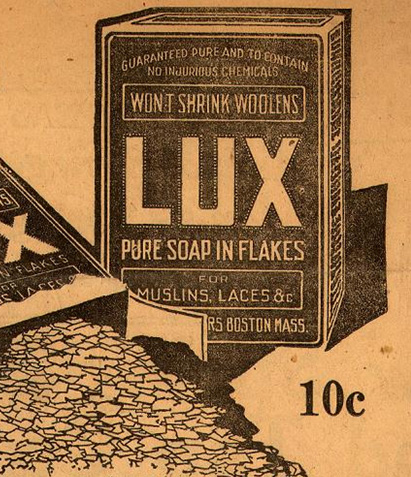
Early ad for Lux Laundry Soap - Wiki Commons - Public Domain

Monday, October 22, 2012

“John the Revelator”

Well, it’s Monday, it’s music, & it didn’t take too long to return to the blues! Or at least to two men who are typically classified as blues artists, Blind Willie Johnson & Son House. In fact, “John the Revelator” is a gospel or spiritual from the African American tradition. Blind Willie Johnson was a street preacher as well as a street musician—a common combination in the early to mid 20th century (the Reverend Gary Davis is another well-known figure who combined the two roles), while Son House was himself a preacher before he succumbed to the power of the blues!

The two versions are quite different, musically & lyrically. Johnson is accompanying himself on guitar & has his wife, Willie B. Harris, as back-up singer. Son House on the other hand, always dispensed with his National guitar when he performed this song & sang it a cappella. Johnson’s version was recorded for Columbia in New Orleans on December 11, 1929 (the A side, backed by “You’re Gonna Need Somebody On Your Bond”), & was also included as a selection on Harry Smith’s Anthology of American Folk Music. Son House’s version was recorded for The Legendary Son House: Father of Folk Blues (Columbia, 1965).  Another stirring version by House was released on Delta Blues & Spirituals (Capitol, 1995), & was recorded at a show at the 100 Club in London, England on July 14, 1970.

This post is dedicated to my dear friends Sheila & Mairi. Enjoy!


Lyrics

The lyrics below are Blind Willie Johnson's version of "John the Revelator" as found in the Anthology of American Folk Music. Subsequent versions feature a variety of substituted verses and different interpretations of Johnson's lyrics, all quoting passages from the Bible, in the tradition of African American spirituals.

    [call] Well who's that writin'? [response] John the Revelator
    Who's that writin'? John the Revelator
    Who's that writin'? John the Revelator
    A book of the seven seals

    [call] Tell me what's John writin'? [response] Ask the Revelator
    What's John writin'? Ask the Revelator
    What's John writin'? Ask the Revelator
    A book of the seven seals

    Well ooh ooh why me, thousands cried holy
    Bound for some, Son of our God
    Daughter of Zion, Judah the Lion
    He redeemeth, and bought us with his blood

    [Repeat verses 1 & 2]

    John the Revelator, great advocator
    Get's 'em on the battle of Zion
    Lord, tellin' the story, risin' in glory
    Cried, "Lord, don't you love some I"

    [Repeat verses 1 & 2]

    Well Moses to Moses, watchin' the flock
    Saw the bush where they had to stop
    God told Moses, "Pull off your shoes"
    Out of the flock, well you I choose

    [Repeat verses 1 & 2]

These are the lyrics for Son House's 1965 recording version, which explicitly reference three theologically important events: the Fall of Man, the Passion of Christ, and the Resurrection.

    [call] Who's that writin'? [response] John the Revelator
    Tell me who's that writin'? John the Revelator
    Tell me who's that writin'? John the Revelator
    Wrote the book of the seven seals

    [call] Who's that writin'? [response] John the Revelator
    Tell me who's that writin'? John the Revelator
    Well who's that writin'? John the Revelator
    Wrote the book of the seven seals

    You know God walked down in the cool of the day
    Called Adam by his name
    But he refused to answer
    Because he's naked and ashamed

    [Repeat verses 1 & 2]

    You know Christ had twelve apostles
    And three he led away
    He said, "Watch with me one hour,
    'till I go yonder and pray."

    [Repeat verses 1 & 2]

    Christ came on Easter morning
    Mary and Martha went down to see
    He said, "Go tell my disciples
    To meet me in Galilee."

    [Repeat verses 1 & 2]

Sunday, October 21, 2012

Photo of the Week 10/21/12

Fire Plug w/sticker
N. Interstate Ave., Portland, Oregon
Saturday 10/20/12

Thursday, October 18, 2012

Barbie Angell in Her Own Words


Hey, friends! So happy that we have an interview today with poet/artist/performer Barbie Angell. Barbie’s book of children’s poems, Roasting Questions (with her own illustrations & layout) is being issued through Grateful Steps in Asheville, North Carolina, & I’m really excited by this.

You can view Barbie’s book at this link to its dedicated website (& other links throughout the post!)—but not only can you view the book: you can pre-order your copy (or copies), & also sponsor the book to help raise money for the printing—Barbie explains that process in the following interview. I will say that this is a particularly good time to pre-order &/or sponsor, because Barbie recently received a $500 donation with the stipulation that the amount be matched during the following week, which runs from Monday 10/15 until Monday 10/22.

If you’re a regular reader here, you don’t need me to tell you how delightful, witty & downright fun Barbie’s poems & art both are. So here’s a chance to get to know this wonderful artist just a little bit better! 


J: I’m so happy about Roasting Questions, & I know you are thrilled too. The publishing process through Grateful Steps, which is a publishing house in Asheville, may be unfamiliar to some readers—it’s a bit like Kickstarter isn’t it? Could you go over that so people get a feel for the process & how they can participate? 

B: Absolutely. Shortly after Grateful Steps came to me about doing a book of children’s poetry, they became a non-profit publishing house.  Because of this, they raise the money for printing costs from the pre-sales orders.  Since people have been asking me for some time to sell audio files, prints of my art and such, I decided we could offer those as a Kickstarter-style incentive as well.  There are a lot of fun extras starting at $1 and, as with Kickstarter, each level includes all the offers in the previous levels.  I know that people are more likely to buy something they can hold right away and getting the pre-sales orders in as quickly as possible will help get the books in the hands of the readers that much sooner.
 

J: I have the advantage on many of the readers, because I at least know the broad outlines of how you began writing—& it’s a fascinating story. Could you tell us a little about that, & specifically, when you first knew you wanted to be a writer? 

B: I always wrote songs as a child, parodies actually, but I never wrote poems.  I wrote puppet plays too and I’m certain that Broadway producers would love to get their hands on the original script of Raggedy Andy and Square Bear.  When I was 13, I went to Mooseheart, a school for children who had no place else to go. 

My first Christmas there I was given a diary, and since a diary is not really a safe place for ones thoughts in an institution, I used it to write poetry.  While I struggled with punctuation and other English composition rules, I excelled at creative writing.  Often my teachers would ask me to read my stories to the class and, as a senior, I won my first award for writing a Memorial Day speech. 

When I went to college I was pre-law.  I had wanted to be a lawyer since I was 6 years old.  I know, straight from ballerina to lawyer, I was an odd child.  My theater director was also my advisor and, after making myself quite known on the campus with my “How to” paper in English 101, my advisor sat me down for a serious talk.  I thought it was because I had taken the standard assignment and caused controversy.  My paper was entitled “How to abstain from having sex on a date.”  In fact, he wanted to convince me to change my major.  He felt that if I could make myself so well-known, on a campus with over 500 students, by merely not taking the easy route and writing the typical “How to make ramen noodles in a 4-cup coffee maker,” then I really had no choice but to become a writer.  That man, Jerry Dellinger, would go on to make certain that I did realize what my passion was.  He stood behind me and urged me forward, as he so often did when I acted in his plays.  In essence, he directed my life. . . and I think he did a pretty excellent job.
 

J: It’s safe to say that anyone with your talent for children’s poems must have read a lot when she was young. Please tell us about a few of your own favorite books from childhood! 

B: My favorite books when I was a child were all of them.  I was allowed to stay up late if I was reading and I was always reading.  Anytime a subject fascinated me, I read about it.  Reader’s Digest usually sparked my interest in new topicsfor instance,  I remember my mother being rather disturbed when I started reading everything I could about the holocaust.  I didn’t know at the time that her family was Jewish and it seemed a bit harsh for a seven year-old, but there I was, learning all I could.  I’m often told that even my children’s poetry has an introspective side to it that hints at something deeper.  I think that’s because I was so determined to learn about all aspects of life, not just the happy stories that my friends read.  Of course, I was an enormous admirer of Shel Silverstein.  I knew most of his poetry, and a great many of his songs, by heart.  I wrote rhyming songs all the time, often in the meter of his work.  My other big influence was Lewis Carroll.  I completely related to the idea of a girl falling into her imagination.  His wordplay and obscure references always entertained me.  I think he and Dr. Seuss are two of the best at creating nonsense language that makes perfect sense.  While I don’t do a lot of that anymore, I used to incorporate quite a few nonsense words into my work.  I am such an admirer of Lewis Carroll, that my writing room is full of Alice memorabilia and the walls have Wonderland murals painted on them. 

J: Many people who read your poems are struck by your use of personification—you use abstract qualities as “characters” & “objects” in ways that really bring them to life—one of your greatest strengths as a writer. Do you have any ideas on why this particular technique is so prominent in your writing? 

B: One of my favorite books as a child was Little Pilgrim’s Progress, by Helen Taylor.  In fact, it’s one of the few things I still have from my childhood.  It was based on John Bunyan's story and all the people in the book were named for their most obvious characteristic.  Children named Obstinate and Pliable.  A city named Destruction.  I think this is where I first associated with the personification that I’m sort of known for in my writing.  I’ve also always been mesmerized by language.  Common sayings like “holding a grudge” take on an entirely new meaning for me.  I like to take a different view whenever I can.
 

J: You also illustrated Roasting Questions. I love your eye for color & the way your drawings both focus on one aspect of the poem & also create a whole other world of imagination thru their detail. Could you talk a little about your illustrations—about the process & the techniques? Do you ever start a poem from a drawing, or is it always the other around. 

B: I call my work “refrigerator art” because it’s the sort of thing a mom would hang on her fridge.  The scenes usually have a sun in the corner, a tree and something else.  Kind of like a child’s drawing would.  My older brother and younger sister are brilliant artists.  I felt I could never achieve what they can, so I looked at things from a different angle and tried to create my own style.  I have only ever drawn one piece which inspired a poem from me.  It’s the art and poem for the Hop Ice Cream Cafe.  All the others I struggled to find just the right way to accent the poem with the art.  I have incredibly high standards for my own work.  I don’t seek perfection in anything I do, but I always try to do my very best. 
J: I know you consider Shel Silverstein to be a major influence. What do you think you’ve learned from his poems that has carried over to your own? 

B: I do consider Shel to be a major influence.  I think he & I have something very strong in common in the way we address our audience.  People tell me all the time, and always have, that my work reminds them of Shel’s.  When I actually read his poems though, we sound nothing alike.  The similarity, I think, is that neither of us really wrote for children.  I don’t have them in mind as an audience I need to please when I write and I don’t think he did either.  And I think that is the best way to write for children.  When I perform a children’s show, I’m always terribly nervous.  They aren’t going to laugh if I’m not funny.  They won’t pay attention if I’m not interesting to them.  They don’t respond positively to condescension.  Because of that, I think that trying to write to please them would be an insult to the purity and integrity they show to the arts.  I’m not saying that they aren’t polite, just that they are more honest with their responses.  When a child laughs, or thinks, or is mesmerized because of my words, that means far more to me than an adult having the same reaction because I know that I’ve worked harder to garner that response.  Does that make any sense at all?
 

J: There are a lot of food references in your poems—what do you think about that? & more importantly, what’s your favorite flavor of ice cream? 

B: There are a lot, aren’t there?  I don’t know why that is.  I’m not a big fan of foodI’m one of those people that can go the entire day without realizing that I haven’t eaten.  My favorite flavors of ice cream are all from Hop Ice Cream in Asheville.  The owner and ice cream creator Ashley Garrison has a way of taking her creations to the next level. . . and then the one after that.  Salted Caramel is a given, but I also love everything she makes with coconut in it and I’m a huge fan of her Cannoli ice cream too.


Thanks so much for the interview & your participation in Robert Frost's Banjo, Barbie Angell! & once again, friends, do yourself a favor & order yourself a copy of Roasting Questions—& consider getting some of those lovely extras by sponsoring the process too!


Photos of Barbie Angell at her book launch show at Asheville's Altamont Theater are by Erin Scholze of Dreamspider Publicity & Events—thanks, Erin!