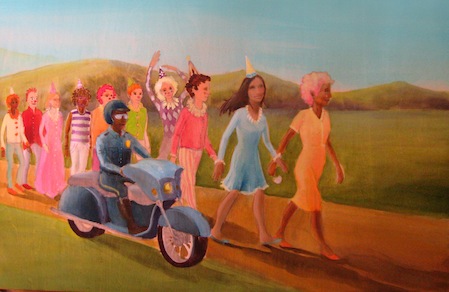
A miscellany like Grandma’s attic in Taunton, MA or Mission Street's Thrift Town in San Francisco or a Council, ID yard sale in cloudy mid April or a celestial roadmap no one folded—you take your pick.
Happy Saturday, dear readers. Just checking in with you quickly about some changes I’ll be trying on the blog at least during the month of April.
I’ve decided that I’ll be reducing the Monday Morning Blues & Banjo Friday series to every other week rather than weekly. As I mentioned in yesterday’s post, these series simply aren’t getting many readers at all, & the posts themselves—while generally enjoyable to write & research—are relatively time-consuming. The series will run in alternate weeks—for instance, this coming Monday I’ll run the Monday Morning Blues (with a brand new series starting up—stay tuned), but there won’t be a Banjo Friday on April 6th; then the next week it will be just the opposite.
All the other series will continue as they have been running—Barbie Angell’s & L.E. Leone’s poems will appear on alternate Tuesdays; Rose City Wednesday & Sunday’s Photo of the Week will continue to appear weekly. There will be no regularly scheduled posts on Thursday or Saturday, but I will leave them open (especially Thursday) for things that may come up thru the week; that's also at least theoretically true for the open Mondays & Fridays. Anyhow, that's pretty much how things have been for a while.
This will mean I'll only be committed to writing two posts per week, & I suspect that will generally be a good change—for me at least. But I assure readers—& also other people involved in the blog—that there are things the blog offers that continue to excite me, & that continue to fit into the rhythm of my life—which of course has changed very much over the past several months. Maybe I feel the need myself to re-group some, & cutting back on the music posts seems a way to give myself a little space to do that. I have been very much absorbed in the question of “3-D” versus “virtual” life of late, & drawing back a little on the blog is also a way of addressing that question.
But if you know me at all, you know I’m a Heraclitean at heart—I believe very much in the concept of change—never stepping in the same river twice & so forth. So for now these ideas are a concept I’ll experiment with in April, & come May, we’ll see which direction we turn!
Have a nice Saturday, friends. I leave you with the great, unique & inimitable Fats Waller to tell you the rest of the story!
I’ve written about Bill Keith before in the Banjo Fridayspace, but most of that writing has been devoted to his performance of music that’s outside the typical banjo repertoire. However, Keith’s playing builds fundamentally from the bluegrass tradition even when he travels far afield; & his playing & techniques have contributed significantly to moving this tradition forward, while simultaneously opening up other musical avenues for the banjo to explore.
One of Bill Keith’s big contributions to the bluegrass repertoire has been his using his melodic playing style to further the banjo’s use in interpreting fiddle tunes. Of course whether you’re talking bluegrass or old-time music, the fiddle is the primary melody instrument , with the banjo & (in bluegrass at least) the mandolin playing important but secondary roles. There have been exceptions—Earl Scruggs was certainly the primary melodic mover & shaker for the Foggy Mountain Boys—but as a generalization about the genres it’s certainly true.
The fact is, the way a banjo & a fiddle produce sound are very different. Everything about a fiddle is essentially melodic, from the warmth of its tones to the sustain produced by the bowing; meanwhile, everything about the banjo tends at its base to be percussive—a banjo is, after all, essentially a drum on a stick with strings. Even the big resonator banjos favored in bluegrass have very little sustain—in other words, the notes die out quickly—& generally sustain is a hallmark of a melody instrument. To compensate for the lack of sustain, the banjo player has a simple expedient—play a lot of notes!
Now this has been going on for a long time amongst banjoists & neither Scruggs nor Keith, nor any of the innovators changed that fact. What they changed has more to do with the way those torrents of notes are generated. Scruggs style was based on syncopated patterns that played “arpeggios”—in other words, the single notes that form chords. In the sense that this is chord-based, one might characterize it as “horizontal” playing, because the left hand is fundamentally forming chords across the width of the fretboard. Keith’s innovation—in dimestore terms—was to produce the notes more in terms of scales than chords, so that the left-hand movement becomes “vertical”—in other words, the left hand travels up & down the fretboard.
I’d hoped to share a video today of Keith playing a banjo trio with Tony Trischka & Béla Fleck on “John Hardy”—the cut is from their 1980 Rounder album, Fiddle Tunes for Banjo. Sadly, I found out embedding is disabled on that video, but you can view it on YouTube here. However, I did find a video of Keith tearing up a couple of standard fiddle tunes in a medley of “Devil’s Dream” & “Sailor’s Hornpipe” (with rhythm guitar backing by Jim Rooney), & that’s a lot of fun as well!
Hope you folks have been enjoying Banjo Friday. Not to introduce a “buzz killer,” but I’ve noticed that the viewing stats for both of the regular music features, Banjo Friday & Monday Morning Blues, have been dropping steadily, & over the past couple of months are really quite low. At this point, they seem to be the least popular features on the blog, which puzzles me a bit. So if you enjoy them, please help to spread the word!
[Today's post, rounding off our month of promoting David LaMotte's White Flour project, is by Barbie Angell]
With just 2 days left of David LaMotte’s Kickstarter project for his children’s book, White Flour, John asked me to write a piece in support of this, and we hope to drum up some last minute support. Yes, now is the time to discuss the ku klux klan, the Coup Clutz Clowns & what happens when hatred meets humor.
This past week, while I was catching up on Facebook & Twitter, I was horrified to discover that some people find the anti-Obama, “n-word” bumper stickers
to be funny. I was even more bothered by the fact that the rest of the
posts were people shaking their head, but not completely outraged.
Have we as a nation become so complacent about racism that we no longer
feel compelled to act against it? Does it take the shooting of an unarmed boy
to give us cause to raise our voices? Do we have to encounter such
extremes to become involved? I think not. I think we just don’t know
what we can do….but I believe David’s book provides an answer and that
is one reason I am so fully in support of it.
White Flour illustration by Jenn Hales.
White Flour tells the true story of a whimsical and effective
response by counter-protesters to a white supremacists’ march in
Knoxville, Tennessee in 2007. The Coup Clutz Clowns, a group of local
anti-racism activists, used humor and non-violence to reveal the
silliness of the march, vanquishing hatred with laughter.
The clowns slightly altered the supremacists’ chants to make them
a bit… better. As the hooded marchers shouted “white power!” the
clowns joined right in, shouting “white flour!” and pulling out bags of
the stuff they had brought from home for a flour fight. They walked a
bit farther and decided they had heard wrong, and that the klansmen must
be shouting “white flowers!” so they shouted that, and passed flowers
out to the crowd …and it gets better from there (the full text of the
poem is below). The point is that rather than shouting down the
shouters, meeting rage with rage, they simply refused to take such
foolishness seriously. Fight and flight are not our only two options,
and humor, it turns out, beats hatred. At least it did on that day. ~ David LaMotte
Do I propose we all dress up as clowns and take a stand if the klan
comes to our town? No. But I do suggest that we teach our children
the values that are so cheerfully and eloquently brought to light in
White Flour. Teaching our children that bigotry is wrong is only the
beginning, but what an important beginning it is. I’ve tried to
explain it to my six year-old son, and it is a completely foreign
concept. He kind of understands that some people don’t like the little
girl he has a crush on. Since she is an African-American he knows
they can easily see the difference in her skin color, but he doesn’t
comprehend how that can be bad. Explaining to him, however, that some
people don’t like me because I’m a Jew, is altogether lost on him. I
don’t look any different than other white people, but I’m hated by some
just the same. As for explaining his Godfather, who is gay, or any of
my gay, lesbian or transgendered friends (whom he adores), well, to him
that’s just an ungraspable idea. The fact that they love shouldn’t be a
bad thing, no matter who that love is given to.
The other incredibly important lesson in David LaMotte’s poem, White
Flour, is that the clowns are not reaching for violence to counter
hatred. They are reaching into their bag of tricks for humor, praise
and peace. David best explains this in an email discussion we had recently.
White Flour illustration by Jenn Hales.
Someone sent me an indie press article about the event and I was
knocked out by several things: one, that the mainstream press had missed
this. Two, that it’s such a good example of creative nonviolence—
finding a third way beyond fight and flight. Three, that it was so
effective. And four, that it’s so creative and funny. I find it to be
an accessible story for lots of audiences, but also extremely
instructive, so I wanted to share it.
“Breaking the script” is a fundamental tenet of creative
nonviolence. Responding in ways that are completely unexpected breaks
us out of our patterns and opens a conflict situation up to new possible
outcomes. I love what these folks did, and it’s been fun to track them
down and have some conversations about it. The original organizers are
really excited about the book.
There are plenty of other examples of this in my own life and in
conflict situations I’ve been around, but this is the most entertaining
story I know to illustrate that point.
The first time I heard David perform White Flour,
I asked him if I could get an audio version of it to send to my family
and friends for Christmas. Being such a wonderful friend and wanting to
spread this story far and wide, he agreed without hesitation. When I
learned that this, my favorite poem of all time, was going to be turned
into a children’s book, I was completely thrilled. A few weeks ago,
when he launched the Kickstarter project, I felt certain that it would
be successful as long as people were aware of it. This story is so
important, especially for children. It isn’t preachy or condescending;
on the contrary, it’s fun and accessible. It is, in my opinion, the
perfect way to educate our children on bigotry and nonviolence. Most
importantly, it’s true. It’s a piece of history that should be
remembered. Should be celebrated. Should become a part of our
national conversation about putting an end to racism.
When the White Flour project surpassed its goal of $18,500 in 12
days, I was amazed. People really embraced this story. They fell in
love with the idea and wanted to share it with their friends, both in
real life and online. You may think that the story ends here, but it doesn’t. David has
gained some pretty impressive attention with this real-life story,
turned into a poem, turned into a children’s book. There is now talk of this book
becoming a part of the 5th grade curriculum in schools in Texas. He
is in also in contact with a national publicist and has learned that
several well-known artists in the music industry are planning to give
testimonials about his book.
White Flour illustration by Jenn Hales.
Given all this inspiring news, White Flour is no longer going to be a
little project that inches its way up a tiny hill. No, that plan just
isn’t what this book wants to do. This is now the Little Book That
Could and, with the help of 471 backers so far, this book fully intends
to climb a mountain. I truly believe that it can. The original goal
of $18,500 to print 2,500 copies of White Flour is a distant memory.
The top of this mountain is now $39,000 for an initial printing of
10,000 copies and a national publicity campaign. This means that we
need to continue to spread the word. If this money is brought in
strictly through pre-orders, at $25 each, we only need 412 more to reach
this goal.
That $25 on the Kickstarter page not only orders the book and
includes the shipping, but because of the way Kickstarter works you also
get whatever was included prior to that level. In this case, it would
include:
$1 – SMILE! I will look up from my computer and grin and be thankful for
your kind support. Then I will celebrate that there are people in the
world who are happy to trade a dollar for a smile, and to help with an
effort to tell an inspiring story with no tangible reward to themselves.
You rock.
$5 – LAUGH! Loads of gratitude, plus a digitally (i.e. magically)
transported scan of some book art to use as wallpaper on your computer
screen.
$15 – CLAP! We’ll send gratitude, digital wallpaper and an e-book version of White Flour.
And, of course,
$25 – STAND UP! We’ll send the physical book and pay the postage
(please add $5 if overseas) and we’ll send you the wallpaper image.
There are many other levels for this book, including autographed
copies of the book, David’s award winning album, S.S. Bathtub, VIP
tickets to one of his release parties and even the opportunity to have
him perform for you.
I’ve gone on long enough about this book….and so I leave you with
David LaMotte performing White Flour. This book will go far, mark my
words, The Little Book That Could will climb unimaginable mountains and
become an essential tool to help keep bigotry out of the hearts of our
children.
as always, thanks for playing. : ) you can find additional information about White Flour at www.whiteflourbook.com
Welcome, my friends, to another Rose City Wednesday, Bridgetown edition!
Tho the gray skies & drizzle have returned now, we had some glorious weather late last week & into the weekend & I decided to make the most of it on Saturday with an excursion to another nearby bridge—no more chilly & slippery bridge outings for me! Indeed, Saturday was one of the finest days this year, & with only a sport jacket & light clothes I was almost too warm at points along the way.
The Broadway Bridge connects Northeast & Northwest Portland, following the large NE Broadway Avenue thoroughfare across the bridge that bears its name, at which point Broadway (now NW Broadway) veers off at a 45 degree angle southward, while NW Lovejoy continues more or less due west into the rather toney Pearl District. But I’m getting ahead of myself.
The Fremont Bridge & in the distance, The St John's Bridge-looking north from the Broadway Bridge
I caught the #4 Division bus near my place & got off at NE Vancouver & Weidler. From here it’s an easy downhill walk of about five blocks to the bridge. You could also take any Max line to Rose Quarter & walk from there north on Interstate; it wouldn’t be much further, & in fact that’s what I did in reverse heading home.
Bicyclist approaching the spot where one would stop if the drawbridge were raising
The Broadway Bridge is reported to be one of the more popular bridges for bicycle crossings, & I must say that based on my one walk, this could well be true—the cyclists were out in profusion. But the walkways on either side of the Broadway Bridge are reasonably commodious, & despite a fair amount of bike traffic, I never felt rushed or inconvenienced. & no doubt due to the fine weather, there were also a fair number of other pedestrians.
Inner
structure, plus streetcar wires; this is a more accurate picture of the
color--Golden Gate Red, AKA International Orange! The first two photos
were shot somewhat into the sun.
The Broadway Bridge was opened in 1913; at the time, it was the longest bascule type bridge in existence (if you follow that last link, you’ll see a gif of how a bascule bridge works.) Because the bascule mechanism is rather complicated, the Bridge has undergone a number of repairs over the years. However, the most recent work done on the Broadway Bridge (in the summer of 2010) is quite exciting to me as a person who relies almost exclusively on public transit. As you can see in some of the photos, the rails & overhead electrical system of the Portland Streetcar have been installed on the Broadway Bridge, & the Bridge is scheduled to start carrying streetcar traffic this September. This is great news, because it will be the beginning of the eastern expansion of the streetcar system. While the Trimet buses & Max light rail trains run thru all sections of Portland proper & into the suburbs as well, the Streetcar currently only runs on the west side of the city. I’m really looking forward to this change! Interestingly enough, streetcars did cross the Broadway Bridge from when it was first opened until 1940.
Portland skyline looking southwest (taken from the south walkway)
The Steel Bridge - looking south from the Broadway Bridge
It was a beautiful day, & I feel I took full advantage of it—ended up walking about 20 blocks once I got to the west side until I reached Powell’s; but I confess I was a little wobbly by the time I made it all the way back to the other side. My timing was also good this time around—the clouds just began to come in around 4:00 p.m. just as I was setting foot back on the east side.
[Title aside, our favorite Rockstar Poet in Residence Barbie Angell is not playing games in today’s poem! But as always, she’s got something to say in her fun & unique way.]
New From Milton Bradley
It’s a world of utter mania on an endless shopping spree. It’s what no one ever told you, it’s exactly what it seems.
There are no grand surprises on the witness stand of life. Its design is based on choices not just the rolling of the dice.
And when it hands you lemons, time and time again, relax and put your feet up, ‘cause it’s a game you’ll never win.
It’s all about direction and being honest with yourself. It’s not about reflections or the fickle fate of wealth.
But don’t misunderstand me, I’m not saying that you’ll lose. Be everything you can be. Be the best you find in you.
So when the curtain finally falls and the yodeling is done, it’s whether you have lived your life, not if you lost or won.
Happy Monday, friends! The Monday Morning Blues this morning is coming at you with another exciting performer in our Any Woman’s Blues series.
Roxanne Potvin is I believe the youngest musician profiled so far in the series—not quite 30 years old as of this posting. But despite that fact, she has already amassed an impressive resume as guitarist, singer, & songwriter. Potvin has released four albums, beginning with her self-produced 2003 release, Careless Loving, which contained a half dozen original numbers, as well as covers of tunes from the likes of Dinah Washington & Etta James. She followed this up with the 2006 The Way It Feels on Alert Canada, an album on which she was joined by several notables, including Bruce Cockburn & John Hiatt, & which also featured a cover from one of her guitar heroes—her version of Freddie King’s “Your Love Keeps Working On Me.” This was followed by No Love for the Poisonous in 2008, also on Alert Canada, which was released to glowing reviews, & the 2011 release, Play in which Potvin moved more in the directions of folk & pop. Play was released on the Black Hen Music label.
In addition to those releases as a solo artist, Roxanne Potvin also collaborated with Sue Foley & Deborah Coleman (two guitarists who’ve been featured in previous Any Woman’s Blues installments) on the 2007 album, Time Bomb on Ruf Records. Time Bomb featured each guitarist as a soloist, & then brought the three women together to combine their impressive guitar chops on the final cut, “In the Basement.”
As one might assume based on her label, Ms Potvin is Canadian, born in Regina, Saskatchewan in 1982. Her family moved to Ottawa when she was two, & she began singing as a young child. When she took up guitar in her teens, she was drawn to a number of noted blues players—Freddie King, whom she names as a special influence, as well as Muddy Waters, Jimmy Reed & Lonnie Johnson—but also to artists from other genres as well, including vocalists Aretha Franklin, Sarah Vaughn & Dinah Washington, & also John Hiatt & Elvis—& in recording her most recent album, she notes she found herself “going back to the Beatles & Beck.” She is currently based out of Gatineau, Quebec; her website is maintained in both English & French, & Potvin is herself bilingual.
We’ve got a couple of videos to showcase Roxanne Potvin’s talent, & I know you’ll enjoy them. The first video, “A Love that’s Simple,” focuses more on her wonderful vocal ability, while the second, “Caught Up,” not only features another great singing performance, but also some really nice guitar work. As you can see, Potvin plays a Telecaster. I’ve also seen photos & videos of her with an acoustic, but I’m unable to identify the brand or model. She gets a great tone out of the Telecaster; I really enjoy her direct playing style.