A happy Banjo Friday, friends! We have a special post today that features not one, but two—count ‘em, two!—superb banjo players! Today’s post also addresses the fact that not all banjos come equipped with five strings.
Yes, it’s true—while what most people picture in their minds when they hear the word “banjo” is a 5-string instrument—& the sound of the 5-string, especially playing bluegrass, is probably what the majority of people hear as the prototype banjo sound—there are two other popular forms of the banjo that only have four strings & are played very differently from their 5-string cousin. These are the tenor banjo & the somewhat less well-known plectrum banjo.
I spent several years playing the plectrum banjo, & I still have one (see pic!), tho it hasn’t made the trip to Oregon yet. I’ve also dabbled on the tenor banjo, but sold mine along with several other instruments before I moved—mild regret on that score, but I didn’t feel as much affinity with that instrument as with others.
Both the plectrum banjo & the tenor banjo were developed around the turn of the 20th century as part of the banjo orchestra phenomenon (yes, whole orchestras composed of banjos of various shapes & sizes!) & also as part of the burgeoning hot jazz scene. The 5-string banjo is not especially suited to playing the more complex chord progressions of jazz tunes because the 5th string is a drone & would be a discord in songs with more complex harmonic changes. The plectrum banjo is essentially a 5-string banjo without the drone string. The standard tuning of a plectrum banjo is CGBD, which used to be standard for a 5-string too, with the addition of the high G as the drone string. Plectrum banjos also are sometimes tuned to DGBE, like the four highest-pitched strings of a guitar—this is called “Chicago tuning” or “guitar tuning,” & was developed to allow guitar players to more easily double on the instrument. In fact, that’s the way I always tuned mine. As the name suggests, the instrument is typically played with a plectrum or pick, not with the fingers or fingernails as is the case with the 5-string banjo.
The tenor banjo most likely developed when the mandolin orchestra phenomenon morphed into the banjo orchestra phenomenon, sometime in the late 19th or early 20th century. One of the members of the mandolin family is called the mandola, & the standard tuning of a mandola is the same as the viola—CGDA. From what I’ve read, the tenor banjo was developed to allow mandola players to switch easily to a banjo sound, since the standard tuning of the tenor is also CGDA (tho the tenor has been adopted into Celtic music, & in that context its often tuned GDAE like an octave mandolin.) As you can see in the video, the scale length of the tenor banjo is also considerably shorter than that of a plectrum or 5-string banjo. Again, the tenor banjo is typically played with a pick.
The two players in the video are top-notch performers on their instruments, Cynthia Sayer is one of the best plectrum banjo players going. She is a member of Woody Allen’s New Orleans Jazz Band, & has both consulted & provided music for some of his films. Her most recent album, Attractions (Plunk Records) featured her duets with jazz guitar giant Bucky Pizzarelli. I recommend it!
Steve Caddick, meanwhile, is also a top-notch performer on tenor banjo. He’s recorded seven albums between 1987 & 2007, & he performs with both The Red Suspenders & Avalon. Going back to my earlier point about the tenor banjo & the mandola, Mr Caddick also played mandola for a couple of years with the Providence Mandolin Orchestra.
“Bye Bye Blues” is a great old standard, & Sayer & Caddick take the tune on a delightful romp (admittedly, the spoken intro may go on a bit longer than is ideal, but hang in there.) Enjoy!
Pic at top of the post shows my 1930s Stromberg-Voisinet plectrum banjo!
A miscellany like Grandma’s attic in Taunton, MA or Mission Street's Thrift Town in San Francisco or a Council, ID yard sale in cloudy mid April or a celestial roadmap no one folded—you take your pick.
Friday, September 30, 2011
Thursday, September 29, 2011
"This Poem"
[Today is a great day for the blog, because we're welcoming back our "Mystery Poet in Residence, B.N.—but now appearing under her current nom de plume, Brittany Newmark. This is a powerful & moving poem, & I feel honored to post it on Robert Frost's Banjo.]
This Poem
This poem will not survive
Even the brittle page it is written on
Or the cool night that shapes the
Bare tree branches and ices slick asphalt
The page that opens onto the sheave of other similar silent pages
each accumulating the greasy ash smudge of deeper
secrets, resentments and loss
that collect in the dark.
Better to imagine the yellow and green plastic of ride along toys,
a blue wooden boat that transported the
children across the great lake to stand tiny on a distant shore.
Come home, come home,
We are waiting
for you
And have warmed your place next to us,
Whatever it was
(that came between us)
forgotten
Already.
This poem will not be read in the dim halo
of a sodium street light and will never document the things kept hidden in our pockets,
never recommend me for anything more that what I have here in my hand. Empty the
coins that haven’t been, the bent keys
The light returns like an echo.
But there are still pages holding out for meaning
Here is the part in the book I told you about
The scene when we walk
And when I turn
The path back is strewn with abandoned objects
Brittany Newmark
© 2011
This Poem
This poem will not survive
Even the brittle page it is written on
Or the cool night that shapes the
Bare tree branches and ices slick asphalt
The page that opens onto the sheave of other similar silent pages
each accumulating the greasy ash smudge of deeper
secrets, resentments and loss
that collect in the dark.
Better to imagine the yellow and green plastic of ride along toys,
a blue wooden boat that transported the
children across the great lake to stand tiny on a distant shore.
Come home, come home,
We are waiting
for you
And have warmed your place next to us,
Whatever it was
(that came between us)
forgotten
Already.
This poem will not be read in the dim halo
of a sodium street light and will never document the things kept hidden in our pockets,
never recommend me for anything more that what I have here in my hand. Empty the
coins that haven’t been, the bent keys
The light returns like an echo.
But there are still pages holding out for meaning
Here is the part in the book I told you about
The scene when we walk
And when I turn
The path back is strewn with abandoned objects
Brittany Newmark
© 2011
Tuesday, September 27, 2011
“Wanting Nothing”
[I have to say it: this is one of my favorite Barbie Angell poems! She had me at “unobtanium.” & then there's another of Barbie's cool drawings, which she tells me is titled "Paradox." I know you'll enjoy this too!]
Wanting Nothing
I’m getting used to wanting nothing
And it’s harder than I thought.
It’s made from unobtanium
And nothing can’t be bought.
I have nothing when I wake up.
I have nothing when I sleep.
So I figured that I’d give up
On the somethings I don’t need.
And nothing can be small.
It won’t take up any space.
And if I ever lose it,
It’s quite easy to replace.
I have some nothing no one gave me,
And I keep it in my mind.
There’s lots of extra room there,
So it’s easier to find.
And I’d like to give you something,
But I like you more than that.
‘Cause everyone gives something
when they don’t know where nothing’s at.
So here’s a piece of nothing,
Please keep it close to you.
If you find you’re out of something,
It’s nothing you can use.
Barbie Dockstader Angell
© 2009-present
Wanting Nothing
I’m getting used to wanting nothing
And it’s harder than I thought.
It’s made from unobtanium
And nothing can’t be bought.
I have nothing when I wake up.
I have nothing when I sleep.
So I figured that I’d give up
On the somethings I don’t need.
And nothing can be small.
It won’t take up any space.
And if I ever lose it,
It’s quite easy to replace.
I have some nothing no one gave me,
And I keep it in my mind.
There’s lots of extra room there,
So it’s easier to find.
And I’d like to give you something,
But I like you more than that.
‘Cause everyone gives something
when they don’t know where nothing’s at.
So here’s a piece of nothing,
Please keep it close to you.
If you find you’re out of something,
It’s nothing you can use.
Barbie Dockstader Angell
© 2009-present
Monday, September 26, 2011
Any Womans Blues #14 – Deborah Coleman
Good morning—er, well it’s till morning out here on the U.S. Left Coast, at least for a little while (assuming you read this within minutes of when it posts.) The Monday Morning Blues train has arrived, & better late than never as we always say!
Today’s feature is this month’s installment in the Any Woman’s Blues series, & wow, what an exciting artist we have for your listening pleasure today! Deborah Coleman is a virtuosic guitarist, as well as a fanastic singer, & she infuses her contemporary blues with a healthy dose of soul. After all, the term R&B did originally mean “rhythm & blues,” & included musicians like John Lee Hooker & Muddy Waters. As you can hear from her guitar playing, especially on her live version of “The Dream” in the first video below, there’s also plenty of rock & roll bite—in all the best senses—in her playing as well.
Interestingly, Deborah Coleman dates her interest in blues to a show she saw at age 21 which featured Waters, Hooker & the great Howlin’ Wolf, tho she also lists a number of other influences—from Jimi Hendrix & Memphis Minnie, & from Patti Smith to Bessie Smith. Ms Coleman grew up in a musical family, & began learning guitar at age 8; she also began her professional music career as a bassist at age 15. However, she married in her mid twenties & spent the next several years working as an electrician & a nurse, while keeping music as a sideline. Then she entered the National Blues Talent Search of South Carolina's Charleston Blues Festival in 1993 & won first prize, which then propelled her into a full-time touring & recording career.
Deborah Coleman has released eight solo albums, starting with the 1995 New Moon Records release Takin’ a Stand. Following this, she released five albums on the great blues label, Blind Pig Records, followed by releases on Telarc & JSP. The latter is her most recent, the 2007 release Stop the Game. In addition, she recorded Time Bomb with guitarists Sue Foley (who was our very first featured artist in the Any Woman’s Blues series) & Roxanne Potvin.
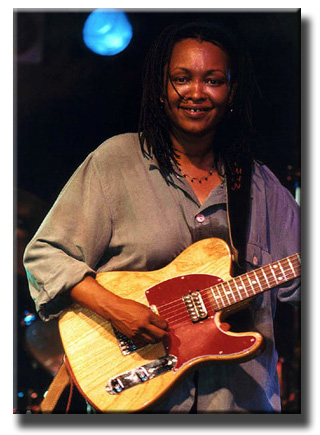
Deborah Coleman performs using both a Gibson Les Paul (again, check out “The Dream” video) & a Fender Telecaster (see pic leading off post.) In addition to her great guitar playing & singing, she’s also a composer—in fact, both “The Dream” & “My Love Belongs to You” are originals.
Deborah Coleman won an Orville Gibson Award for Best Blues Guitarist in 2001, & has placed two albums on Billboard’s top 20 chart—these were the Blind Pig releases Livin’ On Love (2001) & Soul Be It (2002). In addition, she has been nominated for a W.C. Handy Blues Music Award nine times!
What an exciting performer! I know you’re going to love her music.
Pic of Deborah Coleman links back to source.
Today’s feature is this month’s installment in the Any Woman’s Blues series, & wow, what an exciting artist we have for your listening pleasure today! Deborah Coleman is a virtuosic guitarist, as well as a fanastic singer, & she infuses her contemporary blues with a healthy dose of soul. After all, the term R&B did originally mean “rhythm & blues,” & included musicians like John Lee Hooker & Muddy Waters. As you can hear from her guitar playing, especially on her live version of “The Dream” in the first video below, there’s also plenty of rock & roll bite—in all the best senses—in her playing as well.
Interestingly, Deborah Coleman dates her interest in blues to a show she saw at age 21 which featured Waters, Hooker & the great Howlin’ Wolf, tho she also lists a number of other influences—from Jimi Hendrix & Memphis Minnie, & from Patti Smith to Bessie Smith. Ms Coleman grew up in a musical family, & began learning guitar at age 8; she also began her professional music career as a bassist at age 15. However, she married in her mid twenties & spent the next several years working as an electrician & a nurse, while keeping music as a sideline. Then she entered the National Blues Talent Search of South Carolina's Charleston Blues Festival in 1993 & won first prize, which then propelled her into a full-time touring & recording career.
Deborah Coleman has released eight solo albums, starting with the 1995 New Moon Records release Takin’ a Stand. Following this, she released five albums on the great blues label, Blind Pig Records, followed by releases on Telarc & JSP. The latter is her most recent, the 2007 release Stop the Game. In addition, she recorded Time Bomb with guitarists Sue Foley (who was our very first featured artist in the Any Woman’s Blues series) & Roxanne Potvin.
Deborah Coleman performs using both a Gibson Les Paul (again, check out “The Dream” video) & a Fender Telecaster (see pic leading off post.) In addition to her great guitar playing & singing, she’s also a composer—in fact, both “The Dream” & “My Love Belongs to You” are originals.
Deborah Coleman won an Orville Gibson Award for Best Blues Guitarist in 2001, & has placed two albums on Billboard’s top 20 chart—these were the Blind Pig releases Livin’ On Love (2001) & Soul Be It (2002). In addition, she has been nominated for a W.C. Handy Blues Music Award nine times!
What an exciting performer! I know you’re going to love her music.
Pic of Deborah Coleman links back to source.
Sunday, September 25, 2011
Saturday, September 24, 2011
Illustrations of Reality
Today we go back at last to Pirate Goat’s Log of Summer Island. Goat’s Log is a record of Pirate Goat adventures on the Island in the St. Lawrence River and is one of many layers of reality that intermingle quite happily on that enchanted isle.Perhaps it would be a good idea to dwell on those multiple realities for a moment. I have heard Monsters express confusion and some discomfort about those who treat Animals “as if they were real.” This perplexes many dwellers of Big Bed Land, who find it quite odd that Monsters treat money as if it were real. When money is just bits of paper and plastic! Furthermore, Monsters have invented a kind of Time that is also a Monster, and seems to control them. Bink, while hesitating to criticize the “Time is Money” reality of Monsters when they have clearly worked so very hard on it for centuries now, would just like to point out that sometimes less is more. Less work, more play, Bink ventures to suggest.
Here are several viewpoints of Summer Island. Mouse Fairy Goldenrod joined Goat in many of Goat's adventures and even won from Goat the rare honor of a written description of her
She noticed that Willabear, the only BBL Animal at the Island who did not eventually go on any of the river-swimming expeditions, had a very different point of view of the Island - mostly from the vantage point of the
Here is another view of the Island from the hands of the remarkably talented Monster Margot. She herself dwells in the multi-faceted realities of being Mouse Fairy Tulip, our Beloved Queen, as well as Pioneer Woman, mother, artist, and now community social activist for the arts!
Friday, September 23, 2011
“Greasy Coat”
A happy Banjo Friday, friends! We’ve got another wonderful old-time tune for your listening pleasure today, so be prepared for some musical fun!
We’re back with another cello banjo take today—it really is an intirguing instrument, especially in the hands of someone as skilled as Cathy Moore (last week’s post) or Mary Z Cox, who’s the performer in today’s video clip.
I’ve been a fan of Mary Z Cox for some time; she’s a talented clawhammer-style banjoist & also an excellent mountain dulcimer player. Ms Cox has issued seven cds, six of which feature her as a solo banjo player (tho she also multi-tracks some duets with herself), while the other, Drumming On the Edge Of Banjo, also features her playing dulcimer & guitar in addition to banjo & places her in a group setting with drummer Yazid, guitarist Bob Cox & bassist Jim Crozier. This album has been featured on NPR’s Thistle & Shamrock show.
Now don’t let the fact that Ms Cox’s cds are self-produced fool you—the production quality is high, & her playing is absolutely top-notch. Mary Z Cox combines a wonderful & inventive melodic sense with the great rhythmic drive always associated with the best clawhammer playing. After all, in the old days clawhammer playing was first & foremost used as a style for accompanying dances, so it has to have a strong pulse & rhythm. Mary Z Cox will most certainly get you tapping your feet—at least!
I should mention that Mary Z Cox has a new cd entitled The Girl With the Banjo Tattoo; this is available directly from her website (see link above) or also at CDBaby, where you can get an mp3 download version. I highly recommend her music. The Girl With the Banjo Tattoo has an interesting playlist that includes both old-time fiddle tunes & traditional folk tunes, & Mary Z Cox plays a number of banjos—she says the album features “Cello banjo, cigarbox banjo, banjolin, John Bowlin 1865 fretless, Deering Gabriella and more fun banjos on solos and duets.”
The song “Greasy Coat” is a standard in the old-time fiddle repertoire, & there seems to be an interesting story behind it. Here’s what Andrew Kuntz has to say about the tune in his excellent Fiddler’s Companion.
Hope you enjoy it!
We’re back with another cello banjo take today—it really is an intirguing instrument, especially in the hands of someone as skilled as Cathy Moore (last week’s post) or Mary Z Cox, who’s the performer in today’s video clip.
I’ve been a fan of Mary Z Cox for some time; she’s a talented clawhammer-style banjoist & also an excellent mountain dulcimer player. Ms Cox has issued seven cds, six of which feature her as a solo banjo player (tho she also multi-tracks some duets with herself), while the other, Drumming On the Edge Of Banjo, also features her playing dulcimer & guitar in addition to banjo & places her in a group setting with drummer Yazid, guitarist Bob Cox & bassist Jim Crozier. This album has been featured on NPR’s Thistle & Shamrock show.
Now don’t let the fact that Ms Cox’s cds are self-produced fool you—the production quality is high, & her playing is absolutely top-notch. Mary Z Cox combines a wonderful & inventive melodic sense with the great rhythmic drive always associated with the best clawhammer playing. After all, in the old days clawhammer playing was first & foremost used as a style for accompanying dances, so it has to have a strong pulse & rhythm. Mary Z Cox will most certainly get you tapping your feet—at least!
I should mention that Mary Z Cox has a new cd entitled The Girl With the Banjo Tattoo; this is available directly from her website (see link above) or also at CDBaby, where you can get an mp3 download version. I highly recommend her music. The Girl With the Banjo Tattoo has an interesting playlist that includes both old-time fiddle tunes & traditional folk tunes, & Mary Z Cox plays a number of banjos—she says the album features “Cello banjo, cigarbox banjo, banjolin, John Bowlin 1865 fretless, Deering Gabriella and more fun banjos on solos and duets.”
The song “Greasy Coat” is a standard in the old-time fiddle repertoire, & there seems to be an interesting story behind it. Here’s what Andrew Kuntz has to say about the tune in his excellent Fiddler’s Companion.
There are several meanings for the term ‘greasy coat.’ It is an old-time euphemism for a condom, but it has also been suggested the term refers to an unwashed fleece (i.e. still retaining the lanolin), and a Confederate soldiers coat, worn, greasy and dirty from overuse.
Hope you enjoy it!
Subscribe to:
Posts (Atom)