Tuesday, July 8, 2014

"Ch’ang-kan"


Ch’ang-kan

Soon after I wore my hair covering my forehead
I was plucking flowers and playing in front of the gate,
When you came by, walking on bamboo-stilts
Along the trellis, playing with the green plums.
We both lived in the village of Ch’ang-kan,
Two children, without hate or suspicion.
At fourteen I became your wife; I was shame-faced and never dared smile.
I sank my head against the dark wall;
Called to a thousand times, I did not turn.
At fifteen I stopped wrinkling my brow
And desired my ashes to be mingled with your dust.
I thought you were like the man who clung to the bridge:
Not guessing I should climb the Look-for-Husband Terrace,
But next year you went far away,
To Ch’ü-t’ang and the Whirling Water Rocks.
In the fifth month “one should not venture there”
Where wailing monkeys cluster in the cliffs above.
In front of the door, the tracks you once made
One by one have been covered by green moss—
Moss so thick that I cannot sweep it away,
And leaves are falling in the early autumn wind.
Yellow with August the pairing butterflies
In the western garden flit from grass to grass.
The sight of these wounds my heart with pain;
As I sit and sorrow, my red cheeks fade.
Send me a letter and let me know in time
When your boat will be going through the three gorges of Pa.
I will come to meet you as far as ever you please,
Even to the dangerous sands of Ch’ang-fēng.


Li Po
Translation by Arthur Waley (1918, public domain)


[This is the poem Ezra Pound translated in his 1915 Cathay collection as “The River Merchant’s Wife: A Letter.” Waley’s version is more intimate, & provides an interesting contrast.]


Image links to its source on Wiki Commons
Landscape with a bridge - detail: Anonymous, 1st century. Scroll painting on silk.
Public domain

Friday, July 4, 2014

"The Calliope Rag"


Happy July 4th! I thought a brief banjo interlude might be just the thing for the day, & what says Americana better than a Scottish & French sextet playing a composition by an African American composer on various forms of an African instrument that has been considerably altered in the Americas?

The Auld Alliance Banjo Sextet is a spin off from Rob McKillop’s Scottish Classic Banjo Quartet, which features McKillop on gut-strung banjo along with his students, Alasdair Dewar (banjorine), Alan Ramsey (banjo), & Cat Campbell (cello banjo). McKillop has been featured several times on Robert Frost’s Banjo. He’s a classical guitarist, a lutenist, a uke player, & a wiz on various forms of the banjo. In the sextet version of the group, he’s added accomplished French players Eric and Pat Stefanelli.

“The Calliope Rag” was composed by James Scott. Scott is less well-known than Scott Joplin, but he was a major composer in the ragtime tradition who published a number of pieces between 1903 & 1922. In fact “The Calliope Rag” was published posthumously & didn’t become available until 1966!

For those of you celebrating the Fourth of July, hope you have a wonderful day & evening. & for those of you not in the States, hope you have a lovely day!


Image links to its source on Wiki Commons
"Calliope, the wonderful operonicon or steam car of the muses", advertising poster, 1874
Library of Congress. Public domain

Tuesday, July 1, 2014

“On the Sunny Side of the Ocean”

Music for a hot day here in Portland, Oregon—temperatures predicted to climb into the high 90s! We are certainly “On the Sunny Side of the Ocean.”

This is a signature piece from the late, great guitarist & composer, John Fahey. For those who are unfamiliar with his work, he was much influenced by the fingerstyle guitar playing of Delta blues musicians like Skip James, Mississippi John Hurt & Charlie Patton. Fahey morphed the sound of that music into his own style, which he called “American Primitive.” Although Fahey did compose a number of pieces in standard tuning, he (like his blues playing predecessors) favored open tunings like open G (which is the tuning he used for “On the Sunny Side of the Ocean”) & “crossnote tuning,” or open D minor, as was used in particular by Skip James.

“On the Sunny Side of the Ocean” was originally released on Fahey’s 1965 album The Transfiguration of Blind Joe Death; this video is from a 1978 concert in Hamburg, Germany—sorry they cut the final chord a second or two short!

Hope you enjoy it.


Image links to its source on Wiki Commons

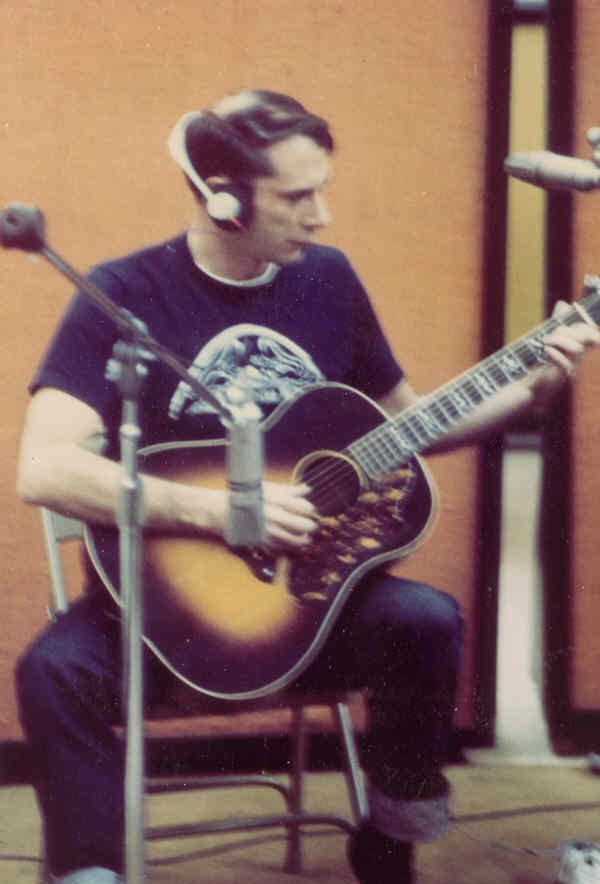
John Fahey in Studio playing his Recording King guitar, c. 1970. Photo is by Ellis408, who makes it available under the Creative Commons Attribution-Share Alike 3.0 Unported license.

Monday, June 30, 2014

Photos of the Month - June 2014

 Garden gate - N Williams Ave, Portland, OR

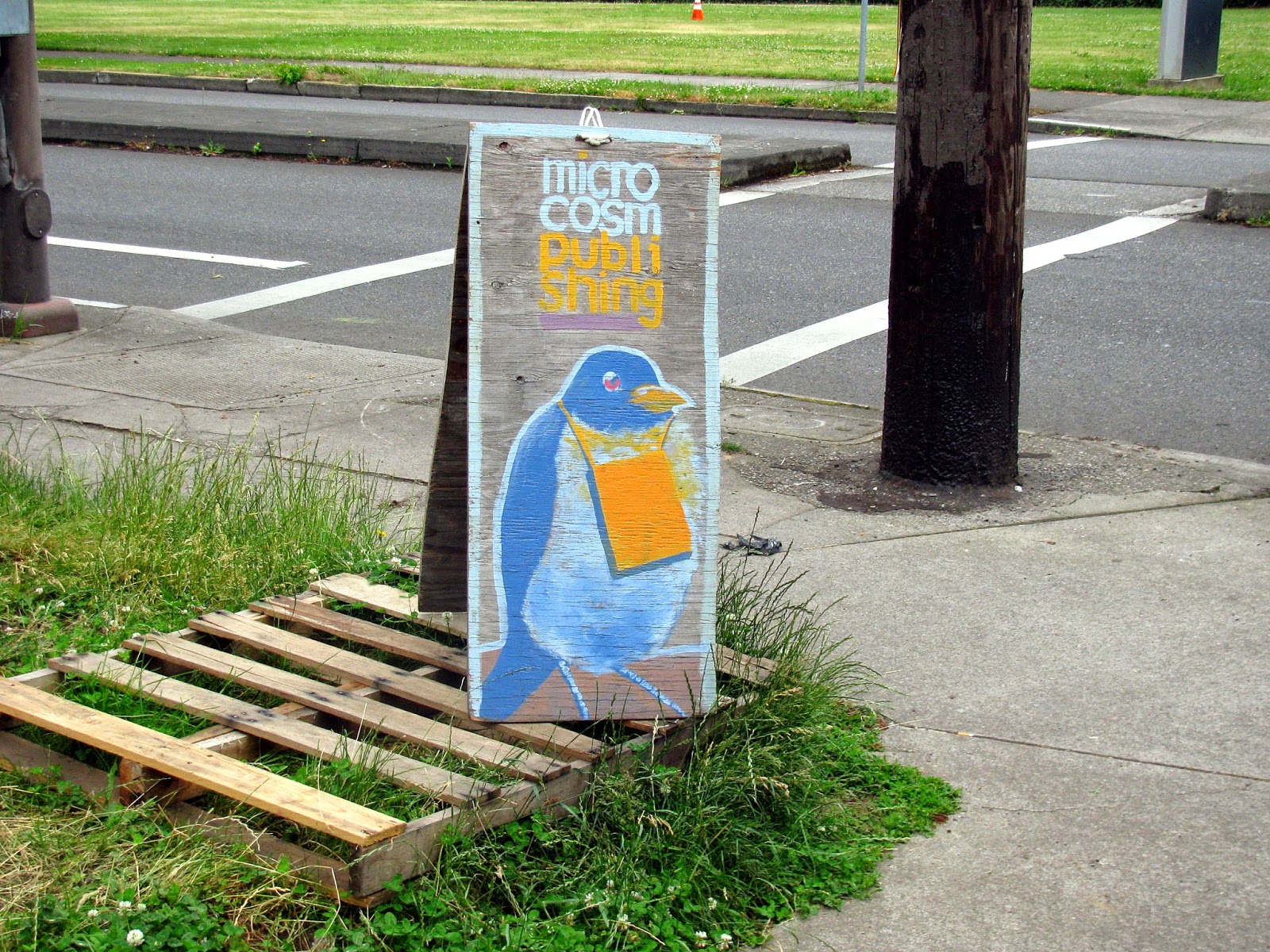
Small press sign - N Williams Ave, Portland, OR

The Wonder Ballroom - NE Russell St, Portland, OR

Parking strip roses - NE San Rafael St, Portland, OR

Roses on a chain link & bamboo fence - NE San Rafael St, Portland, OR

A section of the Multicultural Integrated Kidney Education Mural - NE 7th Ave, Portland, OR

Rose blossom - NE Broadway, Portland, OR

"In the Tree Tops" by Margarita Leon - NE Broadway, Portland, OR

Sullivan's Gulch mural - NE Weidler, Portland, OR

Thursday, June 26, 2014

"Aquarela" ("Watercolor")

A song for an overcast Thursday (overcast at least here in the Pacific Northwest)—the beautiful music & words of “Aquarela” by Toquinho & Vinicius de Moraes. “Aquarela” translates to “Watercolor.”

For those of you whose Portuguese is a bit rusty, I’ve included a translation following the video. This is based on a version from the Lyrics Translate site, but I’ve altered a fair amount, since the original translator seemed to have some problems with English idioms—& in a couple of places I’ve taking some minor liberties in order to suggest (I hope) some of the lyrical beauty of the original. For those who are interested, the Portuguese words are here. One point: the repeated phrase at the song’s end, “Que descolorirá” (translated as “which will fade someday”) is cognate, as you can see, with “discolor,” so the idea of color fading away is right on the surface; it's also a verb that would be used to describe fabric dyes fading in the laundry. The original translator added “someday,” which isn’t in the Portuguese, but I kept it because it gives the impression of an action that takes place gradually & at an indefinite time, which seems very much in the spirit of the song.

Just beautiful!


Watercolor

On a sheet of paper
I draw a yellow sun
And with five or six straight lines
it’s easy to draw a castle

I trace my fingers with the pencil
and there’s a glove on the paper.
And if I draw the rain,
by just stroking two dashes,
I have an umbrella

If just a drop of paint
drips on a blue portion of my drawing,
for an instant I imagine it to be
a beautiful gull, flying in the sky

And the gull flies on and on
tracing a huge line over the horizon,
from the north to the south.
And I'm flying along with her
Over Hawaii
Beijing or Istanbul.
I paint a sailboat,
sailing smoothly away
There's so much of the sky and sea's immensity
in the blue-green color

Through the clouds a beautiful airplane,
pink and granite-gray, flies over
its colors tingeing all the surroundings,
as it passes by, lights blinking and flashing

With a little imagination,
I see it taking off, serenely, beautifully
And if you want,
I can make it land

On any sheet of paper,
I can draw a sailboat leaving the quay,
with me and some of my friends on it
drinking and having a good time, all at peace with life

From America to America,
I can travel in just a blink.
I just turn a compass around
and with a circle I draw the world.

A boy is walking on and on
until he reaches a wall
Over this wall, not too far from it,
the future is waiting for us

And the future is a spaceship
that we try to pilot.
But the future’s hurried and relentless.
There's no right time for it to come,
and without asking or warning us,
it just changes our lives
and then it beckons us
to cry or to laugh together

Along this road, it's not our duty
to know or see what's coming to us
No one surely knows where it's taking us
We're just going on the way
crossing a beautiful footbridge
painted in watercolor
that someday will fade after all

On a sheet of paper, I draw a yellow sun
(which will fade someday)
And with five or six straight lines I draw a castle
(which will fade someday)
I just turn a compass around
and with a circle I draw the world
(which will fade someday)

Translation from the Lyrics Translate site, modified by yours truly 


Image links to its source on Wiki Commons.
A watercolour painting set. by Björn Laczay 

The image is made available under the Creative Commons Attribution 2.0 Generic license.

Tuesday, June 24, 2014

"a prayer for greater rains and smaller floods"

a prayer for greater rains and smaller floods


oh Lord of great waters
mighty King
riding mounted on many storms
You who consumed swirling chaos
who thunders like a river freed

loose this day your cascade
justice and mercy, molten and alive
healing pouring down from heavy clouds

grant peace oh Lord
to the worms on the pavement
the crushed petunias
and the picnics
give them rest in Your light

grant peace to my soul, Lord
in the hiss of traffic through rain
the beat of water on window
fresh wet asphalt smell through an open door

remember to us, oh Lord of the deluge
Your terrible flood
Your wonderful destruction
remember to us, oh Lord
Your cleansing fires to come
in these
Your great rains and small floods

Mairi Graham-Shaw
© 2014


Image links to its source on Wiki Commons.
William Blake: "The Lord Answering Job Out of the Whirlwind," from the Butts set. Pen and black ink, gray wash, and watercolour, over traces of graphite. 1805
Public domain

Monday, June 16, 2014

"song with waxing gibbous moon'


song with waxing gibbous moon

a sliver missing from the lefthand edge
that much shy of a silver perfect circle

in two nights bicyclists will still be pedaling
north on Williams Avenue past chain link & roses

& in truth the roses draw inward dulled by twilight
a vague crimson ache clotted in a front yard

but I was mentioning the moon’s imperfection
& thinking of gawky calla lilies on a lawn

otherwise gone to dandelion & ripple grass—
on another front porch a bicycle’s suspended

outlined in fairy lights—but as I was saying,
when I say moon I mean  you—

you: a word all vowel & lacking a lefthand
edge in my mind, so when I say you

I mean me—when the full moon rises Friday
above bicycles & blossoms & this construction site’s

gravel & cyclone fencing I know already
its disc will glow amber behind clouds & clouds


AK Barkley
© 2014