A miscellany like Grandma’s attic in Taunton, MA or Mission Street's Thrift Town in San Francisco or a Council, ID yard sale in cloudy mid April or a celestial roadmap no one folded—you take your pick.
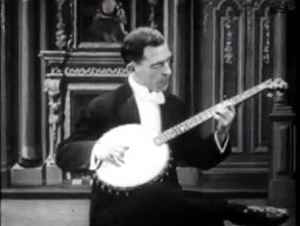
Today we wrap up our monthly series on Vess Ossman, the “classic style” banjoist who made some of the first ragtime recordings & also some of the first banjo recordings. As far as I can determine, Ossman’s earliest recordings date to 1897, when he recorded “The Smiler” & Sousa’s “Stars & Stripes Forever.” In fact today’s recording, “Ragtime Skedaddle” (with piano accompaniment to Ossman’s banjo) dates to 1899.
Recordings at that time were made on cylinders—the disc record was still several years away. The cylinders were first made of wax, but later were made of celluloid, & were marketed as “indestructible.” Fortunately, a number of them proved to be, & there are organizations like the Cylinder Preservation Project (link here to their home page, & here to their Facebook page), which are making an effort to preserve the actual cylinders & digitize the music they hold. There are a number of recordings on the Project’s website, all free to listen to (obviously, all this music falls in the public domain.)
In referring you to the site, I probably should note that a fair number of music titles from this era, including several recorded by Ossman himself, contain offensive racial epithets. Sadly, the banjo has always had a fraught history in this country in terms of its symbology as an instrument that began with black/African origins & was co-opted by white/European culture. It’s a deep subject, & one that would require more space than I have here to treat. Those who are interested in reading more about the banjo’s social history in the U.S. really should check out the fine Picturing the Banjo, which I reviewed on the blog some time ago.
In the meantime, this is delightful music, & I hope you enjoy it! Back next month with a new series.
The photo of Vess Ossman links to its source on violafair.com. It appears to be a still of Ossman from an early film. In any case, since Ossman died in 1923, any photographic image of him must of necessity be in the public domain.
these dormer windows, the afternoon sun’s flash splashing across their eyes. the sidewalk’s impassive at any rate, despite a crazy quilt of house colors looked at asquint, and bare gnarled cherry boughs.
the young woman, lavender wool cap askew, walks a black lab, who has other ideas entirely. the girl on the bike calls in Spanish to the boy steering a kick scooter over chalk hearts and flowers and cracked pavement.
the half moon’s a silver parachute, it goes without saying, and six people with plastic shopping baskets mingle in the market amongst eggplants and egg cartons and an actual vinyl lp playing Bob Dylan.
you might be asleep: lilac purple of early crocuses, plaid-coated plywood clown, paint-chipped, in a garden; how moss shimmers like seaplants atop a stone retaining wall, the couple returning from the café,
their coffee in red to-go cups, camellias blooming on a front yard across the way beside the birdbath. you count the steps you take. history is always like this, in motion in increments along this sidewalk.
Today would normally be the day we read one of A.K. Barkley’s poetic offerings, but sadly, that will be delayed this week. Mr Barkley has quite a busy schedule at times. But he has assured me he’ll have something ready in time for a Wednesday morning post, so I decided to cut him some slack.
Briefly, in other blog news: Probably obvious, but Monday Morning Blues is on indefinite hiatus. The fact is, I just don’t really have much to say about blues music these days. Although as a performer I’ll always keep my hand in with the blues, my personal focus is in different directions at this time. I have moved the link down the page, but you can still use that to access past posts.
Despite my “burnout” on the blues, at least in terms of writing, I am going to keep the Any Woman’s Blues series going at least until I work through the list of performers I compiled way back when. The series will be returning in March, but with a difference: each Monday in March will be an installment in the Any Woman’s Blues series. Then I plan on taking a couple of months off for other musical features, & probably returning with Any Woman’s Blues in June—& so forth. I’m hoping this posting schedule will work well for me & enable me to bring the series to the conclusion I’d planned.
Speaking of my musical direction, you probably have noticed the link to my public musician’s Facebook page, which for the time being is serving me as a website; here’s the link. Since it’s a public page, anyone can go there & view all the content, whether they have a Facebook account or not. If you do have an account, “likes” are very welcome & appreciated, as it helps me to get my material out to more people. I will occasionally post some of my original music on the blog, but the majority of it will be found on the Facebook page, at least for the foreseeable future. You can also see photos of me in various bands & with various guitars & other instruments past & present. Once I get a webcam that wants to cooperate, there will be videos as well.
I have a lovely video for you today featuring this month’s featured artist, Gal Costa, with yet another giant of Brazilian music—Antonio Carlos Jobim (AKA Tom Jobim), one of the major forces behind the bossa nova movement, & a man whose songs have become classics in North American jazz circles almost as much as they are in Brazil: a very short list, with English titles: “The Girl from Impanema,” “Quiet Night of Quiet Stars,” “The Waters of March,” “No More Blues,” “One Note Samba,” & many more. Truly one of the 20th century’s greatest songwriters.
& while North Americans may associate his songs with the singing of Astrud Gilberto, as well as with João Gilberto & for those a bit more in the know, Elis Regina, it’s also true that Gal Costa is one of Jobim’s foremost interpreters. In fact, prior to her involvement in the Tropicalismo movement, which was more counter-culture, more inclusive of foreign influence, Gal Costa says that bossa nova was everything to her. In a 1988 Spin magazine article, Costa said, “I was fascinated by João Gilberto’s cultivated singing, his technique…And I was very radical. I only liked bossa nova, & anything that wasn’t bossa nova was mindless, a sellout…rock & roll, whatever.”
While Costa turned away from the bossa nova sound in favor of the more psychedelic Tropicàlia during the late 1960s & much of the 1970s, she eventually gravitated back to that style, & has made a number of recordings of the great bossa nova songs. Her vocal style is a bit less laid back than some singers associated with bossa nova—certainly very different from the Gilberto’s—João singing almost in a whisper, & Astrud in the musical equivalent of a “flat affect.”
Costa & Jobim had a notable concert together in Los Angeles in 1987 (YouTube link to the entire concert here); if you’re not up for the entire hour-long show, I’d still recommend this version of “Corcovado” (AKA “Quiet Night of Quiet Stars”) excerpted from it. But here we have a version of Jobim’s beautiful love song “Dindi” that's not from this show, but is from that same general period. It's a beautiful performance by both Costa & Jobim, & I must say the two of them have musical flirting down to a high art!
By the way, you’d probably figure this out, but just in case: the subtitles in this video are in Spanish, & Gal Costa is, of course, singing in Portuguese—hence the discrepancies.
Just wonderful in so many ways—hope you enjoy it, too!
A happy Sunday, friends! There’s some really delightful music for you today.
The name Gaspar Sanz is not known to the general public, but he was one of the most important composers for the baroque guitar. Sanz lived from 1640-1710 in the area of Madrid, Spain, where he studied & later taught at the University of Salamanca. In addition to his work in music, he also wrote poetry, though his poems have not proved as durable as his compositions.
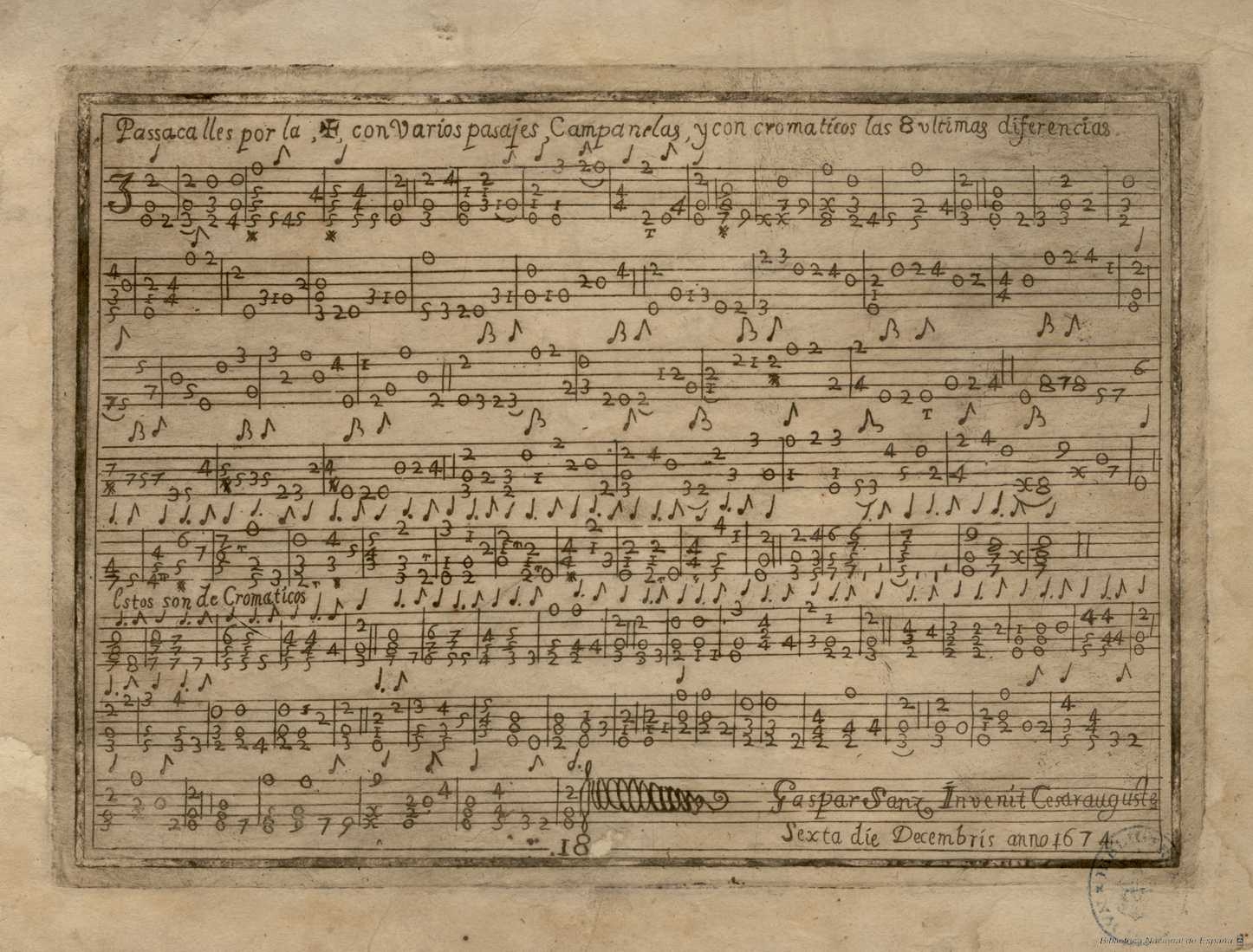
Sanz is noteworthy for three published books that were designed as instruction & song collections for the instrument we know call the baroque guitar. Typically, the baroque guitar has either 10 strings in four double string courses, or nine strings, with four double courses & one single (usually the treble string.) Often this was tuned (from lowest sounding string to highest ADGBE, with the doubled D strings (& sometimes the A strings) actually be an octave apart—but as guitar players will see, this is like the standard modern guitar tuning without the low E string. Sanz, however, used a different tuning: GABDE. This strikes me as quite unusual, as the top two strings are only a whole tone apart.
“Canarios” is one of his best known pieces—presumably based on music from the Canary Islands. It’s here given a wonderful interpretation by a duo known as Luteduo (yes, this is duet month, as you will remember!) Luteduo is Anton Birula on lute or theorbo (as in this video) & Anna Kowalska on baroque guitar or lute. They have recorded four cds, & also have a number of videos up on YouTube. I think I’ve listened to all of these, & they are excellent without exception. This particular performance—in which they deftly interpolate themes from Bach’s cello suites into "Canarios"—was given at the Bialystok Early Music Festival in Poland in July 2009.
Hope you enjoy this lively & enchanting music as presented by the talented Luteduo!
Image links to its source on Wiki Commons Example of tablature manuscript from Instrucciòn de Mùsica sobre la Guitarra Española by Gaspar Sanz, 1674 – public domain