Wednesday, January 30, 2013

Photo of the Week 1/30/13

Tea Chai Tē - A Tea Bar
SE 13th Avenue, Portland, Oregon
Monday 1/28/13

Tuesday, January 29, 2013

“Not Said….”

Not Said….

The world’s slowest conversation
can make a heart skip several beats,
and those distant observations
leave the brain stuck on repeat.

A few moments every season,
lost in one compelling gaze.
A slight graze on the cheek
can fill a mind for days.

So much yet unknown,
caught in the fickle web of self.
The fantasies and wayward dreams
tucked safely on a shelf.

And nothing’s ever offered.
There is no goal to be attained.
With no logic to the longing….
It can never be explained.

Barbie Angell
© 2011


By the way, you can read a really good interview with Barbie on The Sill of the World at this link; & if you're not familiar with The Sill of the World, you're in for a treat, because it is an excellent blog! Barbie Angell being on The Sill of the World is just double wonderfulness.

Sunday, January 27, 2013

Sonata IV in G major by Nicolas Chédeville

A happy Sunday! Time for some lovely music.

We started January out with a piece featuring the viol, & so I thought we would bring the month to a close with the same, though this is a “bigger sound,” with the tenor viola da gamba backed by harpsichord & joined by recorder.

The musicians are part of the ensemble Passacaglia,  which is based in Great Britain. Passacaglia is made up of Louise Bradbury, Oliver Webber, Robin Bigwood, Annabel Knight, Reiko Ichise; Bigwood is playing harpsichord here, while Knight plays recorder & Ichise the viola da gamba. Passacaglia is an active group, & I notice they have some concerts coming up in February that our friends in the UK may enjoy.

Besides this piece’s obvious musical charm, it’s also interesting because it was attributed to Vivaldi for quite some time. Nicolas Chédeville was a musette player & maker, as well as a composer—the musette is a form of the bagpipes that was used frequently in baroque music. The story of his impersonating Vivaldi runs as follows (from Wikipedia):

In 1737 he made a secret agreement with Jean-Noël Marchand to publish a collection of his own compositions as Antonio Vivaldi's op. 13, entitled Il pastor fido. Chédeville supplied the money and received the profits, all of which was attested to in a notarial act by Marchand in 1749. This may have been an attempt to give his instrument, the musette, the endorsement of a great composer which it lacked.
It seems that Monsieur Chédeville was not only a composer of delightful music, but a man with a healthy sense of humor!
Hope you enjoy this lovely piece, which is so beautifully rendered.


Image links to its source on www.passacaglia.com

Friday, January 25, 2013

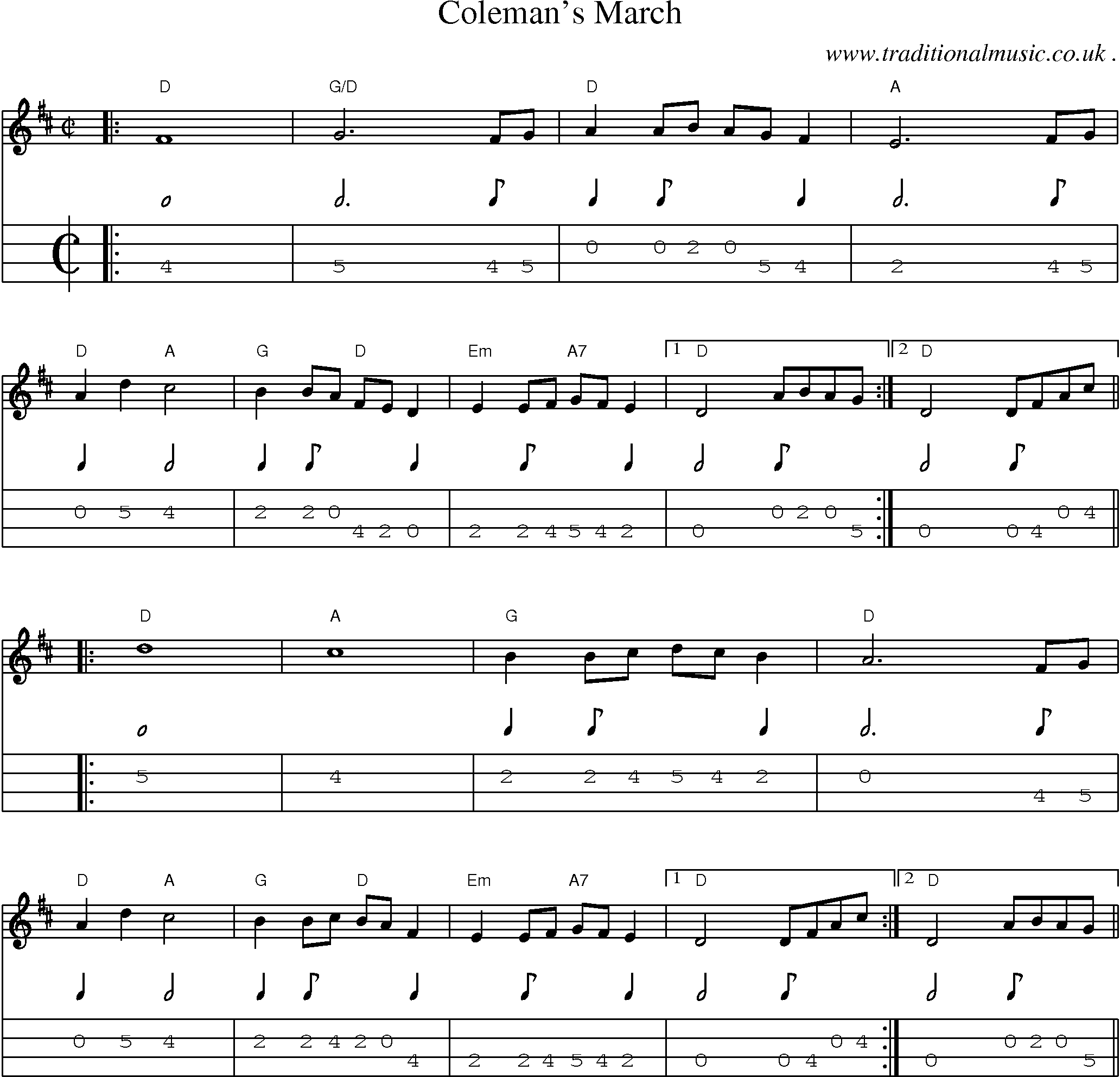
“Coleman’s March”

A happy Banjo Friday everybody! I know the Fridays have been banjo-less around here in January, but never you fear: I have a fun banjo series planned for February—& I have some very fun banjo music for you today.

If you’re familiar with Banjo Friday, you know that I’m always happy to showcase the banjo in unusual settings, so when I saw today’s video, I knew I’d have to post it. For one thing, as regular readers know, I’m a big fan of Cathy Fink & Marcy Marxer, who I think are true forces for good in the music world & indeed in the world in general.  These women have been touring Asia with American Voices Abroad, bringing their wonderful renditions of American old-time music to kids, & of course as is typical, they are teaching & encouraging participation along the way. You can read about their travels on their blog.

Fink & Marxer are also teaming up with some top musicians from the countries they’re visiting, & in this show in Malaysia, they are joined by Kumar Karthigesu & Vick Ramakrishnan of the Malaysia World Music Group on sitar & tabla, as well as by fellow Yank Barbara Lamb on fiddle.

I love this version (though I might wish the sitar were brought forward a hair in the mix)—there is something so odd & yet so right about the mix of banjo with sitar & tabla. If you want a more straightforward version as a point of contrast, here’s a link to Fink & Marxer playing “Coleman’s March” on 5-string & cello banjo respectively.

Hope you enjoy it!


Image links to its source on traditionalmusic.co.uk. The tablature is for mandolin.

Wednesday, January 23, 2013

Photo of the Week 1/23/13

Piano with tree mural
N. Williams Ave, Portland, Oregon
Monday 1/21/13

Tuesday, January 22, 2013

the camellia rag

the camellia rag
 

the spinet piano transmogrified to dormant tree:
an A# diminished scale’s black and white keys
tumbling into this January sky—

there is nothing to resist:
hoarfrost on green lawns, a single camellia bloom
dangles in a welter of branches, a red quarter note.

exuberant felt hammers,
the song sparrows in their boxwood hedges—
the syncopation of breath & step & peripheral vision,

the many walks I’ve taken down this very street
with you, yes, you! arpeggiated white key chords
from the left hand, the right hand’s

fingers holding the promised first camellias
before their season, but barely. holding an envelope
with its cancelled stamp,

holding a ginger snap, holding dozens of
black and white abstractions against the blue
where apartment houseplants gesticulate to the tune.


AK Barkley
© 2013


Image links to its source
Camellia Japonica: from Flore des serres et des jardins de l'Europe: Louis Van Houtte, 1860s. Wiki Commons – public domain

Sunday, January 20, 2013

Chaconne by Robert de Visée

Happy Sunday! I have some lovely music for your enjoyment today.

If you’ve been following along on Early Music Sunday, you’re at least somewhat familiar with the looks & sound of the theorbo, a rather over-sized member of the lute family that was developed in the 17th century & had its heyday in the Baroque period, with its role diminishing through the 18th century. There were several notable composers for the instrument; we heard a piece by Johannes Kapsberger last week, & this week we are hearing a “Chaconne” by Robert de Visée, a composer & musician in the court of Louis XIV, though there is speculation that he was Portuguese by nationality. In fact, de Visée wrote music not only for lute & theorbo, but also for the guitar, though of course this means the baroque guitar which differed from what we know as a guitar in several respects—it was smaller, had doubled strings (like a modern 12-string or a mandolin) & had only five string courses (either 9 or 10 strings total, because the highest pitched string often wasn't doubled), while the conventional modern guitar has six strings with no doubling.

The Chaconne is an interesting form. Although the name is French (or ciaconna in Italian) it is thought to be Spanish in origin, & there’s some speculation that the Chaconne form ultimately derived from Native American music. It is, in the words of Wikipedia:

a type of musical composition popular in the baroque era when it was much used as a vehicle for variation on a repeated short harmonic progression, often involving a fairly short repetitive bass-line (ground bass) which offered a compositional outline for variation, decoration, figuration and melodic invention.

We encountered the “ground” or “ground bass” recently when listening to the venerable “Greensleeves.” In essence, the Chaconne in its baroque manifestation was an opportunity for improvisation.

Today’s performer is Xavier Diaz-Latorre, who specializes in early instruments such as the theorbo, baroque lute & baroque guitar. He studied with the renowned Hopkinson Smith, & has performed with period ensembles such as Hespèrion XXI & Le Concert des Nations, as well as with other respected European orchestras & consorts.

Enjoy!


The image of Xavier Diaz-Latorre links to its source at www.br.de